
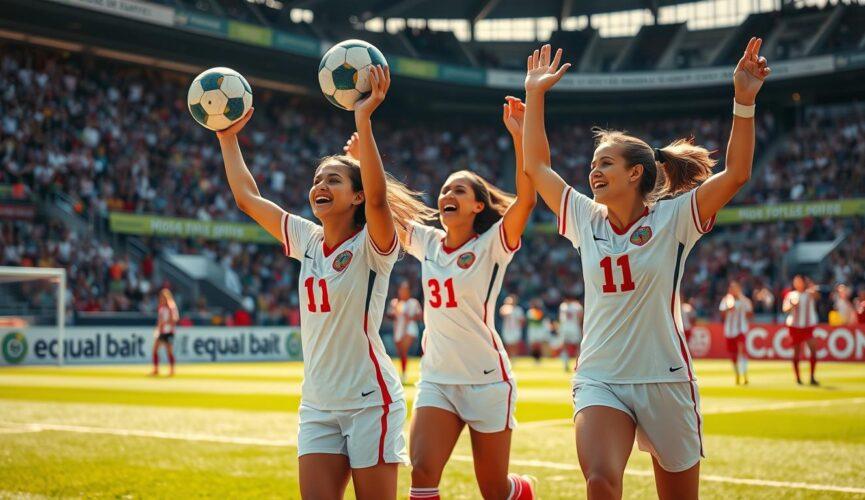
The beautiful game has a dark secret. Women’s teams give top-notch entertainment and win championships. Yet, they earn like they’re from another era.
I’ve been keeping up with this fight. The soccer field has turned into a battleground for fair pay. It’s like Billie Jean King vs. Bobby Riggs, but with more lawyers.
Women outperform men but get paid less. It’s a mix of economic nonsense and old traditions.
April 2 is Equal Pay Day. It’s when U.S. women earn what men did in 2018. Women athletes are leading the fight for pay equity in sports.
This fight is more than sports. It’s about changing society and achieving fairness. The USWNT’s journey shows us where this battle is going.
Why Pay Disparities Exist
Imagine the US Women’s National Team winning big but earning like they’re newbies. The wage gap in soccer is more than just money. It’s a mix of history, economic mistakes, and what I call the “legacy discount.”
From 2016-2018, the USWNT made $50.8 million, while the men’s team made $49.9 million. Yet, the women were paid less than the men. It’s like paying your top author less than the guy who writes the book jacket.
FIFA’s prize money shows a huge gap. The men’s World Cup got $440 million, while the women’s got $110 million. This isn’t just a wage gap. It’s a huge financial gap with no clear way to cross it.
Men’s soccer had a 100-year head start in building business ties. Women’s soccer was told to wait. This created the “legacy discount,” where women’s sports are valued by old standards, not current performance.
Broadcasting deals reveal a lot. Networks pay less for women’s sports than men’s. Even Gareth Southgate, England’s men’s team manager, has spoken about these economic facts, wishing he hadn’t.
The fight for equal pay in women’s sports is about fairness and logic. The USWNT has been the top earner for years but is paid like temporary workers. It’s like finding out your best employee is making less than the intern.
This isn’t just sexism, though sexism is part of it. It’s a mix of history, old ways of valuing sports, and outdated broadcast deals. The beautiful game deserves better math.
U.S. National Team’s Lawsuit
The USWNT took a bold step by suing U.S. Soccer in 2019. It was more than just a lawsuit; it was a fight for equality. They used evidence to challenge the system.
Imagine arguing with four World Cup trophies as proof. The women’s team outshone the men, winning championships like they were trading cards. But their pay was like minor league baseball.
The 2022 agreement was a major win. It made sure women and men got equal pay. It also created a new way to share prize money.
- 45% of pooled World Cup prizes goes to women’s players
- 45% goes to men’s players
- 10% goes to US Soccer development programs
This system shows success in soccer isn’t just about gender. It’s about the whole team. It’s a smart way to share success.
Megan Rapinoe said they wouldn’t settle for anything less than what they deserved. The women’s team was building a strong case while the men’s team missed the 2018 World Cup.
The settlement was big, but the real win was setting a precedent. They used their success to prove their worth. It’s like showing your sales numbers to ask for a fair share.
This wasn’t just about protesting. It was about using facts to fight for equality. The USWNT showed they’d already earned their place.
This lawsuit will be remembered as a key moment in history. It showed how to fight for equality with evidence. The USWNT didn’t just want a seat at the table; they brought their own.
International Movements
The USWNT lawsuit was just one part of a worldwide fight for fair pay. Fair pay is a universal issue, understood by everyone.
In 2017, the US Women’s Ice Hockey Team threatened to boycott over pay. Their stand was heard across sports.
Basketball shows a stark contrast. WNBA players get only 22.8% of league revenue, while the NBA splits 49-51%. Many WNBA stars play overseas to make a living.
Surfing also made a big move in 2018. The World Surf League started paying men and women equally. It was a big step forward.
Tennis achieved pay equality in Grand Slams back in 2007. But Venus and Serena Williams continue to fight for future generations. Progress is not always smooth.
A global players’ union report found something shocking. 29% of World Cup players hadn’t been paid for qualifying. It’s like finding out your favorite restaurant doesn’t pay its staff.
But, some countries are leading the way. Brazil, New Zealand, Australia, and England have all agreed to equal pay for their national teams. They’re changing the game.
| Country/Sport | Policy Change | Year Implemented | Key Details |
|---|---|---|---|
| United States (Soccer) | Equal Pay Agreement | 2022 | Back pay + tournament bonuses |
| New Zealand (Soccer) | Equal Pay Agreement | 2018 | Match fees + commercial revenue |
| Australia (Soccer) | Collective Bargaining | 2019 | Revenue sharing model |
| World Surf League | Equal Prize Money | 2018 | All championship events |
| Grand Slam Tennis | Equal Prize Money | 2007 | All four major tournaments |
These global movements show that fair pay is not just an American issue. It’s a worldwide fight. The real question is, how many more athletes will have to fight before change comes?
How Equal Pay Benefits the Game
Equal pay isn’t just about fairness; it’s a smart investment for soccer. The numbers show it’s a great opportunity.
The NWSL saw a 20% jump in season tickets after fixing pay issues. This shows fans value professional sports more when athletes are treated as such.

FIFA’s data is stunning. Commercial revenue is up 33% yearly, and broadcast revenue is up 22%. These numbers are huge, not just for sports.
When athletes are paid well, they can focus on their game. This is basic economics: invest in talent, get better results.
More pay attracts better players. Better players lead to better games. And better games mean more money. It’s a cycle that makes sense.
FIFA’s Chief Women’s Football Officer, Sarai Bareman, sees huge growth. She’s talking about an under-valued asset that’s about to boom. Investors are already seeing the value in women’s sports.
The case for equal pay is strong. We’re seeing a market shift, and it’s working for everyone.
| Metric | Women’s Soccer Growth | Traditional Sports Average | What This Means |
|---|---|---|---|
| Commercial Revenue | 33% annual increase | 5-7% annual increase | Explosive market demand |
| Broadcast Revenue | 22% annual growth | 3-4% annual growth | Growing audience engagement |
| Season Ticket Sales | 20% increase (NWSL) | 2-3% industry average | Strong fan commitment |
| Investment Return Potentia | High growth trajectory | Mature market returns | Undervalued opportunity |
This isn’t just about doing the right thing. It’s about making smart choices. Equal investment leads to huge growth. The game becomes more beautiful and profitable for all.
Player Stories
The real drama happens on soccer fields and in courtrooms. Athletes face challenges that make Atlas look like a slacker. They’re not just playing for wins; they’re fighting for fairness and trying to score goals. It’s a tough job.
Becky Sauerbrunn talked about the “heavy responsibility” of fighting for equality. Imagine trying to focus on the game when you’re also working on legal stuff. Male athletes don’t have to deal with this double burden.
Megan Rapinoe’s World Cup was about more than soccer. It was about leaving a legacy and making a difference. She turned every goal into a statement, every interview into a call for change. Rapinoe became an accidental activist, focusing on justice instead of just playing.
Hilary Knight said they’re fighting for the greater good. It’s not about personal gain; it’s about changing the system. These athletes risk losing endorsements and facing backlash for their beliefs.
Serena Williams is fighting for her daughter’s future. She’s not just earning prize money; she’s working for a fairer world for future athletes. That’s a legacy worth fighting for.
Skylar Diggins-Smith said we need more people at the table. It’s not just about individual heroes; it’s about working together. True change comes from collective action, not just from stars.
| Athlete | Role | Contribution to Equal Pay | Signature Statement |
|---|---|---|---|
| Becky Sauerbrunn | Defender/Advocate | Legal strategy leadership | “Heavy responsibility” of dual roles |
| Megan Rapinoe | Forward/Activist | Media amplification | World Cup as leverage platform |
| Hilary Knight | Ice Hockey Pioneer | Cross-sport solidarity | “Greater good” philosophy |
| Skylar Diggins-Smith | Basketball Organizer | Coalition building | “More people at our table” |
| Serena Williams | Tennis Legend | Generational advocacy | Fighting for future generations |
These Player Stories show something amazing. Today’s women athletes are part-time lawyers, full-time activists, and top athletes all at once. They’re changing what it means to be a professional athlete – and they’re doing it effortlessly.
Modern Progress and Setbacks
It seemed like we’d reached the end of the fight for equal pay. But then, the 2021 NWSL abuse scandals hit. They showed us a system full of problems. Coaches like Paul Riley were just the tip of the iceberg.
The Sally Yates investigation was like a horror movie. It found sexual coercion and verbal abuse. It made us wonder if we’d gone back to the Mad Men era.
Here’s a shocking fact: 75% of women’s team managers are men. This isn’t just a problem – it’s a huge issue. Money is getting closer to being equal, but power is not.
Look at the Nigerian team’s boycott threats. See Canada’s ongoing struggles. These are top-notch programs treating women’s soccer unfairly. It’s like getting a promotion but having to make coffee for everyone.
Labor unions are more than just negotiators. They’re essential for survival. The NWSL Players Association became a strong force. They fought for more than just contracts – they fought for respect.
| Team/Country | Issue | Union Response | Outcome |
|---|---|---|---|
| NWSL (USA) | Systemic abuse scandals | Collective bargaining for safety protocols | New safeguarding policies implemented |
| Nigeria | Payment delays & boycott threats | Player solidarity campaigns | Partial payments made, ongoing negotiations |
| Canada | Budget cuts & program funding | Public advocacy & legal pressure | Temporary funding restored, long-term uncertain |
| Global | 75% male managers in women’s soccer | Diversity initiatives & hiring protests | Slow progress, increased awareness |
The table shows slow progress. Labor unions are fighting for equal pay and safety. It’s like trying to score while defending against a counterattack.
Changing cultures is harder than changing money. Money is flowing better, but power structures are stuck. It’s a long fight for equality.
But these setbacks have made labor unions stronger in women’s sports. Sometimes, hitting rock bottom helps us find strength. The real question is how ugly the fight will get.
How Fans Impact Advocacy
Ever wonder if your screaming at the TV during a women’s soccer match actually matters? Let me answer that with some numbers that would make any accountant smile. The 2019 Women’s World Cup drew 2 billion viewers globally while selling 1.5 million tickets. That’s not just audience size – that’s economic leverage.
Here’s the beautiful irony: the same capitalist system that created pay disparities is now helping fix them. Why? Because money talks louder than tradition. The USWNT has made more money than the men’s team every year from 2016 on. This isn’t an accident – it’s arithmetic.
Your viewership isn’t passive consumption. It’s activist voting with your remote control. Every time you:
- Stream a women’s match
- Buy a player’s jersey
- Engage with content on social media
- Attend a live game
You’re casting ballots for equality. Broadcast deals follow eyeballs. Sponsorship agreements follow engagement. Organizational change follows economic pressure.
The data tells a compelling story about how fan support translates to tangible progress:
| Metric | Women’s Soccer Impact | Men’s Soccer Comparison | Advocacy Result |
|---|---|---|---|
| World Cup Viewership | 2 billion (2019) | 3.5 billion (2018) | Increased broadcast negotiations |
| USWNT Revenue | Higher than men’s team revenue | Consistently lower | Bargaining power for equal pay |
| Sponsorship Interest | 23% growth (2015-2020) | 7% growth (2015-2020) | More equitable endorsement deals |
| Social Media Engagement | Higher per post | Lower per post | Increased brand investment |
Next time someone claims “nobody watches women’s sports,” show them these numbers. Then politely show them the door. Your fandom has become the most powerful advocacy tool in the fight for equality – and the players are counting on you to keep the pressure on.
Broadcast networks notice when ratings spike. Sponsors notice when engagement soars. And federations definitely notice when revenue patterns shift. Your remote control is now a weapon for change – use it wisely.
Conclusion
U.S. Soccer President Cindy Parlow Cone called this a historic moment. Moments like these need to be remembered and celebrated. The victory for equal pay in soccer has become a model for gender equality in sports everywhere.
FIFA has promised equal prize money by 2026-2027. But promises are just words. It’s the action that matters. The fight for equality in women’s soccer is ongoing, from youth programs to global development.
The victory for equal pay is here to stay. Players have legal backing, economic proof, and fan support. It’s time for institutions to change or get left behind. The game is becoming fairer, thanks to those who spoke out against unfairness.