Author: Emma Davis

The Ultimate List of NCAA Women’s Soccer National Champions

NCAA Women's Soccer

Women’s college soccer has a trophy room with one giant blue-and-white shadow across it: North Carolina. Every program wants to build a dynasty. The Tar Heels already built the mansion, decorated it, and left everyone else fighting for the best view from the front lawn.

That does not make the NCAA Division I women’s soccer championship race boring. Far from it. The full title count tells a sharp story about how the sport grew from one dominant standard-setter into a deeper, faster, more national championship fight. Florida State has turned the modern era into its own statement. Stanford, Notre Dame, UCLA, Santa Clara, Portland, USC, Florida, Penn State, and George Mason all have their own places in the history book. For fans looking to analyze these historic programs from a handicapping perspective and hunt for value on future tournament boards, you can discuss sports betting strategies with a seasoned community of bettors online.

For young players, coaches, parents, and fans, this list is more than trivia. It shows what championship programs keep producing: player development, recruitment pipelines, tactical identity, tournament toughness, and the kind of team culture that survives pressure. That same player-first mindset connects directly with the habits built through women’s soccer fitness, where the best teams separate themselves long before the College Cup lights turn on.

The Championship Standard Still Starts With North Carolina

North Carolina owns the top spot by a margin that looks almost unfair on paper. The Tar Heels have won 22 NCAA Division I women’s soccer national championships, making them the most successful program in the history of the tournament. Their 2024 title, a 1-0 win over Wake Forest, gave the program its first NCAA crown since 2012 and pushed the Tar Heels back to the center of the college soccer conversation.

That title carried extra weight. It came in a season of transition after longtime head coach Anson Dorrance retired in August 2024. Dorrance had shaped the identity of North Carolina women’s soccer for decades, turning Chapel Hill into the sport’s measuring stick. Then interim head coach Damon Nahas led the Tar Heels through the 2024 bracket and into another championship moment.

North Carolina’s dominance is not just about volume. It is about eras. The Tar Heels won the first NCAA women’s soccer championship in 1982, then stacked titles through the 1980s, 1990s, and 2000s. Their run turned women’s college soccer into a national platform, then forced every ambitious program to ask the same hard question: how do you close that gap?

The official NCAA women’s soccer champions history still reads like a North Carolina archive for long stretches. Yet the more recent title race has shifted, and that shift matters.

The Programs With The Most NCAA DI Women’s Soccer Titles

The top of the championship table has two clear tiers. North Carolina stands alone. Florida State has become the strongest modern challenger. Behind them, Stanford and Notre Dame hold a shared place as multi-title giants with national brands, elite recruiting pull, and deep College Cup history.

RankProgramNCAA DI National ChampionshipsChampionship Identity
1North Carolina22The original dynasty and all-time benchmark
2Florida State5Modern powerhouse with three titles from 2021-2025
3Stanford3Technical, possession-based national contender
3Notre Dame3Historic title program with repeated final appearances
5UCLA2West Coast giant with elite talent pipelines
5Santa Clara2Technically sharp program with deep tournament history
5Portland2Tradition-rich program with a strong player-development legacy
5USC2Big-stage winner with two championship runs
9Florida11998 champion that broke through during UNC’s peak era
9Penn State12015 champion with Big Ten credibility
9George Mason11985 champion and early national force

This table makes one fact loud: only a small group of programs have ever climbed the final step more than once. Women’s college soccer may have hundreds of DI teams, but championship repetition is rare. Winning once requires form, health, depth, and tournament nerve. Winning twice or more requires a full program machine.

Florida State Is The Modern Pressure Point

Florida State’s rise has changed the way the championship list feels. The Seminoles won their fifth NCAA title on December 8, 2025, beating Stanford 1-0 at CPKC Stadium in Kansas City. Wrianna Hudson scored the late winner, and Florida State claimed its third national championship in five seasons.

That matters for one simple reason: this is the closest any current program has come to building a true post-North Carolina dynasty.

Florida State’s titles in 2014, 2018, 2021, 2023, and 2025 show a program that keeps refreshing itself without losing its competitive edge. The Seminoles have done it with athletic defending, brave tournament performances, big-game midfielders, and forwards who punish small mistakes. Their 2025 win over Stanford was not a runaway. Stanford created chances and controlled long spells, but Florida State found the goal that mattered.

That is championship soccer in its most ruthless form. Pretty possession helps. Talent helps. Star power helps. The trophy still goes to the team that handles the decisive moment.

The Seminoles now sit second all-time with five NCAA DI women’s soccer titles, and their place in the sport’s history feels more secure with each December run.

Stanford And Notre Dame Built Different Types Of Greatness

Stanford and Notre Dame both sit at three NCAA championships, but their paths feel different.

Stanford’s national titles came in 2011, 2017, and 2019. The Cardinal became known for polished buildup play, elite attacking talent, and a player pool that often looked ready for the professional game. Stanford has been close again in recent years, reaching the 2023 and 2025 finals against Florida State. The gap between second place and champion can feel cruel, especially for a team with Stanford’s quality.

Notre Dame’s three titles came in 1995, 2004, and 2010. The Irish were one of the first programs to push back hard against North Carolina’s grip on the sport. Their 1995 championship was a landmark, and their later titles proved the program could keep returning to the top across different rosters and eras.

The ESPN women’s soccer title list gives the broader all-time picture, but the lesson is sharper than the numbers. Stanford and Notre Dame show two paths to staying relevant: build a technical identity, recruit nationally, and keep reaching the matches where history gets written.

The Two-Title Club Is Deeper Than Casual Fans Think

UCLA, Santa Clara, Portland, and USC each own two NCAA championships. That group helps explain how women’s college soccer expanded beyond one region and one dynasty.

UCLA won in 2013 and 2022, giving the Bruins a modern title profile that matches their reputation for elite talent. The 2022 championship was especially dramatic, with UCLA beating North Carolina 3-2 after extra time. That result felt symbolic: a West Coast giant beating the sport’s historic giant on the biggest stage.

Santa Clara’s titles in 2001 and 2020 came nearly two decades apart. That gap says plenty about program patience. It is hard enough to win once. Winning again across eras requires belief in the same deeper standards.

Portland won in 2002 and 2005, powered by one of the most respected traditions in women’s college soccer. The Pilots became known for producing elite players and creating a serious soccer culture in a market that cared.

USC won in 2007 and 2016, showing the tournament’s ability to reward programs that peak at the right time. The Trojans may not carry the title volume of North Carolina or Florida State, but two championships put them in exclusive company.

Single-Title Programs Still Changed The Bracket

Florida, Penn State, and George Mason each have one NCAA DI women’s soccer championship. That may sound modest beside North Carolina’s total, but single-title seasons often carry huge historical value.

George Mason’s 1985 title came during the tournament’s early years, before the sport’s modern recruiting and media structure took shape. Florida’s 1998 championship was a major breakthrough during a period when North Carolina still controlled much of the national conversation. Penn State’s 2015 title gave the Big Ten a major women’s soccer moment and rewarded a program that had spent years building toward the top.

A single championship can shift recruiting, raise standards, and give future players proof. For a young athlete deciding where to play, the banner on the wall still speaks.

What The Title Count Says About Player Development

Championship numbers are fun. Development patterns are more useful.

The programs at the top of the list tend to share several traits: deep benches, clear tactical systems, strong goalkeeper play, mature midfield decision-making, and the ability to win one-goal matches under tournament pressure. They are not just collecting stars. They are building players who can solve problems under stress.

That is why this list matters for girls watching from club fields, school teams, and weekend tournaments. National champions are shaped by repetition: sprint mechanics, recovery habits, passing detail, film study, confidence, and emotional control. The gap between a strong team and a title team often appears in small moments — one tracked runner, one brave save, one clean first touch, one striker who stays calm with the season on her foot.

The best programs make those moments feel normal.

The Current Championship Picture

As of the 2025 NCAA season, the top of DI women’s soccer looks like this: North Carolina remains the all-time ruler, Florida State owns the strongest modern momentum, and Stanford keeps knocking loudly on the championship door. Notre Dame, UCLA, Santa Clara, Portland, and USC carry enough history to stay in every serious title-count conversation.

The next big movement on the list will likely come from Florida State, Stanford, UCLA, or another modern contender with the recruiting base and tactical identity to survive six tournament rounds. North Carolina’s 22 NCAA titles will not be caught soon. Florida State’s climb to five, though, proves the chase is alive.

For every young female player watching the College Cup, that may be the best part. The history is heavy, but the next chapter is still open.

Injury Prevention for Female Soccer Players: Complete Guide to Stay in the Game

Soccer Injury Prevention

Female athletes are at a higher risk of tearing their ACLs, with rates two to nine times higher than males. Why is this happening?

It’s not just bad luck. Most of these injuries happen without any contact. They occur during simple actions like cutting or landing. It’s all about how our bodies move.

Think of a knee doing an unwanted move, or strength imbalances. These are common causes of ACL tears.

This issue is complex, mixing biomechanics with cultural factors. We often see quick fixes on social media. But these are just nonsense.

Real injury prevention needs a deeper approach. We must look at the facts, not just the trends.

Preventive Training Programs

Preventive training programs are like the seatbelts of soccer. They save lives and careers, but getting everyone to use them is hard. It’s like fighting against common sense.

Programs like the FIFA 11+ can cut down ACL injuries by 40-45%. This is a big deal. So, why aren’t teams making it a priority? It’s not because of lack of knowledge, but because of practical issues.

Coaches are too busy and think prevention takes away from tactics. Athletes, even young ones, find it boring. They believe skill and grit are enough to protect them.

A real preventive program is not just a quick warm-up. It’s a deep commitment to every training session. It’s as important as learning tactics or doing fitness tests.

Source 3 says injury prevention should be a coached, year-round program. It needs leadership support and should be part of every training. It’s like updating your body’s software to avoid crashes.

This approach is the best way to prevent injuries. It builds strong tissue and smart muscle connections. It’s about being proactive, not reactive. Effective training routines focus on long-term health, not just short-term gains.

Not using preventive training can lead to injuries, lost seasons, and missed opportunities. Investing in smart training is a smarter choice. It’s not that hard to make the right decision.

Strength Training for Injury Prevention

Muscle imbalances are not just about looks; they can lead to serious injuries like ACL tears and stress fractures. Strength training for female athletes is not just about looking toned. It’s about building strong muscles to protect your body.

Think of your body like a machine. A knee that caves in during landing shows weak glutes and quads. Wobbly movements when changing direction mean your core is weak. These issues can lead to serious injuries.

A female soccer player in professional athletic wear, confidently performing strength training exercises in a well-lit gym environment. Foreground features her engaged in a squat with a barbell, showcasing her determined expression and proper form. The middle ground includes a variety of gym equipment, like dumbbells and resistance bands, emphasizing a focus on injury prevention through strength training. In the background, soft natural light streams in through large windows, illuminating the space and creating a motivational atmosphere. The setting conveys a sense of empowerment and dedication to fitness maintenance, capturing the importance of strength training for athletic performance and injury prevention. The overall mood is energetic and inspiring, highlighting health and strength.

Fixing these issues takes time and effort. It’s not about quick fixes or new gear. It’s about getting strong and maintaining fitness over time.

The Non-Negotiable Benchmarks

Forget vague goals. Sports science gives us specific targets. For female soccer players, research suggests aiming for a deadlift of 1.25 times your body weight and a back squat of at least 75% of your body weight. These are not random numbers. They show a baseline strength where muscles, not joints, handle the impact of sports.

Exercise Benchmark Standard Common Weakness Link Training Focus
Deadlift 1.25 x Body Weight Posterior chain (glutes, hamstrings, back) Hip hinge mastery, progressive overload
Back Squat 0.75 x Body Weight Quadriceps, gluteal strength Depth control, tempo squats
Hamstring-to-Quad Ratio 0.6 – 0.8 (Hamstring strength as % of quad) ACL vulnerability, knee stability Nordic curls, Romanian deadlifts
Core Stability Test Hold a rigid plank for 90+ seconds Trunk dominance, power leakage Anti-rotation drills, loaded carries

Why These Ratios Matter More Than Your Max

Weak glutes are a serious issue, not just a missed gain. The hamstring-to-quadriceps strength ratio is key for knee health. Aim for a ratio between 0.6 and 0.8 to prevent knee hyperextension.

Core stability is more than a plank for Instagram. It’s about transferring force without your spine wobbling. A weak core means power leaks, wasting your quads and glutes’ strength. It’s a slow but essential strategy for fitness maintenance.

The Year-Round Mandate

Don’t treat the weight room as a pre-season fling. Injury prevention is a year-round commitment. Slow, consistent progress is key. Add five pounds, master the form, repeat. It’s not about ego; it’s about efficient muscle use.

Think of it as upgrading your body’s software to handle more forces. You’re fixing biomechanical issues like knee cave and trunk wobble that can cause injuries. This careful, repetitive work is the ultimate fitness maintenance.

Forget about “toning.” Focus on heavy lifts and smart progressions. Build that armor. When your muscles are your main shock absorbers, you’re not just preventing injury. You’re building resilience. And that’s your blueprint for durable fitness maintenance.

Proper Warm-Up & Cool-Down Protocols

Forget what social media fitness influencers say about getting ready for a game. The real deal about warm-ups and cool-downs is much more important. In sports medicine, these are essential steps before and after playing.

Don’t just wing it. Starting with static stretches before activity is not effective. Using plyometric drills as a joke is also wrong.

A smart dynamic warm-up gets your nervous system ready, not just your muscles. Think of the FIFA 11+ program. It starts with simple movements and builds up to agility drills. The goal is to get your heart rate up and your body ready.

Deceleration is a key skill that’s often ignored. It’s not just about running fast. It’s about stopping, cutting, and landing safely. Poor coaching in this area is common.

Deceleration isn’t flashy. It’s about teaching athletes to “drop their hips” and “sit in the pocket.” Imagine a shortstop getting ready to field a ground ball. They get into a stable position. This is what you want during cuts or landings.

Landing wrong can lead to injuries. It’s about absorbing force, not getting hurt. Modern sports medicine teaches athletes to land safely. This is a key skill for durability.

A good protocol is structured. It starts with general movements and ends with sport-specific drills. The cool-down is just as important. It involves gentle movements and targeted stretching when muscles are ready.

This isn’t just about following a routine. It’s about understanding your body. These rituals are key to playing safely and effectively. Ignoring them is foolish. Embracing them shows you value sports medicine and athleticism.

Nutrition for Injury Prevention

Form and force are important, but nutrition is key to avoiding injuries. Think of your body as a building that’s always being fixed. Even with great coaches and strong muscles, poor nutrition can weaken it.

Nutrition is like a constant repair crew for your body. It works all day, every day, whether you’re sleeping or online.

A vibrant and informative scene depicting nutrition for recovery protocols, specifically focusing on female soccer players. In the foreground, an arranged display of wholesome foods including fruits like bananas and berries, nuts, lean proteins, and colorful vegetables, emphasizing their importance in injury recovery. The middle ground features a soccer player in modest athletic wear, studying a nutrition chart, surrounded by sports equipment like a soccer ball and cones, symbolizing training and recovery. The background is a bright and airy gym space, with natural light streaming through large windows, creating an inviting atmosphere. Capture the essence of motivation and health, showcasing the synergy between nutrition and athletic recovery, all rendered in vivid colors and sharp detail.

This isn’t about strict diets. It’s about fueling your body for long-term health. Good nutrition helps control inflammation and strengthens your body. Without it, your training is like building on sand.

So, what should you eat? Let’s look beyond the usual smoothies.

  • Protein is Your Repair Crew: It’s not just about how much you eat. It’s when you eat it. Eating protein throughout the day helps fix small injuries. Skipping it after working out is like not sending the repair team.
  • The Connective Tissue Duo: Collagen & Vitamin C: Your ligaments and tendons need special care. Collagen is like the steel, and Vitamin C is like the glue that holds it together. Bone broth is a good start, but it’s not everything.
  • The Silent Saboteur: Chronic Under-Fueling: This is a big problem. Eating too little, even for athletes, is like running a business in a constant crisis. It leads to poor maintenance and weakens your body.

Forget about fads. Good nutrition is the foundation of injury prevention. Your diet is the key to keeping your body strong. You can’t build a strong athlete with poor nutrition.

Return-to-Play Guidelines

So you’ve rebuilt the knee. The surgeon is happy. The physio is impressed. But the real test isn’t in the clinic. It’s in your head, on that psychological tightrope stretched over a canyon of doubt.

The data shows 70-78% of athletes return to play after an ACL reconstruction. The unspoken part? Returning at your previous level—or higher—without that nagging fear is the true victory.

Reinjury isn’t just a physical statistic. It’s a ghost that haunts your movement patterns. That first full-speed cut on the field isn’t just a test of ligaments. It’s a battle against the memory of the pop.

How do you quiet that voice? You don’t just jump back in. You climb a ladder.

The process starts with rock-solid fitness maintenance. This isn’t about getting swole. It’s about re-establishing a baseline of strength and control your body can trust. From there, you graduate to sport-specific drills.

You simulate the chaos of game intensity in controlled bursts. Each successful repetition is a brick in the wall of confidence.

The final stage is purely mental. It’s the warrior mentality meeting a smart, graduated protocol. You must learn to trust the repaired knee as if it were the original.

This phase of fitness maintenance is psychological. It’s about believing the work you’ve done.

This journey back is the final, critical chapter in the saga of staying in the game. It’s where preparation meets the moment of truth. The goal isn’t just to return to sport. It’s to return without the shadow.

How to Build Connections and Advance in Women’s Soccer

Women Soccer Networking

In today’s sports world, just having talent isn’t enough. You need to make connections too.

The game has changed. It’s all about data and strategy now. Your speed and passing skills are just the basics.

What really sets you apart isn’t your stats. It’s your personal roster—your career team.

This isn’t about small talk at parties. It’s a big plan for your future in sports.

Experts agree: going it alone is a rookie error. It’s time to team up.

It’s not just about who you know. It’s about who knows you, believes in you, and wants to work with you.

Building Relationships with Coaches & Players

Let’s be honest: a LinkedIn connection isn’t a real relationship, not in the world of soccer. Building a strong network here means more than just asking for favors or sending nice messages. It’s about creating real connections with people.

A UEFA B coach will tell you that trust is key. Trust comes from knowing your players as people first, athletes second. This isn’t just being nice; it’s smart. When you know someone’s life and goals, you can communicate and perform better than any plan.

This idea works for all professional relationships in sports. Connecting with others, like analysts or mentors, needs the same approach. You must be yourself, not just your resume. This makes you a trusted friend, not just a name in a list.

So, how do you go beyond saying “great game”? How do you build real connections that matter? It’s about having meaningful conversations. These conversations have three parts:

  • Demonstrates Understanding: Talk about specific moments in the game, like a tactical change or a player’s effort. It shows you’re not just watching; you’re analyzing.
  • Shares Insight, Not Just Opinion: Instead of saying a striker should have scored, talk about the goalkeeper’s play. Share data or comparisons. You’re adding value.
  • Offers Value: This is the key. Can you help them? Mention an article, a resource on football, or an introduction? Being generous is priceless.

This way, networking becomes a chance to build a lasting professional relationship. It shows you’re willing to give as much as you take. In a field often focused on the short-term, being someone who truly connects is a big plus.

Your network’s strength shows how much empathy and authenticity you put into each connection. See every person as a complex individual. The rewards—trust, opportunities, and a good reputation—are what make a career last.

Social Media Strategy for Soccer Professionals

Forget the curated vacation photos. Your online presence should be a key part of your soccer networking strategy. In today’s world, your social media is like a 24/7 global press conference. Are you sharing clichés or insightful analysis?

A dynamic scene showcasing a professional women's soccer networking event centered around social media strategy. In the foreground, diverse soccer professionals in business casual attire engage in conversations, each holding smartphones and tablets displaying social media platforms related to soccer. The middle layer features a round table with laptops, soccer memorabilia, and digital screens illustrating social media analytics and strategies. The background depicts a cozy event space with banners highlighting women's soccer achievements. Natural lighting filters through large windows, creating a warm, inviting atmosphere. The composition captures a sense of collaboration and innovation, with a focus on building connections within the soccer community.

Focus on more than just your personal life. Share content that shows you’re a thoughtful voice in soccer. NBA coach Nick Nurse uses X for real fan engagement and sharp commentary. Baseball coach Matt Lisle gained a huge following by sharing sport-specific wisdom, not selfies.

Their advice? Substance attracts opportunity. Your goal is to make your digital presence a career asset. This is a long-term play in the attention economy.

Start with LinkedIn. It’s your digital business card to the industry. Does your profile scream “hire me” or “collaborate with me”?

  • Use a professional headshot, not a team photo from 2012.
  • Craft a headline that states your role and ambition.
  • Detail your experience with the precision of a scout’s report.
  • Share articles about tactics, player development, or industry trends.

On platforms like X, conversations move quickly. Join football discussions but avoid toxic debates. Offer a unique perspective. Quote a smart analyst. Ask a thought-provoking question. This way, you’ll catch the attention of the right people.

The difference between effective and ineffective online activity is clear. The table below shows the difference:

Action Ineffective Approach Effective Strategy for Soccer Networking
Profile Bio “Soccer lover” or empty. “Performance Analyst | Specializing in youth development | Seeking collaborative projects.”
Content Shared Only game scores and memes. Thread breaking down a tactical trend from the weekend’s matches.
Engagement Style Arguing with anonymous accounts. Thoughtfully replying to a coach’s post with a data point or respectful counterpoint.
Long-term Goal Accumulating followers. Building a reputation as a knowledgeable professional.

This strategic approach does more than get likes. It opens career doors. A well-commented analysis could catch a scout’s eye. A consistent, professional LinkedIn presence makes you discoverable for consultancy roles. Your online persona is no longer separate from your real-world career. It is your career, playing out in public.

Mastering this social media strategy is key to modern soccer networking. It’s about playing the smart game, both on and off the pitch.

Attending Soccer Events & Conferences

Digital connections are great, but nothing beats the real thing. A live event is where sports connections truly come alive. It’s like comparing a LinkedIn profile to a real conversation.

At events like the National Sports Forum, it’s all about making deals and changing careers. It’s not just a meeting; it’s a high-stakes game where preparation meets opportunity.

But showing up is only half the battle. The other half is a tactical game plan. Your first move? Research attendees like you’re scouting an opponent. Know who’s speaking and which organizations are coming.

Next, craft an elevator pitch that’s compelling. It should be short, memorable, and clear about what you do and what you’re looking for. Be human and interesting, not corporate.

Once you’re there, aim for meaningful conversations. Ask questions and listen more than you talk. The best sports connections come from mutual curiosity, not sales pitches.

Maximizing Your Conference Game Plan

How do you go from being a passive attendee to an active participant? Target specific sessions or social mixers. Don’t hide in the back row. Introduce yourself to your neighbor. The coffee line is a great place to network.

The follow-up is key. A generic “nice to meet you” email is useless. Your follow-up should be specific and suggest a next step, like a virtual coffee. This ensures you’re remembered after the conference ends.

Event Primary Focus Best For Building Connections In Key Preparation Tip
National Sports Forum Sports marketing & sales leadership Front-office executives, sponsorship strategists Review the panelist list and formulate one sharp question per session.
SBJ CAA World Congress Global sports business trends League officials, media rights professionals, investors Study the annual “State of the Industry” report to inform your conversations.
United Soccer Coaches Convention Coaching education & methodology Coaches, technical directors, talent scouts Prepare to discuss tactical trends, not just ask for a job.
Local/Regional Coaching Clinics Hands-on skill development Grassroots coaches, aspiring trainers, community leaders Volunteer to help organize; visibility leads to deeper conversations.

Let’s be honest. The real value of these events isn’t in free swag or open bars. It’s in the quality of the handshakes that turn into collaborations months later. A local clinic can lead to a mentorship, just like a global congress can spark a partnership. Proximity breeds possibility.

Your network is your net worth in this industry. Conferences and events are where that net worth is forged. Do your homework, craft your pitch, and follow up like a pro. The field is waiting.

Finding Mentors in Women’s Soccer

Forget fairy godmothers; the modern women’s soccer pro needs a wise guide. This isn’t about magic. It’s about finding a partner in strategy. Navigating this career can feel like trying to understand a smudged playbook.

A mentor is like a coach who redraws the lines for you. They make sense of the chaos.

Data shows that visibility is key. Women in soccer have long lacked clear paths to success. Having a role model is not just inspiring. It’s also informative.

It turns dreams into real plans. Your mentor is proof that success is possible.

Finding a mentor isn’t waiting for someone to offer. The best mentorship opportunities are seized. Look for professionals whose paths you admire.

Don’t just focus on the biggest names. Sometimes, the most helpful advice comes from those who are just a step ahead.

A vibrant scene depicting a diverse group of women engaged in a mentorship session, showcasing their connection in women’s soccer. In the foreground, a mentor in professional attire, enthusiastically demonstrating a drill with a soccer ball to a younger mentee, who listens intently, wearing a modest soccer uniform. In the middle ground, other women participate in discussions, exchanging ideas and sharing experiences, with a backdrop of a soccer field filled with lush green grass. The setting is warmly lit by soft, natural sunlight, creating an inviting atmosphere that exudes teamwork and support. The angle captures a dynamic perspective, emphasizing the bond and interaction between mentors and mentees in a positive and inspiring way.

When reaching out, don’t ask for mentorship right away. That’s like proposing on a first date. Instead, engage with their work.

Comment on their projects or ask smart questions after they speak. Ask for a specific conversation: “I admired your approach to [specific thing]. Would you have 15 minutes to share your perspective on [one specific challenge]?”

This shows you respect their time and have done your homework. You’re not asking for a lifelong commitment. You’re looking for a conversation.

Building a relationship is about giving back. A good mentorship is a two-way street. Come prepared to meetings and act on advice.

Offer your skills in return. Be an active learner, not just a listener.

The benefits are huge. A trusted mentor helps you see beyond what you thought was possible. They provide context, advocate for you, and unlock doors you thought were closed.

They turn solo effort into guided progress. They create real mentorship opportunities where you once saw only walls.

Creating Opportunities Through Connections

Think your network is just a contact list? In this game, it’s your starting eleven. The final whistle on networking isn’t collecting business cards. It’s about turning professional relationships into the key that unlocks success.

This is the payoff. Opportunity rarely arrives with a formal knock. It gets passed through a chain of trusted connections. Adopt the mindset of a coach scanning the field: always looking for new routes, creating environments where chances can develop. Your network is that dynamic ecosystem.

Look at the leaders who’ve built dynasties. Emma Hayes didn’t just coach Chelsea Women; she cultivated a web of trust and insight. Michelle Kang’s multi-club ownership model is a masterclass in strategic alliance. Their success, detailed in analyses on women in soccer leadership, shows the power of connection.

The trick is to be strategic without being transactional. Become a connector yourself. Share an opportunity you found with someone else. Strengthen your own position by strengthening the web. Every conversation, every shared piece of intel, is part of a larger career strategy. The destination might be clear, but who you travel with makes all the difference.

Your next big break probably isn’t on a job board. It’s in a conversation you haven’t had yet. Start viewing every professional relationship not as a contact, but as a possible collaborator in your career’s next chapter.

What Young Female Soccer Players Can Learn From Game Management In Elite Football

What Young Female Soccer Players

A young player can spend years learning how to pass, shoot, press, defend, and recover. But one of the hardest lessons in soccer is not technical at all. It is learning how to manage a match when the game starts changing faster than the scoreboard can explain.

That is where elite football becomes such a useful classroom.

Game management is not just something professional coaches discuss in post-match interviews. It is the quiet skill that helps players protect a lead, slow down chaos, recognize momentum, avoid emotional mistakes, and understand what the team needs in the moment. For young female soccer players, especially those hoping to move from youth or recreational soccer into more competitive environments, learning how to read the game can be just as important as learning how to strike the ball cleanly.

The women’s game is becoming faster, deeper, and more demanding. With the NWSL expanding into a 16-team league in 2026, and with more girls looking toward academy, college, semi-pro, and professional pathways, the players who stand out will not only be the most athletic. They will be the ones who understand when to speed up, when to settle down, and when one decision can change the entire rhythm of a match.

Why Game Management Matters More Than Young Players Realize

Many young players think the best player is the one who scores, dribbles past defenders, or makes the highlight-reel pass. Those moments matter, but they do not tell the whole story.

A complete player knows how to manage different phases of a game. She understands when her team needs possession, when it needs territory, when it needs patience, and when it needs urgency. She also understands that a match has emotional weather. A team can be winning and still feel nervous. A team can be losing and still be gaining control. A player who reads those changes becomes valuable because she helps her teammates stay connected.

This is especially important for female players moving into higher levels. At younger ages, physical speed or natural talent can hide decision-making gaps. But as competition improves, every poor choice becomes more expensive. A rushed clearance invites pressure. A careless foul changes momentum. A risky dribble in the wrong third creates danger. A frustrated reaction can turn a manageable moment into a crisis.

Game management is the difference between playing the game and understanding it.

The Elite Football Lesson: Control Can Disappear Quickly

One reason elite matches are useful teaching tools is that they show how quickly control can shift.

Manchester United’s 2-2 draw with Bournemouth in March 2026 offered exactly that kind of lesson. United twice led the match, but Bournemouth kept responding, and the game changed dramatically after Harry Maguire was sent off in the 78th minute. For young players, that kind of match is a reminder that winning positions still require discipline, awareness, and emotional control.

That is why a BanatZayed-style development article can naturally study examples of elite football game management. The lesson is not about copying Manchester United or Bournemouth. It is about understanding the bigger principle: a match is never only about talent once pressure enters the field.

Young female players should watch these moments with specific questions in mind. What happened before the red card? Where was the defensive line? Was the team stretched? Did players communicate early enough? How did the emotional tone of the match change after the sending-off? Those questions teach more than simply watching the final score.

The Four Match Moments Every Developing Player Should Recognize

Game management becomes easier when players can recognize the moments that usually decide matches. These are not always dramatic goals. Sometimes they are small turning points that reveal whether a team is mature enough to handle pressure.

Match MomentWhat Young Players Should NoticeBetter Game Management Response
After ScoringTeams often relax or lose shapeStay compact, communicate, and reset quickly
Before HalftimeOpponents often push for momentumAvoid cheap fouls and protect central spaces
After A MistakeEmotions can create another mistakeSlow the next action and support the teammate
Late In A Close GameFatigue affects decision-makingChoose safer passes, manage space, and stay disciplined
After A Card Or InjuryTeam structure can become unstableReorganize roles and communicate clearly

These moments appear at every level. A 13-year-old girls’ team can experience the same emotional swing as a professional club. The difference is that elite players are expected to recognize the danger earlier.

That is the skill young players should build.

Composure Is A Trainable Soccer Skill

Some players look naturally calm. Others play with visible emotion. Neither style is automatically better. What matters is whether the player can still make useful decisions when the game becomes uncomfortable.

Composure can be trained. It starts with simple habits: scanning before receiving, taking a breath after mistakes, listening to the goalkeeper or center back, and knowing the team’s shape well enough to recover quickly. Coaches can help by creating practice environments where players must solve problems instead of only repeating patterns.

A useful training exercise might be a small-sided game where one team is leading by a goal with five minutes left. Another could require players to complete a set number of passes after scoring before they can attack again. These situations teach athletes to manage time, risk, and emotion.

This connects closely to the broader development work professional World cup players need. Strength, endurance, and recovery matter too, because tired players make rushed decisions. BanatZayed has already explored that foundation through female soccer fitness training, and game management belongs in the same conversation. A player cannot stay composed late in a match if her body and mind are both exhausted.

Communication Turns Individual Awareness Into Team Control

A smart player who stays silent can still help. A smart player who communicates can change the entire team.

Game management depends on communication because pressure often arrives before every player sees it. A goalkeeper may see the field opening. A center back may spot an unmarked runner. A midfielder may feel the opponent pressing higher. A winger may notice that the fullback is tired.

Young players should learn simple, useful communication. Not noise. Not blame. Not panic. Useful information.

That can sound like:

“Time.”, “Turn.”, “Hold it.”, “Step together.”, “Keep it.

Those words seem small, but they create team control. They help players move as a unit instead of reacting as individuals. For girls developing leadership skills, communication is also a confidence builder. A player does not need to be the loudest personality on the team to become a leader. She can lead by giving clear information at the right moment.

Tactical Intelligence Helps Players Earn Trust

Coaches trust players who understand the match.

That does not mean a young player has to be tactically perfect. It means she shows signs of learning. She knows when not to force a pass. She recognizes when the team needs width. She tracks runners even when she is tired. She understands that defending a lead sometimes requires patience, not panic.

This kind of intelligence becomes especially important as the women’s game grows. More professional teams, more visibility, and more competitive pathways create higher standards for young players with a trajectory set in national teams, preparing for the 2026 world cup odds. Coaches are not only asking, “Can she play?” They are asking, “Can she make our team more stable when the match becomes difficult?”

The answer often comes from game management habits.

A technically gifted player who ignores match context may look exciting but unreliable. A slightly less flashy player who reads danger, communicates, and makes good decisions can become the player a coach keeps on the field in hard moments.

How Young Players Can Practice Game Management Now

Game management does not have to wait for elite competition. Young female players can build it in every training session and every match.

The first step is watching soccer differently. Instead of only following the ball, players should watch spacing, body shape, pressing triggers, and how teams react after goals or mistakes. The second step is asking better questions after games. Not just “Did I play well?” but “Did I help the team control the match?”

The third step is learning how to play different scorelines. A team that is winning 2-1 should not always play the same way as a team chasing the game. Players should understand the difference between brave possession and unnecessary risk.

A simple weekly development habit can help:

  • Watch 15 minutes of a professional match and identify one momentum shift.
  • After each game, write down one decision that helped the team and one that created pressure.
  • Ask a coach what the team needed most in the final 10 minutes.
  • Practice communication during small-sided games, not only full matches.
  • Study one player in your position and track what she does away from the ball.

This is not homework for the sake of homework. It is how players begin seeing the sport like competitors instead of spectators.

The Smartest Players Learn Before The Pressure Arrives

The best time to learn game management is not when a final, showcase, playoff, or college ID camp is already slipping away. The best time is now, in ordinary matches where the stakes feel smaller but the lessons are real.

Young female soccer players do not need to wait until they reach elite football to think like elite players. They can start by understanding that every match has a rhythm, every mistake has a response, and every emotional moment asks a question.

Can you stay connected?

Can you make the next right decision?

Can you help your team regain control?

The players who learn those answers early give themselves a stronger future. Because in the women’s game, talent may get a player noticed, but game intelligence helps her stay trusted when the match is on the edge.

Elite-Level Fitness: Training Like a Professional Female Soccer Player

Soccer Fitness Training

Let’s face it. Most training plans for recreational players are like a Netflix binge. They’re random, impulsive, and lack lasting motivation.

We’re going to change that. I’ll show you how periodization works. It’s about dividing your year into smart phases to peak at the best time. It’s like the difference between a random road trip and a well-planned grand tour.

We’ll use insights from elite off-season plans to help you. You’ll learn about macro cycles (your big season plan) and micro cycles (your weekly routine).

The key is smart progression. Treating every workout like a CrossFit Games final leads to burnout. The real magic is in understanding that recovery is where the gains happen.

Ever wondered why your athletic performance drops by July? Periodization explains it. It’s the structure that builds lasting soccer conditioning without the crash.

Professional Soccer Fitness Standards

Forget what you think you know about athletic training. A professional female soccer player’s regimen is far more intense than a Navy SEAL’s. It’s not just hard work. It’s about precision, like a Swiss watchmaker.

Their day starts with weight training, often before dawn. This isn’t for getting big. It’s for building explosive power and injury resistance. It’s like building a skyscraper’s steel framework.

Afternoon sessions focus on soccer skills. This is where strength turns into soccer action. High-intensity drills and cardio are key. The cycle repeats from Monday to Saturday. Sunday is for recovery.

Now, let’s talk about food. Forget your pasta parties. Elite athletes eat porridge with yogurt for slow carbs and protein. Lunch is grilled chicken and sweet potato for muscle repair and energy. Nutritionists plan every meal for performance.

But the real secret is rest. An extra hour of sleep is more powerful than any supplement. Poor sleep hurts performance and increases injury risk.

Rest is essential. For more on recovery, check out these essential recovery tips for female soccer players.

The key takeaway? Fitness is a whole system. Strength training, endurance, diet, and recovery all work together. It’s not just about the body. It’s about optimizing performance.

Strength & Conditioning Programs

A good strength training program can cut your injury risk by over 60%. Yet, many players skip it. Soccer isn’t won in the gym. It’s won by building a strong, resilient body.

Muscle is like an insurance policy. Dr. Tim Hewett’s research showed weakness in hamstrings and quads leads to knee injuries. Strength training isn’t just for looks; it’s about staying strong.

A dynamic scene showcasing elite female soccer players engaging in strength training exercises on a well-maintained outdoor sports field. In the foreground, a diverse group of athletes is performing squats with resistance bands and practicing kettlebell swings, emphasizing muscular strength and coordination. The middle ground features a training coach demonstrating proper form and guiding the players, fostering a collaborative environment. The background displays goal posts and lush green grass, bathed in warm, natural sunlight. Use a slightly low-angle perspective to emphasize the intensity of the workouts and the athletes' determination. The atmosphere is energetic and focused, capturing the essence of rigorous strength and conditioning training essential for elite female soccer athletes.

Forget about endless bench presses. Your new workout plan is focused and effective. It targets muscles that matter on the field.

The Leg Blueprint: Unilateral exercises are key. Life and soccer happen on one leg. Squats and lunges strengthen your knee. RDLs and curls build strength in your back.

The Upper Body & Core Reality: Pull-ups are a game-changer. They boost your athletic performance and core strength. Ditch sit-ups for better exercises.

Your core is for stability, not crunches. Try planks and side planks. They help you stay balanced and strong.

Building strength is a no-brainer. It reduces ACL injuries by a lot. Yet, many think it slows them down. True strength training makes you faster and stronger.

The goal is to perform well without feeling it. You want to be strong when you need to be. Your body becomes a reliable ally, not a weak point.

Cardiovascular Endurance Development

The old days of just jogging for soccer cardio are over. If you think running long distances is the way to go, you’re wrong. This is a common mistake many players make.

Soccer is not about steady running. It’s about quick sprints, stops, and changes in direction. It’s not like running a marathon.

Today, we focus on short, intense efforts. Imagine sprinting for 10-12 seconds, then resting for 30 to 90 seconds. This mimics the game’s demands.

Tempo runs are another key part of soccer training. They’re fast, controlled runs that boost your speed and endurance. They help you stay strong at the end of games.

Small-sided games are also essential. Playing 4v4 or 6v6 in the park is better than any treadmill. It improves your game fitness by making you think and move fast.

This new approach is a game-changer. It turns players who tire easily into those who dominate. For young athletes, learning this early is key to becoming a star. It’s a skill-building secret that sets them apart.

So, say goodbye to old training methods. True soccer endurance is about quick, powerful efforts and smart rest. This builds a strong cardiovascular system for the game.

Agility & Speed Training Methods

Most amateur players train speed the wrong way, making it a slow, tiring effort. True speed work is fast, like a sprint, not a long run. It’s about quick, all-out sprints over 30 yards in under six seconds.

Resting for 3 to 5 minutes between sprints is key. This lets your body’s energy system fully recharge. Less rest means you’re not training speed, but just running tired.

Many amateur players make a big mistake in soccer conditioning. They don’t use tools like Freelap to track their sprints. This lack of data makes it hard to see progress. But with Freelap, you can see your times improve, making the hard work worth it.

Soccer isn’t just about running straight. Stopping quickly is just as important. Training to stop fast helps you change direction quickly and safely. It’s essential for avoiding injuries from sharp turns.

A dynamic soccer training scene showcasing a diverse female athlete in athletic gear, engaging in agility drills on a well-maintained soccer field. In the foreground, the athlete performs ladder drills, with her focused expression highlighting determination. The middle ground features additional training equipment, like cones and hurdles. In the background, lush green trees and a clear blue sky create a vibrant, energetic atmosphere. The lighting is bright and natural, casting soft shadows that enhance the sense of movement. A low-angle shot captures the athlete's agility and strength, emphasizing speed and athleticism. The mood is motivational and inspiring, reflecting the essence of elite-level training.

Forget the fancy ladder drills you see online. Soccer doesn’t follow a script. To be truly agile, you need to train in unpredictable situations. Drills like tag or mirror games help your brain react fast.

By combining speed sprints, deceleration training, and agility games, you can transform your athletic performance. This approach to soccer conditioning makes you fast and smart under pressure. For more on building these skills, check out our guide on agility for soccer players.

Recovery & Regeneration Protocols

Let’s be honest. You can master periodization and nail every agility drill, but without this, you’re just decorating a house built on sand. Recovery is the secret sauce, not an afterthought.

Sleep is your most legal performance enhancer. Deprive yourself, and you sabotage the entire operation—muscle repair stalls, glycogen tanks stay empty. It’s the silent killer of progress.

After you train, your body is in a broken-down, catabolic state. This is your window. You need protein, roughly 20 to 30 grams, to signal the rebuild. But what kind?

Move past the green juice narrative. Think like Dr. Gabrielle Lyon or Dr. Paul Mason. For real repair, you want animal-based protein: red meat, chicken, eggs. They pack B12, iron, carnitine, and carnosine—nutrients that actually help you heal.

This nutritional strategy fuels more than muscle. It supports hormonal balance and sharpens your mind. Effective strength training and serious endurance building depend on this quality fuel.

Regeneration is where your body adapts. It turns effort into results. Ignore it, and you’ve missed the point of the work entirely.

How Recreational Players Can Reach Professional Women’s Soccer

Professional Soccer Pathways

Here’s a cold, hard truth, served with a side of sarcasm. A recent survey claims 3 out of 4 parents believe their child has the skills to be a professional athlete. But the reality is far from a Disney movie. Less than 1% of all youth athletes ever make it to the pros.

If you’re reading this, maybe you’re a woman with a day job and a dream to play at the highest level. This isn’t about blind optimism. It’s about strategic navigation. Think of this article as your guide, filled with data and cultural insights, not fairy dust.

We’re diving deep into the professional soccer world, like it’s a complex movie plot. We’ll skip the clichés of the “traditional route” and explore the real, often messy, paths that exist.

Imagine this as a career pivot playbook. It mixes deep insights from athlete transition research with practical advice. Forget the fantasy. Let’s focus on the logistics.

Professional Soccer Landscape for Women

The path to professional soccer isn’t easy. It’s a tough place where many players face early exits. We’re told to follow a simple path: college, draft, pro contract. But this path is as realistic as a corporate ladder in today’s job market.

This linear model is a harsh filter. For every player who makes it, many talented athletes face setbacks. These can include not being selected, being dropped from a team, or serious injuries. The system is not made for everyone to succeed. It’s designed to find the few who can make it through.

To understand this world, you need to think critically. You’re not just a player; you’re an investor in a high-risk venture. Setbacks are common, not rare. Your ability to handle these challenges is key.

Knowing your worth is essential. You must evaluate your skills and resources like a startup founder:

  • Talent & Athleticism: The basic skills needed.
  • Network & Connections: Your unofficial scouting team.
  • Resilience & Mental Fortitude: How you deal with ups and downs.
  • Financial Runway: The money that lets you play for the long haul.

Seeing your journey in this way changes everything. Instead of focusing on one path, you look at many. It’s about building a collection of chances, not just one big opportunity.

This new way of thinking is freeing. It lets you see value in experiences outside the usual path. Many find their greatest impact comes from helping others beyond playing soccer. This is not a consolation prize; it’s a smart move.

Don’t look for one map to success. Start creating your own map of professional soccer routes. The journey is tough, but your strategy can be smart. Analyze, adjust, and always plan your next step.

Alternative Pathways Beyond Traditional Routes

The path to professional soccer isn’t just one way. It’s a wide network with many semi-pro chances. These spots are key for growing your skills.

Semi-Professional & Amateur League Opportunities

Leagues like the WPSL and UWS are more than just minor leagues. They are strategic incubators for your soccer career. They help you grow, not just play games.

In these leagues, you play a lot and learn to lead. You make your own highlight reel. The pressure is high, but you grow a lot.

A vibrant scene depicting a diverse group of women athletes in active engagement, representing alternative pathways to professional soccer. In the foreground, two women are discussing opportunities, one pointing to a laptop displaying training programs while the other takes notes, both dressed in professional sports attire. The middle ground features a small group of women in a training session, practicing drills under the supervision of a qualified coach. The background showcases a soccer field with a sunset casting warm golden light, creating a hopeful atmosphere. The image captures a sense of community, ambition, and empowerment, highlighting the theme of alternative routes to professional women’s soccer, with dynamic angles to convey movement and enthusiasm.

Here, coaches really know you. They tailor your training to fit you. This builds your self-efficacy, or your confidence in yourself.

Aspect The Traditional NWSL Path The Semi-Pro/Amateur Pathway
Primary Focus Immediate roster contribution & league results Individual skill mastery & tactical experimentation
Development Control Heavily structured by club system Shared between player, personal coach, and team staff
Pressure Environment High-stakes, media-scrutinized Competitive but with room for calculated risk
Community Role Often a distant fanbase Integrated local support, building a personal brand

Choosing this path is not settling. It’s a smart detour that prepares you better for the top. For those who want to make their own way, these leagues are the perfect place to prove yourself.

International Playing Opportunities

Deciding to play soccer abroad is a big step. It’s like starting a new chapter in your life. You’re not just moving to a new team; you’re taking your whole identity with you.

Being a soccer player, an expat, and a solo entrepreneur is tough. You leave behind your family, friends, and coaches. For athletes from certain cultures, this can feel very lonely.

But the pull of playing in Europe, Scandinavia, Australia, and other places is strong. These places offer great opportunities, better pay, and a chance to grow your career. The challenge is being the outsider and facing pressure.

To succeed, you need to be like a diplomat. Research is key. You must learn about the club’s history, visa rules, and the local culture. This helps you fit in and play your best.

Destination Opportunity Profile Cultural Adjustment Research Imperative
Western Europe (e.g., England, Germany, Spain) Top-tier competition, high visibility, strong infrastructure. High pressure, intense media scrutiny, established hierarchies. Club’s financial stability, coach’s philosophy, language requirements.
Scandinavia (e.g., Sweden, Norway) Excellent professionalism, focus on player development, high quality of life. Social reservedness, long winters, high cost of living. Integration programs, climate preparedness, league’s style of play.
Australia (W-League) Growing league, competitive play, reverse-season schedule. Geographic isolation from other major leagues, “sports-mad” culture. Contract length, off-season loan options, travel demands.
Emerging Markets (e.g., Asia, Latin America) Chance to be a pioneer, unique cultural experience, potentially for growth. Variable professionalism, possible logistical challenges. Political stability, club ownership history, medical facilities.

This journey is for the intellectually curious athlete. It’s about more than just playing soccer. It’s about learning to adapt and find your place in a new world.

It’s the ultimate test of your ability to connect in a new place. Success here can make you a better player and a more adaptable leader. Your journey can lead to roles like women in soccer leadership off the field. Your story becomes a global one, with you as the main character.

Age & Fitness Considerations for Late Starters

Your age is a fact, not a verdict. It’s your “facticity,” the raw data of your existence. But here’s the twist: you have “transcendence.” This means you can choose what to do with those facts. So, if you’re 25, 28, or 30 and want a pro contract, your age is more than a number. It’s life experience, a strong mental game, and a purpose tested in the real world.

The path for late starter athletes isn’t about chasing youth. It’s about building durability. Modern sports science helps here. We talk about precision nutrition, data-driven recovery, and training plans that listen to your body.

A diverse group of late starter female athletes training on a soccer field, focusing on their unique training methods. In the foreground, show a determined middle-aged woman practicing dribbling techniques, wearing modest athletic wear. In the middle ground, capture a coach giving constructive feedback to a different athlete as she practices her passing skills, with an encouraging expression. In the background, feature a serene sunset that casts warm, golden light across the field, creating a hopeful atmosphere. The scene should emphasize empowerment and growth, conveying the message that dedication can lead to professional success regardless of age. Use a soft focus lens to enhance the emotional impact of the moment.

This approach means working smarter, not just harder. Your focus shifts to peak conditioning and tactical IQ. It’s like trading a flashy sports car for a custom-built tank. It might not win the first 100 meters, but it conquers the marathon and tough terrain.

This smart approach is key, whether you’re an adult changing careers or a parent dealing with the relative age effect in youth sports. The principle is the same: choose and strategize to transcend given facts.

Let’s look at the competitive landscape. The traditional “phenom” and the strategic “late starter” aren’t on the same path. They play different games with different rules.

Dimension The Traditional Phenom (18-22) The Strategic Late Starter (25+)
Primary Asset Natural athleticism, recovery speed Maturity, tactical intelligence, resilience
Training Focus Volume, skill acquisition, explosive power Precision, durability, sport-specific conditioning
Risk Profile Higher injury risk from overuse, burnout Lower injury risk from smarter load management
Mental Game Developing consistency under pressure Leveraging life experience for in-game calm
Strategic Advantage Physical ceiling, marketable “potentia” Game management, leadership, proven work ethic

See the shift? The late starter isn’t damaged goods. She’s a limited edition with a compelling backstory. Her fitness journey is about building a body that’s informed, not just impressive. It’s about knowing that a well-timed pass or a perfectly read play can be just as devastating as sheer pace.

So, dismiss the “too old” narrative. Your facticity is your foundation. Your transcendence—your choices in training, nutrition, and mindset—is what builds the palace on top of it. For the mature athlete starting later, the game isn’t over. It’s just become more interesting.

Financial Planning for Soccer Pursuits

Let’s talk about the least glamorous page in the playbook. Money. Pursuing professional soccer, through alternative pathways, is a startup venture. It needs capital.

Think of your career as a “meaningful project.” It demands you face immense pressure and limitations. Financial stress can end a career faster than a reckless tackle.

This isn’t about having a trust fund. It’s about being resourceful. You need a budget for unpaid training blocks. You must fund your own flight to trials in Sweden. Health insurance isn’t optional. Maybe you invest in your own video analysis software.

Building a financial runway requires brutal honesty. How long can you sustain this? The answer dictates your plan. Save aggressively from a day job. Pitch local businesses for micro-sponsorships. Cultivate a side hustle you can do from your phone.

This practical groundwork transforms your choices. Solid financial planning lets you say “yes” to the right opportunity in Iceland’s league. It gives you the power to say “no” to exploitative contracts. In the high-risk world of Professional Soccer Pathways, your bank account is a form of self-efficacy. It’s the foundation that lets you play the long game.

How to Get Tryout Ready for Women’s Soccer Teams

Soccer Tryout Preparation

Let’s be honest. That inspirational poster on the gym wall is lying to you.

Making the team isn’t about heart. It’s a tough, numbers-driven check of your physical skills. Think of it more like a harsh business deal. Your speed, stamina, and strength are being carefully evaluated.

The data doesn’t lie. Your coach’s preseason packet is not just a suggestion. It’s a detailed plan. You’ll do lots of “Gassers” until your lungs are exhausted. You need a 2-mile run time that’s fast for a casual jogger. You must also pass the 300 test sprints.

These tasks are not optional. They’re the minimum you need to get on the first team. This soccer fitness training program is all about getting you ready for the high school season.

Your offseason wasn’t a break. It was a secret, hard work period to earn your spot on the team. This article will help you understand what you need for tryout preparation. We want to make sure you’re not left out.

Sport-Specific Training Programs

Soccer is a 90-minute game of quick moves and strategy. Your first touch is as important as your endurance. Generic conditioning programs don’t work because they miss the key skills needed for the game.

The top programs, like the Champlin Park 9-week summer plan, focus on the game’s demands. They prepare athletes for the fast-paced action of a real match.

There are six essential parts to these programs. They are: Proper Warm-up, Agility, Speed and Explosion, Multi-Joint Ground Based Movements, Core Strength, and Mobility & Recovery. These aren’t just about getting fit. They’re about mastering the skills needed to stop, cut, and speed up quickly.

The plan’s structure is key. It’s divided into phases to build, intensify, and peak at the right times. This approach avoids burnout and makes sure you’re ready for the game, not just the gym.

Phase (Weeks) Primary Focus Key Training Components
Foundation (1-3) Building the Base Mastering movement patterns, establishing weight training rhythm, introductory agility work.
Intensification (4-6) Adding Speed & Power Increased load on multi-joint lifts, introduction of advanced agility drills, focused anaerobic conditioning blocks.
Peak (7-9) Sharpening the Blade High-intensity, sport-specific drills, maximal explosion work, tapering for optimal performance.
Constant Thread Technical Ball Mastery Technical Ball Work integrated twice weekly, minimum. The brain and feet must develop alongside the body.

Look at the table and you’ll see Technical Ball Work is a constant. It’s done twice a week, at least. This is because having a good first touch is essential. It’s where athleticism meets skill.

This approach is key to player development. For young athletes, learning these skills early is vital. Check out these skill-building secrets for young female soccer players to start right.

Elite soccer skills development and smart conditioning programs go hand in hand. Without both, you’re not complete. This 9-week plan is your guide to turning raw talent into game-winning skills.

Mental Preparation & Confidence Building

Drilling set pieces until sunrise is not enough without confidence. The tryout is like a stage, and your mind is the star. Forget the workout packet’s secrets—this is the real game.

Coaches look at more than just your first touch. They read your body language like a film. A slumped shoulder after a missed pass sends a strong message.

Your reaction shows how resilient you are. This is where soccer fitness training meets the mind. That final exhausting Gasser? It tests your mental and physical endurance.

Soccer skills development means nothing without confidence. Can you try that tricky turn when tired and watched? That’s the question.

A confident female soccer player stands at the forefront, her stance strong and assured as she holds a soccer ball under one arm. She is dressed in a professional athletic outfit—a fitted jersey and shorts, with cleats firmly planted on the grass. In the middle ground, a training field is visible, with cones and goals set up, embodying a practice environment. The background reveals a vibrant sunset sky, casting warm golden hues over the scene, enhancing the uplifting mood of determination and focus. Soft, diffused lighting highlights her features, capturing a moment of mental preparation and self-assurance as she gazes ahead, embodying the essence of confidence in athleticism. The image evokes a sense of tranquility yet intensity, inspiring viewers to embrace mental strength in sports.

Avoid the “comparing game.” It’s a mental trap. Focusing on others can hurt your own performance. Your journey is unique, but your hustle is universal.

Hustling shows you work hard when no one watches. It shows a deep desire to impact the game. Coaches are drawn to players who motivate others.

Leadership is about setting the mood, not just showing up. Be the one to lift your team’s spirits. This attitude is your secret weapon.

How do you turn this into action? Let’s break down the mental game.

Mental Mistake Confident Response Coach’s Perception
Dropping your head after a lost ball. Immediate recovery sprint to defend. Resilient, coachable, team-first mentality.
Over-apologizing to teammates for an error. A quick “My bad” followed by focused play. Accountable but not emotionally fragile.
Watching a “star” player instead of your role. Executing your own responsibilities with intensity. Self-aware, focused, and reliable.
Going silent during a challenging drill. Offering a simple “Let’s go!” or “Good pass.” Natural leader, positive influence.

Staying positive is a choice, not a trait. It’s about controlling your thoughts. The best players focus on the next action after a mistake.

This mindset makes you stand out. For more on building confidence, check out strategies for aspiring female soccer players.

In the high-stakes game of tryouts, a sharp mind and attitude are key. You can’t bluff fitness or skill. But you can show unshakeable belief in your preparation and value. That’s often what wins the part.

Nutrition for Peak Performance

If your tryout preparation is a blockbuster movie, nutrition is like the sound engineer. Nobody notices them until the audio cuts out.

Let’s be real. A great script and director mean nothing without good audio. Your body works the same way.

Your conditioning programs are like a finely tuned engine. But what fuel do you put in it? If it’s just whatever’s in the vending machine, you’re not going to win.

This isn’t about fad diets or eating like a monk. It’s about managing your body’s energy and repair needs. Mess up, and your body stops working.

Your body needs fuel, water, and repair materials to perform. Carbs and fats are your fuel. Water keeps you cool and hydrated. Protein fixes muscle damage from training.

Ignoring these needs is like tearing down your tryout preparation. The post-workout window is key for muscle repair. Missing it is like missing a chance to grow your business.

Mastering nutrition is what makes you a contender, not just a participant. It turns hard work into results, not just effort.

Fuel Type What It Is The On-Field Result
Performance Fuel Complex carbs (oats, sweet potato), lean protein (chicken, fish), healthy fats (avocado, nuts), consistent water intake. Sustained energy, sharp mental focus, efficient muscle repair, quicker recovery between drills.
Sabotage Fuel Simple sugars (soda, candy), processed snacks, fried foods, chronic dehydration. Energy spikes and crashes, brain fog, increased inflammation, sluggish performance, heightened injury risk.
Strategic Timing Pre-workout: Easily digestible carbs + protein. Post-workout (within 45 min): Carbs + protein to replenish glycogen and repair muscle. Optimal energy availability during session. Maximizes recovery and adaptation, making every training session more effective.
Hydration Protocol Drink water consistently throughout the day, not just during training. Electrolytes added for intense/long sessions. Maintained blood volume, efficient nutrient transport, regulated body temperature, and peak neuromuscular function.

While others chase magic supplements, you’ll have a secret advantage. Proper nutrition gives you a quiet, efficient edge. The table above is a blueprint for turning fuel into power.

Forget the glamour. Focus on the hard work of making a good grocery list. It’s the most powerful part of your puzzle.

Recovery & Injury Prevention

The Champlin Park program doesn’t just suggest lifting weights; it demands it. It sees strength as a must-have, not just a nice-to-have. The program is clear: lift weights or risk injury. It’s not a choice; it’s a rule.

Strength exercises like squats, planks, and pushups are not just for looks. They protect your knees, ankles, and hips from the rigors of soccer. It’s like wearing armor to defend against the game’s challenges.

But, having armor is only part of the battle. The idea that “no pain, no gain” is outdated. Real progress happens during recovery, not during the workout. Champlin Park knows this, dedicating a whole day to “Mobility & Recovery.”

They even suggest a weekly leisurely run to “flush out lactic acid.” This isn’t just about getting your heart rate up. It’s a way to reset your body, like restarting a machine.

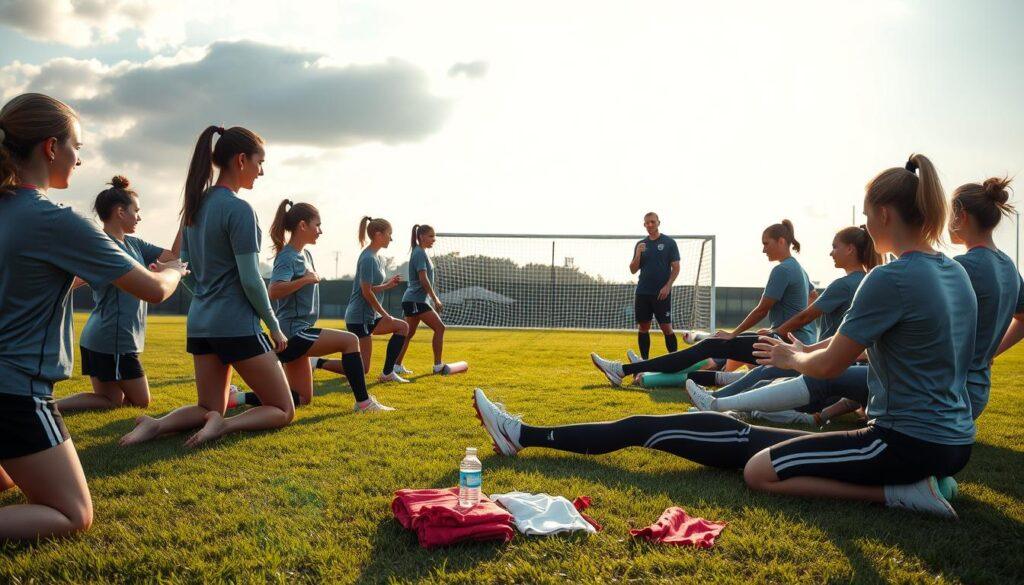
A professional women's soccer team engages in a recovery session on a grassy field after practice. In the foreground, a diverse group of players in modest athletic wear performs stretching exercises, some using foam rollers. In the middle ground, a trainer demonstrates proper post-workout hydration techniques with bottles and sports towels nearby. The background showcases a bright sky with soft clouds and a soccer goal, adding depth to the scene. The lighting is natural and soft, capturing the late afternoon sun that casts gentle shadows on the players. The overall mood is focused and supportive, emphasizing teamwork and wellness in injury prevention and recovery approaches.

Great soccer skills come from having fresh, responsive muscles. You can’t play well if you’re tired and sore. Rest is key to performing at your best.

Ignoring recovery is like stopping a software update mid-install. You’ll crash. The program links soccer fitness training and soccer skills development to smart recovery. Build your strength, then let your body heal. That’s how champions are made.

Timeline for Tryout Preparation

You have the blueprint, the mindset, the fuel, and the repair plan. Now, it’s time to put it all together. This final phase isn’t about cramming. It’s about timing your peak performance perfectly.

Think of your summer as a three-act play. Act I (Weeks 1-3) lays the groundwork. Act II (Weeks 4-6) adds complexity and speed. Act III (Weeks 7-9) is the final sharpening and resting phase. Your conditioning programs need this rhythm.

The intense 6-week window before tryouts is your sprint. But it’s built on a 9-week foundation. This timeline is your project plan. Mark the dates. The final week should be calm and confident, not chaotic.

The countdown isn’t a threat. It’s a rhythm for your preparation. When you step onto the field, you’re not hoping to be ready. You’re executing a plan you started months ago. That’s confidence, not anxiety.

Diverse Career Opportunities in the Women’s Soccer Industry

Women Soccer Career Paths

We cheer for the goal scorers. We debate the manager’s tactics. But have you ever thought about the massive machine that makes the game possible?

It’s not just 22 players and a ball. The global sport business is a huge, multi-billion dollar world. For every moment of magic on the field, there’s an army of professionals working behind the scenes.

Think of data savants analyzing performance. Marketing wizards building global brands. Legal eagles negotiating contracts worth more than some small countries’ GDP. This is the real front office.

Forget the tired idea of a single career path ending at 35. The off-field game offers a maze of opportunities. It’s where the true power brokers and storytellers are.

Let’s pull back the curtain. The beautiful game’s commercial side is often its most fascinating—and overlooked—drama.

On-Field Career Opportunities

Women’s soccer is changing fast. The term ‘on-field’ now covers many career paths, not just one job. Gone are the days of a simple path from college to retirement.

The old way was like a narrow ladder. You climbed until you hit a ceiling. Now, it’s like a vast network of roads. If you miss a turn, more paths appear soon.

The league structure has changed too. The NWSL is no longer the only game in town. The USL Super League and Canada’s Northern Super League are starting up. Even lower tiers are becoming professional, with plans for more leagues.

USL Super League President Amanda Vandervort said, “Rising demand calls for more options, not fewer.” This growth is not just about more leagues. It’s about making soccer a real career, not just a hobby.

This change means more competition, which is good. NWSL Commissioner Jessica Berman calls this time of growth and competition. Players now have more choices and opportunities.

The financial side is key. But the real excitement is what’s being built on top of it. Athletes are becoming entrepreneurs, seeing their playing careers as just one part of their income.

Take England’s Ella Toone as an example. She’s not just playing for Manchester United and the Lionesses. She’s also building her own football academy. Her career is not just about playing; it’s about building a brand.

This changes what we mean by sports industry jobs. Players are now brands, businesses, and content creators. Their careers are not just about playing; they’re about building an empire.

For more on this, check out our analysis of new jobs in women’s soccer.

So, a modern soccer career is like a tactical formation. It needs skill, financial smarts, brand strategy, and vision. Your career is not just about playing; it’s about building a whole ecosystem around it.

Off-Field Soccer Industry Roles

If you think soccer games just happen, I have a surprise for you. The game you see on TV is the result of a huge, hidden industry. This is where the real action happens.

The SheBelieves Summit, presented by Deloitte, is more than just a pep rally. It’s a place where big ideas are born. Companies invest here to help grow the sport, not just to sponsor teams. Deloitte’s support shows how it’s about more than just the game.

This investment has created new jobs that didn’t exist before. Now, we have data experts, community leaders, and league managers. Women’s soccer is growing, and so is the number of jobs in the front office.

For athlete career transitions, this is great news. Retired players have valuable knowledge. They can manage teams or create fan experiences. They move from playing to planning the game.

A dynamic scene depicting the transition of a female soccer athlete into various off-field roles within the soccer industry. In the foreground, a confident woman in professional business attire stands, holding a clipboard and engaging with young athletes in a mentoring session. The middle ground features a diverse group of women engaging in sports marketing discussions, analyzing digital media on laptops, and showcasing sports management in a modern office setting. The background highlights a stadium filled with cheering fans. The atmosphere feels energetic yet professional, with bright, natural lighting illuminating the setting. A wide-angle perspective captures the vibrancy of the soccer industry, emphasizing the diverse career opportunities available beyond playing on the field.

The data shows that growing the sport creates more jobs. We need people in operations, finance, and event management. It’s a perfect match of supply and demand.

Let’s look at where the action is off the pitch.

Role Primary Function Key Skills Transition Relevance for Athletes
Front-Office Strategist Shapes long-term club vision, manages salary caps, and oversees roster construction. Analytical thinking, negotiation, deep knowledge of the sport. Direct application of tactical understanding and team dynamics.
Data Analyst Translates on-field performance metrics into actionable insights for coaching and recruitment. Statistical literacy, software proficiency, pattern recognition. Intimate familiarity with the metrics being analyzed from a player’s perspective.
Community Engagement Director Builds bridges between the team and its local fanbase through programs and events. Public speaking, relationship building, project management. Leverages existing public profile and understanding of fan passion.
League Operator Manages the logistics of competition scheduling, broadcasting rights, and league partnerships. Organizational mastery, stakeholder management, strategic planning. Experience with the grueling schedule and operational needs of a professional season.

Brains are now as important as brawn. This isn’t a consolation prize for retiring. It’s a promotion.

The world of soccer is complex and demanding. It needs the same discipline and teamwork as the game itself. Look at former women soccer players creating impact beyond the game. They show us how to make a difference.

So, next time you watch a game, don’t just watch the players. Look at the people behind the scenes. They’re building the future of soccer, one smart move at a time.

Media & Broadcasting in Women’s Soccer

The most valuable player in women’s soccer might not be on the field. She’s in the production truck, creating stories that turn viewers into fans. This isn’t just a statement; it’s the new way to grab attention.

When you watch a game today, you’ll notice more than just cameras and graphics. The texture of the commentary has changed. Analysts now share the story behind a player’s actions. For example, Beth Mead uses her platform to talk about resilience and identity. Fans connect with the person behind the game, and that connection is valuable.

This emotional connection is a goldmine. It’s funding careers and creating a new path for professionals. We need people who can tell authentic stories with journalistic rigor and cultural understanding. It’s the opposite of old clichés.

So, what are the soccer business opportunities here? Let’s analyze them like a game tape.

  • Content Creators & Digital Strategists: Clubs and leagues need voices that resonate with fans. This means writing that touches the fan’s heart, not just the league table.
  • Broadcast Producers & Directors: The vision for how a story unfolds on screen is key. It’s about capturing the emotions, like the sigh after a missed penalty.
  • Podcasters & Audio Storytellers: Intimacy is the new scale. Deep conversations about the biggest challenge isn’t on the field can build a community faster than a traditional pre-game show.

Even platforms like LinkedIn are stages for intellectual commentary. Former players and executives are analyzing the game’s business with precision. Your voice—your ability to analyze, contextualize, and humanize—is an asset. Proper soccer media training is now as specialized as coaching badges.

The goal is no longer just to inform. It’s to make viewers feel part of something. When you do that, you don’t just cover the game. You help build it. And that, right there, is the most exciting soccer business opportunity of this media renaissance.

Sports Marketing & Sponsorship Careers

The modern sponsorship playbook is more like a best-selling novel than a corporate memo. It’s not just about a logo on a jersey. Today, it’s about telling a story that connects with fans and brands.

Take Deloitte’s partnership with the SheBelieves Summit. It seems like a big company supporting a sports event. But it’s more than that. They’re investing in the sport’s future and creating new soccer careers.

A dynamic scene showcasing a diverse group of professionals actively engaged in a sports marketing meeting focused on women's soccer sponsorship. In the foreground, a confident Black woman in a smart blazer presents a vibrant graphic on a digital screen, while a Hispanic man in business casual attire takes notes. The middle ground features a large, round table surrounded by team members of various ethnicities discussing strategies, with soccer jerseys and promotional materials scattered around. The background includes a large window through which bright sunlight streams, illuminating the modern office space adorned with posters of women's soccer teams. The atmosphere is collaborative and energetic, highlighting the excitement of careers in sports marketing.

These careers blend analytics and creativity. The Partnership Activator creates fan experiences all year. The Brand Strategist makes a company’s values part of the team’s story. The Digital Campaign Wizard tracks engagement to show the value of sponsorships.

This isn’t just marketing for sports. It’s marketing as sport. Every campaign is a game, and every metric is a score. The goal is to build loyalty, not just sell products.

Fans, like those in women’s soccer, want real partnerships. They can tell when a partnership is fake. Success comes from campaigns that make a difference in the community.

For professionals, having the right skills is key. Can you analyze data and tell compelling stories? If so, there are many opportunities. These soccer careers offer a front-row seat to exciting business changes.

So, when you see a brand with your favorite team, look closer. See the strategists, storytellers, and analysts. They’re the ones making every sponsorship a story worth telling.

Fitness & Training Professional Paths

If you think sports industry jobs are all about yelling ‘drop and give me twenty,’ you’re about two decades behind the curve. Today, athletes are seen as complex puzzles. They need experts in biomechanics, data science, and therapy, not just drill sergeants.

We’ve moved from ice baths to cryotherapy chambers and from stopwatches to predictive analytics. This change shows how much the field has evolved.

The fitness world today is a complex, multi-disciplinary field. A sports scientist analyzes lactate thresholds, then passes it to a nutritionist. The nutritionist tweaks glycogen levels, and the physiotherapist fixes muscle imbalances. There’s also a performance psychologist and a data-driven conditioning coach.

This team works together like a human performance engineering firm within a club. They’re not just a support team; they’re essential to the athlete’s success.

The sport’s growth has led to more focus on player development. New leagues aim to bridge the gap between amateur and professional players. This growth creates jobs for specialists who refine raw talent.

Every new academy and fledgling league needs this team. They don’t just need players; they need the people who build them.

The game is getting faster and more demanding. Clubs see investing in human performance as a key advantage. They don’t want to risk a player’s performance without optimizing it first.

So, what do these careers look like? Let’s break it down. The table below shows the key roles in turning athletic talent into polished performance. It’s your guide to the heart of modern soccer.

Role Primary Focus Key Tools & Data Typical Setting
Sports Scientist Physiological monitoring & performance research GPS trackers, heart rate variability, lactate analyzers Professional Clubs, Academies
Performance Nutritionist Fueling strategy & body composition Dietary analysis software, metabolic testing Clubs, National Teams, Private Consultancy
Head Physiotherapist Injury prevention, rehab, & recovery Muscle ultrasound, therapeutic laser, mobility assessments Club Medical Department, Specialist Clinics
Strength & Conditioning Coach Power, speed, and resilience development Force plate analysis, velocity-based training tech Club Training Staff, University Athletics
Performance Psychologist Mental skills & resilience training Biofeedback, cognitive assessment, mindfulness apps Clubs, Olympic Committees, Private Practice

These jobs are not fleeting. They are stable, impactful careers built on expertise. As the sport grows, so does your value. You’ll see players recover from injuries stronger and teams perform better in the 90th minute.

It’s a career for those who love the science of recovery and the humor in preseason challenges. The future of soccer is in the lab, clinic, and gym, not just on the field.

Entrepreneurship in Soccer Industry

Think of entrepreneurship as the final boss-level in the soccer career game. It’s where athlete career transitions stop being a plan for later and start building a legacy now.

Players are no longer just athletes. They are CEOs in cleats. Ella Toone MBE building her own academy is a masterclass in this shift. She’s creating something beyond her playing career while she’s at the top of her game.

This is the new playbook. The modern player’s identity is a diversified portfolio. We see launches for media companies, fashion lines, and tech startups. The pitch is just the launchpad.

Why this explosion in soccer business opportunities? The platform they’ve built has immense influence. Smart players are turning personal brand into sustainable business. It’s a cultural shift as much as a financial one.

For the rest of us, this opens wild new doors. Venture capital, business development, and startup incubation now have a vibrant sports-specific lane. The playbook is being written in real-time. Are you watching?

Soccer Recruiting Tips for Recreational Players Who Want Exposure

Female Soccer Scouting

You think the path to being seen is a secret handshake for the soccer elite? Think again.

It’s a system. And like any good system, it can be gamed. This isn’t about waiting for a scout’s epiphany under the Friday night lights. It’s a calculated, multi-year campaign of self-development and strategic exposure.

The data doesn’t lie. Seventy-four percent of Division I men’s college coaches start their evaluations in the 10th grade. Club experience and tournament performances are your currency. Sure, NCAA rules formally restrict direct contact until later. But the real evaluation machine is always humming, much earlier.

This aligns perfectly with the stated mission of U.S. Soccer’s own Talent ID department: to identify and monitor players. They aim to impact the entire ecosystem. Your job is to understand that machinery.

True player development is what intersects with the gaze of soccer talent scouts. It requires looking beyond traditional grass metrics. Exploring talent identification in alternative formats can reveal key skills. It also means insisting on a holistic environment, supported by robust safe sport initiatives that protect athletes.

Forget destiny. Let’s talk strategy.

Fitness & Skill Development for Recognition

Scouts don’t just watch your 40-yard dash. They check your whole skill set. Everyone can run fast. But, it’s your control over the ball that really stands out. This is key for player development.

Your skills are like a smart investment. A great first touch is like a reliable stock. Vision and passing range are like stocks with big growth chances. Skills like touch, passing, shooting, and dribbling take time to learn but pay off big later.

Are you just fast, or are you versatile? College coaches see you as a future investment. They want speed, but they need technical skills and club experience too. Your skills are the most valuable part of your package.

Tactical awareness is also important. It’s about knowing where to be before the play starts. This is more than just running; it’s about thinking ahead. Can you read the game like a chess player, or do you just react?

Try this self-assessment: compare yourself to college players. Watch their games. Ask yourself:

  • Is my first touch as clean?
  • Is my passing range as diverse?
  • Do I see the same passing lanes they do?

This isn’t about copying them; it’s about finding your own level.

Real player development means growing your skills. It turns you into a complete player. That’s what gets you noticed and recruited.

Tournament & Showcase Participation

Welcome to the world of youth soccer, where talent is everything. Showcase tournaments are where it all happens. It’s not just games; it’s a chance to show off your skills on a big stage.

You’re not just playing; you’re presenting yourself to coaches. They’re watching you closely, ready to make decisions. It’s like a live audition for college teams.

For Division I college coaches, these events are key. They see hundreds of players in one place, saving time. Top events like ECNL and Girls Academy are where the action is.

To stand out, you need to know the game inside out. Make smart moves that coaches notice, even if they’re not on the stat sheet. Show your defensive skills when your team loses the ball. Coaches value soccer smarts and hard work.

This setting creates a lot of pressure. You’re on display, like a product. But instead of getting nervous, stay calm. This shows you’re ready for college.

This is your chance to prove your worth. It’s where your training meets real pressure. Learning to stay focused under stress is key. Resources on building confidence in aspiring female soccer players can help a lot.

A bustling soccer tournament scene showcasing energetic players on a vibrant green field, dressed in colorful team uniforms and focused on the game. In the foreground, a diverse group of enthusiastic young athletes engages in a friendly match, showcasing their skills with the ball. In the middle ground, spectators cheer from bleachers adorned with banners supporting their favorite teams, capturing an atmosphere of excitement and camaraderie. The background features a clear blue sky with a warm sun casting bright, inviting light over the scene, enhancing the vivid colors of the jerseys. The image is shot from a low angle, emphasizing the players' determination and athleticism, while capturing the dynamic movement of the game. The overall mood is lively and inspiring, reflecting the spirit of competition and sportsmanship in soccer tournaments.

So, think like a strategist, not just a player. Know which colleges are coming. Be intentional during warm-ups. Every move you make is part of your pitch.

The showcase circuit values quick thinking and action. You have to show your worth in 90 minutes. It’s a chance to make a lasting impression.

These showcases are a unique chance to meet coaches. But it’s not just about playing well. It’s about showing you understand the game and the opportunity.

Creating a Soccer Portfolio & Highlights

Your soccer portfolio is like a campaign ad. It’s your first chance to impress coaches. It’s not just about showing your skills. It’s about launching your soccer career.

Every second counts. Coaches have little time to watch your video. It should be 3 to 6 minutes long, with 20 to 25 key plays. This is how you grab their attention.

Each clip should answer important questions. Can you handle pressure? Do you have good defensive skills? Your video is your chance to show off.

A long, slow video won’t impress. What coaches want is a fast, action-packed video. Forget the music and slow-motion shots. They want to see your skills in action.

Aspect The “Home Movie” (Loses Votes) The “Political Ad” (Wins the Campaign)
Core Purpose To memorialize a fun season. To solve a specific problem in the soccer recruiting process.
Editing Philosophy Include everything; it was a good play! Ruthless curation. Only the most convincing evidence stays.
Clip Content Isolated skills, celebratory reactions. Game footage showing decision-making under pressure.
Narrative Chronological, “this happened then that.” Thematic, grouped by skill (defending, playmaking, finishing).
Viewer Takeaway “This player had a season.” “This player fits our system.”

Goalkeepers need to mix it up. Show your saves and your skills. It’s all about convincing them you’re the right fit.

Your portfolio is your story. It’s what you tell coaches before you meet them. For more tips, check out this in-depth guide on making a great video.

Networking with Coaches & Scouts

Networking with coaches is more than just collecting business cards. It’s about starting a strategic conversation early. Think of the soccer recruiting process as a specific, rule-bound dating game. You can’t just wait by the phone.

The NCAA rulebook guides your actions. For Division I, the calendar is key. Coaches can start direct communication on June 15 after your sophomore year. That’s when the real race begins.

A dynamic soccer recruiting process scene taking place on a sports field. In the foreground, a group of professional-looking coaches and scouts, dressed in smart casual attire, attentively observe young players practicing drills. One coach, holding a clipboard, engages with a promising player, providing feedback. In the middle ground, several players are skillfully performing, showcasing their talent during a scrimmage, while others are clustered together, discussing strategies. The background features lush green trees lining the field, emphasizing an organized and friendly environment. The lighting is bright and natural, evoking a cheerful atmosphere, with sun rays casting highlights on the players' focused expressions. A wide-angle view captures the action, encapsulating the energy of networking among participants in the soccer talent identification process.

Before June 15, soccer talent scouts work in secret. They can show interest through your club coach. They can watch you at tournaments. But they can’t contact you directly yet. This is your chance to stand out.

To get noticed, start with research. Find schools that match your style and needs. Then, write a personalized email. It’s not about flattery. It’s about showing you’ve done your homework.

Building a relationship takes time. Use your club coach to get noticed early. A respected coach’s endorsement is powerful. When a college coach calls them, you want to be remembered.

Period What Coaches Can Do Smart Player’s Move
Before June 15 (Sophomore Year) Send questionnaires, talk to club coaches, observe at events. Send introductory emails, build a highlight reel, get on their radar.
On/After June 15 (Sophomore Year) Initiate direct calls, texts, emails, send recruiting materials. Respond promptly, schedule calls, ask insightful questions.
August 1 (Junior Year) Begin arranging official visits (paid for by the school). Prepare for campus tours, know what to ask, treat it like a two-way interview.

Official visits start August 1 before your junior year. It’s not a vacation. It’s a chance to show you’re the right fit. Ask about playing time, academic support, and team culture.

The goal of the soccer recruiting process is simple. Make the coach’s job easier. Show you’ve done your homework. Be the standout choice, not just another name on the list.

It’s about smart, targeted outreach. It’s not about spamming everyone. It’s about showing you understand their needs and your own dreams. In this game, being proactive often wins.

Transitioning from Recreational to Competitive

This final leap is a big change. You’re no longer just playing for fun. You’re now the boss of your own sports career.

This change is a big test of your player development plan. You need to check all your old habits. Replace them with a pro’s focus on training, recovery, and watching game footage.

The path ahead is clear. Just playing high school soccer is not enough. At least two years in an elite club is needed. Four years is common. Your coach can help figure out your level and how you’ll grow.

Your goal is to find a competitive club where you play real games. This is where you get noticed. It makes every local tournament more important.

These events are not just weekend fun. They are key business meetings. This is where you show off the skills you’ve worked on for years.

Here, you put it all together. Your improved skills, tournament experience, polished portfolio, and growing network. You’re not just switching leagues. You’re upgrading your whole soccer system.

Career Opportunities in Women’s Soccer Leadership and Management

Women Soccer Leadership

Let’s be brutally honest. The beautiful game has a glaring problem, and it’s not on the pitch.

While female talent explodes in stadiums worldwide, the real power centers—the boardrooms, technical areas, and federation halls—have often felt like an exclusive old boys’ club. The glass ceiling wasn’t just cracked; it was reinforced with concrete.

But the winds are shifting. This isn’t a feel-good diversity seminar. Consider this a diagnostic.

Why are women in sports leadership roles a strategic imperative for innovation and cold, hard growth? Look at the evidence.

Emma Hayes’s tactical genius transformed Chelsea. Michelle Kang’s multi-club ownership play is rewriting the business playbook. These aren’t tokens; they’re titans.

It’s Moneyball for the front office, with a full-blown cultural revolution on the side. The most potent transfer market move isn’t always a player. Sometimes, it’s a perspective.

Coaching Certification Pathways

Becky Hammon didn’t just break into the NBA. She navigated a complex system of coaching licenses to join Gregg Popovich. Her journey, like those of Katie Sowers in the NFL and Jennifer Campbell in the NHL, shows the importance of strategy. A successful soccer coaching career is built on a series of calculated steps, not just luck.

The path to the NWSL or top collegiate teams is not easy. It involves a structured, often political, journey. The U.S. Soccer Federation (USSF) and the Union of European Football Associations (UEFA) guide this path. They offer a range of licenses, from basic to advanced.

The USSF pathway is key for American coaches. It starts with online modules for beginners. The real challenge begins with the ‘F’ license. You then move up through ‘E’, ‘D’, ‘C’, ‘B’, and ‘A’ licenses.

The ‘A’ license is a tough, in-person test. It focuses on tactics and high-performance environments. The Pro License is the highest level, held by top MLS and collegiate coaches. It’s like a black belt in coaching.

The UEFA system is similar, with ‘B’, ‘A’, and Pro licenses. The choice between USSF and UEFA depends on your goals and location.

Pathway Key Levels Typical Duration Approx. Cost Range
USSF Grassroots, F, E, D, C, B, A, Pro 5-10+ years $200 – $15,000+
UEFA B License, A License, Pro License 3-7+ years $5,000 – $25,000+
National ‘C’ License Often a national federation entry-point 1-2 years $1,500 – $4,000

The real story is not just the curriculum. It’s also about money, time, and connections. Can you afford the travel and time for courses? The system favors those with money and flexibility.

Finding a mentor is a big challenge. Hammon used her WNBA experience to get into the NBA. Sowers and Campbell found opportunities through fellowships and gigs. Their strategy was clear: find a niche, get a mentor, and earn the right badges.

But we must question if this system is fair. Does it value knowledge or wealth and connections? The badges show you know the game, but your network can open doors.

See your soccer coaching careers as a two-part journey. It’s a deep dive into the game and a soft-power campaign. Every course, connection, and volunteer role is a step up. The next great coach will know the game and how to climb the ladder.

Referee Training & Advancement

Sarah Thomas didn’t just break the NFL’s officiating glass ceiling. She rewired the entire perception of what a referee’s nerves are made of. Her journey from the Friday night lights of Mississippi to the Super Bowl spotlight is a masterclass in composure.

If coaching is a strategic game of chess, elite officiating is a high-wire act performed under a microscope. Every decision is a live broadcast of your judgment to a stadium of partisan critics. This career is for the unsung strategists, the real-time data processors who manage 22 moving parts and several thousand screaming opinions.

A group of diverse female referees engaged in a dynamic training session on a soccer field. In the foreground, two referees are demonstrating hand signals and positioning techniques, dressed in professional black and white uniforms, showing determination and focus. The middle ground features other trainees observing and practicing their skills, with a soccer ball nearby. The background displays a lush green field and goalposts under a bright blue sky, with soft sunlight highlighting the scene. Capture the atmosphere of empowerment and teamwork, emphasizing the advancement of women in soccer officiating. Use a slightly elevated angle to convey the action and energy of the training, creating a vibrant and inspiring mood.

The pathway from a local assignor’s list to a coveted FIFA badge is less a clear ladder and more an obstacle course for your sanity. It’s opaque by design, filtering for those with an unshakeable mix of law, psychology, and athleticism. Let’s map this clandestine climb.

The physical referee training regimen rivals that of many athletes. It’s not just about keeping up with play. It’s about being in the perfect position, every single time, to see the infraction no one else can. This demands peak cardio and spatial awareness drills.

The mental training, though, is the true differentiator. How do you develop skin thicker than a goalie’s gloves? It involves studying endless film, not for tactics, but for pattern recognition of fouls and player behavior. It’s rehearsing calm communication under fire and making the call even when you know it will ignite fury.

Level Typical Training Focus Key Hurdles Pioneer Example
Local / Amateur Rulebook mastery, basic positioning, conflict de-escalation. Gaining experience, building a reputation with assignors, handling abusive sidelines. Every official starts here, learning to manage community-level passion.
National / Professional Advanced video review, league-specific mechanics, elite fitness testing. Intense competition for few spots, surviving public and media scrutiny. Violet Palmer (NBA): First woman to officiate a major U.S. men’s pro league finals.
International / Elite (FIFA) Global rule interpretations, language skills, handling world-stage pressure. Political navigation within federations, maintaining peak performance for decades. Kari Seitz: Officiated in four Women’s World Cups, a standard-bearer for consistency.

Pioneers like Thomas and Palmer are archetypes. They illustrate that referee advancement requires breaking barriers no rulebook mentions. Thomas’s precision in the hyper-speed NFL and Palmer’s unflappable presence in the NBA proved that the required skill set is gender-blind.

It’s a unique blend: part lawyer, part psychologist, part marathon runner. The best officials are students of human dynamics. They manage player egos, coach frustrations, and game tempo with an invisible hand. Their best tool is often a well-timed, calm word.

This leads to the fascinating paradox for the analytically minded. In officiating training, your masterpiece is the game nobody talks about you after. Perfection is anonymity. It’s a career where success is measured by the absence of controversy, a silent testament to your total control of the chaos.

The next time you watch a game, watch the official. You’re seeing a master of real-time analytics, performing a high-stakes ballet. Their training regimen is the unseen foundation of the spectacle you love.

Sports Administration Career Development

While coaches draw plays on whiteboards, another strategist works on spreadsheets. Welcome to the heart of modern sports. Here, the term “suit” doesn’t have to be negative. Today’s sports administrator is a true expert in many fields: economics, diplomacy, and data science.

These careers shape the business of sports. General managers manage teams within a budget. Operations directors keep stadiums running smoothly. Marketing VPs turn jerseys into global brands. And league commissioners handle tough political issues.

So, what degree is right for this field? An MBA is great for finance and strategy. A law degree helps with contracts and agreements. A communications master’s is key for media and fan engagement. The truth is, there’s no single path. The key is to pair foundational business or legal acumen with a deep, authentic understanding of the sport’s ecosystem.

Kim Ng is a great example. She became the first female General Manager in major North American men’s sports. Her success shows the importance of persistence, legal knowledge, and player evaluation. Her story is a roadmap for careers in sports administration.

Look at Jeanie Buss, guiding the Los Angeles Lakers. Her leadership shows that effective control comes from understanding legacy and business innovation. These examples show a broader movement. As highlighted in a perspective on women leaders in sports, diverse perspectives add value and relevance.

This career path combines passion and business. It requires understanding revenue streams, sponsorship deals, and media rights. Securing a TV deal for a decade is a high-stakes challenge.

The journey into sports business is not a detour. It’s a deeper dive into the game’s mechanics. It’s for those who love the game and its business side. Building a sports administration career means loving the game for its complex, thrilling business.

Networking & Professional Growth

Here’s a secret: your next big opportunity might come from a casual chat, not a formal application. In sports, it’s all about who you know, not just what you know. Your network is key to unlocking new opportunities.

Networking is all about social capital. It’s the sum of your connections, trust, and ability to ask for help. For women in sports leadership, building this capital is essential to overcome bias.

To build your network without being awkward, be strategic.

Forget Attending Conferences; Target Them

Don’t just attend events. Research the speakers and find people whose work interests you. Aim for two meaningful conversations, not just meeting everyone. Ask a thoughtful question and follow up with an email to discuss further.

The Alchemy of the Informational Interview

Informational interviews are powerful. Ask specific, humble questions. Instead of “Can I pick your brain?”, say “I was inspired by your work on [specific project]. I’m facing a similar challenge. Would you have 15 minutes to share a lesson you learned?” This shows you’re a peer, not just asking for help.

A diverse group of women of varying ethnicities engaged in a lively networking event focused on sports leadership, standing confidently in a modern conference room filled with natural light. In the foreground, a woman in a professional suit is passionately discussing ideas with her peers, while another woman in business casual attire takes notes on her tablet. The middle ground features a round table with laptops, charts, and coffee cups, emphasizing collaboration and professional growth. In the background, large windows reveal a view of a soccer field, symbolizing the sports context. The atmosphere is dynamic and empowering, infused with a sense of camaraderie and ambition, captured with soft, warm lighting and a slightly elevated angle to showcase interaction.

But the best network is horizontal, not vertical. Create a group of peers to share challenges and opportunities. Meet monthly to discuss and get a reality check against sexism and bias. This support is vital, as shown in resources on strong networks.

Look at leaders like Baroness Sue Campbell of the FA. Her influence grew through building relationships. This is the model: turn transactions into an ecosystem.

Your value is a mix of capitals. Understanding them helps you invest your time wisely.

Type of Capital What It Is How to Build It Why It Matters for Women
Social Capital The value of your network & relationships. Strategic mentorship, peer alliances, consistent follow-up. Directly counters the “old boys’ club” by creating alternative access points.
Intellectual Capital Your knowledge, skills, and certifications. Continuous learning, specialization, publishing thought pieces. Establishes undeniable expertise, a non-negotiable foundation for credibility.
Reputational Capital How you are perceived professionally. Delivering on promises, championing others’ work, ethical leadership. Builds a track record that biases find harder to dismiss, paving the way for more women in soccer leadership roles and beyond.

Networking is more than just schmoozing. It’s about building your professional environment. Your community is your support, your board, and your source of opportunities. Build it with honesty, and it will support you long after your career.

Building Leadership Skills Through Playing

Can a crunching tackle at midfield teach you about corporate negotiation? Does organizing a backline translate to managing a project team? The answer is a resounding yes. We’re exploring how playing sports builds leadership skills.

Decision-making under fatigue, communicating under pressure, understanding team dynamics—these are not abstract concepts. They are muscles developed on the pitch. The brutal self-awareness from both victory and defeat provides a unique perspective. This perspective is invaluable for anyone plotting their path, including those eyeing soccer coaching careers.

Data shows former athletes often become powerful role models. They inspire the next generation precisely because they’ve been in the trenches. For the former player, the challenge is translating “field sense” into boardroom language. It’s about articulating how reading a game’s flow mirrors market trends.

For everyone else, the athlete’s mindset offers a masterclass in resilience and strategic thinking. The most valuable asset you can bring from the pitch to the executive suite, or into soccer coaching careers, might just be the mud on your boots. It’s proof you’ve navigated the chaos and found a way to win.