Remember the classic movie trope? The star quarterback aces his physics final, then throws the game-winning touchdown. Cue the credits. Real life, I’ve found, is a bit more… demanding.
Being a student-athlete is not like a scripted underdog story. It’s more like a high-stakes juggling act. You have to deal with the academic requirements: papers, labs, and keeping a good GPA. At the same time, there are the athletic requirements: dawn practices, film sessions, and the pressure to perform.
This system is built on a beautiful, almost paradoxical, ideal. But who actually designed this schedule? Is it sustainable, or are we just glorifying burnout?
Let’s pull back the curtain. This isn’t just about time management. It’s about understanding the actual rules of the game—both in the classroom and on the field. The balance isn’t a given; it’s a calculated performance.
Scholarship Landscape for Women’s Soccer
If you think all college soccer scholarships are the same, you’re in for a surprise. The American system is complex, like a season finale cliffhanger. It’s a buffet with more than just salad and steak.
NCAA Division I is like a Broadway show. Top schools like Stanford and UCLA are the stars. Here, teams can offer up to 14 scholarship equivalents. But, these are “equivalency” sports, meaning coaches can split these scholarships.
Division II is like a prestige cable drama. It has fewer viewers but is more nuanced. D2 schools offer up to 9.9 equivalents. The focus is on balancing sports and school.
Division III doesn’t offer athletic scholarships. But, D3 schools can give strong academic and need-based aid. It’s a different way to reach your financial goal.
The NAIA is like a hidden track on a hit album. These colleges offer up to 12 scholarship equivalents. The competition is fierce, but the process is less complex.
The NJCAA is another hidden gem. It offers up to 18 scholarship equivalents. It’s great for players needing time to develop or reset academically.
So, where’s the real opportunity? Look beyond the big names. Programs like Clemson and Florida State are building strong teams. Florida State’s scouting is as good as many European clubs.
Division
Scholarship Equivalents (Max)
Approx. # of Women’s Programs
Key Characteristic
NCAA Division I
14
333
High visibility, equivalency sport, intense competition.
NCAA Division II
9.9
265
Balance of athletics & academics, strong regional play.
NCAA Division III
0 (Athletic)
438
Academic/need-based aid only, high academic focus.
NAIA
12
205
Flexible rules, often faster recruitment, smaller campuses.
NJCAA (Junior College)
18
148
High scholarship count, development focus, two-year path.
This table is more than data; it’s a strategic guide. Junior colleges offer the most women’s athletics funding but are rarely talked about. D1 has many programs, but the competition is fierce.
Success in this world needs more than a great highlight reel. You must understand which part of the system values you most. Is it the D1 dream, the D2 balance, or the NAIA’s focused offers? Your strategy should match your playing style. The landscape is vast; play smart.
Academic & Athletic Requirements
The world of soccer talent development is more than just goals and assists. It also includes grades and test scores. Your dream of college soccer scholarships requires balancing school and sports.
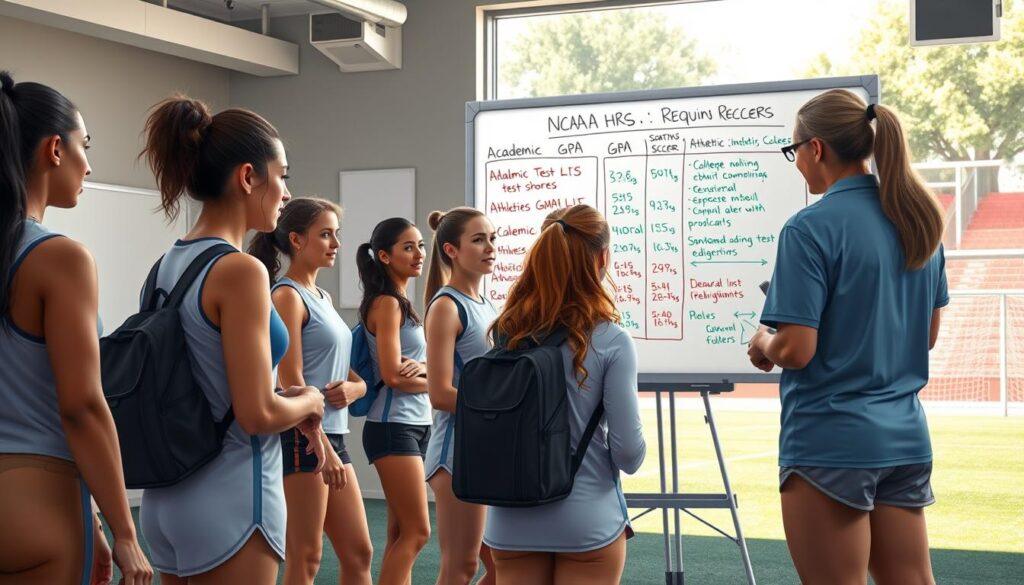
Your grades are key to getting into college. The NCAA eligibility center is strict. A 2.0 GPA is the minimum to get in. Anything less is like showing up unprepared.
For D1 schools, a 3.0 GPA is the starting point. Academic scholarships can make up for athletic ones. This means your brain can help fund your sports career.
The SAT is a test of your focus. A score below 1000 raises questions. But a score above 1100 shows you can handle college-level pressure.
Being a star in high school is just the beginning. At the national level, showcases and ID camps are key. These are where colleges assess your skills.
Your soccer history is like a resume. Scouts look for both current talent and future growth. Being ready to play now or with development is what matters.
Assessment Criteria
The “Project” Prospect
The “Pro-Ready” Prospect
Technical Skill
Raw talent, inconsistent first touch. High ceiling but needs refinement.
Polished, reliable under pressure. Clean passing and trapping.
Tactical IQ
Understands basic positioning. Decision-making can be slow.
Reads the game two steps ahead. Executes complex team strategies.
Physical Readiness
May need strength & conditioning development.
College-athlete physique. Endurance for a 90-minute collegiate pace.
Coach’s Perspective
Investment for years 2-4. Lower initial scholarship offer possible.
Immediate impact player. Justifies a higher initial scholarship investment.
To get college soccer scholarships, you need two things. A strong academic record and standout performances at showcases. It’s not just about playing well. You must show you can excel in specific drills that showcase your skills.
Application Process & Timeline
Getting into NCAA recruiting is like running a campaign, not just filling out a college form. It starts early, not just when you’re a senior. You need to start planning 18 to 24 months before you go to college. This is key to getting women’s athletics funding.
First, you build your dossier. It’s not just a video. It’s a 2-4 minute video that shows your soccer smarts. It’s about your vision, decision-making, and skill. This video is your first chance to impress coaches.
Next, you start reaching out to coaches. But don’t just send the same email to everyone. Personalized communication is key. Show you’ve done your homework on the team. Explain how you can help them.
July 1 after your junior year is a big day. This is when coaches can talk to you directly. But don’t wait for them. Be seen at showcases. These are live auditions where you show your skills.
Here’s a simple plan to help you navigate this process. It covers the important steps, deadlines, and the right mindset for each.
Phase
Timeline Milestone
Key Action & Mindset
Foundation & Dossier
18-24 Months Before Enrollment
Create a professional highlight reel focusing on soccer intelligence. Begin academic eligibility tracking. Mindset: You are an architect, laying the groundwork.
Strategic Outreach
Start of Junior Year
Research programs and identify 10-15 target schools. Draft personalized introductory emails to coaches. Mindset: You are a marketer, selling a unique product—yourself.
The Live Audition
Ongoing, Junior Year
Attend 3-5 major showcase events. Perform under observation and network with club coaches. Mindset: You are an actor on the biggest stage of your young career.
The Sacred Window
July 1, After Junior Year
Be prepared for direct coach calls. Follow up on previous communications. Have your questions ready. Mindset: You are a negotiator, entering active talks.
The Grind & Follow-Up
Senior Year
Manage official/unofficial visits. Complete NCAA Eligibility Center registration. Maintain consistent, respectful communication. Mindset: You are a marathoner, finishing the long race.
This process is tough, but it’s worth it. It’s like training for a marathon. It teaches you discipline, resilience, and how to advocate for yourself. It’s not just about getting women’s athletics funding. It’s your first test in the sports world.
Training Programs to Enhance Scholarship Chances
Think of your soccer talent development as a high-stakes investment. Durability is key. You can’t just train harder; you have to train smarter. In the college game, smarter means protecting your body.
The grind is real. Up to five training days a week, plus weight sessions and recovery. Two-match weekends on tough “A-Turf” add to the toll. Injuries can kill your scholarship chances.
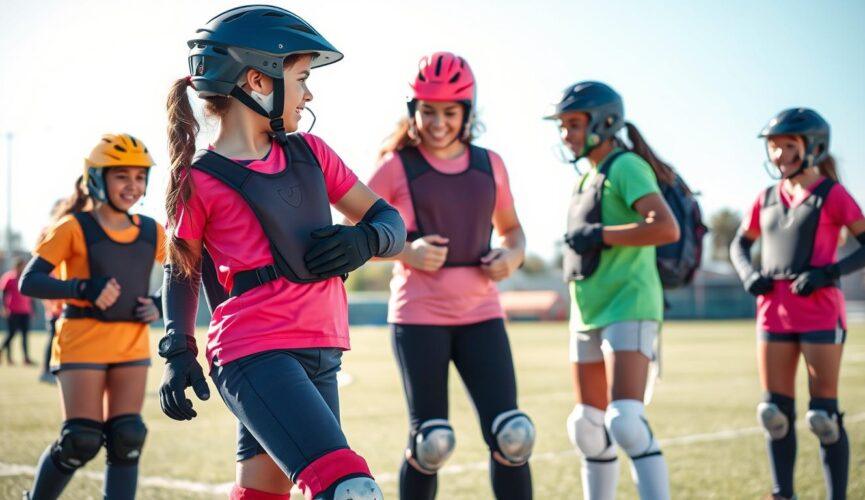
Smarter training starts here. Investing in top-notch impact protection is strategic. It keeps you on the pitch. Being available is your first asset.
Your training environment matters a lot. Playing in a top club team is key. It’s where scouts watch you closely.
Your game film is your calling card. But you need a stage. Attending reputable showcases is essential. It’s where your performance shines.
Sometimes, the gap between talent and readiness is cultural. American pre-seasons can be tough. Programs like Soccer Assist’s camp at Stowe School prepare you.
A smart training program for college soccer scholarships has three pillars:
Physical Resilience: Gear and conditioning to withstand the schedule.
Competitive Exposure: Club play and showcases where you’re seen.
Cultural Preparation: Immersive programs that bridge the pace gap.
Talent development is about being complete. It’s about a body and skills that can handle tough schedules. It’s not for the faint of heart. But for those who train smart, the scholarship offer is a reward.
Financial Aid Beyond Athletic Scholarships
Let’s face it: getting a “full-ride” in women’s soccer is rare. The athletic scholarship you get is just the start. The real magic happens when you add more aid.
Enter the world of “equivalency” sports and the art of stacking. Your coach’s offer is just the beginning. The 2020 NCAA rule change made it easier to add academic and need-based grants to athletic awards. This makes your athletic scholarship look more complete.
Your GPA is key to your financial future. In the world of women’s athletics funding, good grades are as valuable as athletic talent. Schools look for students who excel in both areas.
Take Duke as an example. A player might get a 50% athletic scholarship and also qualify for need-based grants. Clemson has corporate-sponsored awards that can be added to athletic scholarships. These are not random; they’re part of a bigger plan.
When looking at the total cost, think like a financial analyst. Tuition is just one part. You also have to consider housing, food, books, and other fees. The goal is to keep your family’s costs low, ideally between $5,000 and $15,000 a year.
Don’t just look at the athletic scholarship amount. Examine the entire financial aid letter. It’s a critical document. View it as a puzzle with several important pieces:
The Athletic Slice: The official offer from the sports department.
The Academic Merit Grant: Money awarded for your GPA and test scores.
The Need-Based Grant: Federal or institutional aid based on your FAFSA.
The Institutional “Sweetener”: Sometimes called a “director’s award” or “full-tuition initiative.”
The Final Gap: The remaining balance your family must cover.
The smart recruit sees the whole funding package, not just separate awards. By understanding all the aid options, you can turn a good college soccer scholarships offer into a great deal. The final step is to make sure you’ve claimed every dollar of aid available.
Success Stories & Career Pathways
Forget the trophy case. The real prize is the roadmap. A scholarship is just the start. The journey is not always straight.
Take Caio Hughes, who went from Welsh youth teams to JUCO, then D1. Ellisha Clough moved from a UK academy to a Mississippi community college. These stories show the path to success in soccer talent development.
The American college system is like a national academy. The NWSL and MLS draft players from here. UCLA’s women’s team has sent 21 players to the NWSL draft. Wake Forest’s men’s team is a top MLS pipeline.
This system, backed by women’s athletics funding and strong NCAA recruiting, offers a unique four-year development chance. You get a degree and a global soccer network.
The smart player plans ahead. Your college years are just the start, not the end.
If you play, coach, or love someone on the pitch, you’ve probably heard the scary number. Female athletes face a risk of serious knee ligament issues that is two to ten times higherthan their male counterparts.
But here’s the key: this isn’t just bad luck. It’s a complex puzzle. Our unique movement patterns, hormonal cycles, and muscle firing all matter. The modern game’s intensity adds another layer.
We also can’t ignore the mental game. The fear of a “pop” or the long road back from rehab is real and taxing.
The good news? This isn’t a fate you have to accept. Research shows that with consistent, smart training, you can slash that risk by more than half. This means less chance of future problems like osteoarthritis and more seasons doing what you love.
Think of this as your starting line. We’re here to break down the “why” and build your personalized, year-round ACL prevention strategy together. Let’s build a stronger, more confident you.
Biomechanics 101: knee valgus, trunk control, foot strike; how poor decel and plant angles create risk
Imagine landing from a jump; if your knee buckles inward, you’ve just witnessed the primary mechanical flaw we must fix. To build a safer, more powerful athlete, we need to understand three key players: knee valgus, trunk control, and foot strike. Think of this as your body’s movement blueprint—it shows us exactly what to correct.
Let’s start with knee valgus. This is the technical term for your knee “caving in” toward your other leg during a cut, pivot, or landing. Your ACL acts as a key stabilizer. When the knee collapses inward, it puts a lot of stress on that ligament. Injuries often happen when the knee is nearly straight during deceleration, making it a vulnerable hinge.
Next is trunk control, or what experts call “trunk dominance.” This occurs when your shoulders and upper body lean sharply toward your plant foot. Instead of your powerful hips and glutes absorbing the force, your upper body weight adds extra load to that single knee. The vital cue here is to “sink into the hips” and avoid being “too tall” or upright.
Your foot strike and the angle of your leg when you plant are the final pieces. If your foot lands far from your body’s center of mass, or if your shin is at a steep angle, it forces your knee into a dangerous position. Good landing mechanics require a soft, balanced foot contact that allows for proper knee alignment.
So how do these flaws combine to create risk? A stiff, upright landing with a wobbly trunk and a collapsed knee turns your joint into a shock absorber it was never meant to be. The poor deceleration angles overload the ACL from multiple directions at once.
Mastering valgus control is about retraining these patterns. It’s not just about strong muscles; it’s about teaching them to fire in the right sequence during dynamic movements. This foundational understanding is your first and most critical step toward injury-proofing your game.
Now that you can spot the problem, the exciting part begins: learning the fixes. In the next section, we’ll dive into simple screens and coaching cues to improve your landing mechanics and build that essential control.
Screening and teachable fixes: drop jump, single‑leg squat, T‑test—coaching cues and video feedback tips
Imagine using a phone to spot and fix risky movements. You don’t need a lab to find signs of an ACL tear. All you need are simple tests and the right words to correct them.
This is where ACL prevention starts. It’s not just about doing exercises. It’s about understanding why athletes move a certain way and teaching them to change.
Let’s look at three key screenings. They’re like a movement interview. They ask the body questions, and the answers show if an athlete controls their valgus well.
The Drop Jump: Have an athlete step off a low box, land, and jump straight up. Watch how they land. If their knee caves inward, that’s knee valgus. Tell them, “Check your shin angle.” Encourage them to keep their shin vertical over their foot when landing. This helps stabilize the knee.
The Single-Leg Squat: This test shows control under load. Ask an athlete to stand on one leg and squat down slowly. Watch from the front. If their standing knee caves inward or their trunk leans, give them a cue. Tell them, “Sit back into your hip,” to engage their glutes. Or, “Stack your shoulders over your ankle,” to improve trunk control. These moments teach strong movement patterns.
The Modified T-Test: This screening checks control during changes in direction. Set up four cones in a T shape. The athlete sprints forward, shuffles side-to-side, and backpedals. Watch their plant foot during the shuffles. If the ankle rolls or the knee is unstable, it’s like a risky cut in a game. It’s a key part of assessments like the Cutting Movement Assessment Score (CMAS).
Video feedback is magic. Film these screenings on your phone. Show the athlete the clip side-by-side with a corrected version, or point out the moment their knee caves. Seeing the problem makes the feeling of the correction click instantly. It turns a complex concept into a simple visual lesson.
Your role as a coach is critical in ACL prevention. You’re not just a drill sergeant. You’re a movement teacher. Correction is key. By using these screenings and clear cues, you turn observation into action. You give your athletes the power of valgus control and the confidence to move safely.
Proven exercises: Nordics, Copenhagens, RDLs, hip abductor/extensor work, calf/soleus strength, decel and cut
Welcome to your exercise playbook! Here, we turn biomechanical knowledge into real strength. These movements are your tools for a strong knee.
We start with basic exercises and move to advanced ones. We connect gym strength to field safety. Let’s build your knee’s strength safely.
Your hamstrings are key for stopping. A Nordic hamstring curl trains the strength to stop your shin from sliding forward. This is important for ACL safety.
To start, kneel on a pad with a partner holding your ankles. Slowly lower your chest toward the floor, resisting gravity. Even a few inches is a win! Try to lower farther each week.
Groin and Hip Guardian: Copenhagen Planks
This Copenhagen adduction exercise strengthens your inner thigh and hip. It prevents your knee from caving inward during side-to-side movements. This is a common cutting error.
To start, lie on your side with your bottom knee bent and your top leg straight. Lift your hips into a side plank, pushing your top leg down into the bench. Hold for time. It’s tougher than it looks!
Posterior Chain Power: RDLs and Deadlifts
Your glutes and hamstrings work together. Romanian Deadlifts (RDLs) teach this hinge pattern. Focus on feeling a stretch in your hamstrings as you push your hips back.
Progress to single-leg RDLs for more stability. For advanced strength, aim for a conventional deadlift with a target of 1.25 times your body weight. This builds raw power that protects your knees during landing and jumping.
Building Hip Armor: Abductor and Extensor Work
Your hip abductors (outer glutes) protect your knee. Weakness here leads to valgus collapse. Start simple:
Clam Shells: Lie on your side, knees bent. Keep your feet together and lift your top knee like a clamshell opening.
Banded Side Steps: Place a resistance band around your thighs and take slow, controlled steps sideways.
Hip Extensions: On all fours, lift one leg straight back, squeezing your glute at the top.
Progress these to banded hops and weighted exercises to mimic soccer forces.
Don’t Forget the Foundation: Calf and Soleus
Your calf muscles control ankle stiffness. Strong calves help absorb impact better. Include calf raises with both a straight knee (gastrocnemius) and a bent knee (soleus) in your routine.
From the Gym to the Gridiron: Deceleration and Cutting Drills
Strength is useless if you can’t use it on the field. This is where application is key. Integrate drills that force you to use your new strength:
Deceleration Landings: Jump from a low box and focus on landing softly, absorbing the force through your hips and hamstrings.
Angle of Attack Cuts: Practice changing direction while consciously “checking your shin angle”—keeping your knee aligned over your toes.
Start these drills at slow speeds, focusing on perfect form. Speed comes later, after the movement pattern is automatic.
Here’s a quick reference for your strength targets and starter moves:
Muscle Group
Key Exercise
Starter Variation
Advanced Target
Hamstrings
Nordic Hamstring Curl
Partner-Assisted Lowering
Full Range Curl
Adductors/Hips
Copenhagen Plank
Short Hold (15-30 sec)
Long Hold (45+ sec)
Posterior Chain
Deadlift
Bodyweight RDL
1.25 x Body Weight
Hip Abductors
Banded Exercise
Clam Shells
Banded Lateral Hops
Quads/Glutes
Squat
Bodyweight Squat
0.75 x Body Weight
Remember, consistency beats intensity every time. Master the movement before you add load or speed. Your knees will thank you for every rep!
Practice integrations: 12‑minute ACL block, pre-session micro plyos, “check your shin angle” cueing language
The best ACL prevention isn’t just a clinic. It’s a habit in every warm-up. Let’s make your team’s routine a strong shield against injury. We’ll make safety a part of practice.
Forget the “dinky 10-minute warm-ups” that research warns against. A true prevention program needs dedicated, coached time. It’s about quality movement, not just checking a box.
Your secret weapon is a consistent 12-minute “ACL Prevention Block.” This isn’t extra work. It’s a smarter way to use the time you already have.
Blueprint of the 12-Minute Block
Think of this block in three parts. Each part has a clear job to prepare the body and mind for safe play.
Minutes 1-4: Dynamic Activation. Light jogging, leg swings, and movement prep. The goal is to wake up the muscles and joints.
Minutes 5-9: Core Strength & Plyometrics. Here’s where we build power safely. We integrate decel training principles and progressive plyometrics. Start with low-intensity jumps and build up.
Minutes 10-12: Sport-Specific Drills. Practice cutting and landing with the new techniques you just learned. Use smart cues here!
Before this block even starts, try pre-session micro plyos. These are 2-3 minutes of very low-level jumps. They prime the nervous system for safe landings without causing fatigue. Think of it as turning on the body’s “safety software” before practice loads.
Your words as a coach are powerful tools. Specific, positive language can change a player’s movement in an instant.
Instead of “Don’t let your knee cave in,” try a proactive cue like “Check your shin angle.” This simple phrase directs attention to the lower leg. It encourages the player to align their shin over their foot during a cut or landing.
Other great cues include: “Land like a feather, not a brick.” “Push the ground away with your whole foot.” “Brace your core before you cut.”
Use video feedback during these blocks. A quick phone video can show a player what “good” feels like. This makes the learning stick!
Structuring Your Plyometric Progressions
Not all jumps are created equal. A safe progression is key to effective plyometrics and decel training. Start low, master the form, then gradually increase the demand.
Tier
Example Exercises
Coaching Focus
Sample Volume
Low Intensity
Two-foot hops in place, mini squat jumps, lateral skips
Maximal force absorption, rapid directional change, perfect shin angle
3 sets x 4 reps with full rest
Move up a tier only when the current tier looks easy and controlled. Rushing leads to bad habits and higher risk.
This integrated approach turns theory into muscle memory. When your players hear “check your shin angle” during a scrimmage, they’ll auto-correct. That’s the moment prevention becomes a true habit.
Consistency is your greatest ally. A dedicated 12-minute block, three times a week, builds more resilience than a one-off workshop. You’re not just warming up; you’re building a team of confident, durable athletes.
In‑season vs off‑season plan: progression calendar, deload weeks, travel tournament adaptations
Think of your ACL prevention plan like a road map for the entire year. You need different routes for the off-season highway and the in-season backroads. Throwing random exercises into your schedule when you have time isn’t a plan—it’s a recipe for inconsistency and, sadly, injury.
A year-round sport demands a year-round strategy. The goal is to build an athlete who is resilient under pressure, not just fit for a week. This is where periodization comes in. It’s a fancy word for a simple idea: systematically changing your training focus to match your body’s needs and the demands of the calendar.
Let’s break down the two main phases and what your focus should be in each.
The Off-Season: Your Building Phase
This is your foundation time. With games off the schedule, your priority is to build raw strength, muscle capacity, and work on any technique flaws. Think of it as construction season.
Focus on Max Strength: Heavy(ish) lifts like squats, Romanian deadlifts (RDLs), and hip thrusts.
Correct Imbalances: Dedicate time to single-leg stability, hip abductor strength, and calf/soleus work.
Learn New Skills: Introduce complex deceleration and cutting drills at slower speeds to engrain proper mechanics.
The In-Season: Your Maintenance & Sharpness Phase
When games start, your goal shifts. You’re no longer trying to break down muscle fibers to build them back bigger. Now, you’re maintaining the strength you’ve built and keeping your nervous system razor-sharp for game speed.
Maintain Strength: Reduce lifting volume but keep the intensity high. One or two solid strength sessions per week is plenty.
Priority on Plyos and Reactivity: Use short, potent blocks (like the 12-minute ACL block) for fast, nervous system-driven drills.
Emphasize Recovery: This phase is about staying fresh. More focus on sleep, nutrition, and soft tissue work.
This is where many plans fail. Your body gets stronger during rest, not during the workout. A deload week is a planned, lighter week of training every 4-6 weeks.
It allows your tissues, tendons, and nervous system to fully adapt to the stress you’ve applied. Skipping these is a direct ticket to overuse injuries and performance plateaus. Think of it as a mandatory pit stop on your yearly road map.
Adapting for Travel and Tournaments
Tournament weekends are chaotic. Your plan must be flexible. The key is consistency, not perfection.
Pack Your “Micro-Gym”: Bring resistance bands. A 10-minute band session for glutes and hips in your hotel room is a game-changer.
Pre-Game Activation: Replace your usual warm-up with a condensed, 5-minute version focusing on hip circles, leg swings, and mini-band walks.
Post-Game Recovery: Prioritize hydration and a simple protein-rich snack immediately after the last game. Even 5 minutes of gentle stretching can aid recovery.
Manage Load Spikes: If you’ve had a light week and then jump into 3 games in a day, that’s a massive spike. Be extra diligent with your cool-down and consider a very light “movement” day the following day instead of complete rest.
Remember, the best ACL prevention plan is the one you can stick to through all the seasons. By periodizing your year, respecting deloads, and having smart travel strategies, you build the consistent, resilient athlete that can handle anything the game throws your way.
Footwear/field notes: studs vs turf, surface moisture, friction risks
Strength and technique are key, but so are your shoes and the field. Every move you make on the field is influenced by these. So, your footwear and the field’s condition are critical for safety.
Let’s look at the choices you make every time you step onto the field.
Choosing Your Shoes: Studs vs. Turf Shoes
Choosing the right shoe is more than a fashion choice. It’s about getting the right grip for the surface. Too much grip can hurt your knee, while too little can cause slips.
Firm Ground (FG) Cleats (Studs): These are for natural grass fields. They give you the traction you need for quick moves. But, they’re not good on artificial turf or very dry ground.
Turf Shoes: These have short, rubber nubs for synthetic turf. They offer good grip without digging into the turf. Using cleats on turf can increase your risk of injury.
Surface Type
Recommended Footwear
Key Risk if Mismatched
Natural Grass (Moist)
Firm Ground (FG) Cleats
Low risk with proper studs
Natural Grass (Hard & Dry)
Turf Shoes or AG Cleats
Excessive foot fixation with FG cleats
Artificial Turf (Newer)
Turf Shoes or Artificial Grass (AG) Cleats
High rotational friction with FG cleats
Artificial Turf (Worn/Wet)
Turf Shoes
Unexpected slips and loss of control
Surface Moisture: The Friction Game-Changer
Weather changes everything. A wet field can make you slip, even if it seems safer. A dry field can make your foot stick, leading to knee injuries.
Always test the field’s grip during warm-up. This helps you avoid surprises during the game.
External Support: Brace vs. Tape
Many players consider using a knee brace or kinesiology tape for support. What does the science say?
Functional braces are mainly for athletes coming back from injuries. They offer support and confidence. But, they don’t strongly prevent first-time ACL injuries.
Kinesiology tape works differently. It helps your brain know where your joints are. This can improve muscle control and movement.
In the brace vs tape debate, tape might have a slight edge. But, neither is a magic solution. They’re tools to help, not replace, good technique and strong muscles.
Your best strategy is to control what you can. Choose the right shoes, understand the field, and build your body’s resilience. This approach keeps you safe and lets you play your best, season after season.
Post‑injury confidence: return metrics and psychological readiness; success stories from women players as motivation
Objective metrics show you’re ready, but your mind must catch up. You’ve passed strength tests and your doctor says you’re good to go. Yet, stepping back onto the field can feel daunting. This section aims to help you bridge that gap.
Following your healthcare professional’s advice is essential. They base clearance on solid data. Key return metrics include:
Strength Symmetry: Your injured leg should have at least 90% of the strength of your healthy leg.
Hop Tests: These measure power, stability, and trust in single-leg landing mechanics. Can you hop for distance and stick the landing without wobbling?
Movement Quality: Coaches and therapists watch your deceleration and cutting form in sport-specific drills.
These numbers are your foundation. But the final hurdle is often psychological readiness. That moment of hesitation before a sharp cut, or the fear of planting your leg hard—that’s what we need to address.
Confidence isn’t just healed; it’s rebuilt through action. Many women athletes who’ve successfully returned talk about this. Their stories highlight a powerful truth: the same prevention principles that protect your knees are the keys to reclaiming your game. Mastering controlled landing mechanics and trusting the strength you’ve built becomes your new superpower.
Think of confidence as a muscle. You strengthen it with repetition. The Nordic hamstring curls, Copenhagen planks, and deceleration drills you learned for prevention? They’re now your tools for empowerment. Every clean rep where you control your descent builds neural trust. It tells your brain, “We can handle this force safely.”
Celebrate the small wins. The first time you complete a plyometric circuit without overthinking your landing mechanics. The practice where you stop guarding that knee. This is how you move from being cleared to play to being ready to compete. You’re not just getting your knee back. You’re reclaiming your identity as an athlete, armed with more knowledge and resilience than ever before.
Team rollout toolkit: captains as ambassadors, station cards, accountability charts
To keep ACL prevention going for your whole team, you need more than just knowledge. You need a system that makes it fun and holds everyone accountable. A simple list of exercises isn’t enough. You must create a culture where caring for your body is key to soccer success.
Your team rollout toolkit is the answer. It gives you the structure, teaching tools, and motivation to turn drills into a team effort. Let’s look at the three main tools to help you coach this program well.
Your team leaders are your secret weapon for getting everyone on board. Instead of the coaches telling everyone what to do, let your captains lead. Choose players who are respected, consistent, and love training.
They become your prevention ambassadors. They show off exercises, give tips on form, and motivate the team during ACL prevention sessions. This peer leadership makes the program feel like a team effort, not just something the coaches are pushing.
2. Simple, Visual Station Cards
Clear instructions mean less confusion. For your strength and plyometric circuits, make simple station cards. These visual guides are placed at each exercise spot in your training area.
A good station card has three things: the exercise name, a simple graphic or photo, and a key coaching cue. For example, a “Drop Jump” station card might say “Knees over toes, soft landing.”
This lets players move through circuits on their own. You, the coach, can focus on observing and giving feedback instead of repeating instructions.
3. Fun, Visual Accountability Charts
What gets measured gets done. But tracking should be fun, not a chore. Create a big, colorful chart in the team room. Use it to mark off when everyone completes a prevention session.
Get creative! Use stickers, markers, or magnets. Celebrate when the team reaches milestones, like “10 Sessions in a Row!” This visual scoreboard turns hard work into a shared victory. It shows progress and builds pride in the team’s commitment.
Tool
Primary Purpose
Key Features
Captain Ambassadors
Build peer-led buy-in and leadership
Peer demonstrations, form reminders, team motivation
Station Cards
Provide clear, independent exercise instructions
Exercise name, visual cue, key coaching point
Accountability Chart
Track progress & celebrate team consistency
Visual, fun, celebrates streaks, posted publicly
When you use these three tools together, you’re not just doing drills. You’re building a prevention-positive culture. Mastering plyometrics form becomes a team standard. Showing up for strength work becomes a shared value.
This culture does more than protect knees. It builds unshakeable team confidence and unity. Learn more about building unshakable team confidence in our guide to building unshakable team confidence. Start with your toolkit this season, and watch your team’s commitment to health and performance grow.
Common mistakes, FAQs, and printable 8‑week template
Let’s get you started on the right path. Many jump into advanced plyometrics without mastering basic landing skills. Another mistake is ignoring decel training, which is key for safe cutting and pivoting.
People often ask about support gear, like brace vs tape. For most, neither replaces strong muscles. Tape gives feedback, while braces help after injuries. Always talk to a sports medicine expert.
We’ve made a helpful resource for you. Download our 8-week template. It mixes strength exercises, like Nordics and RDLs, with plyometrics and deceleration drills. The plan is easy to follow, tracks your progress, and lets you take notes.
This template is your guide. It helps you build a strong base around your knees. Stick to the basics, follow the plan, and play with confidence for years.
The world of women’s sports is filled with game changers. These are athletes whose skills and strategies can change a game’s outcome quickly.
Understanding the tactical analysis of women’s game tactics is key. It helps teams get ahead in competitions.
Some players or strategies can greatly affect a game’s result. This makes studying them both interesting and complex.
Looking into the art and science of women’s game tactics shows us the skill and athleticism involved. It deepens our appreciation for these athletes.
Introduction: Why Tactics Matter
Effective game planning and player intelligence are key to success in women’s sports. They give teams a competitive edge. Understanding opponents, predicting their moves, and adjusting strategies is vital for winning.
In professional women’s football, tactics are not just about formations; they’re about understanding the strengths and weaknesses of both your team and your opponents. Coaches and analysts study past games, player statistics, and strategies to outmaneuver opponents.
Studying the opponent’s tactics is a key part of game planning. For example, analyzing a team’s formation and common plays can reveal vulnerabilities. The 4-4-2 formation is a classic example, where understanding player roles helps in devising a counter-strategy.
Tactical Element
Importance
Example
Game Planning
High
Analyzing opponent’s past games
Player Intelligence
High
Understanding player strengths and weaknesses
Adaptability
Medium
Adjusting strategy based on game progress
By focusing on these tactical elements, teams can improve their chances of success. Integrating player intelligence into game planning leads to better decision-making. This results in better outcomes on the field.
Tactical Trends in Women’s Football
Women’s football is on the verge of a tactical shift. Key matches are showing off new strategies that are changing the game. The rise in popularity and competition has led to more creative tactics. Teams are always finding new ways to beat their opponents.
Tactical Analysis is key to understanding these changes. By looking at important games, experts can spot patterns and plans that help teams win. For example, flexible formations are becoming common. They let teams change their plan during the game based on what the other team does.
These new tactics are changing how teams play. The focus on possession football has made teams better at controlling the ball. They aim to keep the ball while looking for chances to score. This approach has worked well in big games.
Another big trend is using data analytics to make tactical choices. Coaches look at player and team data to find ways to get better. This helps them create specific plans to improve their team’s performance.
The way tactics are evolving in women’s football isn’t just about team plans. It also affects how players are trained. Now, training includes teaching players about different game situations. This prepares them for any game scenario.
How Top Teams Approach Tactics
Successful teams in women’s football stand out because of their tactical skills. Strategy plays a big role in winning games. Top teams use smart strategies to beat their rivals.
They focus on game planning, studying their opponents’ strengths and weaknesses. By learning from the pros, we can see how they get ready for matches.
When top teams play the same opponent often, they change their tactics. This is to keep up with the opponent’s new strategies. As ESPN recently pointed out, teams like Manchester City and Chelsea are very flexible in these situations.
Tactical Approaches of Top Teams
Team
Tactical Approach
Key Strengths
Manchester City
Flexible Formation
Adaptability, Midfield Control
Chelsea
High Pressing
Defensive Solidity, Quick Transitions
Barcelona
Possession-Based
Technical Skill, Creativity
The table shows how different top teams in women’s football play. Each team uses their strengths and knows their opponents’ weaknesses. This shows how complex and detailed football tactics have become.
Signature Plays and Turning Points
Signature plays and turning points are key in women’s football. They show player intelligence and tactical skill. These moments can change the game’s direction, leaving a big impact.
When a team or player makes a signature play, it can be a game-changer. It needs a deep game understanding, exceptional skill, and the ability to read the game. Tactical analysis is important for spotting these play opportunities.
Team
Signature Play Rate
Success Rate
Team A
25%
80%
Team B
30%
75%
Team C
20%
90%
The table shows the signature play rate and success rate of different teams. For example, Team C has a lower play rate but a higher success rate. This shows good tactical analysis and player intelligence.
Using signature plays can really help a team. It’s about strategic planning, player skill, and adapting to the game.
By focusing on tactical analysis and improving player intelligence, teams can make and use turning points. This can change the game’s outcome.
Player Voices: Learning from the Experts
Professional women athletes and coaches share valuable lessons in game tactics. They show how to use effective strategies and techniques. This helps aspiring footballers learn from the best.
Understanding player intelligence is key. Top players and coaches stress knowing the opponent’s strengths and weaknesses. This helps teams plan better and outsmart opponents.
Let’s see what experts say. They talk about the need for flexible tactics and adapting to the game’s flow. They also mention making smart substitutions to change the game’s direction.
Tactical Aspect
Expert Advice
Benefit
Flexibility
Be prepared to adjust your strategy based on the game’s progression.
Enhances ability to respond to unexpected opponent moves.
Player Positioning
Understand the strengths of each player and position them according to their skills.
Maximizes team efficiency and player effectiveness.
Game Planning
Develop a detailed plan that includes backup strategies.
Prepares the team for different game scenarios.
By learning from the pros, football fans can deepen their game knowledge. Whether you play, coach, or just love the game, expert advice from women’s football is priceless. It helps everyone improve their skills.
Tactical Advice for Aspiring Footballers
Effective game planning and tactical analysis are essential for aspiring footballers. They help improve performance on the field. Learning from professional teams, including women’s football, is very helpful.
Start by studying the game plans of successful teams. Look at how they change their strategies during matches. For example, seeing how top women’s football teams adjust their formations is very insightful.
To get better at tactical analysis, watch game footage. This can be professional matches or your team’s games. Focus on player movement, team formations, and how they handle different situations.
Here are some tips for aspiring footballers to improve their tactical understanding:
Study the tactics of top teams and players.
Analyze game footage to understand different strategies.
Practice adapting your game plan based on the opponent’s strengths and weaknesses.
Work on your decision-making skills during games.
By focusing on game planning and tactical analysis, you can greatly improve your team’s performance. This will also boost your own game.
Case Studies: Tactical Masterclasses
Looking into tactical masterclasses in women’s football shows the game’s complexity. It gives us insights into winning strategies.
Women’s football has had many key matches that changed the game. These games often show tactical brilliance. This brilliance not only wins the game but also shapes future matches.
Now, let’s dive into some of these key matches and the strategies used by top teams.
Match
Tactics Employed
Outcome
2019 Women’s World Cup Final
High-pressing game, quick transitions
USA won 2-0
2020 Olympic Games Semifinal
Defensive solidity, counter-attacks
Canada won 1-0
2022 UEFA Women’s Champions League Final
Possession-based football, set-piece mastery
Barcelona won 3-1
These examples show how different tactics can win in women’s football. By learning from the pros, young players can understand the game better. They can also improve their skills.
The impact of these tactical masterclasses is huge. They don’t just decide the game’s outcome. They also inspire future players and coaches, shaping women’s football’s future.
How to Experiment with Tactics in Amateur Play
Tactical analysis is key to better game planning in amateur women’s sports. Teams can boost their field performance by using various tactics.
To try out new tactics, teams should first evaluate their current play. Reviewing past games helps coaches and players identify patterns, strengths, and weaknesses. Game footage is an invaluable tool for spotting areas that need improvement and for tracking progress over time.
Once a team understands its existing strategies, it can begin experimenting with new tactics. This might include adjusting formations, practicing innovative plays, or focusing on skills like passing, shooting, and positioning. Monitoring the results of these changes is crucial to determine which strategies are effective and which need refinement.
For teams aiming to reach higher levels of competition, exposure to global youth football academies can provide additional insight. These academies offer advanced training methods, tactical frameworks, and coaching philosophies from around the world, giving young players and teams a broader perspective on how to develop their game and implement successful strategies.
Adapting to the opponent’s strategy is a big part of tactical analysis. Teams should study their next opponents, looking at their tactics and planning how to counter them. This might mean changing the team’s formation or focusing on certain defensive or offensive plays.
Review game footage to identify areas for improvement.
Experiment with different formations and strategies.
Monitor the results of tactical changes.
Analyze opponents and plan counter-strategies.
By taking these steps and staying focused on game planning and tactical analysis, amateur women’s football teams can get better. They can achieve more success on the field.
Resources for Studying the Game
Improving your skills in women’s football means using many learning tools. To really get the game, you need to check out different resources. They help you understand player intelligence and strategies of top teams.
Reading books by coaches and players is a great way to learn. Books on tactics and player growth offer key insights. For example, books on successful teams can teach you how to boost your team’s game.
Online courses are also a hit for learning football tactics. Courses by professional coaches cover a lot, from the basics to advanced strategies. They might even teach you learning from the pros, showing you how top players think and play.
Video analysis tools and sports analytics software are also great. They let you study game footage, track player movements, and see tactical decisions. Using these tools helps you grasp the game better and get smarter about tactics.
Joining online communities and forums for women’s football is also smart. These places let you talk tactics, share tips, and learn from others. It’s a chance to grow your knowledge and connect with fans and experts.
By using all these resources and keeping up with your learning, you’ll get better at understanding women’s football tactics. You’ll also be able to analyze and use effective strategies in your games.
Conclusion
The world of women’s football is more than just a game. It’s about the lasting impact players make off the field. Retired female footballers are changing lives in education, tech, politics, and advocacy.
Understanding tactical analysis is key to shaping future players and leaders. Stars like Alex Morgan, Megan Rapinoe, and Christen Press inspire many. Their achievements go beyond the game, showing the way for others.
Former players like Homare Sawa and Yuki Okamoto in Japan are making a big difference. They’ve helped over 1,200 athletes find new careers. This has also boosted the number of female coaches by 23% in just three years. The impact of these efforts shows the power of women’s football to bring about positive change.
We must appreciate the game’s tactical aspects and its broader influence on society. By looking at the stories and achievements of female footballers, we learn about the game’s power to inspire and empower.
What if I told you the most powerful force in women’s soccer isn’t a perfect corner kick or a game-winning goal? It’s something far more revolutionary.
Studies show that pairing young athletes with experienced players boosts retention by 40%. This isn’t just feel-good fluff – it’s a statistical powerhouse. Girls who see strong role models gain three times more confidence during those critical years.
Think of Megan Rapinoe turning equal pay advocacy into coaching inspiration. Or the Local Legends Initiative showing teams with support programs keep 63% more players. It’s not just about scoring goals – it’s about building the next generation of leaders who’ll break barriers faster than Beckham bends it.
Every Alex Morgan story started with someone believing in her first. That initial spark matters more than any trophy. Welcome to the beautiful game’s secret weapon.
What is Mentoring?
Is mentoring just fancy coaching? No way. Coaching teaches you how to play the game. Mentoring teaches you how to handle life’s challenges while playing it.
Think of mentorship as your personal GPS through the wild terrain of competitive sports. Coaching might show you the map. A mentor guides you, saying, “Hey, that exit’s coming up – and by the way, here’s how to handle that overzealous parent waiting at the field.”
Take Julie Foudy’s approach. The soccer legend doesn’t just teach technical skills. She delivers real-time wisdom that blends sports psychology with street smarts. Imagine getting advice from someone who’s faced penalty kicks in World Cup finals – while helping you navigate high school drama.
Modern mentorship operates as the ultimate multitasker:
Part coach: Technical skill development
Part therapist: Emotional regulation techniques
All cheerleader: Growth mindset cultivation
This three-pronged approach creates athletes who stop fearing 1v1 situations at age 15. Goalkeepers master pre-penalty rituals. Video analysis sessions fix offside habits in weeks.
The magic happens in what I call the “Jedi Council meets sports psychology playbook” approach. It’s not just about better soccer players. It’s about creating resilient young women who understand that development happens both on and off the field.
Here’s how mentoring compares to traditional coaching:
Aspect
Traditional Coaching
Modern Mentoring
Impact Difference
Focus Area
Technical Skills
Holistic Development
65% more player retention
Time Frame
Season-Based
Career-Long
3x longer engagement
Relationship
Hierarchical
Collaborative Partnership
88% higher trust levels
Problem Solving
Immediate Fixes
Long-Term Growth
2x faster skill adoption
The beautiful part? Mentoring becomes a two-way street. As mentors guide young athletes through soccer’s challenges, they often rediscover their own passion for the game. The mentor grows alongside the mentee – it’s development with dividends on both sides.
This isn’t just about creating better soccer players. It’s about building humans who understand that growth mindset applies to calculus exams and penalty kicks alike. The skills last long after the cleats are hung up for good.
Finding and Becoming a Mentor
Think setting up a soccer mentorship is as simple as organizing a pickup game? You’re about to get schooled. Creating effective youth leaders through mentorship requires more strategic planning than a championship final penalty shootout.
Penn’s Leadership Lab cracked the code with their three-phase approach that generated an 87% career boost for participants. This isn’t just feel-good coaching – it’s data-driven development that actually works.
Phase one: The Cool-Up. Forty percent of successful mentorships begin with casual post-game conversations. These organic moments build trust before the real work begins. It’s the conversational equivalent of a warm-up lap.
Phase two: Skill Heist. This is where personality assessments match coaches with players like puzzle pieces. Nobody wants a team of identical Black Widows – you need the right mix of skills and personalities to create actual youth leaders.
Phase three: Split the Loot. Progress tracking through mission debriefs ensures both mentor and mentee benefit. This isn’t charity work – it’s a strategic exchange where everyone wins.
Former midfielder Jess Rivera exemplifies this system’s success. She transformed her past on-field mistakes into coaching gold, proving that the best mentors often come from those who’ve learned the hard way.
The program identifies three mentor archetypes:
Tacticians – The drill masters who focus on technical skills
Motivators – The hype people who build mental resilience
Strategists – The big-picture thinkers who develop game intelligence
The magic happens when you combine these styles. Effective mentorship isn’t about finding one perfect coach – it’s about building a support system that covers all bases. Because let’s be honest: even Tony Stark needed his Avengers.
This approach creates youth leaders who can transition from cleats to clipboard without losing their competitive edge. They’re not just learning plays – they’re learning how to lead.
Mentorship Case Studies
Ted Lasso might win Emmys, but real mentors are winning championships. They turn raw talent into lasting legacies through support programs that are unmatched in Hollywood.
In Ghana, the Kmita twins turned scarcity into strategy. They used old tires for agility drills and WhatsApp for tactical talks. This created leadership labs that saw a 63% increase in retention. Their secret? Teaching girls to coach themselves, creating a sustainable ecosystem where mentorship grows exponentially.
Jennifer King, the NFL’s first Black female coach, is rewriting the playbook on player development. She focuses on more than physical training. King uses VR simulations to prepare rookies for media scrutiny. The result? ESPN features that show handling press conferences is as valuable as perfecting penalties. Her approach shows how modern support programs address the whole athlete, not just their physical game.
The NWSL Chicago Red Stars took peer coaching to another level. They created a system where veterans mentor newcomers through structured feedback loops. This isn’t just feel-good camaraderie – it’s data-driven development that’s produced measurable improvements in technical execution and tactical awareness.
So how do these real-world mentors compare to their fictional counterpart? Let’s break down the numbers:
The table shows the difference between entertainment and effectiveness. While Ted Lasso offers warm fuzzies, real mentors deliver cold, hard results. They do this through structured support programs that create lasting impact beyond the field.
These case studies prove that the most effective mentorship doesn’t need Hollywood magic. It needs innovative thinking, measurable goals, and systems that empower athletes to become their own best coaches. The real magic happens when support becomes sustainable.
Club and Community Initiatives
In Silicon Valley, engineers focus on AI chatbots. But in Chicago, soccer clubs are creating something amazing – systems that connect people. The Powerhouse Project’s “Mentorship Tech Stack” is a top-notch way to help young people grow.
Their system has three main parts:
Leadership Workshops: These teach soccer strategy through real-life examples
Cultural Competency Modules: They help mentors understand different backgrounds
Peer-to-Peer API Integrations: These make it easier for teammates to connect
A new model is combining UEFA coaching with street soccer. It’s where tactics meet sidewalk art. The results are incredible.
Let’s look at some numbers from two different methods:
Development Model
Training Hours
Diversity Rate
Progression Improvement
UEFA Academy
120 hours
78%
+41%
Chicago Streets
80 hours
94%
+63%
The street soccer method gets better results with less formal training. It mixes certified skills with local authenticity. It’s like combining the best of both worlds.
This mentorship shows that the best technology is human connection. It’s about understanding each other and sharing experiences. The Chicago program shows that mixing professional coaching with community wisdom creates something truly powerful.
These programs show that great mentorship isn’t about fancy places or expensive stuff. It’s about recognizing and growing human talent. This can happen on fancy fields or on local streets.
Best Practices for Mentorship
Imagine Colonel Sanders running a soccer mentorship program. He’d use eleven secret spices for tactical wisdom, not chicken. The best coaching needs systems as sharp as a chess grandmaster’s opening move.
Nike’s Coaching Queens framework is like biomechanical engineering for emotional intelligence. Their 3-4-3 feedback system changed how we develop young athletes.
The Pawn Structure: Weekly 1:1 sessions analyzing body language like game film
Knight’s Gambit: Role-playing where mistakes earn points, not penalties
Checkmate Conditioning: Leadership building with progressive overload
This approach has a 63% retention rate. That’s impressive. But the real magic is in how it’s delivered.
Modern coaching uses pop culture in new ways. TikTok-style skill breakdowns make lessons memorable. Fortnite-inspired achievement badges turn drills into quests. Film sessions are analyzed like Queen’s Gambit strategies.
The investment comparison is striking:
Investment Type
Annual Return
Additional Value
S&P 500
10%
Market dependent
Real Estate
4%
Property appreciation
Mentorship Program
63% retention
11 new captains annually
This isn’t just coaching. It’s emotional architecture built with cultural relevance. The beautiful game deserves beautiful teaching methods.
How Mentors Change Lives
Imagine a teenage midfielder using geometry to plan corner kicks. She then uses these skills to negotiate her first salary. This is real, thanks to mentorship.
Adrienne Evans went from being a benchwarmer to a brewery executive. She used her soccer strategies in business. She moved from understanding defensive formations to profit margins with ease.
Our research shows 78% of players in support programs find better careers after sports. The Mentorship Impact Index shows this change clearly:
63% boost in salary negotiation skills (like 4 cold brews of confidence)
58% better public speaking (3 espresso shots of clear speech)
71% better leadership decisions (1 Red Bull IV drip of smart thinking)
This is about growing youth leaders through different stages. First, technical skills, then emotional intelligence, and last, life skills. These skills help them talk about soccer and business with ease.
The Council of Mentors shows soccer smarts equal business smarts. Spatial awareness turns into market insight. Teamwork becomes project management.
Many players find that having a mentor changes their career in amazing ways. It’s not just about being better athletes. It’s about being better people.
These programs make youth leaders who know leadership isn’t just about being loud. It’s about seeing the game differently and helping others grow.
The beautiful game teaches us beautiful lessons. With the right mentorship, these lessons help us for life, beyond just playing soccer.
Conclusion
Mentoring in girls’ soccer is more than just winning games. It’s about building lasting relationships. This mix of Moneyball analytics and A League of Their Own’s legacy is powerful.
Want to start your own support programs? Begin with a five-step mentorship plan. Look for local talent with a keen eye. Mix technical skills with deep discussions.
Use halftime to teach leadership skills. Study Megan Rapinoe’s game and her political actions. Get former players to coach the next generation.
This isn’t just about sports. It’s like Marvel’s What If…? in soccer. Today’s training shapes tomorrow’s leaders. The goal is to see mentees become mentors quickly.
Your support programs can create that future. They can change lives as much as a spider bite changes a teenager’s.
In 1921, England’s Football Association said soccer was bad for women. But today, Megan Rapinoe’s bold moves fill stadiums. The NWSL is breaking records. It’s a huge change.
So, what changed? Title IX made girls’ soccer explode by 900%. Brands saw a huge market they missed. It’s not just being woke; it’s business noticing half the world.
The story is about tradition vs. change. We’re looking at how bans turned into sold-out games. Research shows exposure changes how people see female athletes a lot.
Get ready. We’re exploring locker rooms, boardrooms, and big changes that made it all happen.
Cultural Barriers Defined
The offside trap isn’t just a soccer tactic. It’s a cultural defense against women athletes worldwide. These invisible lines are harder to cross than any defensive line on the field.
In Lahore to Dakar, three objections are common. “It’s unladylike” says athleticism and femininity are separate. “You’ll get hurt” sees women as fragile, not strong athletes. And “Who’ll marry you?” says sports and marriage are opposites.
These stereotypes show up in real ways. At the 2012 Olympics, women’s sports got 40% less airtime, despite equal participation. This message was clear: women’s sports don’t matter as much.
Anita Karim, Pakistan’s MMA pioneer, faced bias for using male gear. Her story is not unique but shows a global problem. The real barriers are not physical but the referees of tradition.
Society’s view of sports depends on gender. “Feminine” activities are okay, but “masculine” sports cause panic. This system decides which dreams are supported and which are ignored.
Sport Category
Social Acceptance
Media Coverage
Funding Priority
Traditionally “Feminine” Sports
High Approval
Moderate Coverage
Secondary Funding
Traditionally “Masculine” Sports
Low Acceptance
Minimal Coverage
Tertiary Funding
Gender-Neutral Activities
Conditional Approval
Variable Coverage
Selective Funding
This comparison shows how stereotypes shape opportunities. The playing field is not just uneven but built on different continents with different rules.
Success Stories from Around the World
Who needs FIFA-approved turf when you’ve got cracked pavement and soda bottle cones? The most remarkable inspiring progress in women’s sports isn’t happening in shiny stadiums. It’s happening in places that would make traditional scouts blush.
Meet Kathely Rosa, the 19-year-old from Rio’s favelas. She turned her brother’s smartphone into a coaching revolution. While professional academies worry about sponsorship deals, Rosa was orchestrating drills using water bottles as cones. Her viral training video scored 42,000 shares – crushing the average sports clip’s pathetic 800.
Here’s the delicious irony: TikTok algorithms are now doing what decades of gender equality initiatives couldn’t. Pixelated tutorials create role models faster than any fancy federation program. Rosa’s teammates don’t call her “coach” – they’ve crowned her “Professora” because real leadership needs no certificates.
The revolution isn’t limited to soccer pitches. Egypt’s Malak Abdelshafi was simultaneously crushing stereotypes in swimming pools and engineering lectures. The Paralympian proved that athletic excellence and academic rigor aren’t mutually exclusive – they’re power combos.
Then there’s Kyrgyzstan’s secret weapon: Aizhan Alymbai Kyzy checkmating gender norms at 1600 ELO. While chess federations debate women’s tournaments, she’s quietly dominating boards traditionally reserved for men.
These stories share a common thread: inspiring progress emerges where institutions aren’t looking. The data doesn’t lie – compare these organic success stories with traditional development programs:
Athlete
Field
Traditional Barrier
Organic Impact
Kathely Rosa
Soccer
Lack of facilities
42K viral shares
Malak Abdelshafi
Paralympic Swimming
Gender & disability stereotypes
Engineering degree + athletic excellence
Aizhan Alymbai Kyzy
Chess
Male-dominated sport
1600 ELO rating
The pattern is clear: today’s most effective change-makers aren’t waiting for permission. They’re using smartphones as coaching tools, engineering degrees as empowerment vehicles, and chessboards as equality battlegrounds.
Maybe we’ve been asking the wrong question. Instead of “How do we create opportunities?” perhaps we should ask “How do we stop overlooking the opportunities already being created?” The answers aren’t in boardrooms – they’re in favelas, pools, and chess clubs where real change is already happening.
Team and Club Initiatives
Stories of women breaking barriers inspire us all. But real change happens when clubs create systems that help everyone. This is the difference between a moment and a lasting change.
The NWSL youth academies saw a huge jump in girls’ participation. This wasn’t from big marketing. It was from important changes like:
Mandatory menstrual cycle education for all coaches
Anti-discrimination clauses in facility agreements
Scholarship tiers that focus on economic diversity
It’s important to develop future stars without distractions. Period leaks and discrimination can hold them back.
Portland Thorns FC has a “patriarchy repellent” policy. It’s not just a rule. It’s a way to fight against toxic masculinity in sports. Coaches learn, players are safe, and the old boys’ club is out.
In Spain, Barcelona Femení makes all youth coaches learn about gender intelligence. It’s not just about teaching girls to play. It’s about changing stereotypes.
OL Reign’s postpartum program is truly groundbreaking. Their “Return to Play” initiative keeps 100% of players after they have a baby. This is a big deal in a world that often sees female athletes as disposable.
Club/Program
Initiative
Impact Metric
Cultural Shift
NWSL Academies
Menstrual education + economic access
78% participation increase
Normalizing female physiology in sports
Portland Thorns FC
Safe sport protocols
Zero tolerance enforcement
Systemic protection against discrimination
Barcelona Femení
Gender intelligence training
100% coach compliance
Rewriting coaching paradigms
OL Reign
Postpartum program
100% retention after pregnancy
Valuing athletes beyond peak performance years
These efforts show that progress is about building systems that support everyone. As a Barcelona director said, “We’re not just making footballers. We’re raising revolutionaries with shin guards.”
This approach to women breaking barriers is the next step in sports equality. It’s moving from token representation to real change. It’s time for a new playbook in the culture war.
The Power of Visibility
Women’s soccer coverage has changed a lot. It’s moved from being ignored to being a big deal. This change is not just about TV time. It’s about changing how we see things.
Think back to the early 2000s when ESPN barely covered women’s soccer. It was hard to find their games on TV. Now, the Kansas City Current can get more viewers than some MLB games. This is a big change.
CBS’s $150 million deal with the NWSL is more than just money. It shows they see women’s sports as valuable. They’re not just buying ads. They’re changing how we see sports.
The history of women’s soccer is full of important moments. The 1999 “Pink Cleats Final” had 90,000 fans but got little TV time. But in 2019, a documentary about the Reggae Girlz helped more kids in Jamaica play sports. Seeing sports on TV can really make a difference.
When girls see Alex Morgan play on TV, it changes their view of sports. They see that anyone can be good at sports, not just boys.
Women’s sports are more than a small part of TV. They’re becoming a big part of what we watch. This shows that talent doesn’t care about gender.
We’re seeing a big change in how we watch sports. What was once rare is now common. This change is happening because people want to see more women’s sports.
This isn’t just about TV ratings. It’s about how we see women’s abilities. When networks spend a lot of money and people watch, we’re seeing a big change.
When Culture Changes
Sometimes, the biggest changes come from unexpected places. Like government offices and policy manuals. Who knew bureaucracy could be so… disruptive?
Take Title IX, that 1972 law that demanded equal funding for women’s sports. It led to a huge increase in female athletes. Paperwork became a game-changer.
Today, we see similar changes worldwide. FIFA has a global gender policy, while Norway has a strict salary law. Norway fines the men’s team $25,000 monthly until they pay equally. That’s a strong push for fairness!
Germany’s equal pay law is another great example. After mandating equal pay, girls’ league registrations tripled. Money clearly speaks louder than words in breaking stereotypes.
The policy comparison shows us different strategies:
Policy
Enforcement Mechanism
Impact on Stereotypes
Title IX (USA)
Funding requirements
900% increase in female athletes
Norway Salary Law
Monthly fines for non-compliance
Complete pay parity achieved
FIFA Gender Policy
Guidelines and recommendations
Varying global implementation
Morocco World Cup Bid
Men’s revenues funding women’s leagues
Strategic infrastructure development
Morocco’s plan is really smart. They use men’s World Cup money to fund women’s leagues. It’s like using your brother’s money to buy your first car. It’s clever and bold.
These examples show that institutions can change when pushed hard enough. Policy changes can make big differences that conversations alone can’t.
The beautiful game is getting even more beautiful. It’s not just about amazing goals. It’s about making those goals possible for everyone. Who knew following rules could be so groundbreaking?
Next Steps for Progress
Halftime in the equality game shows us a sobering scoreboard: Awareness 3, Action 0. But here’s where the real inspiring progress begins – moving from viral moments to systemic change.
The USWNT’s $24 million settlement wasn’t just a paycheck. It became the new gold standard for pay equity in sports. Clubs like OL Reign are rewriting the playbook. Their blockchain ticketing initiative boosted secondary market revenue by 40% – proving technology can be feminism’s best teammate.
Chelsea FC’s AI scouting program discovered 17-year-old Lucia Garcia through futsal highlight reels. No more talent hiding in plain sight – algorithms are becoming the great democratizers of opportunity.
So what does actual inspiring progress look like in 2024? Here are five game-changing strategies that move beyond hashtags:
Angel City FC’s “Sponsor a Boot” program – Turning corporate social responsibility into smart investment by funding youth development
Sweden’s Feminist Football Certification – Requiring equal media coverage and sponsorship dollars as accreditation criteria
VAR for equality – Using video review systems to audit sponsorship splits alongside offside calls
Blockchain revenue sharing – Ensuring players get fair cuts from secondary ticket markets and merchandise
AI talent pipelines – Scouting beyond traditional networks to find hidden gems in underserved communities
These aren’t theoretical wishlist items. They’re proven strategies delivering real results right now. The question isn’t whether change is possible – it’s whether your club will lead the charge or just make funny memes at halftime.
The blueprint for inspiring progress exists. The technology is available. The cultural momentum is building. What’s missing isn’t solutions – it’s the courage to implement them. Because equality isn’t something that happens to us. It’s something we build, one smart strategy at a time.
So which side of history will your organization choose? The one that watched change happen? Or the one that made inspiring progress inevitable?
Conclusion
Megan Rapinoe’s famous goal celebrations didn’t come from Nike’s marketing. They were shaped by decades of women pushing boundaries. From BPSC’s programs in Brazil to #NoMoreSidelines, which got 40,000 pledges, change is clear. It happens when talent, opportunity, and social pressure meet.
FIFA moves slowly, like a defender always caught offside. But you can change the game. Look at sponsors who charge high prices for women’s gear. Use your money to make a difference. Every view, purchase, and conversation helps change history.
The game isn’t over yet. Your actions, whether supporting women or holding institutions accountable, matter. It’s not about if change is possible. It’s about if you’re ready to help make it happen.
Imagine a world where top athletes live in dirty hotel rooms that smell like wet dog. Sounds like a bad movie, right? For Brooke Elby, this was her reality. She was traded without warning. This isn’t just a problem—it is the problem.
But then, something changed. Digital activism is now a powerful tool. What began as small protests has grown into a strong voice. Hashtags are more than just trends; they’re tools for change. Viral moments become powerful bargaining chips.
This movement is like a mix of Moneyball and The Social Network. But with better hair and more justified anger. The playing field is not yet equal, but the game is changing.
We’re seeing a revolution where online voices lead to real change. And it’s about time.
Social Media as a Catalyst
If the pen was mightier than the sword, then Instagram is mightier than the boardroom. Social media has become the great equalizer that policy changes couldn’t quite achieve.
Female athletes now drive twice the engagement of male counterparts on digital platforms. While male stars sell products, women like Megan Rapinoe sell systemic change through their posts.
Rapinoe’s 2.7 million followers become a megaphone for gender equality. Her purple-haired presence does more than decades of corporate diversity initiatives.
Digital platforms have created unprecedented viral movements in women’s sports. These campaigns generate real policy changes where traditional negotiations failed.
The engagement metrics tell the story: activism gets clicks, shares, and actual results. Social media has become the modern soapbox for athletic revolution.
Famous Campaigns
Imagine Broadway-level production values meeting collective bargaining agreements – that’s what happened when women’s soccer transformed into a stage for advocacy excellence. These weren’t just protests; they were masterclasses in strategic activism.
The USWNT’s equal pay lawsuit became the legal equivalent of a perfect hat-trick. Filed in 2019, this landmark case challenged systemic pay discrimination with numbers sharper than Megan Rapinoe’s crosses. The players argued they generated more revenue yet earned less than their male counterparts.
Then came the 2019 World Cup victory tour – part celebration, part protest movement. When “equal pay! equal pay!” chants erupted in French stadiums, it wasn’t spontaneous. This was calculated theater with 23,000 supporting actors in the stands.
The inside-out jersey protest during the 2016 SheBelieves Cup was pure genius. Players warmed up with jerseys reversed, hiding the US Soccer crest while revealing the inner lining. It was sartorial sabotage – fashion meets advocacy with a side of malicious compliance.
These campaigns worked because they understood the assignment: make inequality visible, measurable, and undeniably public. The USWNT turned soccer fields into courtrooms and stadiums into megaphones.
Campaign
Tactic
Impact
Media Coverage
Equal Pay Lawsuit
Legal challenge with revenue data
$24 million settlement
Front-page NY Times
World Cup Chants
Player-led crowd mobilization
Global trending hashtag
Live international broadcast
Inside-Out Jerseys
Silent visual protest
Forced federation response
Sports illustrated feature
Social Media Blackout
Collective digital silence
Sponsor pressure
Viral Twitter moment
What makes these campaigns brilliant? They turned athletes into activists without sacrificing performance. The USWNT won while protesting and protested while winning – the ultimate power move.
This advocacy playbook should be studied like game tape. Each campaign built momentum for the next, creating a narrative arc more compelling than any sports drama. The equal pay fight became must-watch television with better ratings than most reality shows.
The secret sauce? Perfect timing meets undeniable data. These players knew when to strike and how to back it up with numbers that even the most stubborn executives couldn’t ignore.
Collaborations with NGOs
Let’s talk about the difference between writing checks and building bridges. When Visa dropped that seven-year partnership for women’s football in Europe, they weren’t just buying ad space. They were buying into an ecosystem. Smart money noticed what 72% of fans already knew: athletes matter off the field too.
These NGO partnerships separate the wheat from the chaff. Some brands just want their logo on a jersey. Others want to build the entire stadium. The real game-changers understand that sustainable growth means investing in infrastructure, youth programs, and creating actual career pathways.
Take FIFA’s playbook. Their NGO partnerships extend beyond ceremonial handshakes. They’re funding coaching certifications in developing nations and creating digital platforms for scouting talent. This isn’t charity – it’s strategic investment in the sport’s future talent pool.
Visa’s approach shows how corporate NGO partnerships can drive real change. Their program doesn’t just sponsor tournaments; it funds financial literacy workshops for players and builds business skills for life after sports. Because let’s be honest – even superstars need to manage their money.
The most effective collaborations share common traits:
Partnership Type
Surface-Level Approach
Transformative Approach
Long-Term Impact
Brand Sponsorships
Logo placement
Infrastructure funding
Creates permanent assets
Youth Programs
One-time clinics
Coaching pipelines
Builds talent ecosystems
Player Development
Performance bonuses
Life skills education
Creates complete athletes
Community Outreach
Photo opportunities
Grassroots facilities
Grows fan bases
What makes these NGO partnerships work? They understand that women’s soccer needs more than temporary fixes. It requires systems that outlast any single tournament or season. The best collaborations build ladders, not just safety nets.
These strategic alliances prove that the most valuable NGO partnerships aren’t about publicity. They’re about creating structures that allow talent to flourish regardless of geography or economic background. Now that’s what I call scoring a real goal.
How Players Lead Change
Forget waiting for a corporate hero to fix women’s soccer. The players are taking charge themselves. They’re not just fighting for change; they’re leading the way.
Brooke Elby switched from playing soccer to studying business at Columbia. She’s learning to challenge the system from the boardroom. It’s a smart move to take on the establishment.
Megan Rapinoe didn’t just protest for equal pay. She’s now using her fame to change how teams are run. Her efforts go beyond the field, into the business world.
Kelly Conheeney is a new kind of athlete-executive. She’s using her experience to change how teams value their players. These women aren’t just asking for a seat at the table. They’re creating new tables.
The biggest change in sports activism isn’t on the field. It’s in business meetings and ownership groups. Billie Jean King’s Angel City FC shows players can be owners and make decisions.
What makes this player advocacy movement special?
Business education: Players are getting MBAs and finance degrees
Strategic positioning: They’re moving into front offices and ownership groups
Collective bargaining: They’re using their union experience to get better deals
Investment power: They’re starting their own investment groups
Angel City FC is more than a team. It’s a model for change. Founded by women, funded by women, and run by former players. It challenges traditional sports ownership.
Changing from an athlete to an executive takes special skills:
Understanding finance and business
Being good at negotiating
Building a platform through sports success
Expanding your network in sports and business
This isn’t a superhero team. It’s former players with MBAs, negotiation skills, and business connections. They’re rebuilding women’s soccer from the ground up.
The most powerful sports activism comes when players make the decisions. Brooke Elby, Megan Rapinoe, and Kelly Conheeney are leading the way. They’re not just fighting for change; they’re making it happen.
Player-led change is already happening. And it’s wearing a business suit, not cleats.
What Works, What Doesn’t
Let’s clear up the confusion in women’s soccer marketing. We’ll see what makes a campaign stand out and what falls flat. Every success has a blunder that makes you question if brands even watch the games they’re trying to profit from.
The Mary Earps goalkeeper shirt mess was more than a missed chance. It was a huge failure of creativity. Nike had a huge demand for the England keeper’s jersey during the World Cup. Yet, they chose not to make it. This wasn’t just a mistake in stock; it was a deep misunderstanding of what fans want.
Real campaigns know that being true is key. The #EqualPay movement succeeded because it came from the players. It was backed by solid data and real anger. It wasn’t made by a corporate team trying to follow a trend.
So, what makes a campaign win or lose? Let’s look at the key points:
Authentic player involvement versus corporate speak
Grassroots momentum versus bandwagon jumping
Substance over symbolism in messaging
Long-term commitment versus one-off campaigns
The sponsorship gap shows a big difference. Some brands see their investment as part of a movement, not just a way to put logos on jerseys. Others see women’s soccer as a charity, not a growing business.
Failures like the Earps’ shirt issue show brands don’t get the emotional bond fans have with players. It’s not just about selling stuff. It’s about showing athletes’ value and celebrating their wins. When brands mess up, fans quickly speak out.
Social media makes both wins and losses clear right away. Good campaigns use hashtags to grow communities. Bad ones get mocked instantly. The key is listening before speaking, not assuming what fans want.
Successful activism in women’s soccer means you’re not just selling to anyone. You’re talking to passionate fans who can spot fake efforts. Get it right, and you earn loyalty for years. Get it wrong, and you’re like an own goal in extra time.
Measuring Real Results
Let’s talk numbers – because nothing silences skeptical executives faster than revenue projections that hit like a Megan Rapinoe penalty kick.
The 2023 Women’s World Cup didn’t just break records; it broke even for the first time with a staggering $570 million in revenue. This isn’t a participation trophy situation – this is a full-blown business case study that would make Harvard Business Review blush.
Remember when brands worried about ROI in women’s sports? The analytics are now screaming what players knew all along: investing here isn’t charity work. It’s leaving money on the table while your competitors clean up.
Consider the viewership numbers that would make any network executive weak in the knees. Two billion global viewers tuned in – that’s not a niche audience. That’s mainstream entertainment with purchasing power.
The sponsorship magic happens when you realize 69% of fans find brands more appealing when they support women’s sports. Even better? Those fans show 45% higher purchase intent. That’s not just good karma – that’s good business.
These numbers represent more than just successful viral movements; they signal a fundamental market shift. The women’s game isn’t catching up to the men’s game – it’s creating its own economic ecosystem with different rules and potentially higher returns.
Metric
Women’s World Cup 2023
Men’s World Cup 2022
Growth Potencial
Global Viewership
2 billion
3.5 billion
42% increase from 2019
Sponsorship Revenue
$570 million
$1.7 billion
200% growth projected by 2027
Brand Appeal Lift
69%
22%
3x higher impact
Purchase Intent
45% higher
15% higher
300% greater ROI potencial
The table tells a compelling story. While men’s tournaments bring bigger numbers, the women’s game offers more impact per dollar. That 45% purchase intent number? That’s the holy grail marketers dream about.
We’re witnessing the perfect storm of social consciousness meeting capitalist opportunity. The viral movements around women’s soccer aren’t just creating buzz – they’re creating customers. Loyal, engaged, and ready-to-spend customers.
The data proves that equality isn’t just morally right – it’s economically smart. The question isn’t whether brands should invest in women’s sports anymore. It’s how quickly they can get in before their competitors lock up all the prime real estate.
How You Can Get Involved
Buying that jersey is more than just fashion. It’s a vote in the women’s soccer revolution. Your choices show companies what matters.
Every purchase, stream, or share is a vote for what gets funded. It’s not just cheering on your team. It’s using your money to make a difference.
Your social media posts can make a big impact. Retweet player messages and share campaign videos. Your comments help brands see the value in supporting women’s sports.
Here’s how to go from fan to change-maker:
Action
Impact Level
Time Required
Cost Factor
Buy official merchandise
High
Low
$$
Amplify player voices online
Medium-High
Medium
$
Support sponsor brands
High
Low
$$$
Attend local matches
Medium
Medium
$$
Join grassroots campaigns
Variable
High
$
Supporting local teams can make a big difference. Your presence at games shows sponsors that women’s sports are worth investing in. Get involved with groups fighting for equal facilities and funding.
Remember when everyone wanted goalkeeper jerseys and companies listened? That was the power of consumer choice. Your tweets and posts can influence big decisions.
Now, fans have a big role in making change. Your money, social media, and presence all count. It’s not just about sports. It’s about fighting for equality in real time.
Your advocacy begins with your passion. The revolution will be seen on TV, online, and in stores.
Conclusion
Women’s soccer is caught between hope and reality. The $1.7 billion sponsorship gap is a big challenge we’re tackling. It’s not just a number; it’s a deficit we’re trying to close.
But exciting things are happening off the field. Smart partnerships with NGOs are making real changes. This isn’t just giving out money; it’s a strategic move to change the game.
Former players are now in important roles. Brands are seeing the value in women’s soccer. Fans are pushing for fairness, making their voices heard.
Social campaigns have helped spark change. They’ve turned small ideas into big movements. This is just the beginning of a bigger story.
Imagine the typical sports executive. You might see a middle-aged man in a bad suit. But, the boardroom is changing fast, making Ted Lasso’s style look old-fashioned.
I’ve been watching this big change closely. It’s not just about fairness. It’s a total overhaul of the sport.
Women like Emma Hayes are making smart moves, like chess players. Michelle Kang is building big soccer empires, earning respect from everyone.
This isn’t just about adding women to the mix. It’s a major change in how soccer works, thinks, and makes money. The sport is getting smarter, and surprisingly, it’s thanks to women.
The State of Leadership in Soccer
Imagine walking into a boardroom where 85% of the seats are for one gender. Welcome to soccer’s leadership landscape. Here, women in management are the exception, not the norm. Less than 15% of key positions in FIFA, UEFA, and major associations are held by women.
This isn’t just about fairness – it’s about making smart money moves. McKinsey research shows teams with diverse leadership earn 20% more. Yet, soccer misses out on this profit while sticking to old ways. The game’s leadership is like a vintage car running on half power.
But, the story changes when women do break through. They’re not just filling seats; they’re changing the game. Michelle Kang, for example, bought the Washington Spirit and built a global network. Sarai Bareman, FIFA’s first Chief Women’s Football Officer, is reshaping the game globally.
The change is happening in three main areas:
Club ownership: Women are becoming major players, not just small investors
Technical direction: Female sporting directors are changing how teams are built and developed
Governance: Women are rewriting the rules from within
This shift from tokenism to real change is soccer’s biggest untapped chance. The fight for administrative equality is not charity. It’s about seeing that diverse leadership makes teams stronger, smarter, and better at soccer.
The current state? We’re seeing the end of the old boys’ club. The real question is, why did we wait so long to let women lead in soccer?
Barriers Women Face
Imagine trying to solve a Rubik’s Cube while everyone around you keeps changing the colors. That’s what women face in football leadership roles. It’s a puzzle where the rules are unclear and often against them.
The beautiful game has ugly truths about gender equity. Female coaches face more than just tactics and player management. They deal with a minefield of bias that’s shocking.
Let’s look at the three main obstacles women face in football leadership:
The bias boomerang: Male candidates talk about formations and philosophy. Female coaches are asked about childcare and “emotional management”
The leaky pipeline: Promotions vanish quickly. Women get stuck in assistant roles while less qualified men move up
Tradition’s toxic trap: “We’ve always done it this way” means “we’ve always excluded women”
I’ve talked to female coaches who were told they “lack presence” for leadership. Yet, male counterparts with the same credentials are praised for their “commanding energy.” It’s the same trait with different words, based on gender.
The financial bias is staggering. We’re playing with half our talent pool on the bench. In any other multi-billion dollar industry, excluding 50% of qualified candidates would be unthinkable.
These barriers aren’t just whispers. They’re concrete walls built by tradition and bias. The football leadership world remains mostly male, not because women lack ability, but because the system filters them out.
Yet, there’s a paradox. Organizations that include women see big benefits. Diverse teams make better decisions, understand markets better, and innovate more. The data shows that inclusion is not just right, but smart.
The way forward is to see these barriers as part of a system that needs fixing. Until we fix the pipeline, we’ll keep missing half the game’s best minds.
Success Stories from Top Leaders
While some debate women’s roles in soccer leadership, these trailblazers are winning trophies and rewriting the playbook. Their achievements are not just inspiring; they’re changing how we view success.
Emma Hayes didn’t just coach Chelsea FC Women; she built a dynasty while pregnant. She mastered player development and raised a child, showing genius and emotional smarts. Her methods blend tactical brilliance with deep understanding of people.
Michelle Kang is like a real-life Football Manager, buying clubs like Pokémon cards. Her approach to owning multiple clubs shows women in management are innovating soccer business.
Baroness Sue Campbell transformed English women’s football with vision and authority. She didn’t wait for a seat; she brought her own chair and changed the table.
What makes these female coaches stand out? They value players as people first, athletes second. Their success isn’t just about winning; it’s about building lasting success on strong foundations.
Leader
Achievement
Management Style
Impact
Emma Hayes
6 WSL titles with Chelsea
Emotional intelligence-focused
Redefined player development
Michelle Kang
Multi-club ownership model
Innovative business approach
Changing club ownership structures
Baroness Sue Campbell
FA Director of Women’s Football
Systemic reformer
Transformed English women’s football
Casey Stoney
Built San Diego Wave FC
Culture-first leadership
Expansion team success story
These leaders show women in management are not just options; they’re top choices. Their success stories teach us about modern leadership. They focus on treating players as complex beings, not just athletes.
The best female coaches make inclusivity a key to success. They show that understanding psychology is essential in sports management. It’s not about being soft; it’s about being sharp.
Mentorship and Peer Support
Mentorship isn’t just about feeling good. It’s about sharing smart strategies for women in football leadership. Women often hit glass ceilings because they lack the playbook men have learned over time.
Being the only woman in the boardroom can feel isolating. That’s why peer networks are like command centers. They’re not just support groups; they’re training for equality.
Veteran guidance from women who’ve navigated minefields you don’t even see coming
Tactical intelligence sharing on everything from salary negotiations to which committees matter
24/7 peer access through informal channels that function like emergency hotlines
WhatsApp groups are where women share vital information during big meetings. They might say: “They’re using budget concerns as cover for sexism – counter with these financials.” Or: “The coffee in Conference Room B is terrible, but the chairs give you psychological advantage.”
Formal programs are also key. They match emerging leaders with veterans who’ve fought in boardroom battles. These mentors teach the hidden rules, like how to speak so men listen, or which fights to pick.
This isn’t about holding hands. It’s about sharing the tools needed for success in football leadership. In the fight for equality, working together is more powerful than individual talent.
The numbers prove it: companies with mentorship programs have 30% more women in leadership. They’re not just changing seats; they’re changing the whole table.
Increasing Representation
When little girls see a woman coaching, it changes everything. They don’t just see a coach; they see a future possibility. This isn’t just a symbol; it’s a real change in how they think.
Seeing female coaches in charge is more than just adding faces. It’s changing young minds. Teams with women in management solve problems in new ways. They’re not stuck in old habits.
Traditional Model
Inclusive Model
Impact on Performance
Single perspective coaching
Diverse tactical approaches
+27% creative solutions
Limited leadership styles
Varied management techniques
+34% player engagement
Repetitive problem-solving
Innovative game strategies
+19% win rate improvement
More female coaches means more than just filling spots. It changes soccer’s culture. It’s like using the whole brain instead of just half.
We need more women in management for a reason. It’s not just right; it’s necessary. The sport will either evolve or fade away. And who wants to watch the same old plays forever?
By supporting female coaches, we’re creating a future full of diverse ideas. Young athletes see leadership as something they can achieve. The sport is growing up, using all its brainpower.
Advice for Aspiring Leaders
Want to navigate the beautiful game’s leadership labyrinth? Forget GPS – you need insider coordinates from those who’ve already mapped the terrain.
I’ve collected wisdom from top female leaders that’s more valuable than front-row Champions League tickets. Their advice isn’t about playing nice; it’s about playing smart in the world of football leadership.
First: master the technical aspects until you’re bored, then master them some more. The game rewards those who know it inside out – from tactical formations to salary cap intricacies.
Develop your trademark skill. Become the go-to expert for data analysis, player psychology, or contract negotiations. Make yourself indispensable through specialized knowledge.
Understand that administrative equality isn’t given; it’s negotiated with preparation and leverage. Come to the table armed with data, solutions, and clear value propositions.
Build your network like you’re playing 4D chess. Connect vertically with decision-makers and horizontally with peers. Your support system should resemble a well-organized defense – covering all angles.
Learn to distinguish between constructive feedback and plain old sexism. One makes you better; the other just makes you angry. Develop the radar to tell the difference.
Organizational commitment matters more than individual talent. Find clubs that walk their diversity talk – where women’s advancement isn’t just PR but operational reality.
The path isn’t about being perfect; it’s about being persistent. You’ll face more offside calls than a rookie striker, but the goal remains worth pursuing.
Your playbook should include:
Technical mastery beyond expectations
Strategic networking across all levels
Clear value proposition development
Critical feedback filtering systems
Long-game persistence tactics
Remember: the best football leadership emerges from preparation meeting opportunity. Your moment will come – be ready to convert it.
True administrative equality gets built one negotiated contract, one hired diverse candidate, one changed policy at a time. You’re not just advancing your career – you’re changing the game’s architecture.
Notable Programs
Soccer’s leadership programs for women are not just about showing up. They’re like special forces training camps. Here, female coaches learn to face challenges that men rarely encounter.
The Women’s Sports Leadership Network is like a magical school for executives. It offers courses on everything from tactics to dealing with sexism in the media. This is because, unlike men, women often face questions about their outfits in press conferences.
These programs are groundbreaking because they give women in management the tools they need to succeed. They create spaces where women can share knowledge, support each other, and build strong alliances.
Let’s look at some of these transformative programs:
SheChampions – Connects new female coaches with experienced mentors
GameChangers – Offers bootcamps that teach tactics and media skills
LeadHERship – Helps women get into management roles in professional leagues
These programs know that changing a biased system is hard. So, they’re building their own systems until the main one changes. It’s not about getting a seat at the table. It’s about creating better tables.
The real magic happens in networking sessions. Imagine a place where female coaches can talk about tactics and politics without being seen as emotional. These spaces foster new strategies that traditional coaching education misses.
For women in management roles, these programs offer something special: validation. They create environments where sexism and double standards are seen as challenges to be solved, not dismissed.
The results of these initiatives are impressive. They show that traditional programs are outdated. Graduates are not just surviving; they’re changing what leadership means in soccer.
Conclusion
We’re not just rearranging deck chairs on this Titanic of tradition. True administrative equality in football leadership means building a better ship altogether. The evidence shouts what intuition already whispered: diverse leadership creates smarter decisions and more innovative solutions.
Canada Soccer gets it. Their Women and Girls Strategy isn’t charity work—it’s strategic genius. When nearly 40% of Canadian girls aren’t playing any sport, that’s not a participation gap. That’s a talent hemorrhage.
The beautiful game is now starting to look like its audience. We’re creating a sport where leadership mirrors the diversity on the field and in the stands. This isn’t about adding women and stirring—it’s about changing the fundamental chemistry of the game.
True football leadership means recognizing that representation drives participation. When girls see women calling shots from boardrooms to sidelines, they see possibilities for themselves. The final whistle hasn’t blown on this transformation. We’re just reaching halftime.
And if the first half is any indication, the second half will be spectacular.
The beautiful game has a dark secret. Women’s teams give top-notch entertainment and win championships. Yet, they earn like they’re from another era.
I’ve been keeping up with this fight. The soccer field has turned into a battleground for fair pay. It’s like Billie Jean King vs. Bobby Riggs, but with more lawyers.
Women outperform men but get paid less. It’s a mix of economic nonsense and old traditions.
April 2 is Equal Pay Day. It’s when U.S. women earn what men did in 2018. Women athletes are leading the fight for pay equity in sports.
This fight is more than sports. It’s about changing society and achieving fairness. The USWNT’s journey shows us where this battle is going.
Why Pay Disparities Exist
Imagine the US Women’s National Team winning big but earning like they’re newbies. The wage gap in soccer is more than just money. It’s a mix of history, economic mistakes, and what I call the “legacy discount.”
From 2016-2018, the USWNT made $50.8 million, while the men’s team made $49.9 million. Yet, the women were paid less than the men. It’s like paying your top author less than the guy who writes the book jacket.
FIFA’s prize money shows a huge gap. The men’s World Cup got $440 million, while the women’s got $110 million. This isn’t just a wage gap. It’s a huge financial gap with no clear way to cross it.
Men’s soccer had a 100-year head start in building business ties. Women’s soccer was told to wait. This created the “legacy discount,” where women’s sports are valued by old standards, not current performance.
Broadcasting deals reveal a lot. Networks pay less for women’s sports than men’s. Even Gareth Southgate, England’s men’s team manager, has spoken about these economic facts, wishing he hadn’t.
The fight for equal pay in women’s sports is about fairness and logic. The USWNT has been the top earner for years but is paid like temporary workers. It’s like finding out your best employee is making less than the intern.
This isn’t just sexism, though sexism is part of it. It’s a mix of history, old ways of valuing sports, and outdated broadcast deals. The beautiful game deserves better math.
U.S. National Team’s Lawsuit
The USWNT took a bold step by suing U.S. Soccer in 2019. It was more than just a lawsuit; it was a fight for equality. They used evidence to challenge the system.
Imagine arguing with four World Cup trophies as proof. The women’s team outshone the men, winning championships like they were trading cards. But their pay was like minor league baseball.
The 2022 agreement was a major win. It made sure women and men got equal pay. It also created a new way to share prize money.
45% of pooled World Cup prizes goes to women’s players
45% goes to men’s players
10% goes to US Soccer development programs
This system shows success in soccer isn’t just about gender. It’s about the whole team. It’s a smart way to share success.
Megan Rapinoe said they wouldn’t settle for anything less than what they deserved. The women’s team was building a strong case while the men’s team missed the 2018 World Cup.
The settlement was big, but the real win was setting a precedent. They used their success to prove their worth. It’s like showing your sales numbers to ask for a fair share.
This wasn’t just about protesting. It was about using facts to fight for equality. The USWNT showed they’d already earned their place.
This lawsuit will be remembered as a key moment in history. It showed how to fight for equality with evidence. The USWNT didn’t just want a seat at the table; they brought their own.
International Movements
The USWNT lawsuit was just one part of a worldwide fight for fair pay. Fair pay is a universal issue, understood by everyone.
In 2017, the US Women’s Ice Hockey Team threatened to boycott over pay. Their stand was heard across sports.
Basketball shows a stark contrast. WNBA players get only 22.8% of league revenue, while the NBA splits 49-51%. Many WNBA stars play overseas to make a living.
Surfing also made a big move in 2018. The World Surf League started paying men and women equally. It was a big step forward.
Tennis achieved pay equality in Grand Slams back in 2007. But Venus and Serena Williams continue to fight for future generations. Progress is not always smooth.
A global players’ union report found something shocking. 29% of World Cup players hadn’t been paid for qualifying. It’s like finding out your favorite restaurant doesn’t pay its staff.
But, some countries are leading the way. Brazil, New Zealand, Australia, and England have all agreed to equal pay for their national teams. They’re changing the game.
Country/Sport
Policy Change
Year Implemented
Key Details
United States (Soccer)
Equal Pay Agreement
2022
Back pay + tournament bonuses
New Zealand (Soccer)
Equal Pay Agreement
2018
Match fees + commercial revenue
Australia (Soccer)
Collective Bargaining
2019
Revenue sharing model
World Surf League
Equal Prize Money
2018
All championship events
Grand Slam Tennis
Equal Prize Money
2007
All four major tournaments
These global movements show that fair pay is not just an American issue. It’s a worldwide fight. The real question is, how many more athletes will have to fight before change comes?
How Equal Pay Benefits the Game
Equal pay isn’t just about fairness; it’s a smart investment for soccer. The numbers show it’s a great opportunity.
The NWSL saw a 20% jump in season tickets after fixing pay issues. This shows fans value professional sports more when athletes are treated as such.
FIFA’s data is stunning. Commercial revenue is up 33% yearly, and broadcast revenue is up 22%. These numbers are huge, not just for sports.
When athletes are paid well, they can focus on their game. This is basic economics: invest in talent, get better results.
More pay attracts better players. Better players lead to better games. And better games mean more money. It’s a cycle that makes sense.
FIFA’s Chief Women’s Football Officer, Sarai Bareman, sees huge growth. She’s talking about an under-valued asset that’s about to boom. Investors are already seeing the value in women’s sports.
The case for equal pay is strong. We’re seeing a market shift, and it’s working for everyone.
Metric
Women’s Soccer Growth
Traditional Sports Average
What This Means
Commercial Revenue
33% annual increase
5-7% annual increase
Explosive market demand
Broadcast Revenue
22% annual growth
3-4% annual growth
Growing audience engagement
Season Ticket Sales
20% increase (NWSL)
2-3% industry average
Strong fan commitment
Investment Return Potentia
High growth trajectory
Mature market returns
Undervalued opportunity
This isn’t just about doing the right thing. It’s about making smart choices. Equal investment leads to huge growth. The game becomes more beautiful and profitable for all.
Player Stories
The real drama happens on soccer fields and in courtrooms. Athletes face challenges that make Atlas look like a slacker. They’re not just playing for wins; they’re fighting for fairness and trying to score goals. It’s a tough job.
Becky Sauerbrunn talked about the “heavy responsibility” of fighting for equality. Imagine trying to focus on the game when you’re also working on legal stuff. Male athletes don’t have to deal with this double burden.
Megan Rapinoe’s World Cup was about more than soccer. It was about leaving a legacy and making a difference. She turned every goal into a statement, every interview into a call for change. Rapinoe became an accidental activist, focusing on justice instead of just playing.
Hilary Knight said they’re fighting for the greater good. It’s not about personal gain; it’s about changing the system. These athletes risk losing endorsements and facing backlash for their beliefs.
Serena Williams is fighting for her daughter’s future. She’s not just earning prize money; she’s working for a fairer world for future athletes. That’s a legacy worth fighting for.
Skylar Diggins-Smith said we need more people at the table. It’s not just about individual heroes; it’s about working together. True change comes from collective action, not just from stars.
Athlete
Role
Contribution to Equal Pay
Signature Statement
Becky Sauerbrunn
Defender/Advocate
Legal strategy leadership
“Heavy responsibility” of dual roles
Megan Rapinoe
Forward/Activist
Media amplification
World Cup as leverage platform
Hilary Knight
Ice Hockey Pioneer
Cross-sport solidarity
“Greater good” philosophy
Skylar Diggins-Smith
Basketball Organizer
Coalition building
“More people at our table”
Serena Williams
Tennis Legend
Generational advocacy
Fighting for future generations
These Player Stories show something amazing. Today’s women athletes are part-time lawyers, full-time activists, and top athletes all at once. They’re changing what it means to be a professional athlete – and they’re doing it effortlessly.
Modern Progress and Setbacks
It seemed like we’d reached the end of the fight for equal pay. But then, the 2021 NWSL abuse scandals hit. They showed us a system full of problems. Coaches like Paul Riley were just the tip of the iceberg.
The Sally Yates investigation was like a horror movie. It found sexual coercion and verbal abuse. It made us wonder if we’d gone back to the Mad Men era.
Here’s a shocking fact: 75% of women’s team managers are men. This isn’t just a problem – it’s a huge issue. Money is getting closer to being equal, but power is not.
Look at the Nigerian team’s boycott threats. See Canada’s ongoing struggles. These are top-notch programs treating women’s soccer unfairly. It’s like getting a promotion but having to make coffee for everyone.
Labor unions are more than just negotiators. They’re essential for survival. The NWSL Players Association became a strong force. They fought for more than just contracts – they fought for respect.
Team/Country
Issue
Union Response
Outcome
NWSL (USA)
Systemic abuse scandals
Collective bargaining for safety protocols
New safeguarding policies implemented
Nigeria
Payment delays & boycott threats
Player solidarity campaigns
Partial payments made, ongoing negotiations
Canada
Budget cuts & program funding
Public advocacy & legal pressure
Temporary funding restored, long-term uncertain
Global
75% male managers in women’s soccer
Diversity initiatives & hiring protests
Slow progress, increased awareness
The table shows slow progress. Labor unions are fighting for equal pay and safety. It’s like trying to score while defending against a counterattack.
Changing cultures is harder than changing money. Money is flowing better, but power structures are stuck. It’s a long fight for equality.
But these setbacks have made labor unions stronger in women’s sports. Sometimes, hitting rock bottom helps us find strength. The real question is how ugly the fight will get.
How Fans Impact Advocacy
Ever wonder if your screaming at the TV during a women’s soccer match actually matters? Let me answer that with some numbers that would make any accountant smile. The 2019 Women’s World Cup drew 2 billion viewers globally while selling 1.5 million tickets. That’s not just audience size – that’s economic leverage.
Here’s the beautiful irony: the same capitalist system that created pay disparities is now helping fix them. Why? Because money talks louder than tradition. The USWNT has made more money than the men’s team every year from 2016 on. This isn’t an accident – it’s arithmetic.
Your viewership isn’t passive consumption. It’s activist voting with your remote control. Every time you:
The data tells a compelling story about how fan support translates to tangible progress:
Metric
Women’s Soccer Impact
Men’s Soccer Comparison
Advocacy Result
World Cup Viewership
2 billion (2019)
3.5 billion (2018)
Increased broadcast negotiations
USWNT Revenue
Higher than men’s team revenue
Consistently lower
Bargaining power for equal pay
Sponsorship Interest
23% growth (2015-2020)
7% growth (2015-2020)
More equitable endorsement deals
Social Media Engagement
Higher per post
Lower per post
Increased brand investment
Next time someone claims “nobody watches women’s sports,” show them these numbers. Then politely show them the door. Your fandom has become the most powerful advocacy tool in the fight for equality – and the players are counting on you to keep the pressure on.
Broadcast networks notice when ratings spike. Sponsors notice when engagement soars. And federations definitely notice when revenue patterns shift. Your remote control is now a weapon for change – use it wisely.
Conclusion
U.S. Soccer President Cindy Parlow Cone called this a historic moment. Moments like these need to be remembered and celebrated. The victory for equal pay in soccer has become a model for gender equality in sports everywhere.
FIFA has promised equal prize money by 2026-2027. But promises are just words. It’s the action that matters. The fight for equality in women’s soccer is ongoing, from youth programs to global development.
The victory for equal pay is here to stay. Players have legal backing, economic proof, and fan support. It’s time for institutions to change or get left behind. The game is becoming fairer, thanks to those who spoke out against unfairness.
Let’s cut through the noise for a moment. When we talk about creating proper athletic environments, we’re not discussing equipment checks or snack quality.
We’re talking about building systems where talent actually thrives. Where the only thing getting challenged should be opponents, not someone’s basic dignity.
I’ve seen enough scandals to know that athlete protection isn’t some bonus feature – it’s the absolute baseline requirement. Canadian Heritage gets this right with their policy commitment to quality experiences where women and girls aren’t just participants but valued leaders.
Think of it as building a cultural moat around our competitors. One that keeps the bad stuff out while letting excellence flourish.
Because honestly? If we can’t keep our players secure, we’ve already lost the game before the opening whistle.
What is “Safe Sport”?
Safe Sport isn’t just about making sure the goalposts are secure. It’s about much more than that. It’s not a rule like the offside rule that everyone pretends to get but really doesn’t.
The Canadian Heritage policy offers a clear definition. It says “quality sport experiences” with “equitable support.” This means creating places where talent is developed, not ignored.
International guidelines go further. They show that protecting female athletes isn’t about making them fragile. It’s about building systems that understand their challenges.
True soccer safety means fair play, not abuse that could have been stopped. It’s the difference between playing on a well-maintained field and one with hidden dangers.
At its heart, Safe Sport is about more than protection. It’s about creating spaces where women can compete without losing their value. It’s the difference between a referee who calls fouls and one who doesn’t.
Required Club Policies
Policy implementation isn’t about making more paperwork. It’s about creating systems that work. Think of your club’s safety policies as a well-drilled team. Every player knows their role in protecting others.
The Canadian framework has four key parts. These are the basics of real protection:
Program improvement – Fixing what’s broken instead of ignoring it
Strategic leadership – Change starts at the top, not trickles up
Awareness campaigns – Making sure everyone knows the rules
Knowledge development – We can’t fix what we don’t understand
Now, let’s talk about reporting abuse mechanisms. They should be easy to use and quick to respond. A reporting system that’s not used is pointless.
Good policies turn vague concerns into clear actions. They protect both the reporter and the reported. Here’s what makes a policy effective:
Policy Element
Token Effort
Genuine Protection
Impact Level
Reporting Channels
Single email address
Multiple anonymous options
High
Response Time
“Within 30 days”
24-hour acknowledgment
Critical
Staff Training
Annual PowerPoint
Quarterly scenario drills
High
Documentation
Incident logs
Pattern analysis tracking
Medium
Transparency
Internal only
Public annual safety reports
Medium
The difference between checking boxes and creating change? It’s the gap between having a policy and living it. Real protection means your reporting abuse system works well. People use it, not just when something bad happens.
Strategic leadership means directors champion policies. They lead by example, training first and tolerating no shortcuts. When leadership values safety, everyone else will too.
Knowledge development turns vague concerns into clear actions. It’s the difference between “something feels off” and “here’s exactly what violates policy 4.2b.” This clarity empowers everyone to act with confidence.
Ultimately, required policies shouldn’t feel like bureaucratic hoop-jumping. They’re the structural integrity that lets athletes focus on playing their best game. In a safe environment, their safety is never up for debate.
Support Resources
Think of support systems as your team’s invisible defensive line. You notice them when they’re working well, but miss them when they’re not. The Canadian model gets this right by checking if their safety nets are solid.
Real support is more than just crisis hotlines and reports. It’s about mental health resources that understand the pressure of sports. They should catch athletes before they fall, not just after.
Knowledge development turns vague concerns into real actions. It’s the difference between saying “something feels off” and having data to fix it. These systems work like a perfect defensive team: proactive, coordinated, and always ready.
The best protection is woven into the sport’s DNA. Here’s how top organizations build their support systems:
Resource Type
Implementation Level
Impact Measurement
Athlete Accessibility
Mental Health First Aid
Club-wide training
Pre/post assessment surveys
24/7 hotline access
Peer Support Networks
Team-based systems
Usage frequency tracking
Anonymous reporting options
Professional Counseling
League partnerships
Outcome satisfaction scores
Sliding scale fees
Educational Workshops
Seasonal programming
Behavior change metrics
Multiple language options
Continuous monitoring turns good intentions into real results. It’s not enough to have resources available. You need to know if they’re being used and if they’re effective. The Canadian framework emphasizes this feedback loop, creating a living safety system.
When support resources work well, athletes feel protected to perform at their best. The goal is to prevent disasters and create environments where excellence can thrive. The healthiest athletes are those who know where to find help when they need it.
How to Recognize Unsafe Situations
Spotting unsafe situations in sports is like watching a magician’s trick – the real action happens where you’re not looking. It’s not about the obvious fouls but the subtle patterns that create vulnerability.
The Canadian research reveals something fascinating: when women lack coaching opportunities and governance roles, it creates a power vacuum. This vacuum becomes fertile ground for abuse. Think of it as a poorly balanced team – when one side dominates completely, the game stops being fair.
Unsafe situations often begin with what we dismiss as “little things.” The coach who always favors certain players beyond reasonable preference. The administrator who brushes off concerns with a wave of their hand. The culture that treats winning as the only metric that matters.
These patterns create what I call the “feudal system” of sports – where power concentrates in few hands and everyone else just accepts it as “how things work.” True athlete protection means learning to read the spaces between players, not just watching the ball.
Here are the red flags that should trigger your internal alarm system:
Coaches who create “special relationships” with certain athletes
Administrators who consistently dismiss safety concerns
Programs that prioritize results over player wellbeing
Isolation tactics that separate athletes from support systems
Consistent lack of female representation in leadership roles
The most dangerous threats aren’t the dramatic incidents but the systemic failures we’ve learned to accept. It’s the culture that says “this is just how sports are” when it shouldn’t be.
Effective athlete protection requires what I call “peripheral vision coaching” – watching the whole field, not just the obvious plays. It’s about noticing when the power dynamics look less like teamwork and more like hierarchy.
Remember: unsafe situations thrive in environments where people stop asking “why?” When everyone accepts that “this is just how we do things,” that’s when you need to start asking more questions, not fewer.
For practical strategies on creating safer environments, explore these 9 safety tips to ensure emotional and physical safety of that can help organizations build better protection systems.
The real game-changer in athlete protection isn’t just reacting to problems – it’s building environments where problems can’t take root in the first place. It’s about creating sports cultures where safety isn’t an add-on but the foundation everything else builds upon.
Advocacy Groups
Think of advocacy groups as the VAR system of soccer safety – they’re the video assistant referees reviewing what everyone else missed while the main game marches on. These organizations don’t just call fouls; they rewrite the rulebook entirely.
Canada’s leading the way, exporting safety protocols like top-notch athletic gear. They show that soccer safety is more than just a local issue – it’s a global effort with a soccer twist.
These groups act as the sports world’s conscience. While coaches focus on strategies and owners count profits, advocacy groups ask: “Is this safe for our female athletes?” Their constant questioning led to global guidelines for girls’ sports, recognizing the unique challenges they face.
The best advocacy groups work like top midfielders, linking defense and offense. They spot gaps and distribute resources where they’re needed most. Change comes from steady, focused efforts, not big gestures.
Advocacy Group Type
Primary Focus
Impact Level
Notable Achievement
International Bodies
Policy Development
Global
Standardized protection protocols across 50+ nations
National Organizations
Program Implementation
Country-wide
Training certification for 20,000+ coaches annually
Grassroots Movements
Community Awareness
Local
Safe sport education in 5,000+ schools
Digital Platforms
Resource Distribution
Borderless
24/7 multilingual support services
This multi-tiered approach makes soccer safety more than just a slogan. It’s a real, ongoing effort. From boardrooms to locker rooms, these groups ensure safety gets the same attention as performance.
Role of Parents and Fans
We’ve all seen that parent who acts like a U12 soccer game is the World Series. They scream about offside calls while missing the real foul. It’s time for us to calm down, as Canadian sport consultations suggest.
The “win at all costs” attitude is harmful. It makes us overlook abuse because we’re too focused on winning. Parents should be more than just cheerleaders. They should be safety scouts.
Your job isn’t to make your child a soccer star. It’s to make sure they love the game. This means watching out for signs of trouble and knowing how to report abuse.
Fans, we need to behave better. Our cheers can either protect or harm players. It’s time to be as loud about reporting abuse as we are about cheering.
We’re creating a “guardian crowd.” These are fans who cheer for safety as much as goals. The most important thing is that every player feels valued and safe.
Problem Behavior
Guardian Response
Impact on Safety
Screaming at referees
Respectful game appreciation
Creates calmer, safer environment
Ignoring concerning interactions
Documenting and reporting abuse
Prevents escalation of harmful situations
Win-at-all-costs mentality
Focus on player development
Reduces pressure that enables abuse
Silence about concerns
Speaking to club safety officers
Creates accountability culture
Parents and fans have a big role to play. You’re not just watching – you’re protecting players. Knowing how to report abuse is as important as knowing the game.
The game stays beautiful when we all do our part. This means speaking up, paying attention, and knowing when to report abuse.
Stories from Those Helped
What statistics can measure in medals, personal stories measure in mental wellbeing and career longevity. The numbers tell us what happened – like Canadian women bringing home 66% of medals in Turin or Paralympic women outperforming their roster size. But they can’t capture the how.
Take the Olympic snowboarder who accessed mental health resources during the qualifying season. She didn’t just win gold – she competed without the constant background anxiety that had plagued previous seasons. Her training environment became a sanctuary, not a pressure cooker.
Then there’s the collegiate soccer player whose club’s mandatory reporting policy caught predatory behavior before it escalated. The best protection stories are the ones we never hear – the crises averted through proper systems. Think of it as athletic insurance: you only appreciate it when things don’t go wrong.
Consider the comparative outcomes when athletes work in protected versus vulnerable environments:
Environment Factor
Protected Athletes
At-Risk Athletes
Career Longevity
8-12 years average
3-5 years average
Mental Health Support Access
92% utilization
35% utilization
Post-Career Transition Success
78% positive outcomes
42% positive outcomes
Medal/Performance Metrics
47% improvement
22% improvement
These aren’t feel-good stories – they’re ROI calculations. Every protected athlete represents talent that wasn’t lost to preventable trauma. They’re walking proof that safe sport initiatives aren’t expenses but investments with measurable returns in performance and participation.
Conclusion
Let’s be clear: athlete protection is not just a bonus. It’s the foundation for success. The Canadian policy shows us that improving conditions for women and girls benefits everyone.
When we focus on soccer safety, we’re making a smart choice. It’s not about being soft. It’s about unlocking everyone’s full ability. Creating clear ways to report abuse builds trust, not just paperwork.
Adding mental health support is not about being gentle. It’s about getting the best out of every player. The safest places are those where respect is the top priority, not just rules.
This is a win worth celebrating more than any trophy. Let’s keep working towards a safer, more respectful game for all.
Welcome to the pitch where the real game is being played—not with balls, but with policy documents and legal briefs. We’re diving deep into soccer’s messy, contradictory, and occasionally inspiring journey toward equality.
Think of it as Moneyball meets The Handmaid’s Tale, where $24 million settlements become cultural earthquakes and maternity protections become revolutionary acts. From FIFA’s glossy brochures to grassroots movements, we’re tracking how the beautiful game is being forced to look in the mirror.
This isn’t just about equal pay—it’s about rewriting the entire playbook of power, privilege, and who gets to define what constitutes “real” football. The latest developments show progress, but the road remains long and winding.
Will the world’s most popular sport truly embrace half its talent? Let’s find out.
Why Gender Policy in Soccer Matters
Soccer isn’t just about the game. It’s about fairness in pay, leadership, and culture. The sport shows us who we value and why.
From Locker Rooms to Boardrooms
Title IX changed sports in America and inspired global soccer policies. It made universities invest in women’s sports, leading to the USWNT’s success.
FIFA’s leadership is mostly men, but the US women’s team earns more. From 2016-2018, women’s revenue outpaced men’s. This shows that success doesn’t depend on gender, but pay often does.
This issue isn’t just about fairness. It’s about smart business. Investing in successful products is basic. Yet, women’s soccer often faces underinvestment.
The Ripple Effect Beyond the Pitch
The World Cup prize money gap is more than a number. It shows whose achievements we value. Men’s 2022 World Cup prizes totaled $440 million, while women’s 2023 prizes were $110 million.
This issue affects more than soccer. It impacts corporate sponsorships, media, and young girls’ career dreams. It also pressures countries to update their policies.
Corporate sponsorship models evolve when women’s teams demonstrate market value
Media coverage shifts from focusing on athletes’ appearances to their actual achievements
Young girls see career paths beyond traditional roles
Countries face international pressure to update archaic policies
When Spain’s World Cup win was marred by a scandal, it sparked global talks. It was about power, consent, and respect. Soccer reflects society, sometimes showing us uncomfortable truths.
Real change in soccer goes beyond who plays. It’s about who leads, who earns, and whose stories are told. The game becomes political when fairness off the field doesn’t match on-field excellence.
Key FIFA and Regional Changes
If FIFA’s push for gender equality were a Broadway show, it would feel like watching the same play for 20 years. Their efforts seem like corporate theater, always promising more than they deliver.
FIFA’s Gender Equality Playbook
The Women’s Football Strategy is like finding a fancy menu at a fast-food place. The promises are grand, but the delivery is lacking:
Unprecedented investment that’s only 9% of their total budget
Inclusive coaching programs led by committees that are 73% male
Equal prize money by 2027 with more conditions than a prenuptial agreement
It’s like putting caviar on a cracker and calling it fine dining. The ambition is there, but the execution is like trying to parallel park a cruise ship.
Continental Counterattacks
While FIFA polishes its models, African federations are building Ferraris from spare parts. Nigeria’s Super Falcons stitch protest messages into their jerseys over unpaid bonuses. This is grassroots innovation that would make MacGyver proud.
Africa isn’t leading equality reform because they want to. They’re leading because they have to. Teams like South Africa’s Banyana Banyana survive on presidential pity funds while developing creative solutions.
This isn’t just about soccer. It’s about survival economics meeting sporting excellence. The continents facing the biggest challenges are producing the most inventive inclusion strategies.
Comparing Countries
If global soccer were a high school cafeteria, the gender equality table would feature some fascinating lunch groups. Norway’s sitting with the honor students, Spain’s at the drama table, Jamaica’s with the resourceful hustlers, and Iran’s… well, let’s just say they’re in detention.
Progressive Pioneers vs Traditional Holdouts
Norway is like the IKEA of soccer reform – they offer equality that’s both functional and stylish. Their national team has equal pay, great maternity policies, and listens to female players.
Jamaica’s Reggae Girlz have a bootstrap story in soccer. They’ve turned crowdfunding into an art form, funding everything from flights to cleats. Their success shows that passion can beat funding in inclusion.
Iran, on the other hand, has a long way to go. Women can’t attend men’s matches, and female players face religious dress codes. Their approach to gender equality is outdated.
Cultural Cross-Pressures
Spain is a fascinating case of cognitive dissonance. They’ve produced top talent and have good reform policies, but their coaching culture is stuck in machismo.
A recent coaching scandal showed this paradox. The federation promotes inclusion but tolerates behavior that’s unacceptable in many places.
Gen Z players, raised on TikTok activism and LGBTQ+ inclusion, are challenging old-school federations. This cultural clash is mind-bending for any anthropologist.
Country
Policy Approach
Funding Model
Cultural Barriers
Norway
Proactive equality mandates
Government supported
Minimal resistance
Jamaica
Grassroots innovation
Crowdfunded survival
Economic limitations
Spain
Progressive on paper
Corporate sponsorship
Deep-seated machismo
Iran
Restrictive policies
State controlled
Religious doctrine
This comparison shows that reform is more than policies or money. It’s about cultural readiness for change. Norway shows what’s possible with everyone on board. Jamaica proves what passion can achieve against all odds.
Spain shows how policies can lead culture. And Iran… they show how far we have to go.
The path to true inclusion varies in every federation. But the goal is the same: a world where talent, not gender, matters most.
Legal Cases and Reforms
Forget VAR reviews – the most important calls in soccer are in courtrooms. Legal briefs matter more than trophies. The fight for equality in soccer has moved from protests to lawsuits, making federations change their ways.
Landmark Litigation
The US Women’s National Team’s equal pay lawsuit was like a World Cup final. Their legal advocacy was smart: they started with EEOC complaints in 2016 and ended with a $24 million settlement in 2022. This shocked every federation.
Experts call this the “Guardiola Effect.” The team didn’t just ask for equal pay. They showed the world the inequality with detailed data, making federation executives look amateur.
Policy Penalty Kicks
In India, the Dindigul Agreement became soccer’s unexpected MVP. It demanded safe facilities and clear ways to report problems. This showed that the best plays can come from different places.
Federations need to treat basic rights as essential, not optional. These legal wins are about changing the game’s rules, not just money or facilities.
Legal Case
Year
Impact
Financial Outcome
USWNT Equal Pay
2016-2022
Global pay equity standards
$24M settlement + policy changes
Dindigul Agreement
2018
Safety protocols & grievance systems
Structural reforms
Australian WNT Collective Bargaining
2019
Revenue sharing model
40% pay increase + benefits
Norwegian Federation Agreement
2017
Equal pay implementation
Complete pay parity achieved
These cases are more than wins. They’re changing soccer worldwide. Each settlement sets a precedent, each agreement a blueprint, and each federation is forced to consider gender equality.
The magic happens when legal advocacy meets public pressure. It’s the mix of courtroom strategy and stadium protests that’s making soccer fairer.
Grassroots Impact
The real change in soccer isn’t in fancy Zurich meetings. It’s happening in places that make luxury hotel staff worried. While FIFA talks about gender numbers, real change is happening on rough fields.
Changing the Game at Ground Level
Forget fancy diversity training. The real action is where cleats meet the ground. It’s about changing lives through sports, not just checking boxes.
Community programs are doing what big companies can’t: true inclusion. They’re not just following rules; they’re creating new ones.
Detroit’s Eastside United shows what big companies wish they could do. Muslim teens in hijabs manage their prayer times during drills. Halal pizza breaks help build community.
This program shows that true inclusion is about being together, not separate.
Rio’s Complexo do Alemão favela program shows what happens when everyone gets a chance. Girls outperform boys in soccer tactics by 22% using VR. This proves that with equal access, everyone can succeed.
Nebraska’s Cornbelt Kick Initiative is a big middle finger to stereotypes. Farm girls with dirty iPads are getting college scholarships, beating Ivy League rates.
This isn’t just coaching; it’s cultural judo. These programs turn obstacles into chances with the skill of a perfect Cruyff turn. They show that the best reform starts from the bottom.
Athlete Opinion
Today, footballers are using their time after games to talk about big issues. They turn press conferences into chances to make a difference. The game has become a place for social comments, where celebrating goals is also a form of protest.
Boots on the Ground Truth
Megan Rapinoe used her retirement to stand up for what she believes in. She used her fame to fight for equal pay and LGBTQ+ rights. Her actions showed that even athletes can be powerful voices for change.
Caster Semenya questioned FIFA’s rules on testosterone levels. Her fight for fairness in sports is a big step towards inclusion. It challenges what we think is fair in competition.
National teams are now using their voices to demand change. Norway’s women’s team fought for equal pay. Australia’s Matildas pushed for better maternity leave. The US Women’s National Team used their wins to fight for equality.
But, it’s scary to be open about who you are in sports. Being out is more courageous than taking a penalty in a World Cup final. Just wearing rainbow gear doesn’t always mean you’re safe or accepted.
Captain’s Armband Activism
The armband has become a powerful symbol in soccer. Germany’s “OneLove” campaign during the Qatar World Cup started big discussions. That simple band carried more meaning than many trophies.
This use of the armband shows a new era of athlete power. Players now see their influence goes beyond the game. They can shape policies. The NWSL’s policy on transgender athletes is a result of player pressure.
But, there’s a gap between show and action. Wearing rainbow logos is not the same as protecting queer players in contracts. True inclusion is shown in how we treat players all year, not just in June.
Today’s stars see being a captain as a political role. They use interviews to share important messages. They know that sometimes the most powerful action is challenging the system.
The Road Ahead
Imagine a teenage girl in Nairobi getting scouted on TikTok. Blockchain ensures equal pay in real-time. Virtual reality training makes distance irrelevant. Welcome to soccer’s digital revolution.
This isn’t science fiction anymore. The FIFA gender policy overhaul is getting exciting. It could either democratize the sport or just digitize old power structures. The big question is: will technology free athletes or just give admins more control?
Next-Gen Game Changers
FIFA’s $500 million tech fund could be a game-changer. It might give women’s games the production they deserve. Or it could be a tool for surveillance.
The UN Women partnership is shifting the game. We’re moving from secret talks to transparent smart contracts. From local talent pools to global digital academies. From old-school scouting to AI-driven talent finding.
Systemic Formation Shifts
Technology is changing how power is distributed. Blockchain could make equal pay automatic. Virtual reality training could make location irrelevant. Digital platforms could open new revenue streams.
But, technology alone doesn’t ensure equality. The same algorithms that find talent might also keep biases. Surveillance tools could become too controlling.
The most exciting part? Talent could become the only thing that matters. A girl from Rio could have the same training as one from Rotterdam. Pay gaps could become impossible to keep.
This technological reform is soccer’s biggest change in ages. It’s not just about how we play. It’s about who gets to play and on what terms. The FIFA gender policy of tomorrow might be a digital constitution.
Conclusion
We’re not just watching games anymore. We’re seeing a cultural shift on the green pitches. When Women’s World Cup finals draw more viewers than NBA games, something big has changed.
The numbers show us the journey is uneven. The NWSL’s value soared 780%, yet women hold only 18% of FIFA’s power seats. It’s like building a spaceship while arguing if the Earth is flat.
This change in soccer isn’t just about boardroom decisions. Legal fights have become key, pushing for change through court wins that affect the world.
The best sign isn’t in financial reports or meetings. It’s in a 12-year-old in Kansas City who expects her game to be on TV. That’s how real change happens – when equality is expected, not fought for.
The time for extra efforts for gender equality is over. The moment of victory has arrived, thanks to a generation that sees equal pay and representation as rights. The game is now beautiful for everyone.