

Imagine the typical sports executive. You might see a middle-aged man in a bad suit. But, the boardroom is changing fast, making Ted Lasso’s style look old-fashioned.
I’ve been watching this big change closely. It’s not just about fairness. It’s a total overhaul of the sport.
Women like Emma Hayes are making smart moves, like chess players. Michelle Kang is building big soccer empires, earning respect from everyone.
This isn’t just about adding women to the mix. It’s a major change in how soccer works, thinks, and makes money. The sport is getting smarter, and surprisingly, it’s thanks to women.
The State of Leadership in Soccer
Imagine walking into a boardroom where 85% of the seats are for one gender. Welcome to soccer’s leadership landscape. Here, women in management are the exception, not the norm. Less than 15% of key positions in FIFA, UEFA, and major associations are held by women.
This isn’t just about fairness – it’s about making smart money moves. McKinsey research shows teams with diverse leadership earn 20% more. Yet, soccer misses out on this profit while sticking to old ways. The game’s leadership is like a vintage car running on half power.
But, the story changes when women do break through. They’re not just filling seats; they’re changing the game. Michelle Kang, for example, bought the Washington Spirit and built a global network. Sarai Bareman, FIFA’s first Chief Women’s Football Officer, is reshaping the game globally.
The change is happening in three main areas:
- Club ownership: Women are becoming major players, not just small investors
- Technical direction: Female sporting directors are changing how teams are built and developed
- Governance: Women are rewriting the rules from within
This shift from tokenism to real change is soccer’s biggest untapped chance. The fight for administrative equality is not charity. It’s about seeing that diverse leadership makes teams stronger, smarter, and better at soccer.
The current state? We’re seeing the end of the old boys’ club. The real question is, why did we wait so long to let women lead in soccer?
Barriers Women Face
Imagine trying to solve a Rubik’s Cube while everyone around you keeps changing the colors. That’s what women face in football leadership roles. It’s a puzzle where the rules are unclear and often against them.
The beautiful game has ugly truths about gender equity. Female coaches face more than just tactics and player management. They deal with a minefield of bias that’s shocking.
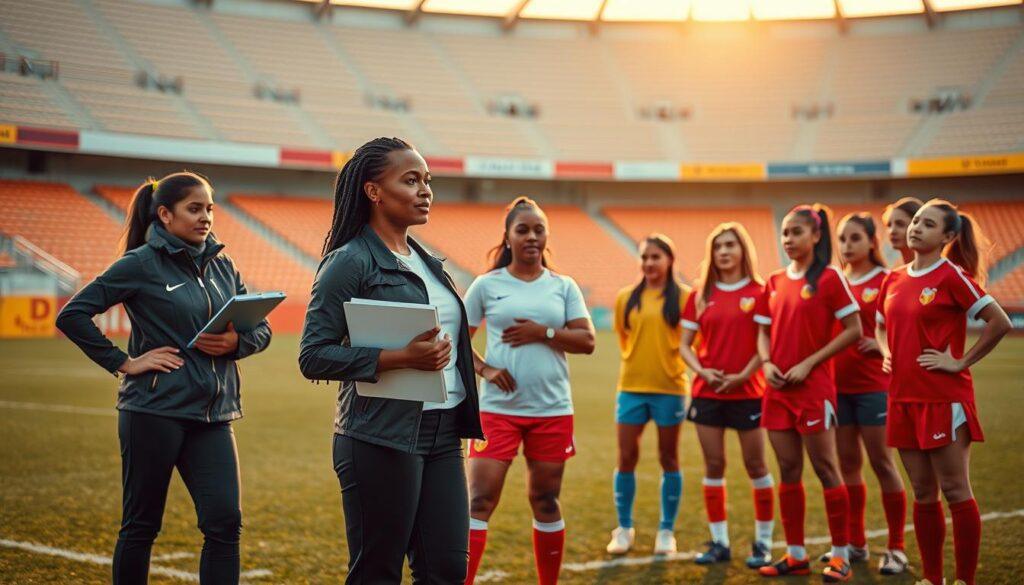
Let’s look at the three main obstacles women face in football leadership:
- The bias boomerang: Male candidates talk about formations and philosophy. Female coaches are asked about childcare and “emotional management”
- The leaky pipeline: Promotions vanish quickly. Women get stuck in assistant roles while less qualified men move up
- Tradition’s toxic trap: “We’ve always done it this way” means “we’ve always excluded women”
I’ve talked to female coaches who were told they “lack presence” for leadership. Yet, male counterparts with the same credentials are praised for their “commanding energy.” It’s the same trait with different words, based on gender.
The financial bias is staggering. We’re playing with half our talent pool on the bench. In any other multi-billion dollar industry, excluding 50% of qualified candidates would be unthinkable.
These barriers aren’t just whispers. They’re concrete walls built by tradition and bias. The football leadership world remains mostly male, not because women lack ability, but because the system filters them out.
Yet, there’s a paradox. Organizations that include women see big benefits. Diverse teams make better decisions, understand markets better, and innovate more. The data shows that inclusion is not just right, but smart.
The way forward is to see these barriers as part of a system that needs fixing. Until we fix the pipeline, we’ll keep missing half the game’s best minds.
Success Stories from Top Leaders
While some debate women’s roles in soccer leadership, these trailblazers are winning trophies and rewriting the playbook. Their achievements are not just inspiring; they’re changing how we view success.
Emma Hayes didn’t just coach Chelsea FC Women; she built a dynasty while pregnant. She mastered player development and raised a child, showing genius and emotional smarts. Her methods blend tactical brilliance with deep understanding of people.
Michelle Kang is like a real-life Football Manager, buying clubs like Pokémon cards. Her approach to owning multiple clubs shows women in management are innovating soccer business.
Baroness Sue Campbell transformed English women’s football with vision and authority. She didn’t wait for a seat; she brought her own chair and changed the table.
What makes these female coaches stand out? They value players as people first, athletes second. Their success isn’t just about winning; it’s about building lasting success on strong foundations.
| Leader | Achievement | Management Style | Impact |
|---|---|---|---|
| Emma Hayes | 6 WSL titles with Chelsea | Emotional intelligence-focused | Redefined player development |
| Michelle Kang | Multi-club ownership model | Innovative business approach | Changing club ownership structures |
| Baroness Sue Campbell | FA Director of Women’s Football | Systemic reformer | Transformed English women’s football |
| Casey Stoney | Built San Diego Wave FC | Culture-first leadership | Expansion team success story |
These leaders show women in management are not just options; they’re top choices. Their success stories teach us about modern leadership. They focus on treating players as complex beings, not just athletes.
The best female coaches make inclusivity a key to success. They show that understanding psychology is essential in sports management. It’s not about being soft; it’s about being sharp.
Mentorship and Peer Support
Mentorship isn’t just about feeling good. It’s about sharing smart strategies for women in football leadership. Women often hit glass ceilings because they lack the playbook men have learned over time.
Being the only woman in the boardroom can feel isolating. That’s why peer networks are like command centers. They’re not just support groups; they’re training for equality.
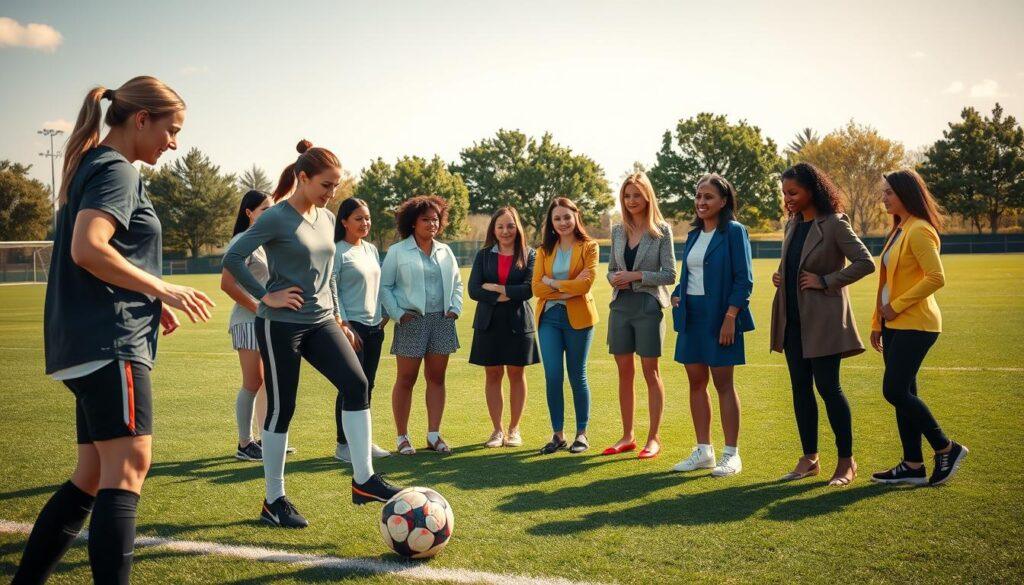
- Veteran guidance from women who’ve navigated minefields you don’t even see coming
- Tactical intelligence sharing on everything from salary negotiations to which committees matter
- 24/7 peer access through informal channels that function like emergency hotlines
WhatsApp groups are where women share vital information during big meetings. They might say: “They’re using budget concerns as cover for sexism – counter with these financials.” Or: “The coffee in Conference Room B is terrible, but the chairs give you psychological advantage.”
Formal programs are also key. They match emerging leaders with veterans who’ve fought in boardroom battles. These mentors teach the hidden rules, like how to speak so men listen, or which fights to pick.
This isn’t about holding hands. It’s about sharing the tools needed for success in football leadership. In the fight for equality, working together is more powerful than individual talent.
The numbers prove it: companies with mentorship programs have 30% more women in leadership. They’re not just changing seats; they’re changing the whole table.
Increasing Representation
When little girls see a woman coaching, it changes everything. They don’t just see a coach; they see a future possibility. This isn’t just a symbol; it’s a real change in how they think.
Seeing female coaches in charge is more than just adding faces. It’s changing young minds. Teams with women in management solve problems in new ways. They’re not stuck in old habits.
| Traditional Model | Inclusive Model | Impact on Performance |
|---|---|---|
| Single perspective coaching | Diverse tactical approaches | +27% creative solutions |
| Limited leadership styles | Varied management techniques | +34% player engagement |
| Repetitive problem-solving | Innovative game strategies | +19% win rate improvement |
More female coaches means more than just filling spots. It changes soccer’s culture. It’s like using the whole brain instead of just half.
We need more women in management for a reason. It’s not just right; it’s necessary. The sport will either evolve or fade away. And who wants to watch the same old plays forever?
By supporting female coaches, we’re creating a future full of diverse ideas. Young athletes see leadership as something they can achieve. The sport is growing up, using all its brainpower.
Advice for Aspiring Leaders
Want to navigate the beautiful game’s leadership labyrinth? Forget GPS – you need insider coordinates from those who’ve already mapped the terrain.
I’ve collected wisdom from top female leaders that’s more valuable than front-row Champions League tickets. Their advice isn’t about playing nice; it’s about playing smart in the world of football leadership.
First: master the technical aspects until you’re bored, then master them some more. The game rewards those who know it inside out – from tactical formations to salary cap intricacies.
Develop your trademark skill. Become the go-to expert for data analysis, player psychology, or contract negotiations. Make yourself indispensable through specialized knowledge.
Understand that administrative equality isn’t given; it’s negotiated with preparation and leverage. Come to the table armed with data, solutions, and clear value propositions.
Build your network like you’re playing 4D chess. Connect vertically with decision-makers and horizontally with peers. Your support system should resemble a well-organized defense – covering all angles.
Learn to distinguish between constructive feedback and plain old sexism. One makes you better; the other just makes you angry. Develop the radar to tell the difference.
Organizational commitment matters more than individual talent. Find clubs that walk their diversity talk – where women’s advancement isn’t just PR but operational reality.
The path isn’t about being perfect; it’s about being persistent. You’ll face more offside calls than a rookie striker, but the goal remains worth pursuing.
Your playbook should include:
- Technical mastery beyond expectations
- Strategic networking across all levels
- Clear value proposition development
- Critical feedback filtering systems
- Long-game persistence tactics
Remember: the best football leadership emerges from preparation meeting opportunity. Your moment will come – be ready to convert it.
True administrative equality gets built one negotiated contract, one hired diverse candidate, one changed policy at a time. You’re not just advancing your career – you’re changing the game’s architecture.
Notable Programs
Soccer’s leadership programs for women are not just about showing up. They’re like special forces training camps. Here, female coaches learn to face challenges that men rarely encounter.
The Women’s Sports Leadership Network is like a magical school for executives. It offers courses on everything from tactics to dealing with sexism in the media. This is because, unlike men, women often face questions about their outfits in press conferences.
These programs are groundbreaking because they give women in management the tools they need to succeed. They create spaces where women can share knowledge, support each other, and build strong alliances.
Let’s look at some of these transformative programs:
- SheChampions – Connects new female coaches with experienced mentors
- GameChangers – Offers bootcamps that teach tactics and media skills
- LeadHERship – Helps women get into management roles in professional leagues
These programs know that changing a biased system is hard. So, they’re building their own systems until the main one changes. It’s not about getting a seat at the table. It’s about creating better tables.
The real magic happens in networking sessions. Imagine a place where female coaches can talk about tactics and politics without being seen as emotional. These spaces foster new strategies that traditional coaching education misses.
For women in management roles, these programs offer something special: validation. They create environments where sexism and double standards are seen as challenges to be solved, not dismissed.
The results of these initiatives are impressive. They show that traditional programs are outdated. Graduates are not just surviving; they’re changing what leadership means in soccer.
Conclusion
We’re not just rearranging deck chairs on this Titanic of tradition. True administrative equality in football leadership means building a better ship altogether. The evidence shouts what intuition already whispered: diverse leadership creates smarter decisions and more innovative solutions.
Canada Soccer gets it. Their Women and Girls Strategy isn’t charity work—it’s strategic genius. When nearly 40% of Canadian girls aren’t playing any sport, that’s not a participation gap. That’s a talent hemorrhage.
The beautiful game is now starting to look like its audience. We’re creating a sport where leadership mirrors the diversity on the field and in the stands. This isn’t about adding women and stirring—it’s about changing the fundamental chemistry of the game.
True football leadership means recognizing that representation drives participation. When girls see women calling shots from boardrooms to sidelines, they see possibilities for themselves. The final whistle hasn’t blown on this transformation. We’re just reaching halftime.
And if the first half is any indication, the second half will be spectacular.