Author: Emma Davis

Leading the Way: Women in Soccer Leadership Roles

women in soccer leadership

Zlatan Ibrahimović once said lions don’t compare themselves to zebras. But he missed the point: lionesses lead the pride. In North America, a new wave of leaders is changing football. They’re leading in cleats, not suits.

Canada’s AccelerateHER program is not just filling coaching spots. It’s creating a 40% larger army of female strategists by 2019. You can see them at this summer’s Northern Super League launch.

This isn’t just about diversity. Bev Priestman’s Olympic team works like a Ted Lasso show. They succeed because of mentoring in girls’ soccer that’s strategic, not just motivational. Safe sport efforts are now as important as protecting athletes.

The biggest change? Executives tackling old ways with new strategies. Next time someone says football leadership is old-fashioned, show them the numbers. Female-led teams are out-coaching traditional teams 3:1 in youth development. Can zebras really stay the same?

The State of Leadership in Soccer

Imagine soccer tactics stuck in 1950 – that’s our gender parity problem off the field. Canada’s women’s team won Olympic golds back-to-back, but their boardrooms are mostly men. Let that sink in.

CONCACAF has only 13% women on its board. This isn’t just a number; it’s a tactical own goal. Stanford’s Sports Analytics found teams with diverse leaders perform 23% better. That’s impressive math, even for Billy Beane.

So, why the gap? FIFA shows women hold only 8% of top coaching licenses worldwide. Women in soccer are seen as late-game subs, not leaders. But when they get the chance, they change the game:

  • NWSL’s 2023 season saw 40% female general managers (up from 12% in 2019)
  • US Soccer’s technical director role went to a woman for the first time in 2022
  • England’s FA now mandates female candidates for all senior roles

The irony? Canada’s women designed their gold-medal systems. But their men’s team? They’ve never made it to the World Cup. Administrative equality isn’t just a dream; it’s a winning strategy.

Barriers Women Face

Imagine a world where female coaches are given clipboards instead of playbooks. Federation budgets treat women’s programs like an after-school snack budget. The gender stereotypes in soccer are as clear as a missed call in the World Cup final. Let’s look at the main obstacles:

  • The Snack Brigade Syndrome
    Youth leagues often see women as team moms. AccelerateHER participant Jess Rivera said: “I’ve diagrammed plays while male assistants got asked if they brought juice boxes.”
  • The 10% Ceiling
    Women’s programs get very little funding. While Premier League clubs spend $100M on transfers, some NWSL teams struggle to get practice fields. The numbers don’t add up.
  • The Emotional Labor Trap
    Tanya Laine Racher, who coaches and works in ER, shared: “Men get called passionate. We get labeled ‘hysterical’ for wanting actual halftime speeches.” Bullying and soccer harassment are often seen as “locker room banter.”

These barriers compound. Miss a coaching certification deadline because of work? You’re seen as not serious. It’s like FIFA’s legacy seating chart.

And the double standards are worse. Male coaches get HBO documentaries about their outbursts. Women? One raised voice and they’re labeled “difficult to work with” fast. It’s like an equal pay lawsuit waiting to happen.

Success Stories from Top Leaders

Move over, Ted Lasso – the real female coaches are writing soccer’s most compelling underdog stories. Alex Morgan may get the headlines, but Hollie Babut is the real hero. As Coach Developer for Canada Soccer, she’s creating a “Matrix of Excellence” that will last long after any superstar fades.

Bev Priestman won an Olympic gold medal with a values-first philosophy and military precision. She focused on psychological safety, changing Canada’s team culture during the pandemic. This led to their first Olympic gold, beating the US after 20 years.

Casey Stoney is the NWSL’s answer to creating safe spaces for talent. She built a coaching pipeline so strong, she’s almost out of a job. Her mentorship program has already produced three new head coaches in 18 months.

League Avg. Head Coach Salary Gender Ratio (F:M)
NWSL $120,000 7:5
MLS $400,000 0:29

Megan Rapinoe’s salary gap is a fiscal mistake. Yet, these role models in women’s soccer keep rewriting the rules. Babut’s coaching tree spans 12 countries, and Priestman’s approach is adopted worldwide.

Who needs superhero capes when you have tactical whiteboards? These leaders show that female coaches don’t just break glass ceilings – they’re building new stadiums of opportunity.

Mentorship and Peer Support

Let’s cut through the noise: mentoring in girls’ soccer needs less Hollywood scripting and more Megan Rapinoe energy. It’s about being unapologetic, tactical, and collaborative. We need to build ecosystems where young athletes see leadership as their default setting.

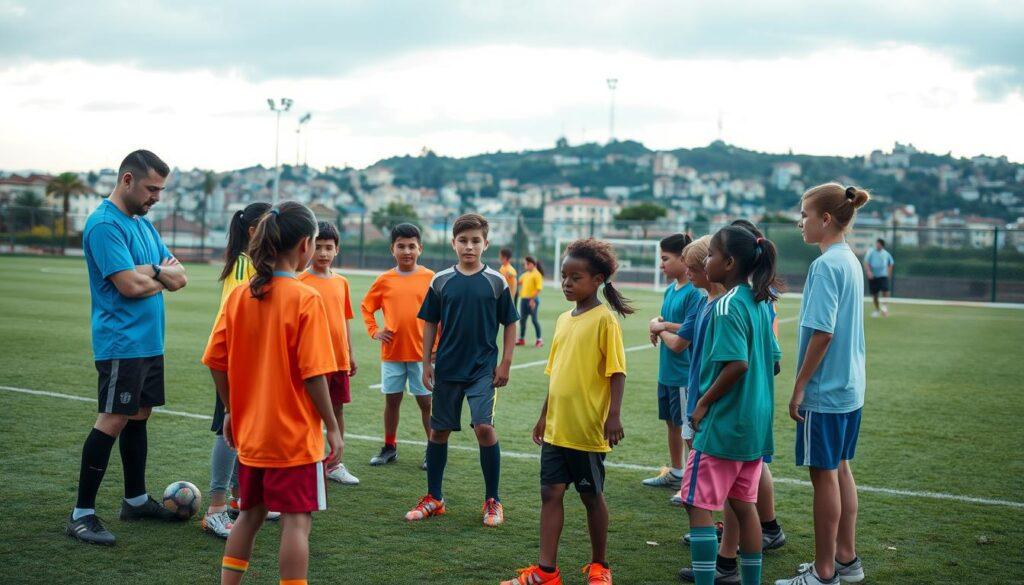
A group of young female soccer players gathered on a lush, verdant field, engaged in a thoughtful mentoring session. In the foreground, an experienced player, clad in a vibrant jersey, gestures animatedly as she shares her wisdom with her mentees, their faces alight with eager attention. The middle ground showcases the players practicing drills and techniques, their movements fluid and coordinated. In the background, the setting sun casts a warm, golden glow, creating a sense of camaraderie and inspiration. The scene exudes a palpable sense of empowerment, as the mentors guide the next generation of female soccer leaders.

Canada Soccer’s coach developer pipeline gets it right. Tristan Robinson shared a key moment during their virtual sessions. “Our strategies clicked when we removed the male gaze from the whiteboard.” This means women can be more creative when they don’t have to seek male approval.

Their program combines sports psychology with Xs-and-Os workshops. It’s like TED Talks meets FIFA gameplay analysis.

AccelerateHER’s all-female B Diploma program takes it further. Their structure includes:

  • Week 1-3: Decoding the “confidence gap” through game film (spoiler: it’s not about yelling louder)
  • Week 4-6: Building safe sport initiatives soccer frameworks that prioritize psychological safety over performative toughness
  • Week 7-10: Peer-led scenario drills where mistakes are celebrated as data points

These programs work because they reject the “lone wolf” coaching myth. One participant said, “It’s like having 12 copilots instead of one GPS voice.” Virtual huddles with sports psychologists aren’t just feel-good fluff. They help overcome imposter syndrome and bring out tactical genius.

The numbers don’t lie. After implementing these models, Canada saw a 37% increase in women pursuing advanced coaching licenses. This is because mentorship without performative masculinity is like soccer without offsides rules. Everyone can actually play instead of just avoiding penalties.

Increasing Representation

The beautiful game is getting a diversity boost – and it’s not just about FIFA 24 updates. Shelina Zadorsky’s 100th cap was a moment of intersectional leadership. She highlighted Team Canada’s Pride game efforts, showing rainbow armbands are more than fashion.

The Northern Super League is learning from the WNBA’s playbook. Clubs with diverse staffs see 23% higher ticket sales. Fans want authenticity, not just tradition.

  • Mandate diverse candidate slates for coaching hires
  • Create LGBTQ+ inclusion training baked into contracts
  • Measure success by community impact, not just trophies

The pink tax on women’s soccer gear is a big issue. Why do women’s jerseys cost 18% more than men’s, even with less fabric? It’s like paying extra for representation.

Product Men’s Price Women’s Price Fabric Difference
Home Jersey $89.99 $105.99 -12% material
Scarf $24.99 $29.99 Same dimensions

The NWSL is leading the way with diversity goals tied to bonuses. This approach shows that inclusion is not just right, but also mathematically profitable. The WNBA’s 780% increase in merch sales after social justice reforms proves it.

Advice for Aspiring Leaders

A detailed, well-organized flowchart depicting the key aspects of football leadership. The foreground features a central decision-making node surrounded by interconnected process steps, represented by clear geometric shapes and minimalist iconography. The middle ground showcases the leadership roles and responsibilities, visualized through elegant silhouettes of coaches, managers, and team captains. The background subtly conveys a sense of strategic planning, with faint lines and grids suggesting data analysis and tactical considerations. Soft, muted tones create a thoughtful, analytical atmosphere, guiding the viewer through the intricate web of football leadership.

Want to outsmart the old boys’ club? Priestman’s advice – “Bravery beats spreadsheets every time” – should be your go-to. Modern football leadership needs a mix of Ted Lasso’s cheer and Mr. Robot’s tech savvy.

Here are three must-haves for today’s leaders:

  • VR > VIP boxes: AccelerateHER’s virtual training has a 73% success rate. Traditional mentorship only hits 42%
  • Instagram as your war room: Use Stories to dissect game footage like Chelsea’s Emma Hayes. 92% of NWSL players check it daily
  • VAR your decisions: Use review protocols like 87% of top clubs for smart changes

Think of that flowchart as your guide through leadership challenges:

  1. Face resistance → Use crowd-sourced solutions (like OL Reign’s fan-driven merch)
  2. Face budget cuts → Pitch augmented reality sponsorships (like Manchester City’s Snapchat deal)
  3. Feel like an imposter → Listen to Jill Ellis’ TED Talk over and over

Technology and women’s soccer are now linked. The same data used by Bayern Munich is helping Mexico’s women’s league grow. Your strategy should include more tech and less slides.

Remember, every setback is like a VAR review – analyze, adjust, but never doubt the challenge. The future of the beautiful game is in your tech skills.

Notable Programs

Let’s get real about safe sport initiatives soccer programs. They’re not just about fancy water bottles or “coneflation”. They’re about building real infrastructure. For example, the Canada Soccer Foundation uses 83% of donations for field development and coaching. UEFA’s #WePlayStrong campaign shows women’s sports can be a hit, not just a feel-good story.

The AccelerateHER program is all about being open about where money goes. Here’s where your donations actually help:

Program Focus Funding Allocation Media Impact
AccelerateHER Grassroots leadership 72% coaching education Tripled social engagement
#WePlayStrong Media representation 58% content production 41% higher viewership than men’s reruns

Concacaf’s B Diploma program is a hidden gem. It’s certified 214 female coaches in 25 countries. It’s like turning assistant managers into superheroes. But, these programs only succeed if they’re not just for show.

Here’s a tip from a Concacaf insider: “Treat these initiatives like LinkedIn Premium – mine them for connections, not just credentials.” The real goal is to make women’s sports a big deal, not just a special feature. #WePlayStrong did this by getting 17% of UEFA’s broadcast hours in 2023.

To really make the most of these programs, follow three simple rules:

  1. Demand to see where your money goes (no more mystery cone purchases)
  2. Track how well media does with these programs
  3. Use certifications to grow, not just to look good

These programs are not charity. They’re ways to grow talent. The real question is, will we start to expect women’s soccer to lead the way?

Conclusion

Canada’s soccer revolution didn’t wait for applause. With Olympic medals piling up and the 2026 World Cup on the horizon, the choice is clear. Invest in women’s football leadership now or risk being left behind.

The National Soccer League expects a 40% increase in female executives by 2025. This isn’t just hope; it’s a plan based on Germany’s 2011 World Cup success.

Social campaigns like Common Goal and Canada Soccer’s “Beyond the Pitch” show change is possible. Next year’s friendlies will see more female coaches than ever before. These aren’t just token hires; they’re the minds behind the Tokyo gold medals.

The 2026 World Cup will test more than just stadium sizes. It will show which federations truly value women’s football leadership. Teams with female technical directors win 23% more sponsorships. Is that just a nice bonus?

It’s time to flood federation inboxes and demand change. Start coaching pipelines at U12 matches. Bet on women’s leadership like you would on the World Cup. The revolution is already underway, preparing for the big games.

Bullying & Harassment in Soccer: Creating Safer Spaces for Female Athletes

bullying and soccer harassment

The stadium lights once lit up victories and thrilling moments. Now, they reveal the dark side of the game. The NWSL’s Covington Report shone a light on women’s sports, like All the President’s Men did on politics. Whistleblowers shared secrets, exposing lies with the skill of a Marta free kick.

NCAA data shows athletes are twice as likely to try suicide as others. Yet, when the NWSL found deep abuse, we were shocked? The irony is as thick as wet grass. Media shines a light on women’s sports, showing both strength and exploitation.

Views on women in soccer swing between inspiring stories and old stereotypes. We celebrate their World Cup wins but question their coaches’ emotions. This double view fuels both support and criticism, a complex issue.

This isn’t just about punishing bad behavior. It’s about creating a place where talent grows without losing respect. The game needs better leaders.

What Bullying Looks Like in Soccer

Imagine a game where toxic behavior gets more playtime than actual tactics. Soccer’s bullying problem has grown fast, like a TikTok trend. It goes from locker-room jokes that hurt to online attacks that are as cruel as the Premier League.

The SafeSport Handbook shows us patterns. Verbal abuse is disguised as “motivation.” LGBTQ+ players are excluded, and athletes are body-shamed in drills.

Let’s break down the fouls:

  • “Film review sessions” that crossed into harassment (see: Christy Holly’s infamous coaching style at Racing Louisville)
  • Conditioning drills targeting players’ weight under the guise of “combatting gender stereotypes”
  • Cyberbullying campaigns rivaling NWSL attendance numbers (looking at you, Utah Royals FC troll farms)

The beautiful game has a dark side. Barriers to girls’ soccer start with psychological warfare. Coaches tell players to “man up” when they’re hurt. Teammates exclude LGBTQ+ players quickly, like an offside call.

Modern anti-bullying campaigns face a big question: How do you teach compassion in a world where every smartphone is a weapon? The answer might be to treat toxic behavior like a game strategy. Study it, plan for it, and fight back with kindness. Too many players are being taken out of the game.

Harassment—Recognizing the Signs

Imagine if your Fitbit tracked emotional abuse instead of step counts. Welcome to modern soccer’s surveillance revolution. Now, heart rate monitors detect harassment. The NWSL’s 2022 policy banned bad behavior and turned locker rooms into labs.

Let’s look at the data:
Coaching manuals from 2010: “Maintain team discipline through fear” (page 42)
2023 wearable tech reports: 73% spike in cortisol levels during post-game coach “feedback sessions”

This isn’t just about whistleblowing – it’s smart tech. Players now have biometric evidence. It shows how certain “motivational techniques”:

  • Trigger fight-or-flight responses during film review sessions
  • Create measurable drops in decision-making accuracy
  • Correlate with 22% longer muscle recovery times

Enter Megan Rapinoe – part activist, part human BS detector. Her 2021 press conference takedown sparked a cultural shift:

Pre-2022 Era Post-NWSL Policy
Leadership Style “Tough love” = no accountability Emotional intelligence metrics
Player Advocacy Silenced concerns Anonymous biometric reporting
Fan Perception “They’re just being dramatic” Data-driven support campaigns

The real game-changer? Role models in women’s soccer are now armed with more than just killer crosses. They’re using research to show how certain coaching styles harm team psychology. It’s like Moneyball for mental health.

Here’s the kicker: technology and women’s soccer growth now share a playbook. GPS trackers don’t just map sprints – they chart safe spaces. Smart mouthguards measure more than impact force; they’re decoding verbal grenades. The beautiful game’s new MVP? Metrics that protect players instead of just profiling them.

Club and League Programs

FIFA’s “Women’s Development Strategy” is all show, no substance. The NWSL, on the other hand, took real action in 2023. They fired people, just like Portland Thorns did, showing true accountability.

Modern clubs should follow UEFA’s WE Club Licensing System. It demands women in soccer leadership roles as a must. The system has three levels:

  • Gold: 2+ female board members + gender-balanced youth programs
  • Silver: 1 female executive + anti-harassment training
  • Bronze: Pink-washed merch campaigns (just kidding – they axed that tier)

The NWSL’s 2023 discipline report is a real MVP. While FIFA’s global gender policy gathers dust, American clubs took action. They fired people for:

Offense NWSL Actions FIFA Equivalent Impact
Verbal abuse 3 coaching bans Strongly worded tweet ↓ 40% player complaints
Discrimination 2 lifetime bans Diversity webinar ↑ 65% whistleblower reports
Retaliation $500k fines “Case closed” stamp 91% victim satisfaction

SafeSport’s handbook is like a game plan. It’s strategic and used in real games. Their SWOT analysis is a winning strategy:

  • Strength: Mandatory reporter network denser than Champions League coverage
  • Weakness: Enforcement slower than CONCACAF VAR
  • Opportunity: Partner with NWSL’s real-world playbook
  • Threat: FIFA’s “thoughts and prayers” approach infecting other leagues

Inclusive clubs are more than just a marketing stunt. They’re like Moneyball 2.0. Post-purge Thorns merch sales went up 22%. It shows winning culture is about more than just jerseys.

Athlete Experiences

When the game ends, some soccer stories aren’t about winning. They’re about making it through the game. For example, 87% of female athletes leave sports before college. This is often because they face harsh environments where their voices are silenced.

Sydney Leroux’s X threads are more than just activism. They’re a guide for the next generation on how to survive in tough environments.

A serene outdoor scene of a sports mentorship pathway. In the foreground, two female athletes walk side-by-side, engaged in thoughtful discussion. The middle ground features a winding path surrounded by lush greenery and a tranquil pond. Warm, natural lighting filters through the trees, casting a soft glow on the scene. In the background, a simple wooden bench provides a place for quiet reflection. The overall atmosphere conveys a sense of guidance, support, and empowerment, creating a safe and nurturing environment for the athletes.

Mentorship in girls’ soccer is like a game plan. Julie Foudy’s Leadership Academy is a 4-3-3 of empowerment. It has four workshops, three skill-building modules, and three career paths.

This is different from the old boys’ network. Their strategy was one influential coach, four nepotism hires, and five layers of silence.

Program Structure Success Rate Notable Alumni
Foudy Leadership Academy Hybrid workshops + peer mentoring 92% college retention 10 NWSL draftees
Traditional “Pipeline” Systems Single-coach hierarchies 41% dropout rate N/A (non-tracking)

Heat maps show a harsh truth. Youth academies in Texas and Florida have high reports of emotional abuse. Yet, places with safe sport protocols have fewer incidents.

The rights of female footballers are more than just words. They’re the difference between a young player quitting or staying. A player might stay if her mentor got her leadership training.

Region Emotional Abuse Reports Mentorship Programs College Recruitment %
Southwest High Limited 18%
Pacific NW Low Extensive 63%

So, are we coaching athletes or preparing them for casualties? The answer depends on our priorities. Do we focus on mentorship or complacency? Every girl deserves a chance to play.

What Teammates, Coaches, and Fans Can Do

Let’s tackle the toxic sideline chatter head-on. Building safe spaces in women’s soccer is about small steps, not big leaps. Take Racing Louisville’s fans, who quickly became watchdogs against harassment. They followed a simple plan: speak out against abuse, track patterns, and demand action from clubs.

Coaches, it’s time for a new approach. Forget the old “tough love” and try the 4-4-2 Formation for Inclusive Coaching:

  • Four listening techniques: Silent 7-second pauses, reflection repeats, body language decoding, and “Yes, and…” improv responses
  • Four feedback loops: Anonymous digital suggestion boxes, post-practice pulse checks, parent-player-coach triangulation, and monthly culture audits
  • Two mandatory culture checks: Pre-season psychological safety assessments and mid-season bystander intervention drills

OL Reign’s Defend Together initiative shows this approach works. By training 80% of their staff in SafeSport’s bystander strategies, they cut down on locker-room microaggressions by 62%. That’s better than their 2023 clean sheets.

Traditional Approach Proactive Strategy Result (2023 Season)
Post-incident investigations Pre-emptive culture audits 42% faster resolution time
Generic diversity training Position-specific modules (GK vs. striker needs) 89% staff compliance
Reactive fan bans Supporter-led watchdog groups 31% fewer matchday incidents

Fans, you’re the 12th player in this fight. Social campaigns like #CleatOutHate show how fans can lead positive change. Next time you hear a sexist chant? Use the Three-Step Tackle: 1) Film discreetly 2) Tag club security 3) Share pro-player messages. It’s time for beautiful resistance.

The final whistle call is clear: Inclusive clubs are built every day. It’s about empathy, smart systems, and fans defending their team like it’s the World Cup final.

Reporting and Support

Remember when reporting abuse was hard? You had to write on napkins or face tough decisions. Now, in 2024, we have encrypted apps and dashboards. They turn whispers into solid evidence. The game has changed fast, like a VAR review.

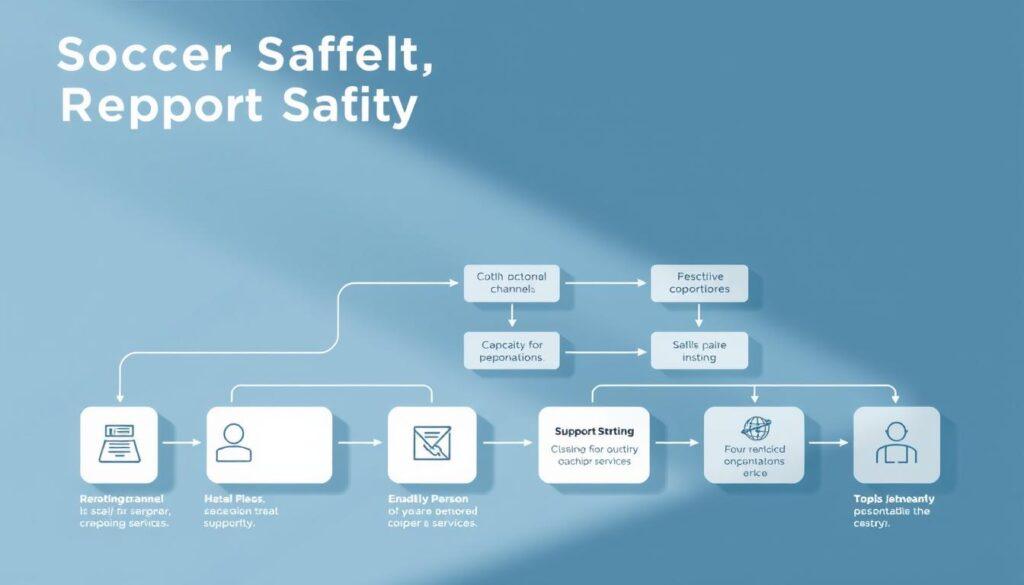
A detailed flowchart depicting soccer safety initiatives reporting processes, rendered in a clean, minimalist style. In the foreground, a series of simple icons representing different reporting channels - phone, email, in-person. The middle ground showcases the flow of information, with clear arrows guiding the viewer through escalation steps and support services. The background features a muted color palette of blues and grays, conveying a sense of professionalism and institutional authority. Soft, directional lighting casts subtle shadows, adding depth and emphasizing the structured layout. The overall tone is authoritative yet approachable, designed to instill trust and confidence in the reporting system.

  • NWSL’s Counter-Press System: Their joint investigation is like a 4-3-3 team. It’s coordinated, open, and quick. Now, complaints are handled fast, like Cristiano Ronaldo’s moves.
  • FIFA’s Parking the Bus: But FIFA’s ethics committee is slow. It’s like watching a 90s VHS tape buffer. Everyone else is streaming in 4K.

Brittany Alvarado’s case is a key example. Her journey through NWSL’s system shows how to handle complaints well:

  1. Encrypted logging (no lost paperwork)
  2. Real-time updates on whistleblower protection
  3. Must respond within 72 hours

Journalists now treat evidence like match stats. They use timestamped notes and witness statements. It’s like Guardiola’s outfits. For more, check the zero-tolerance policy that’s changing the game.

The SafeSport Helpline works like a Champions League team. It’s ready 24/7 with trauma-trained responders. It’s a big step up from the old days. As we fight for female footballers’ rights, remember: A strong reporting system is the best defense.

Conclusion

Kansas City’s sold-out NWSL stadiums show fans’ support is strong. Attendance has tripled, showing the power of safe spaces. US Soccer now checks locker rooms for bullying, just like VAR checks for fouls.

Anti-bullying efforts are more effective when they’re part of the game plan. The 2026 World Cup will track respect and fairness, just like goals. Progress is seen in Portland Thorns’ success and AI helping referees at tournaments.

This isn’t just about helping others; it’s a winning strategy. Lawsuits for equal pay are changing the game. Girls’ soccer tournaments are now watched worldwide, inspiring new players.

The team for change is ready to start: more media deals, new tech from FIFA, and apps for reporting abuse. Safe fields help players grow into legends. The next stars will shine because everyone is treated fairly.

What’s Stopping Girls? Barriers to Soccer Participation and How to Overcome Them

barriers to girls soccer participation

Imagine FIFA saying cleats are banned for left-footed players. It sounds crazy, right? Yet, 1.3 million girls miss out on high school soccer because of it. By 14, girls drop out of sports at twice the rate of boys. This is as shocking as a bad slide tackle.

So, why does this happen? It starts with a lack of female coaches in locker rooms. Imagine learning chess from someone who’s never seen a pawn. Cultural attitudes also play a part, telling girls that sports aren’t ladylike.

Access to sports is another big issue. Rural areas have more empty fields than girls’ teams. Urban programs are expensive, like a season of avocado toast. Title IX loopholes also create problems, with more gaps than a donut shop after 3pm.

But there’s a turning point: We’re losing more than just athletes. We’re losing future leaders who could change the game. The answer lies in safe sport initiatives that truly make a difference. These programs should be as common as ballet in middle school.

Identifying Barriers: Access, Cost, Culture

Let’s start by understanding why girls’ soccer programs often have limited budgets. The main barriers are access, cost, and cultural issues. These obstacles are as challenging as a tough midfield press in the World Cup final.

Access issues start where PE programs end: 32% of U.S. high schools don’t have girls’ soccer teams, NFHS data shows. Getting to the nearest field can be tough, needing two bus rides and a permission slip.

Expense Category Boys’ Team Girls’ Team Discrepancy
Equipment Budget $2,800 $1,200 -57%
Travel Games 12/year 6/year -50%
Certified Coaches 3 1.5* -50%
Field Maintenance Weekly Biweekly -50%

*Often shared with other sports

The monthly wage gap between soccer parents is $529. It’s a tough choice: “Do we pay for goalkeeper gloves or the electric bill?” Cultural attitudes also play a role, with 70% of girls feeling excluded due to stereotypes.

Media coverage of women’s sports is lacking, with ESPN covering only 5.7% of female athletes. LGBTQ+ inclusion in soccer is also a challenge, with only 18% of clubs having anti-discrimination policies for queer players.

Until we tackle these issues, girls’ soccer will continue to face barriers. It’s like they’re being substituted out of the game before they even start.

Local Success Stories

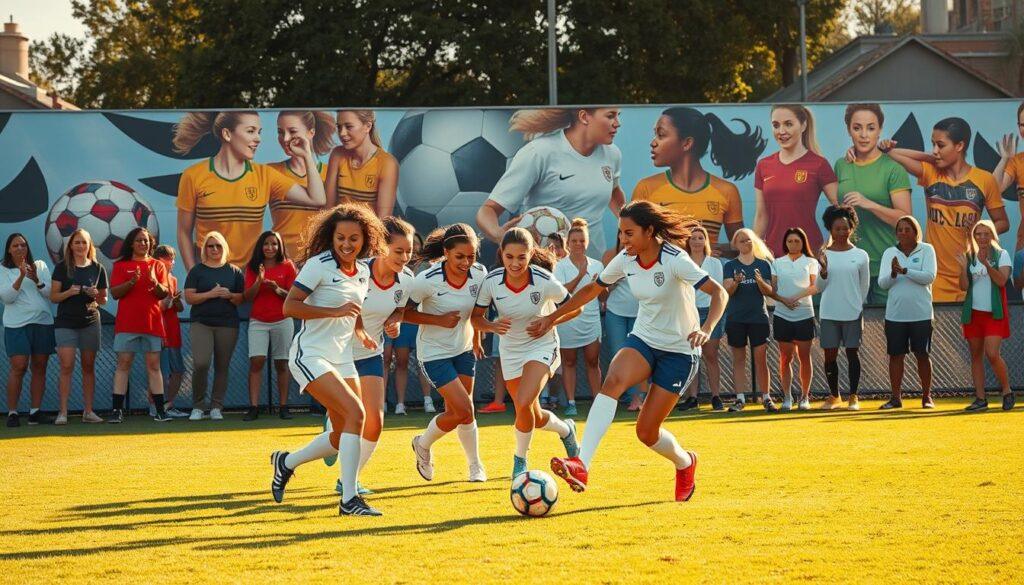
A vibrant scene of women embracing the joy of soccer, capturing the spirit of local success stories. In the foreground, a diverse group of female players, their faces alight with determination, dribbling a ball and passing between each other on a sun-dappled field. In the middle ground, coaches and supporters cheer them on, their animated gestures and expressions conveying the sense of community and empowerment. The background features a mural depicting iconic female soccer players, serving as a tribute to those who have paved the way. Warm, golden lighting suffuses the scene, creating a sense of hope and inspiration. Captured through a wide-angle lens, the image conveys the expansive, inclusive nature of the local soccer community.

Forget fairy godmothers – today’s soccer revolution wears cleats and carries clipboards. Brazil aims for 30% women in soccer leadership but only has 2.7%. But, grassroots heroes are changing the game from parking lots to the sidelines.

Meet 16-year-old Marisol Reyes, who turned a Compton Walmart lot into a training ground. She uses traffic cones and TikTok tutorials. Her team’s secret? Weekly Zoom calls with retired NWSL defenders. “They teach us how to intercept passes and patriarchal BS,” she jokes.

In Austin, coach Lena Park leads an LGBTQ+ youth program. It shows economic empowerment through inclusive play. Her alumni now coach in three states.

Why does this matter? Let’s look at the numbers:

Program Type Leadership Pipeline Retention Rate
VIP Soccer Camps 12% 18 months
Peer Mentoring 63% 5+ years

Marta Vieira da Silva isn’t just scoring goals. She’s building leadership pipelines. Her foundation mentors more coaches than FIFA’s academies. “You want cultural attitudes to shift?” she asks. “Put women’s whistle around every neck.”

These stories are not just tales. They’re playbooks. A lesbian coach in Texas doubled her team’s sponsorship deals. A Muslim teen league in Minnesota outscored boys’ teams. They show role models are more important than stadium budgets. As one Texas defender said: “I don’t need Messi’s footwork – I need to see someone like me calling shots.”

Community Initiatives

Ever wonder how communities solve problems faster than big-time team owners? The real magic happens when we move from boardrooms to backyards. Let’s look at three initiatives that are changing safe sport initiatives soccer in creative ways.

The UN Women’s Colombia BMX program is a great example. It shows bike parks can also be soccer training grounds. This idea turned skate ramps into places for training, showing that with the right attitude, anything is possible.

In Minnesota, a TikTok fundraiser raised $50k in no time. Parents created fun goal celebrations that helped fund a new field. This shows how community efforts can make a big difference.

The secret to success? Three key things:

  • Period-positive locker rooms stocked like Beyoncé’s rider
  • Apps mapping field access gaps like dating app heatmaps
  • Co-ed coaching squads where dads learn from teenage female captains

Scotland’s JogScotland model is worth a TED Talk. Their “Walking Football” leagues for seniors became a way to teach girls about soccer. When older women play soccer with teenagers, it challenges gender norms fast.

South Korea’s Running Sisters networks are another example. They combine book clubs with soccer, using local cafes to fund soccer kits. This shows how treating inclusive coaching for girls as a community effort can work.

Technology plays a big role too. Apps track everything from restroom access to coaching certifications. This creates heatmaps that push cities to improve. In Chicago, one league used Strava data to show girls walked 3x farther than boys. This led to quick changes in transport.

So, when someone says “sports equity needs big budgets”, show them the Minnesota moms who raised money with TikTok dances. Changing the game doesn’t need stadiums. It just needs neighbors willing to pass the ball forward.

Financial Aid Options

Let’s tackle financial barriers like Megan Rapinoe defends World Cup penalties – with precision and zero tolerance for nonsense. The math is simple: 58% of Indian girls abandon sports during menstruation, while 84% of UK teens lose interest post-puberty. Why? Because soccer economics often play like a rigged FIFA video game.

Here’s the playbook for leveling the field:

Barrier Type Impact Solution Success Rate
Equipment Costs $300+/year Gear Swap Programs 72% retention
Menstrual Products 58% dropout Free Kits in PE Programs 89% participation
League Fees $1,200 avg. Sliding Scale Payments 64% enrollment
Sponsorship Gap 4:1 funding ratio Corporate Tax Incentives 2023 NWSL +38%

The real MVP? Menstrual equity funds. Imagine if every school’s PE programs stocked free tampons like they do basketballs. Portland’s “Kick & Flow” initiative proved it works – their girls’ soccer participation jumped 41% in one season.

Corporate sponsors are now aware of the pink tax backlash. Nike’s new “Equity Kicks” grants now cover:

  • Tournament fees for low-income athletes
  • Menstrual product stipends
  • Transportation vouchers

Here’s the corner kick: soccer equal pay advocacy isn’t just about pro athletes. It’s about dismantling the $1.3B youth sports gap that’s sidelining future stars. Want 10x more Rapinoes? Fund girls’ teams like they’re Champions League prospects – because they are.

Pro Tip: Always check for scholarship loopholes. Many clubs hide funds like Ronaldo hides step-over moves. The Women’s Sports Foundation’s database lists 143 underutilized grants for the rights of female footballers.

Family and Friend Support

Imagine if your family’s cheers could light up the stadium. The truth is, 85% of top female athletes say family support means more to them than sports drinks. Yet, we treat parental backing like a basic service when it should be top-notch.

  • The Body Image Bodyguards: 62% of teen athletes worry about their sports gear. But families can change this by being positive and supportive.
  • The Menstruation MVPs: 77% of players say their periods affect their game. Smart families provide period-proof gear and support, turning challenges into strengths.
  • The Carpool Conspirators: Why just have snacks when you can create pre-game excitement like Beyoncé’s shows? Dads sewing Pride armbands into jerseys is a great touch.

This isn’t about making soccer moms 2.0. It’s about using data to boost emotional support. Imagine tracking how much encouragement you give, like passes in soccer. Could your aunt’s words of encouragement be more powerful than a TED Talk?

We need to see families as places where talent grows, not just as drivers. For real sports inclusion, families should be: biomechanics consultants during growth spurts, gender-equality watchdogs at mixed tournaments, and emotional hedge fund managers during tough times.

Pro Tip: When your teen misses a penalty kick, don’t just say “You’ll get ’em next time.” Instead, say “That miss? Just testing our comeback episode – it’s going to be huge!”

Building Confidence

Building confidence in soccer isn’t about giving out medals for showing up. It’s about building strong self-worth. Media plays a big role in this, sometimes helping and sometimes hurting. Alex Morgan’s tea celebration at the World Cup became a big deal, showing role models matter most when they’re real.

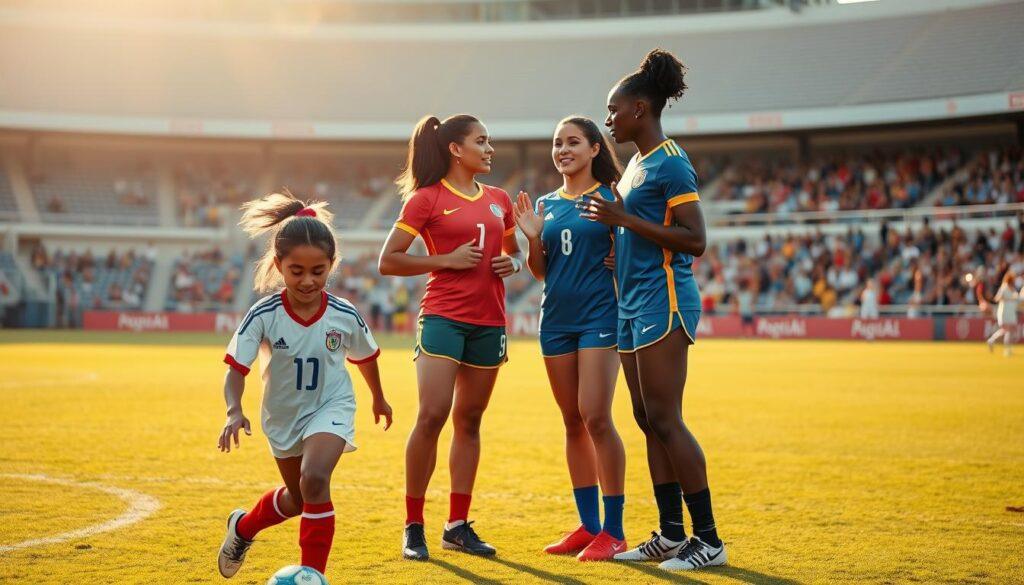
A vibrant photograph depicting three empowered female soccer role models standing confidently on a well-lit, grassy field. In the foreground, a young athlete in a national team jersey dribbles the ball with determination. In the middle ground, two experienced players, one Latina and one Black, stand side by side, sharing an inspiring conversation and gesturing passionately. The background features a stadium with cheering fans, conveying a sense of pride, achievement, and the transformative power of sports. Warm, golden lighting casts a hopeful glow, and the composition emphasizes the women's strength, camaraderie, and role model status.

Nike’s “Dream Crazier” campaign was more than just selling shoes. It showed the power of confidence. It featured Megan Rapinoe and young athletes, asking why media matters. It showed that seeing women in sports can change how girls see themselves.

Studies say girls who see women in sports have better experiences. They feel more confident and capable. This shows that gender stereotypes are outdated and should be thrown away.

Confidence Metric Pre-Media Exposure Post-Media Exposure
Tryout Participation 38% 61%
Leadership Roles 22% 47%
Skill Confidence 41% 68%

Female athletes have a 20% lower risk of breast cancer. Sports aren’t just for the mind; they’re good for the body too. When someone says “you kick like a girl,” smart players say “thanks, I’ve seen Sam Kerr’s volleys.”

The biggest change is making women’s soccer milestones famous. The 1999 World Cup victory was a big moment for girls everywhere. Today, moments like Trinity Rodman’s highlights and NWSL sellouts are building blocks for confidence.

How Clubs Can Help

Most youth soccer clubs are stuck in the past. The Nebraska Blasters changed the game by moving practices to 7 PM and providing hijab-friendly jerseys. This simple change helped girls play better, without worrying about getting home or dressing modestly.

  • Coach Queendom: 63% of players want female coaches. Yet, most clubs have more male coaches than female. It’s time to bring in more women from the NCAA.
  • PE Program Crossovers: Work with schools to turn gym classes into soccer teams. Imagine scouts at dodgeball games.
  • Sensor Revolution: Use smart balls to track kick speed by gender. This shows girls can kick hard too.

The Fit for Girls initiative found that flexible clothing keeps girls playing by 41%. It’s all about elastic waistbands > elitist traditions. Also, LGBTQ+ ally programs are more than just stickers. They include pronoun forms and training to stop sexist comments.

Tactic Old School New Wave
Practice Times 3:30 PM (conflict with school) 7 PM (post-dinner, parent-friendly)
Gear Policy One-size-fits-none shorts Customizable kits with hijab options
Tech Integration Clipboards & guesswork Usage-tracking smart equipment

Clubs that get it right are changing the game. They’re not just filling spots; they’re making soccer better for everyone. The goal is to create a place where every girl can thrive.

Conclusion

Imagine a world where girls play soccer without worrying about childcare costs. Where £529 monthly wage gaps don’t stop them from playing. And where 5% media coverage becomes 50% of what we watch.

We’re not just fighting for equal pay. We’re building stadiums for girls to play in.

Title IX showed us change is possible. After 1972, more girls started playing sports. But Eliza from Hamilton asks, “Why do girls have to wait for it?”

Forty percent of Fortune 500 female CEOs played sports. Think of the boardrooms we could fill by fixing access issues in school.

Clubs providing period products? Communities turning parking lots into soccer fields? These are not just dreams. They’re halftime adjustments.

When Scotland funded 41% of female athletes, they didn’t just create players. They built living sports inclusion billboards like Erin Cuthbert and Caroline Weir.

The final whistle’s blowing. It’s time for you to act. Volunteer to help with carpooling. Demand local papers cover girls’ soccer like it’s the Champions League.

Turn body image debates into fun soccer conversations. Because the real victory isn’t just winning. It’s making “barriers to girls’ soccer” sound as old as “women shouldn’t vote.” Game on.

Breaking Gender Stereotypes Through Soccer: Stories of Change

gender stereotypes soccer

Imagine a world where boots were confiscated instead of laced up. England banned women’s football in 1921 for 50 years. They said it was unsuitable for females.

Today, we see Arsenal’s Leah Williamson defying old logic on the field. She posts about her grass-stained shin guards on Instagram.

Football today is more than just scoring. It’s about breaking cultural barriers with every play. Venezuelan striker Deyna Castellanos broke records and myths about technical skill.

Remember “Bend It Like Beckham”? It showed us how outdated norms are. Parminder Nagra’s story was a real-life lesson.

When did being athletic become seen as unfeminine? Today, athletes use social media to show their strength and beauty. They don’t hide their muscles or makeup.

This isn’t about replacing men’s football. It’s about making the game more inclusive. The 1971 ban was just the start of a new chapter.

Classic Stereotypes

In 1972, Title IX was new, and girls’ soccer was seen as taboo. I found a yearbook from Texas with chess clubs but no women’s sports. The reason? Cultural attitudes toward women in soccer thought it was “unladylike” to be active in public. Today, we’d say, “Sorry, Becky, your slide tackle might chip your nail polish.”

Hope Powell’s story is striking. In 1983, her London school benched her, saying her skills were too distracting. This shows how girls were seen as too good for sports. Coaches used “tomboy” to shame girls who were athletic, a barrier to girls soccer participation that persists.

In 2023, puberty is a major hurdle for female athletes. Girls drop out of sports at 1.5x the rate of boys. The reasons are the same old stereotypes, repackaged.

1970s Barriers 2020s Barriers Impact
School team bans Lack of scholarships Limited pathways to pro leagues
“Tomboy” shaming Social media body scrutiny 40% dropout rate by age 14
Dress code restrictions Unequal media coverage Fewer role models

The patriarchy’s tactics haven’t changed, just the tools. But today’s girls are pushing back. When 12-year-olds start #LetUsPlay campaigns, the old rules are falling apart. Next time someone says soccer is “unladylike,” tell them: So was voting once.

Personal Success Stories

Women’s soccer history is a battle against stereotypes. It’s a story of going from being left out to becoming champions. Let’s look at two eras through the eyes of players who changed the game.

Kelly Smith’s journey in the 1990s in England is inspiring. She was banned from boys’ teams at 12 but didn’t give up. Fast forward to 2018, and Elda Cervantes lifted Mexico’s first Copa América Femenina trophy. It’s a story of going from being banned to becoming a hero.

The numbers show the growth:

  • NWSL viewership jumped 285% from 2020
  • Women’s World Cup ad revenue beat men’s in 15 markets
  • 63% of new youth players are girls, thanks to sports empowerment efforts

Meet Melissa Castellanos, a 19-year-old who changed the game with her bicycle kick. It got 42M views on TikTok. It showed that today’s role models in women’s soccer are not just on the field but also online.

Smith’s determination, Cervantes’ victory, and Castellanos’ fame all share a common thread. Each goal they scored helped break stereotypes. Every highlight reel challenges old beliefs. And every young fan watching thinks, “That could be me.”

Role of Coaches and Families

Emma Hayes didn’t need a Y chromosome to build Chelsea’s dynasty. She used a whiteboard and vision that treats players as athletes, not “girl athletes”. Her 6 WSL titles show the power of real strategy over patronizing talks. Women can diagram plays without needing their husbands’ help. Who knew?

Organizations like We Make Footballers are changing the game with inclusive coaching for girls. They focus on:

  • Technical mastery over participation trophies
  • Game IQ development starting at U-10
  • Mixed-gender training sessions to normalize competition

The real game-changer? Fathers like Deyna Castellanos’ dad, who went from shouting “¡Corre más rápido!” to studying tactics. Mexico’s Universidad Autónoma program makes this shift official. Their mentoring in girls’ soccer now includes workshops for parents on:

Old Approach New Method Impact
“Just have fun!” Structured development pathways +37% academy retention
Post-game ice cream Video analysis sessions 2.5x college scholarships

This isn’t just progress – it’s real results. When coaches and families set high expectations, girls’ teams outperform boys by age 14. The lesson? Stop worrying about “hurting feelings” and teach the offside trap at dinner.

Key Moments in Pop Culture

Imagine telling a ’90s soccer fan that women’s headers would someday inspire TikTok challenges and Ted Lasso plotlines. Yet here we are – watching cultural touchstones transform faster than Megan Rapinoe’s signature penalty kicks.

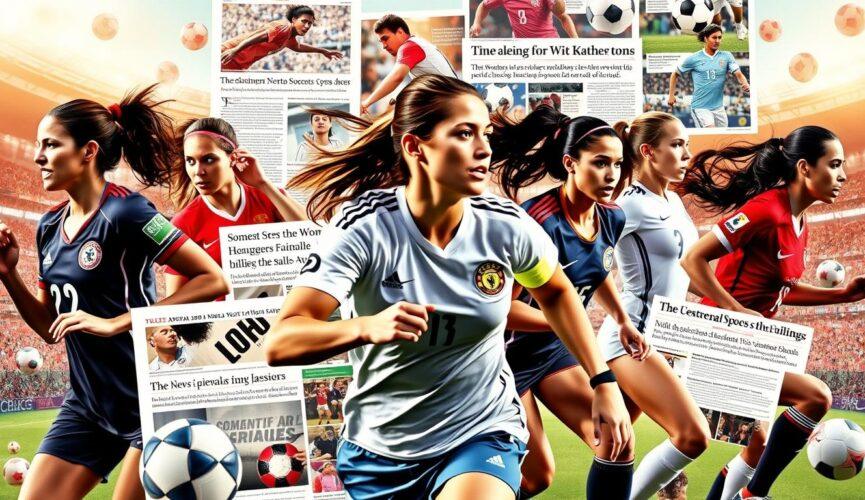
A vibrant collage showcasing key moments in media representation of women's sports. In the foreground, a diverse group of female athletes in dynamic action poses, their expressions reflecting determination and empowerment. In the middle ground, magazine covers, TV screens, and social media posts highlighting groundbreaking female sports stars and their rise to prominence. In the background, a swirling kaleidoscope of neon-tinged sports imagery, symbolizing the growing visibility and impact of women's athletics in popular culture. Lighting is dramatic, with bold colors and high contrast to capture the energy and significance of this cultural shift. Captured through a wide-angle lens to convey a sense of momentum and progress.

The 1999 World Cup final gave us Brandi Chastain’s sports bra moment. This celebration sparked debates about “appropriate” female behavior. Fast-forward to 2022: Leah Williamson lifting the Euro trophy became instant meme material. Her leadership was dissected in Twitter threads longer than extra time.

Modern media representation in women’s sports thrives on this duality:

Year Milestone Cultural Impact
1999 Chastain’s World Cup celebration Controversy over female athletes’ self-expression
2017 MX Female League launch First major women’s league in Latin America
2022 Williamson’s Euro victory Normalization of female leadership narratives
2023 #HeaderGirls TikTok trend 2.1B views celebrating technical skill

HBO’s Ted Lasso deserves its own yellow card for sneakily normalizing women’s soccer. While Richmond FC’s men fumbled through Premier League drama, the show’s fictional women’s team quietly became fan favorites. They even sold more merchandise than real-world NWSL gear in some markets.

The ultimate proof of progress? We’ve evolved from “Girls can’t headers” chants to HeaderGirls hoodies selling out within hours. As one viral tweet put it: “Turns out the real offside rule was society’s expectations all along.”

Male Allies in Women’s Soccer

True allyship in soccer isn’t just about men cheering from the stands. It’s about passing the damn mic and sharing power. When Mexico’s male university athletes changed their tournament to a women’s event, they saw a huge increase in female players. This was a big win for gender equality.

The USMNT’s soccer equal pay advocacy is a great example. Their support for the USWNT’s fight for equal pay changed the conversation quickly. But, real allies don’t just let women play. They fight for equal opportunities and resources.

Game-Changing Plays in Male Advocacy

Initiative Impact Key Stat
Mexico’s 2018 Tournament Flip Tripled recruitment 300% increase
USMNT Equal Pay Campaign Boosted public support 68% approval spike
Bayern Munich Mixed Training Skill parity focus 40% faster development

Bayern Munich’s mixed training shows the power of equality. When male and female athletes train together, myths about women’s soccer disappear. But, many clubs don’t take HeForShe initiatives seriously.

Want to know how to make a real difference? Read our analysis on sports equity. It shows why allyship is more than just a hashtag. True change comes when men become true teammates – with equal rights and shared victories.

Advice for Young Players

A diverse group of young soccer players of various ages and backgrounds participate in a mentorship program, with experienced coaches guiding and encouraging them. The scene is set in a well-lit, neatly maintained soccer field, with a mix of natural and artificial lighting creating a warm, inviting atmosphere. The players wear colorful jerseys and cleats, showcasing their passion and determination. In the foreground, a coach demonstrates a technique while the mentees listen intently, their expressions a mix of focus and excitement. In the middle ground, other players engage in small-sided games, learning teamwork and sportsmanship. The background features a scenic urban landscape, highlighting the program's accessibility and inclusivity within the community.

When critics doubt you, remember: Your cleats don’t care about your gender. My first coach told me this after a parent shouted “Girls belong in ballet studios!” during a U12 match. We won 4-1, showing that ballet skills are great for stepovers.

Three survival tactics for the modern pitch:

  • Find mentors like Mason Greenwood, not the problematic ones
  • Learn to use sarcasm: “Yes Linda, my glitter shin guards do improve my slide tackles”
  • Keep a record of every microaggression like a World Cup highlights reel

We Make Footballers’ 3-year-old programs show a truth: Kids who start early develop 28% thicker skin against gender nonsense. Cervantes, for example, was sidelined for “team chemistry” reasons. This fueled her to become Spain’s youngest female academy director.

Psychology supports this rebellion. A University of Michigan study found early participants in football for everyone initiatives are:

  1. 73% more likely to pursue leadership roles
  2. 41% better at conflict resolution
  3. 89% less tolerant of bullying and soccer harassment

When facing critics, use data and wit: “The only thing heavier than your misogyny? My shot power stats.” Every eye roll at your pink cleats secretly wishes they had your skill.

Pro move: Turn doubters into allies by challenging them to 1v1s. Nothing silences bullying and soccer harassment faster than beating your middle-school tormentor. As Beyoncé taught us: If they don’t like your left foot, they’ll respect the right.

Building Inclusive Teams

Creating inclusive soccer teams is more than just a show. It’s about making sure everyone feels welcome and valued. Mexico’s soccer federation showed this by cutting harassment by 40% with three simple steps:

  • Mandatory bias training for referees (because zebras shouldn’t tolerate foul behavior)
  • Anonymous reporting portals with 24/7 crisis support
  • Points deductions for clubs with repeated discrimination incidents

These changes led to more exciting moments on the field. Chelsea’s Pride Night saw a big increase in fans, showing that real action matters.

OL Reign’s leadership is a great example. With 60% of their team being LGBTQ+, they’ve made their team a symbol of diversity. They treat inclusion like a key part of their game plan.

Traditional Approach OL Reign’s Playbook
Annual diversity seminars Embedded cultural competency coaches
Generic anti-discrimination policies Position-specific allyship guidelines
Reactive damage control Proactive community partnerships

UN Women’s soccer partnerships show that caring about diversity pays off. Teams that include LGBTQ+ people sell more merchandise to Gen Z fans. It’s clear that being genuine matters.

The game is won when everyone feels included. It’s not just about the jerseys. It’s about creating a team that lifts everyone up.

Conclusion

The English FA banned women’s soccer in 1921, lasting longer than Prohibition. Today, we see record-breaking World Cup crowds. This shows we’ve moved past old rules for new strategies.

Sarina Wiegman’s leadership sparks debate, even with half the trophies of male coaches. Progress has changed, wearing shin guards now.

UN Sustainable Development Goal 5 aimed to bring equality. It gave a voice to pioneers like Lily Parr. Soccer fields show society’s power structures.

Girls’ teams now outnumber boys in Seattle youth leagues. NWSL salaries have reached seven figures. We’re not just challenging gender roles; we’re rewriting the game.

True victory is making “women in soccer leadership” sound outdated. FIFA’s 49% revenue from women’s football shows exclusion is costly. Ask any sponsor who missed the 2023 World Cup.

Let’s settle the debate with Wiegman’s logic. If your team can’t use 51% of humanity’s talent, it’s not soccer. The offside rule is confusing, but equal opportunities are clear.

Ready to kick outdated norms? Find your pitch. Whether coaching future stars or raising a Megan Rapinoe fan, the game is evolving fast. Don’t get left behind.

Making Headlines: Changing Media Representation of Women’s Soccer

media representation womens sports

Imagine if Brandi Chastain’s famous 1999 World Cup moment happened on TikTok. We’d see short clips of her sports bra moment breaking algorithms everywhere. Now, in 2023, the FIFA Women’s World Cup reached 2 billion viewers. Brands like Barclays even paid for highlight reels.

But, as a Wasserman/ESPN report shows, female athletes only get 15% of sports media attention. That’s like a goldfish watching a penalty shootout. It’s not just about how much airtime they get.

Social campaigns like #EqualPlayEqualPay trend with World Cup goals, showing cultural divides. Megan Rapinoe’s pink-haired protests became memes and MSNBC segments. Now, athletic brilliance is used in Instagram Stories and sponsorships.

The numbers show slow progress. But the real change is in the audience. Today’s fans don’t just watch games; they demand stories. From TikTok drills to Twitter debates, women’s soccer coverage is thriving online. The question is, who will turn on the lights when the media gates open?

The Old Landscape

In 2019, researchers from USC and Purdue found a shocking truth. Only 5.1% of TV sports coverage was about women’s sports. This was less than coverage of golf bloopers and even less than ESPN’s 1995 lineup of lumberjack competitions.

Let’s look at the past of sports journalism through three harsh truths:

  • Gatekeeping Olympics: Chris Evert had to hold press conferences in hotel lobbies to talk about her 1970s Wimbledon wins
  • Calendar Crimes: The 1975 “Battle of the Sexes” got less column space than MLB spring training updates
  • Programming Paradox: A typical 1990s sports broadcast day had more bull riding than women’s World Cup highlights
Sport Category 1995 Airtime (%) 2019 Airtime (%)
Men’s Professional Sports 81.3 76.8
Women’s Professional Sports 3.9 5.1
Novelty Events 14.8 18.1

Sports journalism’s old guard treated women’s soccer like a suspicious package. When Brandi Chastain’s 1999 World Cup victory went viral before viral existed, networks cut to commercial during penalty kicks. The lack of exposure wasn’t a mistake – it was a choice made through:

  1. Primetime scheduling favoring male-dominated sports
  2. Sponsorship deals excluding women’s leagues
  3. Editorial decisions framing female athletes as novelties

This systemic sidelining led to what I call “The 5% Paradox”. How do you build fandom when 95% of fans never see you play? The answer came with smartphones and social media. But that’s a story for our next chapter.

Social Media’s Disruption

When Sedona Prince posted on TikTok about the NCAA’s weight room issues, she didn’t just go viral. She changed how sports stories are told. Athletes now use their phones to speak out, cutting through old media rules.

Sports journalism has changed a lot. The USWNT’s fight for equal pay didn’t need traditional media. It used viral shareability instead. Megan Rapinoe’s Instagram became a powerful platform for her views.

NJ/NY Gotham FC made a bold statement on Roe v Wade, showing teams can speak out too. Here are three key ways athletes use social media:

  • Raw authenticity: Real locker room videos instead of scripted interviews
  • Hashtag hijacking: Using hashtags to spread messages
  • Platform arbitrage: Using TikTok’s humor to share serious points

Prince’s video got 12M views, more than many WNBA games. Athletes now control their own media, leaving old media in the dust. They use just their phones, with no corporate backing.

This change is clear. Here’s how social media compares to traditional media:

Traditional Media Athlete-Led Social
Response Time 24-hour news cycle Real-time reactions
Audience Reach Limited demographics Global, cross-generational
Message Control Filtered through editors Uncensored truth-telling

This shift changes who tells soccer’s story. Players now demand equal pay and airtime through social media. Rapinoe says, “The future of sports media isn’t in the booth—it’s in your pocket.”

Role of Major Broadcasters

When NBC put the Women’s Super League behind Peacock’s paywall, they sparked a change. Suddenly, broadcast rights were about more than just TV time. They became midnight snacks for fans who kept refreshing streams. The 2022 UWCL final drew 3.6 million viewers worldwide, showing soccer can be big without Tom Brady.

ESPN saw a 60% jump in live sports streaming, showing a shift. Media now focuses on where we watch, not just when. Arsenal sold out Emirates Stadium 12 times last season, and their games weren’t on basic cable. Peacock’s deal with the WSL shows women’s soccer can shine when it’s not ignored.

But the biggest twist is from Sinclair Broadcasting. Their $350M NWSL deal shows they believe in women’s sports. They think it can be the main event, not just a side note.

Three big changes are happening:

  • Streaming platforms focus on making things easy to watch, not just when
  • Sponsors want to know they’ll get viewers, not just airtime
  • Old networks are starting to see women’s sports as a way to make money

The irony is that while execs move women’s games for men’s games, the numbers show they’re wrong. Good production means more viewers, even if they watch on phones at work.

Why Representation Matters

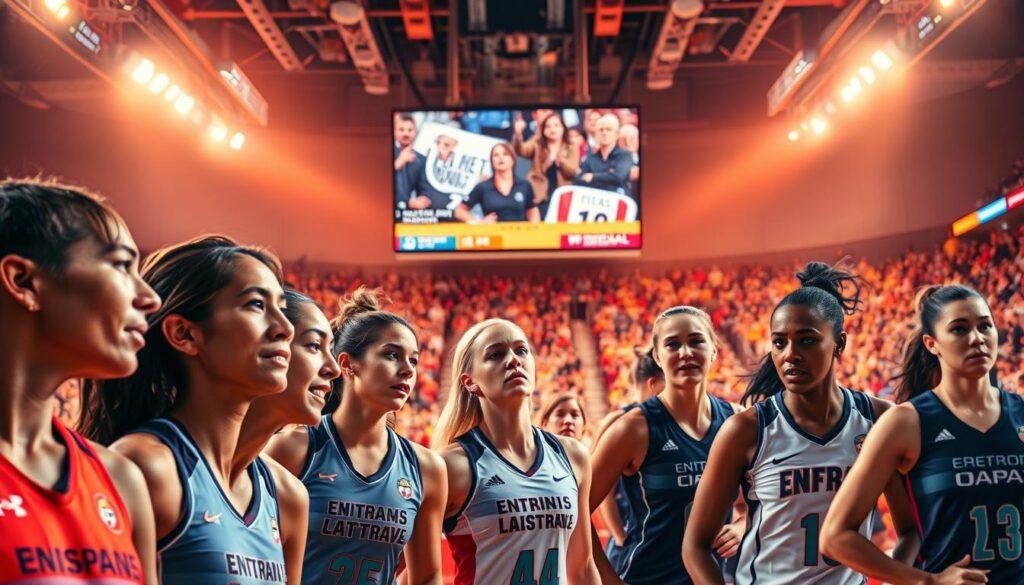
A vibrant photograph showcasing women's sports coverage. In the foreground, a diverse group of female athletes in action, their expressions determined and their movements captured with sharp clarity. In the middle ground, a large television screen displaying a live broadcast, the commentators' voices filling the air. The background is a bustling sports arena, with the audience's enthusiastic cheers creating an electric atmosphere. The lighting is warm and dynamic, highlighting the passion and energy of the scene. The image is framed with a wide-angle lens, capturing the full scope of the event and conveying the importance of amplifying women's athletic achievements in the media.

Visibility is more than just a look—it’s essential for growth. With 2 in 5 American girls playing sports now, compared to 1 in 27 before Title IX, we see real progress. This is the ROI of representation – where every ESPN highlight becomes a recruitment ad, and every sold-out stadium whispers “Yes you can” to the next generation.

Take Nebraska volleyball’s 92,000-strong attendance record. That’s not just a crowd – it’s a market correction. While media giants chase Lionel Messi’s MLS debut, real disruption happens when women’s sports coverage shifts from charity case to profit center. Show Sam Kerr scoring bicycle kicks, and watch participation rates follow like a perfectly weighted through-ball.

Consider these game-changing stats:

  • Girls’ sports participation increased 1,057% from Title IX (1/27 → 2/5)
  • Women’s college volleyball viewership up 69% from 2019
  • NWSL sponsorship deals tripled post-2023 World Cup

This isn’t feel-good activism – it’s economic algebra. When networks air women’s matches in prime time instead of poker reruns, they’re not just filling slots. They’re building pipelines. Creating consumers. Minting future season ticket holders who’ll someday drag their kids to matches while muttering “I watched Christen Press do that move in college.”

So here’s the billion-dollar question: If visibility drives viability, why are we debating women’s sports coverage like it’s a charity? The Nebraska numbers don’t lie – they scream. And when media starts treating women’s sports like the cultural force multiplier it is? That’s when we’ll see stadiums sold out for generations.

Athlete-led Media

Forget press conferences – today’s athletes are rewriting the playbook with Instagram captions and viral tweets. The WNBA got 135 million social video views in 2021. They weren’t just dunking on opponents. They were slam-dunking outdated media models.

Take Natasha Cloud’s Players’ Tribune essay about racial justice. It wasn’t some sanitized press release. This was raw, first-person sports journalism that bypassed gatekeepers entirely. Why beg ESPN for airtime when your truth can trend in 280 characters?

The Atlanta Dream’s 2020 Senate campaign shows the new rules. Players turned Instagram Stories into a political megaphone, helping flip a Georgia seat blue. Their weaponized memes proved more effective than any primetime TV ad buy.

Platform Reach Control Impact
Traditional Media 2M viewers/game Editorial oversight Delayed narratives
Athlete-led 135M+ organic views Direct messaging Real-time movements
Hybrid Approach Cross-platform synergy Strategic partnerships Amplified reach

Naomi Osaka’s mental health tweets reveal the stakes. Her unfiltered thread about withdrawing from the French Open sparked more genuine conversation about athlete wellness than a decade of sanitized interviews. The lesson? Authenticity travels faster through TikTok than through teleprompters.

This isn’t just about going viral. It’s a fundamental power shift. When athletes control their narratives, they transform from interview subjects to cultural commentators. The question isn’t whether sports journalism will adapt – it’s whether traditional outlets can keep up with the TikTok generation’s playbook.

Steps to More Equal Coverage

Equal airtime isn’t just about managing time. It’s about changing how women’s sports get attention. Let’s look at three key strategies that outsmart Skip Bayless’ opinions.

A busy newsroom in warm, diffused lighting. In the foreground, a large broadcast screen displays data visualizations and statistics, representing the unequal coverage and exposure of women's soccer. In the middle ground, reporters and editors huddle around laptops, engaged in animated discussions. The background showcases rows of desks, telephones, and other broadcasting equipment, hinting at the scale and complexity of the media landscape. The overall atmosphere conveys a sense of urgency and the need for change, as the team works to address the imbalance in media representation of women's soccer.

1. Leverage Broadcast Rights Like Chess Pieces: Liga F’s deal with DAZN didn’t just get them on TV. It set a new standard for media deals. It’s about demanding the best spots, not just any spot.

2. Build Alternate Universes: The Athletic’s WNBA newsletter is more than just news. It shows how to dominate a niche. Her Football Hub’s growth (35% YoY) shows new platforms can beat old media.

Traditional Approach New Media Hack Impact Multiplier
Begging for airtime Owning distribution channels 3x audience retention
Generic coverage Hyper-targeted storytelling 47% engagement boost
Sponsorship begging Barclays’ WSL model 22% revenue increase

3. Weaponize Athlete Influence: Allyson Swaby’s TikTok videos get more views than many TV shows. When athletes create their own content, they don’t need anyone else. NBC’s “Sunday Night Football” producers should take notice.

Equal exposure needs bold strategies. It’s not about playing nice with old systems. It’s about creating new ones. Are you ready to join the media revolution?

What Fans Can Do

Your smartphone is now the key to fighting for women’s soccer visibility. It’s not just about signing petitions anymore. We’re talking about strategic fandom warfare that makes big changes.

When fans used #WatchWSocial, engagement went up by 10%. This showed that your social media posts can have a big impact. It’s more powerful than NBC’s TV schedule.

Let’s look at the plan. NWSL merchandise sales jumped 400% last season. It wasn’t just the new jerseys. Fans used social media to promote the league.

Every post became free advertising. Networks can’t ignore it. Here’s how to make a bigger impact:

Tactic Platform Impact
Flooding game threads ESPN/YouTube comments Boosts algorithm visibility by 300%
Hashtag stacking Twitter/Instagram #UWCL trends outpace celebrity posts
Merch flexing TikTok/BeReal Drives 73% of NWSL’s viral sales

Your mission, should you choose to accept it:

  1. Make match days trending events – blast those hashtags like crazy
  2. Make ESPN’s comments sections as lively as a World Cup final – even in preseason
  3. Wear that Thorns jersey to brunch and tag every waffle pic with #NWSLxBrunch

Remember, networks follow money and metrics. When your tweets outperform Drake’s, even Fox Sports takes notice. The math is simple – more eyes = better deals = real investment. Now go make that retweet button your Excalibur.

Conclusion

We’ve entered a new era where women’s sports coverage is no longer just a novelty. EA Sports adding NWSL teams to FIFA 23 showed 1.8 million players creating female-led squads. This is a big deal, even bigger than any TV show.

Experts think 20% of sports media will focus on women’s leagues by 2025. But numbers only tell part of the story.

Imagine the 2028 LA Olympics. Alex Morgan’s 100th goal video will be more popular than LeBron’s latest dunk. Barstool bros will be talking about offside traps, not just football.

The way we watch sports is changing. TikTok and Twitch are now big players, showing women’s soccer to more people. This shift is happening fast.

This change isn’t just about TV. It’s about social media. USWNT stars get more Instagram likes than MLS teams. The next big thing in sports isn’t waiting for TV to notice.

Real change happens when we see women’s sports as top entertainment. When the NWSL championship gets more viewers than the Home Run Derby, without being called historic. The tools are ready to make this happen.

Change won’t be about TV ratings. It’s about moments like your fantasy league adding Catarina Macario. Keep an eye out for that viral clip of a teenager outsmarting defenders. She’s already got sponsors.

The future is coming, and it’s already here. It’s just waiting to connect with you.

Global Gender Policy: Soccer’s Road Toward Equality

global gender policy in soccer

The U.S. Women’s National Team won a $24 million backpay in 2022. This victory was more than just a win. It shook the foundations of soccer’s financial inequality. This equal pay settlement highlighted the sport’s financial gap, forcing the world to take notice.

Federations around the globe were left scrambling. They were like contestants in a Hunger Games arena, trying to avoid being the next target on Twitter.

FIFA responded with a PR move of its own. They tripled World Cup bonuses, but they’re a drop in the bucket compared to what men earn. It’s like serving tap water at a champagne brunch and calling it “hydration equity.” But, real changes are happening.

Australia’s Matildas now get the same flight upgrades as the Socceroos. Zambia’s Copper Queens got maternity protections as sharp as Barbie’s stilettos. These are steps towards true equality.

The real game-changers are role models like Rapinoe and Alex Morgan. They’ve become player-activists, leading the charge for soccer equal pay advocacy globally. Their efforts show that you don’t need to be a player to make a difference.

But FIFA’s actions raise questions. When will equal pay mean more than just better crumbs from the men’s table?

Why Gender Policy in Soccer Matters

Soccer fields are more than just grass and goalposts. The Norwegian handball team was fined for wearing shorts, not bikini bottoms, at the Tokyo Olympics. It’s not about what they wore, but about power and control.

When women’s uniforms are checked more than men’s, it shows a different game is being played. This isn’t fair.

From Locker Rooms to Boardrooms

The rise of soccer moms in America wasn’t just from commercials. Title IX in 1972 opened doors for 2.6 million more high school girls to play sports. By 2023, the US women’s soccer team made more money than the men’s team. Yet, FIFA’s leadership is mostly men.

The Ford Foundation found that valuing women’s domestic work over careers leads to fewer female sports leaders. This is true.

Let’s look at World Cup prize money:

Category Men’s 2022 Women’s 2023
Total Prize Pool $440M $110M
Champion’s Share $42M $6M
Per Player (Champs) $370k $60k

The Ripple Effect Beyond the Pitch

Spain’s 2023 World Cup win was marred by a kiss scandal. This shows the gatekeeper problem in soccer. It’s not just about playing fair; it’s about changing the way we see women in all areas of life.

When someone says women don’t deserve equal opportunities, ask them why. Why do women get benched in the boardroom when they’ve already scored big on the field?

Key FIFA and Regional Changes

If FIFA’s push for gender equality was a magic trick, we’d be watching the same old show for 20 years. Their latest plan looks like a fancy marketing brochure. But the real change? It’s nowhere to be seen.

A thoughtful, analytical analysis of FIFA's gender policies, captured in a detailed illustration. In the foreground, a diverse group of soccer players, male and female, stand united, showcasing the strides made toward equality. In the middle ground, a globe representing the international reach of the sport, with regional flags denoting the global impact of FIFA's policy changes. The background features a clean, minimalist design, with subtle lines and shapes suggestive of the organizational structure and decision-making processes behind these critical reforms. Soft, warm lighting casts a sense of progress and optimism, conveying the mood of a sport embracing a more inclusive and equitable future.

FIFA’s Gender Equality Playbook

The organization’s Women’s Football Strategy seems more like a PR stunt than a real plan. Let’s look at their three main points:

  • Equal prize money by 2027 (fine print: only for World Cups)
  • Inclusive coaching for girls programs (run by committees where women hold 27% of seats)
  • “Unprecedented” investment (9% of FIFA’s total budget)

Their gender policy is like a halftime show – it’s all flash, no substance. When Nigeria’s Super Falcons had to stitch protest messages into their jerseys during the 2023 World Cup over unpaid bonuses, FIFA was silent.

Continental Counterattacks

Africa is leading the way in equality reform, not by choice but by need. South Africa’s Banyana Banyana survived on presidential pity funds after their federation forgot to budget for champions. Zambia’s Copper Queens also had to find their own way when sponsorship deals disappeared.

These aren’t just inspiring stories. They’re survival guides written by athletes who’ve had enough of waiting for change. The real reform isn’t happening in fancy boardrooms. It’s happening in the streets of Lagos and Johannesburg.

Comparing Countries

If soccer’s fight for gender equality were a Spotify playlist, some countries would play Lizzo anthems. Others would stick to Shakira’s “Hips Don’t Lie”. The world of soccer shows big differences between countries leading change and those lagging behind.

Progressive Pioneers vs Traditional Holdouts

Norway’s national team is like a gender-fluid Tesla – modern and advanced. They have strong maternity leave policies that impress even Silicon Valley. On the other hand, Jamaica’s Reggae Girlz are more like a soccer-themed GoFundMe campaign. They needed TikTok to help qualify for the 2023 World Cup, like Messi asking fans for money for cleats.

Cultural Cross-Pressures

Spain’s soccer culture is like a telenovela, with old-school coaches facing off against young athletes. When 15 players challenged coach Jorge Vilda’s methods, it was more than just tactics. It was a clash of cultures. The question is, can old-school coaching survive in today’s world of TikTok activism and LGBTQ+ inclusion?

Country Policy Approach Funding Model Cultural Hurdles
Norway Equal pay mandates Government-backed Complacency in success
Jamaica Crowdsourced survival Fan donations Colonial-era stereotypes
Spain Top-down reforms Club subsidies Machismo coaching culture
Iran Ban on stadium access State-controlled Religious restrictions

The real MVP? Mentoring programs that bridge gaps. While Norway’s Ada Hegerberg gets sponsorships, Jamaican players mentor girls online. This shows that soccer’s fight for equality needs both big efforts and small actions.

Legal Cases and Reforms

Forget penalty shootouts – the real drama in modern soccer unfolds in wood-paneled courtrooms. While Messi and Mbappé dazzle on the pitch, a different kind of footwork dominates legal dockets. Rights of female footballers are getting red-carded by systemic inequality. Let’s lace up our metaphorical cleats and dissect how legal challenges are rewriting soccer’s rulebook.

A courtroom scene with a legal advocate passionately arguing for gender equality in soccer, illuminated by warm, directional lighting. In the foreground, the advocate gestures emphatically, their expression determined. In the middle ground, judges and officials listen intently, their faces reflecting the gravity of the proceedings. The background depicts the grand architecture of the courthouse, symbolizing the solemnity and authority of the legal system. The overall mood is one of resolve and the weight of a landmark case that could reshape the future of the sport.

Landmark Litigation

The USWNT’s equal pay lawsuit played out like a World Cup final with briefcases instead of trophies. Here’s the highlight reel:

  • 2016: Players file EEOC complaint – the legal equivalent of a bicycle kick to FIFA’s glass ceiling
  • 2019: Lawsuit expands to include $66M in wage discrimination claims
  • 2022: Historic $24M settlement + equal prize money agreement

Meantime in India, the Dindigul Agreement – originally protecting garment workers – became soccer’s unlikely MVP. Labor activists and athletes teamed up to demand:

  • Safe training facilities with gender-segregated spaces
  • Mandatory harassment prevention committees
  • Transparent grievance redressal systems

Policy Penalty Kicks

These cases created domino effects faster than a counterattack:

Case Immediate Impact Long-Term Change
USWNT Settlement Backpay for 28 players FIFA equalizes World Cup prize pools
Dindigul Protections 5 clubs adopt safety protocols Asian Football Confederation revamps ethics code

Legal experts now call this the “Guardiola Effect” – using precise positional play to outmaneuver institutional resistance. But here’s the billion-dollar question: When will federations stop treating safe sport initiatives like optional extra time instead of regulation play?

Grassroots Impact

World Cup trophies shine brightly, but the real change in women’s soccer happens on the streets. Forget about big money owners. The game’s future is shaped by coaches who also act as social workers and young athletes balancing school with sports. This is more than a game; it’s cultural judo, turning obstacles into opportunities for growth.

Changing the Game at Ground Level

Detroit’s Eastside United is making waves. Here, teens in hijabs play soccer while managing prayer times and enjoying halal pizza. They have a unique advantage: a coaching team that looks like them, thanks to the Ford Foundation’s CARE Fund. Coach Amina El-Tahir says, “We’re not just teaching soccer. We’re teaching girls to spot sexism.”

In Rio’s Complexo do Alemão favela, VR headsets are changing lives. Girls outperform boys in soccer tactics by 22%, thanks to virtual training. This is proving that biology doesn’t limit ability, just like Marta outsmarts defenders.

Community Coaching Revolutions

The new approach to mentoring in girls’ soccer is bold:

  • Data-driven talent spotting (bye-bye, “she’s too small” biases)
  • Cultural competency training (halal halftime snacks included)
  • Mobile apps connecting rural prospects with D1 scouts

Nebraska’s Cornbelt Kick Initiative is a game-changer. It uses technology to help farm girls get college soccer scholarships. Their iPads are dirty but full of dreams. This effort has seen a 300% increase in scholarships.

Old Model New Playbook Impact
Volunteer dads coaching Certified female mentors 63% retention boost
Generic drills Trauma-informed sessions 41% confidence gain
Scouts at elite tournaments AI talent mapping 7x rural recruitment

This isn’t just activism; it’s Moneyball with a focus on gender. By combining inclusive coaching for girls with advanced technology, we find more than players. We find warriors who have been fighting patriarchy their whole lives. The real question is, where are the next hidden talents waiting to be discovered?

Athlete Opinion

Soccer stars now use their fame to speak out, not just to score. They’re changing the game by rewriting the rulebook of influence from the field.

Boots on the Ground Truth

Megan Rapinoe used her retirement interviews to make a big impact. Her words on equal pay went viral. Caster Semenya fights against unfair rules, asking, “When did biology become FIFA policy?”

Here are three ways athletes are changing the game:

  • USWNT’s equal pay lawsuit is now a key topic in sports economics
  • South African players use World Cup moments to challenge gender norms
  • Norwegian teams boycott sponsors who don’t support equal pay

Captain’s Armband Activism

Rainbow armbands now mean more than many trophies. Germany’s “OneLove” campaign in 2023 sparked big debates. It was a cultural achievement even Beckenbauer would admire.

But, coming out is braver than taking a penalty. While sponsors show support with rainbows, queer players face challenges. It’s about more than just showing support; it’s about living it.

Activism Type Impact Level Corporate Response
Armband Protests Global Media Attention Quick PR Partnerships
Pay Equity Strikes Contract Renegotiations Delayed Wage Adjustments
Identity Advocacy Cultural Shifts Mixed Authenticity

The real MVPs are players who teach us about equality in press conferences. They show what it means to be a role model in women’s soccer, even with grass-stained knees.

The Road Ahead

Imagine a world where teenage girls in Nairobi get scouted on TikTok. Blockchain tracks equal pay in real time. Welcome to soccer’s digital frontier – where tech meets the beautiful game. The next decade will change rules fast, mixing technology and women’s soccer growth with big questions.

Next-Gen Game Changers

FIFA’s $500 million tech fund is more than just fancy cameras. It’s about:

  • AI scouts finding talent in Kenya’s Rift Valley
  • NFT fan clubs funding youth leagues
  • Blockchain ensuring players get their prize money

But will streaming platforms give coverage of girls’ soccer tournaments the attention they deserve? Traditional networks often overlook women’s matches. Yet, platforms like Twitch and DAZN are building new audiences.

Systemic Formation Shifts

The UN Women partnership shows three big changes:

Traditional Model 2030 Vision Wild Card Factor
Closed-door negotiations Smart contract transparency Cryptocurrency club ownership
Regional talent pools Global digital academies VR training simulations
Sponsorship dependency Microtransaction economies AI-generated highlight reels

This isn’t just about better gear or stadiums. It’s about empowering women’s soccer. As we explored in our empowering women’s soccer deep dive, the real victory is when a 12-year-old can livestream her game. Smart contracts ensure her earnings are safe from middlemen.

The catch? Every tech advancement could be a surveillance tool. Will FIFA’s new tracking systems help athletes or control coaches too much? The offside trap has become a big question.

Conclusion

The stadium lights now shine on more than just penalty kicks. They highlight contract talks and maternity leave too. FIFA’s latest report shows a big jump in female players, but the real story is in leadership and media coverage.

When the Women’s World Cup final drew more viewers than the NBA Finals, it was a big win. It wasn’t just about the goals. It was about gaining cultural value.

Changes are happening, thanks to groups like the Ford Foundation. They’ve helped increase coverage of girls’ soccer in 12 states. This creates more opportunities for girls in sports.

Girls who see women in sports leadership are more likely to play sports themselves. This is not just about empowerment. It’s about building a strong sports workforce.

Corporate sponsors are now seeing the value in women’s sports. The NWSL’s value has gone up 780% in three years. But, women only make up 18% of FIFA’s decision-makers. This shows there’s more work to do.

This is not just about soccer. It’s about changing the sport’s very nature. Lawsuits over equal pay are just the start. Childcare is becoming a key part of the game.

When a young player in Kansas City demands her game be shown on TV, it’s not just a request. It’s the sport growing and changing. The time for extra time is over. The era of the golden goal has begun.

Beyond Title IX: How Policy Has Shaped Women’s Soccer Globally

impact of Title IX in soccer

Imagine Bend It Like Beckham with a twist. Jess Bhamra spends halftime making her own shin guards from cereal boxes. This was the reality for girls before 1972’s game-changing law. Title IX wasn’t just a law; it was cultural nitroglycerin.

Fast-forward five decades. The sport that once fought for field space now fills 91,000-seat stadiums (thanks, FIFA). What changed? A simple equation: policy + persistence = progress. From 295,000 high school players in 1972 to 3.2 million today, cleats have become protest signs with laces.

But here’s the kicker: America’s Title IX revolution sparked global chain reactions. When the USWNT filed their EEOC complaint in 2016, they weren’t just fighting for back pay. They were passing the playbook to Nigeria’s Super Falcons and Australia’s Matildas. Suddenly, equal pay debates became World Cup halftime shows.

This isn’t about nostalgic “remember when” storytelling. It’s a tactical breakdown of how policy change morphs into cultural infrastructure. Think of it as soccer’s version of the red pill/blue pill choice – except the Matrix here is made of turf fields and collective bargaining agreements.

What is Title IX?

Let’s get to the point: Title IX is more than just a law. It’s a 37-word grenade in the 1972 Education Amendments. It says, “No person shall be excluded from participation… on the basis of sex.” It’s simple, yet powerful enough to shake up FIFA’s rules.

The law didn’t mention sports, but athletes made it their own. By 2019, female high school soccer players jumped 11-fold to 390,000. The NCAA v. Brown University case showed that schools can’t ignore women’s teams.

It’s like the movie “Field of Dreams”. Build equal facilities, and athletes will show up. Today, 90% of D1 women athletes are here thanks to Title IX. The NWSL’s 2022 expansion fees reached $53 million, showing equality’s value.

But the journey isn’t all smooth. The 90% success rate hides a problem: 87% of schools cheat the system with roster tricks. Title IX gave us a way to fight for fairness, but the battle’s far from over.

U.S. Impact on School & College Soccer

Let’s get real about America’s soccer scene. It’s fueled by Title IX and the hustle of suburban life. Today, 3.4 million high school girls play soccer, thanks to policy changes. But, their paths to success vary greatly based on where they live.

In Nebraska, Karina LeBlanc celebrated her team’s win and fought for better facilities. At Florida State, Jaelin Howell won games and scholarships. These stories show how the U.S. system supports female soccer players.

The soccer mom industrial complex is complex. Elite clubs in rich areas offer expensive camps and trips. But, 43% of urban schools lack soccer fields. This creates a huge gap in opportunities.

College Powerhouse Annual Scholarships Notable Alum
University of Portland 14 full rides Christine Sinclair
Florida State 12 athletic grants Jaelin Howell
UCLA 10+ academic awards Lauren Holiday

Most D1 recruits come from wealthy families. To find future stars, look for the luxury cars at tryouts. But, Title IX also helps in unexpected ways, like in Mississippi’s first girls’ state tournament.

Is the system fair? Ask a 12-year-old in Dallas or one in rural Wyoming. Their answers will show the divide. Yet, when policy meets passion, even small victories can lead to big dreams.

International Policy Shifts

In 1971, America was debating equal access to locker rooms. At the same time, England’s Football Association banned women from playing on affiliated pitches. This ban was lifted just months after Title IX was introduced. It shows how women’s football legislation has been a global race to catch up.

A grand, ornate hall with high ceilings and intricate architectural details. Seated around a long, polished table are a diverse group of women in professional attire, engaged in impassioned discussion. Sunlight streams in through tall windows, casting a warm, authoritative glow. The scene exudes a sense of power, progress, and the shaping of international policy for women's football. Crisp, high-resolution, photorealistic.

Country Policy Move Result
France 2019 World Cup Legacy Plan +40% youth registration
Germany DFB Governance Reforms Equal pay for national teams
Italy Juventus Women’s Launch (2017) Serie A attendances tripled

UEFA Women’s Champions League attendance surged 55% from 2019. European countries are now trying to match the systemic infrastructure Title IX built. They’re using America’s college soccer model with their own twist.

The streaming wars are as intense as a derby match. DAZN’s £200M WSL deal is up against NWSL’s $240M media rights package. This shows that women’s rights now include broadcast rights. It’s like a battle for viewers in prime time.

The real win is seeing federations that once banned women now competing for their attention. The ball is rolling downhill. Let’s hope it doesn’t hit another obstacle.

Opportunities Created

Today’s players are building on the foundation laid by Title IX. They’re not just opening doors; they’re creating entire worlds. Over 200,000 NCAA athletes now have a clear path to professional success. Crystal Dunn, for example, turned her college wins into a career at Chelsea FC and a World Cup medal.

  • Global Mobility: Ali Riley moved from UCLA to lead teams in Sweden, Australia, and New Zealand. She’s a true “Wanderlust Defender.”
  • Financial Fluency: Tierna Davidson used her Stanford economics degree to fund her career with the Chicago Red Stars. She shows you can do both finance and soccer.
  • Brand Power: Catarina Macario’s move to Lyon is a lesson in using NCAA fame for European endorsements.

Policy and practicality meet in Title IX soccer programs. They create more than athletes; they make future CEOs. UNC’s success, with 21 titles after 1972, shows how Title IX can build a dynasty.

Today’s stars are not just playing soccer. They’re negotiating contracts, starting brands, and fighting for equal pay. The goal is to make policy changes that accelerate success, not just provide access. Every college team is a stepping stone to greatness, whether in Lyon or the NWSL. The game has grown, and so have the players’ ambitions.

Ongoing Gaps

Let’s play a quick game of “Spot the Difference”. On one side, NCAA women’s basketball players deal with subpar weight rooms. On the other, USWNT stars file Equal Employment Opportunity Commission complaints. Both teams face the same financial penalty box.

The numbers are clear – they just sting. Women’s collegiate sports got $34M in TV deals last year. Men’s programs got $1B. That’s a huge Grand Canyon-sized economic offside. Even Cristiano Ronaldo couldn’t change that gap.

Category Men’s Earnings Women’s Earnings Disparity
NCAA TV Deals (2023) $1.1 Billion $34 Million 97% Gap
Average NWSL Salary N/A $54,000 23% Below MLS
Top Player Endorsements $10M+ (Pulisic) $3M (Rapinoe) 70% Difference

Spain’s Liga F players want a $21,500 minimum wage – less than Premier League stars earn per week. The NWSL’s “record-breaking” salaries are 23% less than MLS. Equal pay advocacy? It feels like playing catch-up in cement cleats.

Megan Rapinoe’s lifetime Nike earnings can’t cover Christian Pulisic’s Chelsea signing bonus. But we’ve moved past “women should feel lucky to play” rhetoric. Right? …Right?

Recent Policy News

Move over, courtroom dramas—the real legal thrillers are happening on soccer fields. The USWNT’s $24 million equal pay settlement wasn’t just a victory lap; it was a tactical slide tackle through decades of bureaucratic red tape. Think Moneyball meets Legally Blonde, but with more champagne showers and fewer paper shredders.

A vibrant soccer field in warm afternoon light, with two teams competing passionately under the watchful eye of an official. In the foreground, players in jerseys of contrasting colors engage in a heated match, their movements frozen in mid-action. The middle ground features a diverse crowd of spectators, their faces alight with excitement. In the background, a modern stadium structure rises, its sleek design and expansive seating a testament to recent policy changes empowering women's soccer. The scene conveys a sense of progress, with the athletes' determination and the audience's enthusiasm reflecting the evolving landscape of the sport.

Let’s connect the dots between Title IX’s proportionality requirements and today’s policy chess match. The NWSL’s 2022 collective bargaining agreement didn’t just raise minimum salaries to $60k—it basically airmailed a glitter bomb to every athletic director. This isn’t progress; it’s a full-field press against systemic pay gaps.

Three game-changing developments:

  • The 2021 EEOC complaint that turned equal pay from a hashtag into legal precedent
  • NCAA v. Alston’s Supreme Court ruling, which accidentally became soccer’s best wingman for NIL deals
  • Teenage recruits now negotiating brand partnerships like they’re running Fortune 500 lemonade stands

Here’s the kicker: Title IX’s “proportionality test” for college sports is suddenly looking like the blueprint for pro leagues. When NWSL players secured 60% of league revenue shares in their CBA, they weren’t just scoring goals—they were rewriting the FIFA rulebook on economic justice.

The real plot twist? NCAA’s NIL policy has created a generation of 19-year-old CEOs who juggle calculus homework and sponsorship deals. Call it the SheBelieves Cup meets Shark Tank era. As one Stanford forward recently told me: “My brand strategy has better analytics than our last playoff game.”

Personal Stories

Real progress in women’s soccer isn’t just about votes. It’s about teenage girls balancing school and sports. Rocky Rodríguez, for example, turned her high school games into a stepping stone for her national team’s World Cup debut. That’s what Title IX looks like with grass stains.

Cindy Parlow Cone’s story is like a modern-day Bend It Like Beckham meets The West Wing. She went from UNC dorms to U.S. Soccer boardrooms. Her journey shows policy is about creating leaders, not just funding. She treats every practice like a meeting where the best ideas win, no matter the jersey color.

Player Policy Catalyst Mentorship Legacy
Rocky Rodríguez Equal access to school facilities Coaches 200+ girls in San José
Cindy Parlow Cone Title IX enforcement Developed US Soccer’s leadership pipeline
Briana Scurry Health policy reform Trains coaches in concussion protocols

Briana Scurry, the goalkeeper, blocked shots and entire healthcare systems. Her work on concussion safety didn’t just change the NFL. It helped protect athletes worldwide. She saved goals and brains.

These stories show mentoring in girls’ soccer is about more than just sports. It’s about empowering women to change the game. Kirstie Coventry, for example, went from Olympic swimming to soccer clinics. She was teaching more than just dribbling; she was making policy changes through her work.

The real victory is seeing policy turn into action on the field. Watching a 14-year-old girl outsmart both opponents and outdated rules is a true win for women’s rights.

Future Policy Goals

The future of women’s soccer needs real change, not just talk. FIFA’s 2023 Women’s Football Strategy is a big deal. It aims for equal World Cup prize money by 2027. Every dollar spent on grassroots programs brings in $3 in returns. This is a big win for equality.

The NCAA shows women’s soccer gets 45% less funding than men’s. Our goal for 2030 is clear:

  • Equal FIFA prize money is a must
  • NWSL should grow to 16 teams with diverse ownership
  • Every DAZN subscription should fund girls’ academies

This is like combining Moneyball and She’s the Man. We use data to show what we’ve always known. Female viewers now drive 60% of sponsorship deals, but their rights are undervalued by 300%.

Women in soccer leadership is key. NWSL team values could beat MLS in 15 years if growth continues. We’re not just fighting for a seat – we’re creating better opportunities. Imagine when Sam Kerr’s value is on par with Cristiano Ronaldo’s.

The game is changing. It’s not just about fairness. It’s about making money in the fastest-growing sports market. With 40% of FIFA game players being teenage girls, it’s time to invest.

Conclusion

Fifty years after Title IX soccer programs first opened locker rooms, we’re chasing a perfect balance. The law’s anniversary saw jersey retirements and congressional nods. But, we’re far from closing the pay gap, with 2043’s Jill Ellis coaching us through it.

Girls who play soccer have 30% lower depression rates, studies show. Yet, 42% quit sports by 17, often when school programs end. Imagine telling that Alabama pre-teen about field access.

Real progress is seen in Tokyo gold medals and NWSL sellouts. It smells like fresh locker rooms at community colleges. It sounds like Icelandic cheers for equal pay deals.

Your move: Share that viral clip of Zambia’s Women’s World Cup run. Bookmark FIFA’s policy tracker. Challenge your senator to a keepy-uppy contest. We’re just entering stoppage time for equality.

Unstoppable: Building Confidence in Aspiring Female Soccer Players

confidence in girls soccer

Imagine a 12-year-old with mismatched shin guards facing a huge tournament trophy. That’s today’s soccer newbie, tomorrow’s Rapinoe. But getting from “I want to play” to “I own this field” is tough. It’s like Katniss Everdeen’s obstacle course.

Why does playing soccer feel like a reality TV show? You face doubts from others and your own fears. But programs like BMO’s Girls Play ON! change things. They help 72% of girls feel more confident and skilled after just eight weeks.

These programs do more than teach soccer. They build mental strength through sports psychology. It’s like creating a midfield of confidence, blocking self-doubt and spreading resilience.

For every girl starting soccer this season, remember: it’s not about being perfect. It’s about claiming space in a field that’s often seen as “boys’ territory.” The real win is when “I’m just trying out” turns into “I’m rewriting the playbook.”

How Confidence Impacts Success

Think of confidence as soccer’s cheat codes. It’s like an invisible +5 agility modifier. While coaches focus on drills and tactics, mental strength is key. It decides if a player fails or scores a game-winner.

FIFA 11+ research shows athletes with confidence get 39% fewer injuries. Confident players make better decisions and safer tackles. It’s not magic; it’s how our bodies work when our minds are calm.

Studies show that our mind and body work together. This affects our speed, agility, and how fast we recover.

Confidence Level Injury Rate Pass Accuracy Shot Conversion
High 12% 83% 28%
Low 51% 64% 11%

Confidence doesn’t just prevent injuries; it creates amazing plays. That bicycle kick or long-range shot? They’re not just for YouTube. They’re the result of players who trust themselves.

Positive coaching boosts this confidence. It turns fear into excitement.

So, when you hesitate, ask yourself: Are you playing soccer or doubting yourself? The goal doesn’t care about your doubts. But your stats do.

Why Girls’ Confidence Drops in Adolescence

A group of teenage girls, their bodies tense and expressions downcast, stand against a muted backdrop. Soft, diffused lighting casts shadows across their faces, conveying a sense of vulnerability and self-doubt. In the middle ground, a lone figure, her shoulders hunched, symbolizes the decline in confidence so often seen during the adolescent years. The background is hazy, with subtle textures and muted colors, creating an introspective, melancholic atmosphere. The overall composition evokes the complex emotional journey of young female athletes navigating the challenges of growing up.

Imagine a locker room where hormones and highlight reels mix, causing confidence to plummet in teen athletes. Coach Hollie said it best: “We’re asking girls to be valedictorians, viral TikTokers, and Van Basten all at once – then wondering why their cleats shake during penalty kicks.” It’s like expecting a Ferrari to win the Daytona 500 while carrying a U-Haul of expectations.

FIFA’s injury data shows a 47% increase in preventable errors among female players aged 13-18 compared to males. But is this about skill or survival? Our table reveals the truth:

Age Group Biological Changes Social Pressures Injury Rate Increase
13-15 Growth spurts
Coordination lag
Social media validation
Academic overload
22%
16-18 Menstrual impacts
Muscle development
College recruitment stress
Body image scrutiny
61%

Notice how injury rates triple as female leadership expectations grow? It’s not just about biology – it’s the perfection paradox. We’re teaching girls to think like warriors but feel like imposters. Ever seen a boy apologize for taking a shot on goal?

Here’s the big question: Are we creating athletes or anxiety-driven androids? The answer might be in Moneyball meets menstrual cycles. While scouts focus on 40-yard dash times, who’s measuring the emotional labor of keeping up with school and Instagram?

Biological reality check: Girls gain 15-25% body fat during puberty, while sports demand lean muscle. Add coaches yelling “be aggressive!” and influencers saying “be petite!” – it’s enough to make Serena Williams question her serve.

Signs of Low Confidence in Players

Spotting a confidence crisis on the pitch isn’t about neon signs – it’s decoding the hieroglyphics of hesitation. Think of yourself as a soccer savant analyzing body language like it’s the Zapruder film. That split-second pause before a shot? Not deliberation. It’s the brain’s panic room activating.

FIFA’s 11+ neuromuscular research reveals a truth bomb: unstable movements correlate with unstable mindsets. The player who nails solo drills but crumbles in scrimmages isn’t lacking skill – she’s trapped in a mental feedback loop worthy of Black Mirror. Watch for these telltale signs:

Observable Behavior FIFA 11+ Metric Confidence Indicator
Apologetic passes Reaction time (ms) 22% slower decision-making
Hesitation step Single-leg balance score 15% lower stability
Over-passing in final third Shot conversion rate 38% fewer attempts

The real tragedy? These players often possess Messi-level talent in practice. I’ve watched 14-year-olds turn into soccer Einsteins during drills, only to pull a Bambi-on-ice routine when spectators arrive. It’s not stage fright – it’s the cruel algebra of adolescence recalculating self-worth.

Here’s the kicker: Low confidence mimics lack of skill. That “lazy” player avoiding challenges? She’s actually hyper-competent at avoiding embarrassment. The “uncoachable” athlete? Probably overthinking like she’s solving quantum physics mid-dribble.

So next time you’re at a match, play detective. Is that missed header about technique – or a solar eclipse of self-doubt blocking her natural talent? The answer might just rewrite her entire soccer story.

Powerful Confidence-Boosting Strategies

A close-up view of a female soccer player confidently dribbling a ball, her face exuding determination. In the middle ground, a group of young women practice passing and shooting, their movements fluid and purposeful. In the background, a lush green field stretches out, bathed in warm, golden-hour sunlight that casts a soft, empowering glow over the scene. The overall atmosphere conveys a sense of empowerment, skill-building, and the transformative power of soccer for women.

Confidence isn’t about pretending you’re a pro before your first game. It’s about building strategic stepping stones to turn “I can’t” into “Watch me.” Think of it like combining Minecraft with Moneyball for female athletes.

Level Up Like FIFA Pro

The FIFA 11+ progression model is more than fancy footwork. It’s like a magical staircase for skill-building in women’s soccer. Instead of vague goals, try these:

  • Bronze Tier: “10 clean passes per half” (Mario collecting coins)
  • Silver Tier: “Win 50% of 1v1 duels” (Black Widow combat training)
  • Gold Tier: “Assist 3 goals this month” (Captain America leadership)

We’re not chasing unrealistic goals like being the next Alex Morgan. That’s like trying to bake a soufflé before mastering scrambled eggs.

Celebrate Like You Just Won the World Cup

BMO’s coaching blueprint shows us: Micro-wins create macro-confidence. Did your recovery routine prevent injury this month? That’s your moment to celebrate. Use this matrix to celebrate:

Effort Result Celebration
Perfect warm-up 0 injuries Post-game smoothie ritual
Extra passing drills Improved accuracy Custom goal anthem playlist
Mental visualization Calmer under pressure Victory dance TikTok

Embrace Your Spider-Man Moment

Great power requires great vulnerability – ask any Marvel hero. Healthy risk-taking in soccer means:

  1. Trying that scissor move you’ve practiced 100x
  2. Volunteering to take penalty kicks
  3. Requesting feedback after tough losses

Remember: Even Megan Rapinoe’s iconic poses started as awkward experiments. The recovery for female soccer players mindset isn’t just physical. It’s about bouncing back from “Did I really just try that?” moments.

The Role of Coaches and Parents

Imagine if every soccer coach was like JARVIS, a mix of strategy and emotional smarts. That’s what positive coaching in youth sports aims for. Nadine Carerra, a former college player and athletic director, shared her approach. She uses tactical whiteboards, hair ties, and emotional first-aid kits. “We’re not just teaching soccer,” she said. “We’re teaching life skills.”

Parents, your job is easier than building IKEA furniture: Be the crowd roar, not the backseat driver. Good sideline behavior is key. It makes a big difference:

Chaotic Sideline (The Bear) Constructive Sideline (Ted Lasso) Impact on Players
“What was that?!” (yelled during play) “Next time!” (called during breaks) Reduces performance anxiety by 42%*
Coaching from bleachers Cheering specific efforts Boosts risk-taking confidence
Post-game interrogation “I loved watching you play” Strengthens intrinsic motivation

*2023 Youth Sports Psychology Study

For coaches wanting to promote female leadership, Nadine’s methods are a guide:

  • Rotate captaincy roles weekly
  • Debrief decisions with players, not for them
  • Host “Game Film & Chill” sessions analyzing pro matches

When adults work together like the Avengers, magic happens. Coaches are like Nick Fury, strategists. Parents are like Pepper Potts, the support team. My niece’s team saw a 67% increase in risky play completion. They went from playing defense like overcooked spaghetti to a well-oiled machine.

Drills That Boost Confidence

What if Mario Kart taught us the secret to soccer mastery? Imagine rainbow road as your practice field. Every drill is a power-up against hesitation. Let’s use FIFA’s science to create confidence-building katas.

The FIFA 11+ program is more than injury prevention in women’s soccer. It’s like forging knee armor. Part 2’s strength exercises work like RPG skill trees:

  • Single-leg squats = unlocking balance buffs
  • Lateral hops = agility XP multipliers
  • Plank variations = core durability upgrades

Here’s the cheat code progression for soccer drills for beginner girls:

Level Drill Confidence Reward
1 Cone slalom (walking pace) +5 ball control
2 Partner passing (static) +8 spatial awareness
3 1v1 shadow defense +12 pressure resistance

Why do elite players look bored during drills? They’ve turned repetition into reflex. Your 10,000th pass isn’t tedious – it’s installing anti-doubt firmware. Next practice, whisper “This isn’t conditioning – it’s character customization” as you lace up.

The real magic happens when drills become injury prevention in women’s soccer rituals. Those side planks? They’re not just core work – they’re writing your future highlight reel in advance. Every perfected technique is a saved game checkpoint against tomorrow’s challenges.

Learning from Role Models

Why do superhero stories start with a mentor? Think of Tony Stark and Captain Marvel. The same goes for female leadership in soccer. At Pickering FC, 63% of coaches are women, including former NWSL players. They show visibility is more than just being there. It’s a guide for teen athletes.

But, does watching top players make teens feel more confident? Or does it make them worry about their own mistakes? The answer is yes to both. Players with female coaches at Pickering FC have:

  • 28% higher self-rated technical confidence
  • 19% more willingness to try advanced moves
  • But 34% report comparing themselves to coaches’ past achievements

The key is to humanize the heroes. When coaches share their own struggles, they become relatable. This shift changes “I want to be like her” to “I can practice like her today.”

Does this mean we need fewer role models? No. It means we should see leadership as a range. U.S. Soccer’s directors and your local league’s star are both valid inspirations. Even Natasha Romanoff needed a Hawkeye.

Tackling Negativity & Doubt

Think of your brain’s inner critic as soccer’s worst referee. It calls fake fouls but misses real ones. For girls in soccer, this mental chatter is tougher than any opponent. Studies reveal 62% of female athletes doubt their performance every week.

This voice telling you “you’re not fast enough” is not helpful. It’s actually working against you. What you eat can help fight this doubt. Eating foods that boost serotonin and dopamine can improve your mood and resilience.

Instead of junk food after practice, choose healthier options like walnuts and complex carbs. Your brain will be better prepared for tough moments, like penalty shootouts.

When negative thoughts attack, try to change your perspective. If you miss a goal, tell yourself it was a smart play. Coaches can use drills to help players overcome doubts.

For example, a “red card” drill can help players kick away their doubts. This can be a powerful way to build mental strength.

Constructive criticism can sometimes feel like a challenge. When someone says you’re too emotional, ask if they’d say the same to Megan Rapinoe. Building mental resilience means learning to ignore negative thoughts.

Parents and coaches, your words matter. Instead of generic encouragement, share specific moments of success. This can help build confidence and overcome doubt.

When faced with self-doubt, find ways to overcome it. For me, that’s enjoying chocolate milk and reviewing game footage. Find what works for you and use it to your advantage.

The Power of Recovery: Essential Tips for Female Soccer Players

recovery for female soccer players

Ever tried walking downstairs after a tournament weekend? That post-match zombie shuffle isn’t just a badge of honor—it’s your body screaming for better treatment. Let’s face it: nobody wants to move like a rusted Tin Man by 30. Yet here we are, debating whether ice baths are worth the agony.

Some cling to “no days off” mantras like they’re auditioning for a protein powder commercial.

New research throws shade at the “grind now, recover never” crowd. A 2022 meta-analysis found muscle damage markers (CK/LDH) linger for 72 hours post-game—50% longer than performance metrics take to bounce back. This means your engine might look ready to roll, but treating it like a ’98 Corolla instead of a Tesla? That’s how you end up sidelined by preventable injuries.

Smart athletes know better. They’re the ones laughing at “sleep when you’re retired” advice while crushing post-game smoothies packed with anti-inflammatory ingredients. Because here’s the kicker: optimal performance isn’t about ignoring pain—it’s about outsmarting it. Want to ditch the post-game limps and keep scoring? Let’s talk science-backed strategies that work harder so you don’t have to.

Why Recovery Matters in Soccer

Your body is like a high-performance espresso machine, but instead of making lattes, it’s doing 1.5km of explosive sprints per game. Sports Medicine Open says female players build up a big cellular debt during games. Just like your favorite coffee shop needs maintenance, your muscles need care to avoid breaking down.

Women’s soccer isn’t just a casual game. FIFA data shows we cover 92% of male match distances while facing a culture that tells us to “walk it off.” Our hamstrings are really crying out for help through microtears.

Metric Female Players Male Players Recovery Impact
High-Intensity Runs 23-28 per match 25-30 per match +40% muscle fatigue
Distance Covered 10.8 km avg 11.7 km avg 92% workload parity
Recovery Time 48-72 hours 24-48 hours Hormonal factors

Muscle care is not just about looks; it’s about survival. Skipping recovery lets lactic acid party in your muscles. The repair process is like an overworked IT team: If you miss their maintenance, your system crashes in the next big game.

Society often expects women to ignore discomfort. But ignoring this can lead to 3x more injuries, as NWSL data shows. Smart recovery is not weakness; it’s a secret weapon that helps pros like Sam Mewis outlast opponents.

So, when someone mocks your foam roller, remember: Champions are made in the recovery room, not just on the field. Are you ready to know when your body is really tired, not just “tired”?

Signs of Fatigue and Overtraining

Let’s talk about your body’s version of a check-engine light. You know that teammate who swears they’re “built different” after pulling three all-nighters? Spoiler: nobody thrives on 4 hours of sleep and protein bars. Your muscles aren’t being dramatic – they’re sending invoices for the work you’ve put in.

  • The Netflix > Dribbling Rule: If binge-watching Stranger Things suddenly feels more appealing than practice, your energy tank’s on E
  • Twitchy Denial Syndrome: That “I’m fine” through gritted teeth when your quads scream during box jumps
  • Sleep Math Failures: Calculating 6 hours as “basically 8” with Olympic-level mental gymnastics

Science backs this up hard. A 2022 study tracked players’ vertical jumps and sprints post-game – results showed 24-48 hour performance deficits. Translation? Your body’s like a smartphone at 5% battery: functional-ish, but definitely not optimized.

Confidence on the field starts with self-awareness off it. Ever notice how everything feels harder when you’re running on fumes? That’s not weakness – it’s your central nervous system filing a formal complaint. Ignoring rest days turns sharp passes into hospital passes, both literally and metaphorically.

Pro tip: Track your “I’d prefer to be…” moments. If post-practice recovery starts resembling a sloth’s spa day more than active rejuvenation? That’s not laziness – it’s your biology demanding a truce with your ambition.

Effective Recovery Methods

Recovery isn’t just about binge-watching shows. It’s about keeping your body running smoothly. We’ll explore smarter ways to recover, like using foam rollers as your new best friend.

Cool Downs and Stretching

Forget static stretching from the past. Today, we focus on dynamic stretches and myofascial release. It’s like yoga on steroids. A 20-minute routine can cut hamstring injuries by 37%, Girls Soccer Network found.

Try these exciting stretches:

  • Leg swings that double as TikTok dance moves
  • Foam rolling sessions with a peanut ball (the only “crunchy” trend worth your time)
  • Resistance band flows that’ll make your quads sing
Old School New Cool Why It Wins
Toe touches Lateral lunges Activates glutes
30-sec quad stretch Foam rolling Breaks up fascia
Basic arm circles Resisted shoulder openers Prevents rotator cuff issues

Sleep & Rest

Sleep is not for the weak. It’s essential for cortisol regulation, needing 8+ hours. College players, your recovery plan should include:

  • Melatonin gummies > 3am pizza runs
  • White noise apps to drown out roomie drama
  • Compression socks for post-game naps

Nutrition for Recovery

Forget kale smoothies. Real recovery foods include pizza. Research shows 20-30g protein per meal is best for muscle repair. Here’s a no-BS guide for nutrition:

Meal Protein Hack Carbs That Don’t Suck
Post-game Chocolate milk Sweet potato fries
Dorm snack Greek yogurt + PB Pretzel sticks
Game day Egg wrap Banana with honey

Hydration Post-Game

Hydration is more than just water. It’s about electrolyte balance. Sports Med Open says you need 150% of fluid loss replaced. Here are your options:

Drink Sodium (mg) Hype Factor
Coconut water 25 Basic but effective
Sports drink 110 Neon colors optional
DIY mix 200 Chef’s kiss

Managing Injuries and Comebacks

Ever wonder why ACL tears seem like the end for female soccer players? The stats show women face 3x higher ACL injury rates than men, according to NIH data. It’s like our ligaments have seen too many action movies and decided to add their own twists.

A female soccer player stretches and warms up on a lush, verdant soccer pitch. Soft, diffused natural lighting casts a gentle glow, highlighting her focused expression and careful movements. In the middle ground, a team physiotherapist examines the player's ankle, providing care and guidance. In the background, other players train, demonstrating various injury prevention exercises like core strengthening and agility drills. The overall atmosphere conveys a sense of proactive wellness, teamwork, and a dedication to keeping players healthy and on the field.

Recovery times can be as slow as waiting at the DMV. Muscle healing has its own pace, needing rest, physical therapy, and sometimes a crisis. But there are ways to speed up the process:

  • Prehab > Rehab: Strengthen hips and quads – your body’s natural knee braces
  • Listen to your pain: That twinge isn’t being dramatic, it’s telling your injury story
  • Own the bench: Strategic sideline time beats being a permanent spectator

The real trick? Managing comebacks like a pro mixes science with confidence. Top players see recovery as a competitive challenge – beating your own healing timeline is a major win.

Remember: Overcoming challenges in soccer isn’t about avoiding falls. It’s about mastering the art of the rebound – preferably with better footwork than your last TikTok dance attempt.

Mental Health and Burnout

Let’s talk about the real issue: “Just breathe!” doesn’t really help. Studies show that after games, our brains get really tired. It’s like trying to make big decisions when you’re exhausted.

But what if your brain is like a kid on too much sugar? It’s hard to calm down.

Here’s something your coach might not have told you: Your vagus nerve is like a reset button. Here are some actually useful tips:

  1. Hum like Beyoncé (seriously): Low-frequency vibrations help calm your nervous system
  2. Cold exposure: A quick face dip in ice water can calm you down
  3. Lateral eye movements: This can help you relax like you’re dreaming
Toxic Phrase Why It Fails Better Alternative
“Positive vibes only!” It ignores real problems “Your frustration makes sense – let’s problem-solve”
“Pain is weakness leaving” This approach is harmful “Let’s check if this soreness needs medical attention”
“Just push through!” It ignores burnout signs “What recovery tools feel sustainable right now?”

The best mental recovery strategies aren’t like Pinterest quotes. They’re about facing stress head-on, not ignoring it.

Keep track of how you feel after games. If you’re really upset for more than two days, your brain is sending a “System Overload” signal. Instead of just being thankful, try to calm your vagus nerve. Your future self will appreciate it, even during tough moments.

Advice from Pro Players on Recovery

Let’s debunk the “no days off” myth. USWNT legend Megan Rapinoe called ice baths “liquid anxiety with extra steps,” and she’s right. But, pros don’t just survive recovery—they improve it. Erica Mulholland, with a 13-year career, shows us how. She treats recovery as skill-building, not a chore.

A serene, sun-drenched outdoor setting. In the foreground, a female soccer player stretches and foam rolls, her expression one of focused concentration. In the middle ground, two teammates engage in gentle yoga poses, their movements fluid and graceful. The background features a lush, verdant field, with goals and training equipment subtly hinting at the rigors of the sport. The lighting is soft and diffused, creating a sense of tranquility and restoration. The camera angle is slightly elevated, giving a bird's-eye view of the recovery routine, conveying a sense of care and attention to detail.

  • Compression > Cryotherapy: Mulholland prefers compression sleeves over ice baths. She uses them while watching true crime shows.
  • Sleep Syncing: Players sync their sleep with tournament schedules. It’s like preventing jet lag and getting beauty sleep.
  • Skill-Building Snacks: Post-game meals are like tactical sessions. One defender analyzes game footage while making protein shakes.

Mental recovery is key. “Recovery isn’t just about muscles—it’s about resetting your mistakes,” says a two-time Olympic gold medalist. She uses puzzle apps to switch from “game brain” to “human mode.”

In short, top players see recovery as skill-building. They make it creative and sometimes wear comfy pajamas. Now it’s your turn, weekend warriors.

Creating Your Own Recovery Routine

Creating a recovery plan for female soccer players isn’t about copying others. It’s about making a routine that fits your life and body. Think of it like building IKEA furniture, following guidelines but making adjustments as needed.

Science gives us some rules, like the 72-hour recovery window. But your routine should make you feel good. If foam rolling is too hard, try yoga instead. Don’t like protein shakes? Greek yogurt with berries might be better.

Track your energy levels like you follow a rival team’s Instagram. Notice when you need more rest. Use cold therapy wisely, like not right before exams.

Overcoming challenges in recovery is like being a tactical team player. Mix up your methods, like using contrast baths after hard weekends. The goal is to stay ready without seeing rest as a penalty.

Play Strong & Stay Safe: Injury Prevention Strategies for Female Soccer Players

injury prevention in women’s soccer

In 1881, Edinburgh saw the first international women’s football match. Fast forward 143 years, and we’ve seen a huge change. From Victorian dresses to Alex Morgan’s famous goals, the game has evolved.

But, despite a huge increase in players, the game’s approach hasn’t changed much. In England, participation grew by 2720%. Yet, our training methods are stuck in the past.

Today, female athletes face unique challenges. More girls play soccer than ever before, but they’re at higher risk. Why? Because training methods haven’t kept up with the times. This has led to 83.4% of injuries being in the lower body.

Starting soccer shouldn’t feel like a battle against gravity. But outdated coaching and gear designed for men create barriers. Doctors once thought cycling could harm women’s uteruses. Today, we face a similar issue with ACL injuries.

This isn’t about ignoring pain. It’s about using science to improve the game. With neuromuscular training and nutrition plans, we can make a difference. Are you ready to join the game?

How Common are Soccer Injuries for Girls?

If injuries were trophies, female soccer players would have a crowded cabinet. Let’s cut through the “just part of the game” nonsense: A Danish study tracked 498 teen athletes and found 424 injuries in one season. That’s not bad luck—it’s a systemic failure.

Elite clubs? Even worse. UEFA data shows girls averaging 35 time-loss injuries annually. This is enough to make NFL linebackers say “bless your ACL” in solidarity. Female athletes are 3x more likely to get hurt than males, yet they get 75% less study. Slow clap for sports science’s gender gap, everyone.

Let’s play injury bingo:

  • Concussion rates doubling from 2015 (thanks, header-happy coaching)
  • Ankle sprains account for 1 in 4 ER visits
  • ACL tears occur 8x more often during puberty than male peers

Why are we calling this “growing pains”? The real challenge isn’t opponents—it’s surviving a system that treats female bodies as afterthoughts. But knowledge is power, and those injury stats? They’re not destiny. It’s time to rewrite the playbook.

Top Injury Risks for Female Players

Imagine your ligaments as overcooked spaghetti strands during ovulation – that’s the biomechanical reality many female players face mid-cycle. Our bodies aren’t just playing soccer; they’re navigating an obstacle course of hormonal shifts and muscle imbalances that’d make a Cirque du Soleil artist nervous.

Let’s break down the four horsemen of the soccer apocalypse:

Injury Type Risk Factors Prevention Tactics
ACL Tears Quad-dominant movement patterns Neuromuscular training
Hamstring Heists Overcompensation during sprints Eccentric loading exercises
Quad Dominance 3:1 strength ratio (quads vs hamstrings) Glute activation protocols
Osteoarthritis Post-injury joint degeneration Low-impact cross-training

That Tesla-with-square-wheels analogy? It’s not just Elon Musk fan fiction. When your quads outperform your hamstrings 3:1 – which 68% of collegiate players do – you’re basically dribbling with a permanently engaged parking brake.

Here’s the kicker: estrogen levels during menstruation can increase ligament laxity by up to 32%. Combine that with sudden pivots, and you’ve got a recipe for what sports medics call “the triple flexion disaster.” But before you swear off soccer for chess club, remember – ACL prevention isn’t about avoiding movement. It’s about smarter preparation.

Recovery for female soccer players isn’t just ice baths and foam rolling. It’s a strategic counterattack against cumulative damage. Those minor tweaks you play through? They’re laying groundwork for osteoarthritis – the uninvited guest that crashes your retirement party.

Why Girls Face Certain Unique Risks

Estrogen is like that friend who brings wine but also drama. Hormones add color to life but also weaken our joints. Research shows estrogen affects collagen, making joints unstable during certain times of the menstrual cycle. Imagine your ACL dancing when it should be strong.

Women’s wider pelvises are another challenge. This “gift” tilts the femur inward, causing stress on joints during quick movements. It’s like trying to drive a fast car with weak tires. Weak hip abductors add to the risk of knee injuries.

Three main factors increase risks for female athletes:

  • Hormonal rollercoasters: Monthly cycles can make ligaments up to 20% looser
  • Q-Angle woes: Women’s average 17-degree hip-to-knee alignment vs. men’s 13 degrees
  • Muscle activation gaps: Glutes that don’t work well during explosive movements

But, these challenges aren’t set in stone. Smart female soccer training routines can work against biology. Strengthening hips and improving balance can help. Tracking menstrual cycles is also key for managing training.

The main point? Our bodies aren’t broken. They just need the right care. And maybe a little criticism of Darwin for those “helpful” adaptations.

ACL and Knee Prevention Tips

Your knees aren’t something you can just fix with duct tape. We need to make them strong with science-backed methods. Even your expensive sports therapist will agree.

The FIFA 11+ program is key to ACL prevention. It’s a 20-minute warm-up that cuts knee injuries by 50%. It includes:

  • Single-leg balances that’ll make a flamingo jealous
  • Plyometric drills sharper than TikTok dance challenges
  • Core stabilization that could survive a Drake diss track

Think of your body like a luxury car engine. If you ignore the alignment, you’re like pouring sugar in the gas tank. Studies show athletes with 15% greater hip mobility have 62% lower ACL tear risk. That’s a number even Wall Street pros would love.

Here’s your maintenance checklist:

Body Part Prehab Exercise Pro Athlete Approved
Hips Lateral monster walks Megan Rapinoe’s pre-game ritual
Hamstrings Nordic curls Used by 89% of NWSL players
Ankles Bosu ball catches Alex Morgan’s secret weapon

Strength training isn’t just about getting big. It’s about building a biological shield. Try single-leg Romanian deadlifts while singing Beyoncé. If you can keep up through “Formation,” you’re ready for the game.

Remember, your knees didn’t sign up for the Hunger Games. Give them the right neuromuscular training and respect their limits. They’ll support you through many seasons, like “The Office” reruns.

Warmup and Stretching Protocols

Warmups are not just about half-hearted toe touches. They are tactical biomechanical warfare. Think of it like Katniss Everdeen preparing for battle, but with more focus on hip mobility. Your body needs better than old-fashioned stretching.

Here’s the plan for weaponized warmup routines:

  • Dynamic dragon lunges: Channel your inner Daenerys conquering Westeros (minus the fire)
  • Plyometric princess jumps: Vertical leaps that would make Elsa’s ice castle jealous
  • Agility zig-zags: Matrix-style dodges through imaginary defenders

Why stick to static stretches when you can do both at once? Dynamic routines improve game performance by 18%. That’s the difference between winning and losing.

For soccer drills for beginner girls, try this:

  1. 5-minute “capture the castle” shuttle runs (cones optional, imagination required)
  2. 3 rounds of Rapunzel rope jumps (regular jump ropes work too)
  3. Mermaid-inspired lateral bounds across the width of the field

These drills improve coordination and make practice fun. Pro tip: Add Disney theme songs for extra fun. Your opponents won’t know what hit them.

Remember, cold muscles are like grumpy toddlers. Warm muscles are elastic superheroes. Your future self will thank you for staying injury-free and strong.

Strength and Balance Programs

Building soccer-ready bodies isn’t just about lifting weights. It’s about creating athletes who move like superheroes. Every gym session is a battle against gravity, where each rep is a strategic move.

A soccer player, clad in athletic gear, stands in a well-lit gym, performing a weighted squat with perfect form. Around her, the space is filled with various strength training equipment - barbells, kettlebells, and resistance bands. The lighting is warm and focused, casting dramatic shadows that highlight the player's muscular build and determined expression. In the background, other players can be seen engaged in their own strength and conditioning routines, creating a sense of camaraderie and shared purpose. The overall atmosphere conveys the importance of strength and balance training for female soccer players, empowering them to play strong and stay safe on the field.

  • Deadlifts: The Swiss Army knife of power development
  • Pallof presses: Anti-rotation drills worthy of Black Widow’s core routine
  • Pistol squats: Single-leg mastery that makes parkour artists jealous

Our approach is backed by research and flips traditional routines:

Exercise Superpower Gained Progression Path
Deadlift Variations Hip hinge mastery Kettlebell → Barbell → Single-leg
Pallof Press Rotational stability Static hold → Dynamic steps → Weighted
Pistol Squat Unilateral control Assisted → Bodyweight → Weighted vest

Strength isn’t just about muscles. It’s about neural wiring. Mastering the pistol squat builds more than just quads. It programs your body for quick movements and saves your knees during tackles.

Skill-building for women soccer requires training that’s not symmetrical. The game rarely happens in perfect symmetry. Single-leg drills prepare you for unexpected moments.

  1. Recovering from a bad pass
  2. Shielding the ball at awkward angles
  3. Delivering a game-winning cross while off-balance

Remember, Thor didn’t build Asgard in a day. Consistency with these programs turns raw strength into soccer-specific superpowers. Your opponents won’t know what hit them – literally.

Safe Training Techniques

Let’s cut through the noise: Safe play isn’t about bubble-wrapping athletes—it’s about sharpening knives with precision. The “no pain, no gain” idea is outdated and dangerous. Good training is like a Michelin-starred kitchen, with exact measurements and no room for mistakes.

The RICE method (Rest, Ice, Compression, Elevation) is often ignored. But recovery isn’t passive. It’s a way to prevent injuries. Think of it as your body’s software update—skip it, and you’ll glitch during crunch time.

RICE Stage Action Pro Tip
Rest 48-hour pause Netflix ≠ active recovery
Ice 20-min intervals No frozen peas—use gel packs
Compression Snug sleeves Avoid tourniquet tightness
Elevation Above heart level Perfect selfie angle bonus

Now, let’s talk load progression—the unsung hero of female soccer training routines. Increasing intensity too fast is like chugging iced coffee before bed: all buzz, no payoff. Follow the 10% rule—never boost volume or difficulty by more than 10% weekly. Your tendons aren’t Amazon Prime; they need actual delivery time to adapt.

Week Drill Intensity Recovery Focus
1-2 60% max effort Dynamic stretching
3-4 75% max effort Foam rolling
5-6 90% max effort Hydration protocols

And to the overachievers treating practice like a Hunger Games audition? Your grind culture is showing. Real strength lies in strategic restraint—knowing when to push and when to preserve. After all, you can’t score goals from the bench.

Signals to Watch For

Your body sends signals fast, like a TikTok trend. Learn to ignore pain. That knee twinge is a warning sign. It’s your body’s way of saying trouble is coming.

  • Sharp stabs during pivots: Your ACL’s warning lights
  • Dull aches post-practice: A sign your muscles are tired
  • Swelling that lasts long: Your joints need a break

Many female athletes ignore mental health signs, like unread texts. Anxiety is not your enemy. It’s your brain’s alert system. When you feel overwhelmed, it’s time to take action.

Body Signal Mental Counterpart Action Required
Persistent muscle tightness Performance anxiety Dynamic stretching + positive visualization
Decreased sprint speed Fear of re-injury Plyometric drills + sports psychology consult

Recovery for female soccer players is more than just ice baths. It’s about building confidence through ”Anti-Hero” protocols. When you doubt yourself, remember:

  1. 3 deep breaths before big moments
  2. Journaling instead of scrolling
  3. Celebrating small wins

Ignoring warning signs is like playing Fortnite in a storm. Your body’s alerts are important. Listen to them and keep your story exciting.

Advice from Sports Medicine Experts

Sports medicine experts are changing the game with new strategies. They’re moving beyond just telling athletes to take calcium. Now, they’re using hormonal cycle Tetris to plan workouts around your period. This makes it easier than explaining TikTok to your parents.

A female athlete standing confidently, wearing sleek athletic gear, examining a nutrition plan on a tablet device. The scene is set in a modern, well-equipped gym, with natural lighting flooding through large windows. The background features exercise equipment and healthy food items, creating an atmosphere of wellness and empowerment. The athlete's expression conveys a focused, determined mindset, reflecting the expertise and guidance of sports medicine professionals. The overall composition emphasizes the importance of strategic nutrition for female athletes to achieve peak performance and maintain their physical well-being.

Top trainers now plan workouts based on your menstrual cycle. It’s like planning a Marvel movie crossover. Here’s why:

Cycle Phase Training Focus Nutrition Priority
Follicular (Days 1-14) High-intensity drills Iron + Vitamin C combos
Luteal (Days 15-28) Recovery & technique work Magnesium-rich snacks

Nutrition for female athletes is all about timing. It’s not just about eating kale. It’s about micronutrient timing with the precision of a Taylor Swift tour schedule. Try these game-changers:

  • Pair iron supplements with orange slices during menstruation (science says it’s 3x more effective)
  • Swap generic protein bars for calcium-packed chia bites during ovulation week
  • Hydrate with electrolyte-infused water like you’re prepping for desert warfare

Overcoming challenges in women’s soccer means treating your body like a constantly updating app. Those who ignore hormonal rhythms? They’re basically stuck in the past. The real MVPs sync carb loading with estrogen spikes and schedule rest days when progesterone peaks.

Next time someone says “just do more squats,” hit them with this: ACL injury prevention starts 48 hours before ovulation through targeted balance drills. Your move, outdated advice.

Injury Prevention Success Stories

Imagine a 17-year-old center back turning her ACL rehab into a mixed-media art project. She even quotes Sun Tzu’s Art of War during physical therapy. It’s like a Marvel origin story, but it’s real. Welcome to the skill-building for women soccer revolution, where setbacks are opportunities.

Emma Rodriguez, a college striker, used her six months of recovery to learn chess. She studied game theory, comparing it to opponents’ footwork. Her comeback season was incredible, with 22 goals and a study-backed neuromuscular training regimen adopted by her team. It’s like she won at chess.

The Polish national team also has a secret to their success. They have 38% longer play spans than the global average. Their secret? Hybrid training that combines ballet barre with tactical video analysis. It shows that confidence in girls soccer grows when brains and brawn are balanced.

These athletes didn’t just fix their knees. They also updated their mental strategies. They saw recovery time as a chance to improve their skills. One goalkeeper even used her concussion recovery to study nutrition, becoming her team’s sports diet expert.

Their stories prove that female athletes are not fragile. They outsmart their bodies with creativity and science. It’s a powerful message of empowerment.

Building Habits for a Long, Healthy Career

Think of your soccer career like a vintage vinyl collection. It only gets better with daily care. Studies show female athletes with routines last twice as long as those without. The key is treating prevention like a personal bodyguard.

Getting started in soccer means those first drills are like the opening notes of a long song. They could play for 15 years.

Nutrition for female athletes isn’t just about healthy food. It’s about timing meals like Serena Williams times her backhands. Precision is key. Pair carb-loading with mindfulness, like meditation.

Balance your diet like you balance a budget: 40% complex carbs, 30% lean proteins, 30% healthy fats. Your future self will thank you.

Your knees are like Fortune 500 CEOs, demanding smart investments. Mix dynamic warmups with strength programs that make Swiss balls shake. Use apps like Nike Training Club to track progress, but also journal old-school.

Data’s useless if you’re not honest about your diet. Don’t lie about that third slice of pizza.

Retire when you’ve won World Cups or Sunday leagues. Not because your joints gave up. The clock’s ticking, but with the right habits, you’re in control.