The 2026 NWSL playoff race has reached the point where one result can redraw the postseason picture. After 27 matches, North Carolina Courage holds eighth place with 42 points, Seattle Reign sits just outside the line with 40, and Denver Summit remains alive on 38. Only six points separate fifth-place Kansas City Current from tenth-place Denver, with three regular-season games still available to each club.
The same distinction matters for adult fans who use betting markets as another way to follow a match. A price can reflect expectations, but it cannot explain why a team may be vulnerable or improving. Before using any wagering platform, supporters can separately examine factors such as reputation and customer experience through BetOnline user ratings. That platform evaluation should remain separate from the soccer analysis itself: the important question here is what the standings may be failing to show.
Those numbers explain who is currently ahead, but they do not explain who is in the strongest position. BanatZayed’s guide to women’s soccer match analysis shows why the same principle applies within individual games: results matter, but movement, pressing, space and decision-making reveal how those results were created. A playoff race deserves the same treatment. Goal difference, remaining opponents, player availability and the way teams are actually performing can reveal more than points alone.
One Goal Changed the Playoff Line
The clearest example arrived on October 2.
Seattle entered its home match against North Carolina holding eighth place and a one-point advantage over the Courage. Gianna Paul’s 48th-minute goal gave North Carolina a 1-0 victory, moving the Courage to 42 points while Seattle remained on 40. Paul’s goal was her first as a professional.
It was not a dominant scoreline. Seattle produced 17 shots to North Carolina’s 10 and hit the woodwork three times, while the expected-goals figures reported after the match were close: 0.75 for Seattle and 0.81 for North Carolina. Yet the Courage collected the three points that mattered most.
That is exactly why the playoff table must be read carefully. A narrow result can create a meaningful points swing without proving that one side has suddenly become dramatically stronger than the other.
For a visual example, the full Seattle Reign vs. North Carolina Courage highlights show how small the margins were in a match that ultimately flipped the postseason positions.
Goal Difference Matters Twice in the 2026 NWSL Playoff Race
Goal difference is useful because it serves two purposes.
First, it can provide a broader measure of how a team has performed across the season. North Carolina has scored 50 goals and conceded 39 for a +11 differential. Seattle has scored only 33 while conceding 32, leaving it at +1. Denver, two places below Seattle, sits at +8.
Second, goal difference is not merely an analytical tool. It is the NWSL’s first standings tiebreaker when clubs finish level on points. Total wins comes next, followed by goals scored.
That makes North Carolina’s advantage especially important if the race tightens again.
Team
Points
Goal Difference
Current Position
Kansas City Current
44
+10
5th
Angel City FC
43
+16
6th
Portland Thorns FC
43
+6
7th
North Carolina Courage
42
+11
8th
Seattle Reign FC
40
+1
9th
Denver Summit FC
38
+8
10th
The table also reveals why fifth through tenth should be viewed as one connected race rather than separate battles. Kansas City may look comfortably above the cutoff, but only six points separate it from Denver with nine still available.
A pair of wins can change much more than eighth place. It can affect seeding, potential quarterfinal opponents and who earns the right to host an opening-round playoff match.
The Remaining Schedule Matters More Than a Generic Form Guide
Late-season analysis often becomes too dependent on “last five” records.
That approach ignores who those matches were against and, more importantly, who comes next.
Seattle has three very different challenges remaining: a road game against Chicago, another away match against Utah and a regular-season finale against Orlando.
Denver finishes with Angel City and Racing Louisville at home before traveling to North Carolina on November 1.
North Carolina, meanwhile, hosts San Diego on October 17, travels to Portland and then closes the regular season at home against Denver.
That final Courage-Denver meeting could become especially significant if Denver gains ground over the next two rounds.
This is where schedule context becomes more useful than simply saying one team is “in form.” A club facing opponents near the top of the standings has a different route than one playing eliminated or struggling teams. Travel matters. Venue matters. So does the possibility that an opponent’s own playoff position may already be settled by the final weekend.
Player Availability Can Change a Team Before the Standings Notice
The table also assumes every version of a team is the same.
It is not.
Injuries, suspensions, international duty and workload can reshape how a club presses, builds attacks or protects a lead. The NWSL’s availability reports regularly list players ruled out or carrying questions into matchweek, making lineup confirmation especially valuable late in the season.
This is not simply a matter of checking whether the star scorer is available. Losing a holding midfielder can change how aggressively the full-backs move forward. Missing a center-back can force a defensive line five yards deeper. Removing a high-energy winger may reduce a team’s ability to press from the front.
Fatigue deserves similar attention. Research examining recovery after women’s soccer matches found that different physical and perceptual markers recover on different timelines, with some effects still measurable well after the final whistle.
BanatZayed’s discussion of conditioning lessons from women’s soccer greats provides useful background here. Strength, sprint capacity, recovery and workload management are not separate from match performance. They help create it.
With three games left, a player being available is not always the same as that player being fully fresh.
Do Not Confuse Goals Scored With Attacking Reliability
North Carolina’s 50 goals immediately stand out beside Seattle’s 33.
But even that comparison needs context.
A season total shows output, not necessarily how repeatable the attack will be in the next match. The useful questions are more specific: Is the team consistently reaching dangerous areas? Are several players contributing? Is finishing concentrated in one scorer? Does the attack disappear against deeper defensive blocks?
Those questions matter because late-season matches often change tactically. Teams protecting playoff positions may become more conservative. Clubs chasing eighth place may have to accept more transition risk.
The situation can produce matches that look nothing like earlier meetings between the same sides.
That is why one statistic should rarely control the analysis. Goals, shots, chance quality, possession and field position become much more useful when they tell the same story.
Why Betting Odds Should Come After the Soccer Analysis
Markets can respond rapidly to injuries, starting lineups, recent results and public expectations. That makes them interesting as a snapshot of collective opinion.
They are less useful when treated as the explanation itself.
Seeing one team priced as the favorite does not tell a supporter whether the market is reacting to home advantage, a missing defender, recent finishing, public reputation or some combination of those factors.
A better process starts with the soccer.
Check the standings. Compare goal difference. Examine the opponent. Confirm the available players. Look at how chances are being created and conceded. Only then compare that assessment with what the market appears to expect.
That approach does not eliminate uncertainty. It simply prevents the odds from becoming a substitute for analysis.
Three Games Can Still Rewrite the Story
The final stretch of the 2026 NWSL playoff race is compelling precisely because the standings are both informative and incomplete.
North Carolina owns eighth place after its crucial win in Seattle, but a two-point advantage is hardly decisive. Seattle remains within one victory of changing the picture again. Denver is farther back, yet its +8 goal difference and nine remaining available points mean it cannot be dismissed.
Above them, Kansas City, Angel City and Portland are still close enough to be pulled into the fight for positioning.
Watch the points, but also watch the margins behind them.
Goal difference could become an official tiebreaker. Remaining opponents will determine the difficulty of each route. Availability reports can change expectations before kickoff. And a single deflection, as Seattle learned against North Carolina, can turn a competitive performance into a result that moves the entire playoff line.
With three matches remaining, the table tells us where every team stands.
Every Sunday, I see a show that rivals reality TV: how match officials are treated. It’s not just about following rules; it’s about who has the whistle. The stats are shocking. In basketball, illegal head contacts are punished only 3% of the time. Rugby? A high tackle gets a slap on the wrist just 6% of the time. Is this really a game, or are we just signing away our rights?
Talking about female match officials is more than just checking a diversity box. It’s about a big failure in sports leadership. Representation isn’t charity; it’s key for keeping players safe. Women bring a fresh view to the chaos of officiating, facing doubts about their authority.
Imagine a world where following the rules really cuts down on injuries. Maybe the solution isn’t more tech, but who’s making the calls. It’s time for a change, one that puts safety and respect first, not old norms.
Pathway Grassroots to Pro: Badges, Assessments, and Camps
Starting as a woman referee is like finding your way through a tricky maze. It starts with the grassroots badge. This might sound simple, but it’s not. You’ll face parents who think the offside rule is a government plot.
Then, there are the assessments. These are formal tests where every call is checked by an expert. It’s not just about knowing the rules. It’s about making tough decisions under pressure.
Camps are like boot camps with a twist. They teach you to manage the game, not just follow the rules. You learn to handle the people involved, which is harder than the rules themselves.
The journey is tough, testing your body and mind. Women often face doubts about their place. But those who make it through change what it means to be in charge, one call at a time.
Stage
Description
Challenges
Grassroots Badge
Initial certification for local officiating.
Dealing with parental criticism.
Assessments
Formal evaluations of decision-making.
High-pressure scrutiny.
Camps
Intensive training and psychological management.
Balancing knowledge and interpersonal skills.
Day in the Life: Fitness Test Prep, Travel Kit, and Mental Focus
Referees start their day with a test that’s as tough as the games they watch. The referee fitness test is fair to all, focusing on your fitness level and endurance. I’ve seen top women officials beat men in sprints, only to face doubts about their ability to keep up.
Now, let’s talk about the basics. My travel kit is all about keeping it simple. It has:
Two whistles (one backup, because fate has a funny way of testing us)
Cards that feel heavier than they look
A snack that won’t stage a rebellion mid-sprint
Each item is chosen for a reason, making sure I’m ready for anything. But the real challenge is mental focus. It’s about ignoring the crowd’s doubts and staying sharp during the game.
Being a referee isn’t just about physical strength; it’s a mental battle too. It’s about keeping calm in the chaos of the game. Here’s how I manage:
Aspect
Description
Importance
Fitness Test
A rigorous assessment of physical endurance
Ensures readiness for high-pressure situations
Travel Kit
Essential gear for officiating
Prepares for unexpected challenges
Mental Focus
Ability to concentrate amidst distractions
Crucial for making accurate decisions
Being a referee means embracing the chaos and staying in control. It’s a tough job that needs both physical strength and mental sharpness. That’s what a day in the life of a referee is all about.
VAR, Tough Calls, and Captain Communication Tips
VAR was meant to change the game for referees, but has it really made a difference? Many thought it would end disputes and pub arguments. But, it often seems like a Rorschach test for our own biases. Even referees can’t agree on some calls, even after reviewing slow-motion replays.
Women officials face extra challenges. They get a lot of attention and must make tough calls with confidence. The key is to communicate well with team captains. This is an art that needs both authority and diplomacy.
When making a tough call, staying calm and firm is key. Saying “I saw it differently” can help ease tensions and show respect. Treat captains as respected colleagues, not just opponents. This way, you can have clear talks without getting defensive.
Referees do more than just enforce rules; they also help prevent injuries. As the pressure grows, being able to communicate well becomes even more important. If you want to learn more about female footballers’ rights, check out this guide for young athletes.
How Rec Players Can Help: Respect, Language, and Self-Officiating
Imagine if every recreational player became a champion of respect. It’s a bold idea, but the respect campaign should be more than just a poster. It should be a rule that players enforce themselves. In the wild world of recreational leagues, players need to take charge.
Many leagues have only one referee and little support. This can lead to a lot of arguing. Women referees often face extra disrespect, hidden as helpful advice. Players can change this by being mindful of their words and actions.
By calling their own fouls, players can help fix the low penalization problem. It’s not just about being kind; it’s a real solution. When players show they’re accountable, it makes the game safer. Without strict rules, injuries can happen more often.
Action
Description
Impact
Audit Language
Be mindful of how you speak to referees.
Promotes a respectful atmosphere.
Self-Officiate
Call your own fouls during play.
Reduces pressure on referees.
Encourage Peers
Foster a culture of respect among teammates.
Creates a unified front against dissent.
Your attitude in Sunday league games matters a lot. It’s not just about playing; it’s about public health. For more tips on creating a respectful game environment, check out this resource.
Fitness for Refs: Interval Protocol and Agility Set with Cues
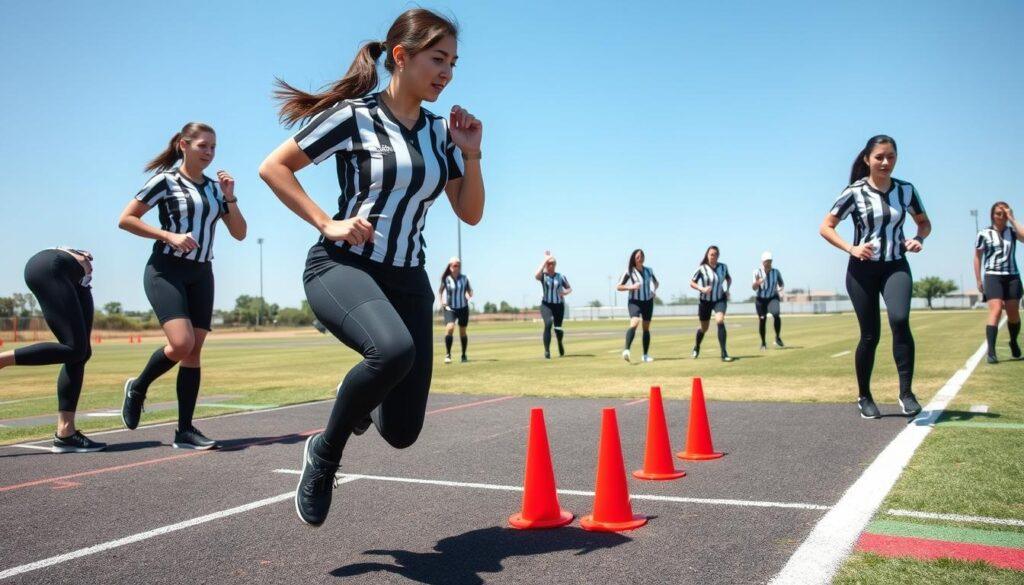
Think a referee’s fitness test is just a casual jog? Think again. These tests are tough, simulating the intense demands of a real match. The referee fitness test isn’t just a walk around the pitch. It’s high-intensity sprints, agility drills, and quick recovery periods.
The interval protocol is where the magic happens. Imagine sprinting at full speed, then resting for a short time. This mimics the stop-start nature of a game, where referees must stay sharp and responsive. It’s a carefully calibrated form of torture, ensuring that when the whistle blows, the official is ready for anything.
For women officials, the standards are no different from their male counterparts. Why? Because physiology doesn’t discriminate, and neither should we. The training is intense, and the expectations are high. A fatigued referee can lead to leniency in decision-making, which can have serious consequences on the field.
Now, let’s talk about agility sets with cues. This isn’t just about fancy ladder drills for social media clout. It’s about training your body to react to visual triggers. Picture a sudden change of direction or a flailing arm from a player. Your brain must be three steps ahead, anticipating the next move while your body responds instinctively.
Interval Training: Short bursts of high-intensity running.
Agility Drills: Focus on quick footwork and reaction time.
Mental Resilience: Decision-making under physical strain.
Ultimately, these fitness tests are not just gatekeeping exercises; they serve as vital safety mechanisms. Studies show that decision-making degrades under physical load. A fatigued referee is a lenient referee, and that leniency can result in illegal plays going unpenalized. So, yes, those shuttle runs are saving someone’s frontal lobe.
Breaking Barriers: Stories of Firsts and New Prospects
Every whistle tells a story of courage and the fight for equality. Women referees today are not just officials but trailblazers in a field once seen as male-only. They carry the legacy of those who fought to be seen on the field.
The documentary Whistleblowers sheds light on these women’s experiences at the 2023 Rugby World Cup. It shows the challenges they face, where every decision is scrutinized, not just for its correctness but also for how they look or act. This is their everyday reality.
The first woman to referee a men’s professional game faced incredible challenges. She had to be incredibly fit and composed. The focus on her gender was often more than her skills as a referee. These moments are not just trivia; they show the deep-seated resistance to change.
We celebrate these pioneers, but the fight is far from over. The next step is not just getting more women involved but ensuring they are judged fairly. The true victory will come when a woman referee’s mistake is seen as just that, not a reflection of her gender.
Newcomers now have role models who have faced the initial shock of being a woman in the game. They prove that the sport is changing. For more inspiring stories, check out Desiree Abrams’ journey or see how former women soccer players are making a difference off the field.
Getting Certified: Steps, Costs, Time Commitment, and Benefits
So, you want to become a referee? It’s a journey that requires patience and dedication. First, you’ll take a course that teaches you the laws of the game over a weekend. It’s like cramming for exams, but with more focus on rules and less on sleep.
The cost can vary a lot, from a few dollars to a few hundred. It depends on the sport and where you are. You’ll also spend time on ongoing education and attending clinics. It’s not just about officiating games; it’s about learning and growing.
Women in this field face extra challenges. They often have to prove themselves in a male-dominated world. It can be emotionally draining to assert your authority.
But the rewards are worth it. You get to see sports in a new light, learn from others, and develop strong decision-making skills. It changes how you watch games forever.
Getting certified is more than just a badge. It’s a way to see the world differently. It’s a journey that can be rewarding in many ways.
Spectator Guide: What to Shout and What to Skip
Spectators often think they can judge referees, but do they really get the game? Let’s be honest, most fans can’t pass a simple quiz on the game’s rules. Yet, they feel they can give real-time reviews at top volume, like they’re trying out for a foghorn.
The respect campaign is for everyone, not just players. So, what should you shout? Here’s a hint: skip anything that starts with “Hey ref” and ends with a bad word. And skip sentences with “always” or “never.” If you’re thinking in absolutes, you’re missing the point.
Women officials often face sexist heckling. Comments that would get you fired in any workplace are okay from the stands. Remember, if you wouldn’t say it to a male ref, don’t say it to a female one. That’s pretty basic.
Referees already face a lot of physical and mental strain. Your jokes about their eyesight aren’t helping. They just add to the noise that makes it harder for them to make fair calls.
So, be like a Stoic. Cheer for the good calls and groan at the bad ones. And remember, the person in the middle is doing a tough job you’d fail at in five minutes.
What to Shout
What to Skip
Why It Matters
“Great call!”
“You never get it right!”
Encouragement boosts referee confidence.
“Keep it up!”
“Hey ref, are you blind?”
Positive feedback fosters respect.
“Let’s go, team!”
“You always miss that!”
Support your team, not the negativity.
Resource List: LOTG Updates, Video Libraries, and Quizzes
Knowing the laws of the game is key for any referee. The official LOTG app is a must-have. It may not be the easiest to use, but it has the official text.
Understanding these laws is critical. With updates from IFAB coming often, it’s like trying to catch a bus that never stops.
Video libraries are a goldmine. FIFA’s training clips and World Rugby’s decision-making breakdowns offer valuable insights. For a deeper dive, check out the *Whistleblowers* documentary on rugbypass.tv.
It gives a raw, human look at the pressures of elite officiating. It’s not just about rules; it’s about the heart behind the whistle.
Quizzes are often overlooked but are very important. Platforms like AreYouReadyRef test your knowledge in real-world scenarios. They challenge your understanding and make you rethink the rules.
For women referees, these resources act as armor against stereotypes. Knowing the laws of the game cold is your best defense against any doubters.
Education and resources are vital. The editorial on injury prevention emphasizes the need for training opportunities. This helps bridge the gap between policy and enforcement.
Use this resource list as your toolkit. In a world where a single misinterpretation can spark outrage, being well-informed is not just beneficial; it’s necessary.
In sports, the story often stops when the game ends. But what’s next? Too many athletes fade into obscurity, leaving a legacy that feels unfinished. Moving from the excitement of competition to the quieter world of business and charity can be tough. Yet, for some, it’s a chance to make a new kind of impact.
Warren Creavalle is a great example. As a former Dynamo midfielder, he didn’t just stop playing. He started something new. During a pandemic and a time of big change, he co-founded Black Players for Change. This group gives Black voices a platform in soccer. His story shows that even when a career ends, influence doesn’t have to.
These retired athletes are not just looking back at their past glories. They’re actively shaping the future. They’re going into business, starting new ventures, and leading projects that challenge the usual ways of doing things. It shows that the skills they learned playing sports—like teamwork, resilience, and strategy—are very useful in the real world.
Five Stories Coach Startup Founder Nonprofit Leader Media Voice Advocate
These retired women soccer players are not just looking back; they are changing the game. They move from the field to roles that inspire others. This shows that ex-athletes can do more than just play sports.
Here are five distinct archetypes reshaping the landscape:
Coach: Forget the old idea of coaches. Today, they focus on making athletes feel safe. They create spaces where young athletes can grow without stress.
Startup Founder: Creavalle is a brand started by a retired player. It was launched while they were playing. This shows that the drive to start something new doesn’t wait for retirement.
Nonprofit Leader: This isn’t just about giving to charity. It’s hard work, like starting after-school programs. Kids design their own soccer jerseys, learning while being creative.
Media Voice Advocate: Retired players now shape stories. They use their platforms to push for change and support athlete activism.
Advocate: This role combines all the others. Former players fight against big barriers with the same drive they had on the field.
These five stories are not just exceptions; they are the new standard for retired athletes. The drive that fueled them on the field now fuels change in their lives.
Transferable Skills Leadership Teamwork Resilience Communication
Ever thought that teamwork from the sports field could boost your career? The skills you learn in sports are gold in the professional world. Let’s explore how these skills help former players in their careers.
Leadership is more than just giving orders. It’s about being strong in your beliefs, even when it’s tough. Remember when players stood together in silence to protest? That quiet power can change things in a corporate setting, too.
Teamwork means combining talents to form a strong team. This skill is perfect for the workplace, where working together is everything. It’s about seeing how your own strengths help the whole team, even when it’s hard.
Resilience is key for athletes. It’s not just about getting back up after losing. It’s about being ready to work even harder the next day. Startups talk about “failing fast,” but athletes have been doing this their whole lives. They see every failure as a chance to get better.
Lastly, communication is more than just yelling on the field. It’s about sending messages that really connect, like a visual that speaks volumes. Think of how an athlete might change from ranting on social media to making big changes in the league. That’s strategic thinking at its best.
The great thing about these skills is they can be used anywhere. You might not be able to run a 4.3-second 40-yard dash in a meeting, but the discipline of training? That’s a game changer. The challenge is to use these skills in new places, seeing that a scouting report and a market analysis are similar.
Lifestyle Blueprint Alumni Workouts and Healthy Habits
When your playing days end, it’s time to start a new chapter. Moving from athlete to civilian can seem tough. But, it doesn’t have to be a sad story. It’s about keeping your health in check, not chasing old glory.
Many retired athletes forget about their health after they stop playing. But, the smart ones keep it in mind. They switch up their fitness routine, like trying Pilates instead of squats. This change is not a punishment but a new way to care for your body.
Creavalle is a great example. While others binge-watched, he worked on a Black Lives Matter armband for the MLS. This creative project helped him stay mentally healthy. It shows how former players can make a difference and stay well.
Healthy habits for retired athletes aren’t just about food. They’re about finding a new sense of self. When the structure of a professional team goes away, you need to build a new routine. Remember, rest is not a weakness. A short walk with a podcast can be as good as a pre-game meal.
The main goal is to live a long, fulfilling life, not just to look back at highlights. It’s about enjoying the journey and finding new ways to live well after sports.
How Ventures Support Girls in Sport Scholarships Safe Fields Coaching Ed
To truly support girls in sports, we must build foundations that encompass safety, education, and empowerment. Investing in women’s sports and underserved communities is a game changer. It’s easy to write a check; it’s hard to build a safe field. Today, philanthropy has evolved from guilt-ridden charity galas to high-impact ventures that focus on real outcomes.
Scholarships are no longer just about covering camp fees. They now fund STEM education alongside dribbling drills, preparing young women for a future where they can excel both on and off the field. The “safe fields” movement emphasizes not just softer turf, but creating psychological safety zones where girls can learn without the pressure of a win-at-all-costs culture.
Take Creavalle’s after-school program in Chester, Pennsylvania. On the surface, it’s a jersey design workshop. Yet, on a deeper level, it’s a Trojan horse for design thinking, entrepreneurship, and self-expression. He’s not just teaching kids to kick a ball; he’s equipping them with the tools to create the apparel they wear. This approach is the new coaching education. It’s not about the 4-4-2 formation; it’s about teaching young women to navigate a world that often excludes them.
These ventures recognize that a soccer pitch is just a green rectangle until you layer it with mentorship. The return on investment for these projects isn’t measured in goals scored, but in confidence gained and cycles of poverty broken. It’s the ultimate long-term play. For more inspiring stories of former women soccer players creating impact beyond the pitch, check out this link.
Career Advice for Rec Athletes Networking Certifications Portfolio Building
So, you’ve played in weekend matches and now want a career in sports. You’re in good company! Many recreational athletes are making this move. But, they often miss some key steps. Let’s explore the basics: Networking, Certifications, and Portfolio Building.
Networking is your first step. It’s not just about collecting business cards. It’s about making real connections. Ian Babcock, from *Chat By The Pitch*, built his platform by having meaningful talks with soccer stakeholders. This way, you build relationships and learn more about the industry.
Now, let’s talk about Certifications. In today’s world, having a coaching badge is like having an MBA. If you want to run a coaching business, you need more than passion. Parents want to see your credentials, like safeguarding badges and first-aid training. The modern parent-coach relationship demands it.
Lastly, let’s look at Portfolio Building. Your portfolio should show your analytical skills, not just your athletic prowess. Start a blog or substack to analyze youth tactics. Record podcasts with local club heroes. Show that you can think critically about the game, not just play it. The barrier to start a coaching business is low, but credibility is key.
In conclusion, becoming a successful coaching business owner is more than just playing sports. It takes strategy in networking, getting the right certifications, and building a strong portfolio. For more on how former college athletes make this transition, read this article on career transition programs in the NCAA.
Volunteer Donate Attend How to Plug into Impact Projects
Are you ready to turn your love for soccer into something bigger? Getting involved in impact projects is more than just giving back. It’s a way to use your resources to make a difference. Here are three steps to get started: volunteer, donate, and attend.
Volunteer. If you have free time, use it to help out. Don’t just play soccer; use your skills to make a difference. If you’re an accountant, help with the finances of a local coaching program. If you’re a lawyer, help a nonprofit with their legal needs.
Donate. If you can’t give time, your money can help too. But don’t just give to big organizations. Look for local nonprofits where former players are making a difference. Your $50 could change a child’s life.
Attend. Your presence is important. Go to community meetings, fundraising events, or listen to podcasts like Chat By The Pitch. These events show that former players’ work is valued. It’s not just about learning; it’s about being part of the change.
So, raise your hand and join the movement. The future of soccer is being shaped in local communities and online. Don’t just watch; be part of this exciting change!
Book and Podcast Picks from Each Alumna
What do retired women soccer icons read and listen to after they retire? Their choices show a wide range of knowledge and insights. Each book or podcast they recommend tells a part of their story and the lessons they’ve learned.
For example, the podcast *Chat By The Pitch* is a favorite. Hosted by Ian Babcock, it explores soccer in-depth. Topics include:
The realities of youth soccer culture
Coaching philosophy and player development
Leadership and communication strategies
Parenting athletes in today’s environment
The mental side of competition
Building healthy club culture
Technology’s impact on the game
Grassroots to elite pathways
This podcast stands out from the usual quick opinions. It offers in-depth talks that are both informative and fun. It’s like a mental workout that’s sometimes tough but always worth it.
These athletes also have varied reading interests. For example:
The founder of a nonprofit might be engrossed in lean startup methodologies.
The advocate could be tuning into legal podcasts focused on civil rights.
The coach might explore breathing techniques and nervous system regulation.
These books and podcasts not only make their lives richer but also help them lead and inspire others. As the saying goes, “You are what you read.” These women are reading to grow and lead.
Impact Tracker KPIs and Success Snapshots
Measuring the impact of former players off the field needs data-driven decisions. Warm feelings alone can’t build fields or provide scholarships. We must analyze social outcomes as seriously as we do sports stats. Welcome to the Impact Tracker.
The KPIs here are clear and important. Let’s look at some key metrics:
Scholarships awarded: How many girls got scholarships?
Safe fields built: How many safe fields were made in food deserts?
Coaches educated: How many coaches learned about trauma-informed practices?
These numbers show real changes in lives. We’re focusing on real impact, not just “impressions.” A success snapshot is more than a photo with a big check. It’s a study showing kids in after-school programs graduate 20% more often. That’s a story worth telling.
Creavalle’s journey shows us the importance of qualitative KPIs. He moved from designing for himself to designing for others. This change is what we should track.
We need to see the effect of a single armband on TV. Did it change policies? Did it influence corporate spending? The Sage archetype wants proof. We’re done celebrating intentions; now we check the results. For more on this, see this KPI comparison discussion.
Action Steps Join Mentor or Sponsor a Program
The final whistle on this article signals a call to action. It’s time to shift from passive observation to active participation. Former players off field impact is profound, and you can be part of that change.
First, join the conversation. Engage with podcasts like Chat By The Pitch, where real discussions take place. These platforms focus on the nuances of player development and leadership. Listening to these voices can reshape your understanding of the game beyond just scores.
Next, consider mentoring. You don’t need to have a trophy cabinet to offer guidance. If you have expertise in finance, marketing, or law, your insights can empower a former athlete. A simple hour-long Zoom call can help them navigate the challenges of starting a coaching business or a nonprofit. Your experience is invaluable.
Lastly, sponsor a program. This is where your financial support can create tangible change. Many corporate budgets allocate funds for wellness and diversity initiatives. Redirecting these resources to ventures led by retired women soccer players can amplify their efforts on the ground. Buy the armband, fund scholarships, and invest in the future of the game.
Remember, the legacy of a player is not measured by goals scored but by the infrastructure built for future generations. The ball is at your feet. What will you do with it?
Finding the next big stars in women’s soccer isn’t easy. It’s not just about numbers or stats in an office. True talent scouts have a special eye for youth national team prospects and love the game.
We take a unique approach to find talent. We look beyond the highlights, exploring leagues like the NWSL, Frauen-Bundesliga, and Liga F. Age is important, but it’s different when a young player shines in a senior team.
The game is changing fast. Roles are shifting. For example, Sophia Smith moves from the sidelines to the center with ease. What makes a player stand out? It’s the small details, like quick decisions and hard work that count.
Ten prospects snapshots strengths signature moves mindset quotes
Meet the ten prospects who will amaze you with their skills. They are changing the game in women’s soccer. Each player has a unique style that keeps everyone excited.
The goalscorers who redefine positioning
First, we look at the goalscorers. They can find space where it seems impossible. Their skills and training let them score when others can’t.
Finding space where none exists
Sophia Smith is a great example. She can beat defenders with her quick moves. Her ability to anticipate the game is unmatched. Her first World Cup goal showed how she finds and uses spaces.
The creators who see two moves ahead
Next, we focus on the creators. They have a vision that breaks through defenses. Their foresight lets them make plays that leave defenders confused.
Vision that breaks defensive lines
These players can plan attacks with great accuracy. They see the game in ways others can’t. This sets up amazing goals and assists.
The disruptors who change game tempo
Lastly, we have the disruptors. They are experts at changing the game’s pace. Their energy and tactics can change a match quickly.
When pressing becomes an art form
They excel at turning defense into offense. Their aggressive mindset lets them read the game perfectly. This skill makes them stand out as future stars.
How they train ball mastery speed core recovery day in life
Training for women’s soccer stars is more than drills. It’s a lifestyle. They practice endlessly, beyond what you see on social media. Their success comes from hard, repetitive work that’s not always glamorous.
Ball mastery rituals that build touch under pressure
Ball mastery is more than juggling tricks. It’s about a deep connection with the ball. Players do rituals to control the ball in tight spots. This makes their first touch feel like a part of their body.
The 15-minute warm-up that pros swear by
Every session starts with a 15-minute warm-up. It’s not just a routine. It’s a special preparation that gets their muscles ready and their focus sharp. They do dynamic stretches and ball touches to get ready for the game.
Speed work that translates to game situations
Speed is key, but not just straight-line sprinting. Rising stars work on agility and quick changes. This training prepares them for game scenarios, letting them slow down and speed up while thinking tactically.
Why straight-line sprinting is overrated
Many think speed means just sprinting straight. But games need quick speed in all directions. So, athletes focus on agility drills to improve their field performance.
Core stability as the foundation of durability
Core stability is vital but often overlooked. It supports every move on the field. Players who focus on core training can handle the game’s physical demands and lower injury risks.
The plank variations actually worth your time
Plank variations are not just trendy; they’re effective. Different planks in their routines build a strong core. This strength improves performance and career longevity.
Recovery protocols that extend careers
Recovery is key to extending careers. It’s not just ice baths or foam rolling. It’s a full approach that includes sleep and nutrition. Athletes see food as fuel, knowing it affects their performance.
Sleep, nutrition, and the unglamorous truth
Many underestimate the role of sleep and nutrition. It’s not just about working out. It’s about resting well and eating right. This discipline sets the best apart from the rest.
A skill to steal from each player with a drill progression
Why not learn from the best youth national team prospects? Each player has a skill you can steal. This could be a technical move or a way to make quick decisions on the field. Let’s explore drills that can help you master these skills.
Dribbling deception drills from the best one-on-one artists
First, let’s talk about dribbling tricks. Sophia Smith is great at making opponents lose balance. Start with the mirror drill. Find a partner and mirror each other’s moves while dribbling. This improves your agility and ability to read opponents.
Mirror drill variations for reactive agility
Add challenges to the mirror drill. For example, one player can pretend to move while the other reacts. This boosts your reactive agility and prepares you for intense game moments.
Anticipation and timing exercises for penalty box predators
Now, focus on anticipation. Sophia is good at finding open spots in the box. Play small-sided games with a shrinking goal area. This helps you make quick decisions and understand the game better.
Reading the cross before it’s delivered
Practice reading crosses with a partner. Try to guess where the ball will come from. This drill improves your game reading and reaction time.
Positional fluidity training for modern hybrids
Let’s talk about being flexible on the field. Modern players can play wide and then cut inside. Start by practicing on the touchline, beating a defender, and then crossing the ball. This prepares you for game scenarios and boosts your tactical thinking.
The inside-outside winger circuit
Make the drill harder by adding defenders or limiting touches. This not only sharpens your skills but also prepares you for game situations where you need to adapt quickly.
These drills start simple and get more challenging. They help you integrate these skills into your training. Remember, these are the same steps that top youth players take to improve.
Training for young soccer players is changing a lot. We’re moving away from simple box jumps. Now, we focus on force absorption instead of just power. This is key, as ACL injuries in women’s soccer are a big concern.
It’s not just about jumping high. It’s about landing safely too.
Plyometrics That Prioritize Force Absorption Over Force Production
Plyometrics help players absorb force better. This is where landing mechanics play a big role. Learning to land right can lower injury risks a lot.
Players need to slow down and keep their knees safe. This helps them play longer and better.
Landing Mechanics as Injury Prevention
Knowing how to land is very important. A soft landing means fewer injuries. It’s like a dance, and the smoother you land, the better you’ll do.
Coaches should teach drills that focus on these skills. This prepares players for the game’s challenges.
Sprint Mechanics for Soccer-Specific Acceleration
Sprint mechanics have also evolved. The idea that arm drive is key to speed is not true. What really matters is the relationship between shin angle and ground contact.
Players need to keep a strong posture. This lets force move well from foot to hip.
The Arm Drive Misconception Everyone Has
Many young athletes are taught to pump their arms for speed. But, it’s the lower body that really matters. Fixing this mistake can make players faster and better on the field.
Microdosing: Training the Art of Accumulated Adaptation
Microdosing is a big change in youth training. It’s about short, focused sessions instead of long, distracted ones. Just ten minutes of daily intent can be more effective than two hours of aimless practice.
Why 10 Minutes of Daily Intent Beats 2 Hours of Going Through Motions
The future women stars are not just those who train the longest. They’re the ones who train smartest. Small, focused efforts can lead to big results over time. It’s all about quality, not quantity.
Balancing school and pressure mental health habits for teens and adults
The pressure on rising stars in women’s soccer isn’t just about the game. It’s about managing life’s demands. Young athletes today face an uphill battle, trying to excel academically while also training like future professionals. This challenge often goes unnoticed, yet it can make or break their mental health.
So, what does this academic-athletic tightrope look like? It’s not just about keeping up with homework while fitting in practice. It’s about mastering time management systems that actually work for travel schedules. Here are some effective strategies:
Prioritize Tasks: Identify what must be done daily and what can wait.
Set Realistic Goals: Break larger projects into manageable pieces.
Use Technology Wisely: Calendar apps can help keep track of both school and sports commitments.
Next up is the social media pressure that fuels performance anxiety. With every scroll, young athletes are bombarded with highlight reels of their peers, leading to the infamous comparison trap. But how do elite prospects escape this? Here are some insights:
Limit Social Media Time: Set boundaries to avoid constant comparisons.
Engage in Positive Communities: Surround yourself with supportive peers who uplift, not judge.
Lastly, let’s talk about mental health habits borrowed from sport psychology. These tools are not just fluff; they are proven performance enhancers. Incorporating practices like breath work and visualization can significantly impact an athlete’s routine:
Breath Work: Helps in managing stress and anxiety before big games.
Visualization: Prepares the mind for success by mentally rehearsing performances.
Pre-Match Routine: Establish a consistent routine to foster a sense of control and calm.
Ultimately, the goal isn’t just to produce better soccer players. It’s about nurturing healthier humans who excel both on and off the field. By implementing these strategies, young athletes can better navigate the pressures they face, ensuring they thrive in their dual roles as students and rising stars in women’s soccer.
Where to stream schedules and social follows
Finding where to watch future women stars can be tricky. With women’s soccer on the rise, finding the right broadcast can be overwhelming. Let’s simplify it for you to catch every game.
Broadcast platforms carrying youth and senior competitions
To watch the games, you need to know where to look. Here’s a quick guide to platforms for youth and senior competitions:
ESPN+ – Great for NWSL and select college games.
Paramount+ – Home to the UEFA Women’s Champions League.
Peacock – Streaming some U.S. Women’s National Team matches.
FuboTV – Offers a range of channels broadcasting women’s soccer.
These platforms might require subscriptions. But they’re worth it to follow rising stars in women’s soccer.
The streaming services worth your subscription dollar
When choosing streaming services, look for value. Consider these factors:
Comprehensive coverage: Find services with a wide range of leagues and tournaments.
Quality streaming: Make sure the platform offers a smooth viewing experience.
Accessibility: Check if they have mobile apps or work with smart TVs.
Tournament calendars and key dates for prospect watching
Timing is key to catch the next big talent. Mark these dates on your calendar:
Youth World Cups: U-17 and U-20 tournaments are key for spotting future stars.
Qualifiers: Watch the qualifying matches for the senior teams.
Showcase events: Local tournaments can also reveal talent.
Youth World Cups, qualifiers, and showcase events
These events are where the magic happens. To see rising stars in action, don’t miss them. Follow the tournament schedules closely.
Social media accounts that provide actual analysis
Social media is more than just highlights. For real analysis, explore these accounts:
@TheEqualizer – Offers in-depth coverage and analysis of women’s soccer.
@WomenSoccerZone – Focuses on the latest news and player insights.
@Tactical_Analyst – Perfect for those who love tactical breakdowns.
Who to follow beyond the highlight accounts
These accounts offer more than just highlights. They analyze plays, discuss strategies, and keep you updated on women’s soccer.
In conclusion, the world of women’s soccer is more accessible than ever. With streaming services and social media, there’s a wealth of information out there. For more on catching NWSL games, check out this guide.
Tactical evolution these players signal position changes
Forget everything you thought you knew about player positions; women’s soccer is rewriting the rulebook. The game is changing fast, with players taking on new roles. It’s not just about being good at the game. It’s about being smart and flexible on the field.
The death of the traditional winger and rise of the hybrid attacker
Wingers used to stay wide and cross the ball. But now, we have hybrid attackers. Players like Sophia Smith can play wide and then move to the center. This makes them hard to defend against.
How Sophia Smith and others are redefining wide play
Sophia Smith is a great example of this change. She knows when to stay wide and when to move inside. This smart play is the result of hard work and understanding the game.
Center backs who build like midfielders
Center backs are no longer just defenders. They help start attacks with precise passes. This change is making teams play differently.
The ball-playing defender revolution reaches the women’s game
More teams are using this style. Center backs are now starting attacks and creating chances. This shows how important being versatile is in women’s soccer.
Fullbacks as primary creators
Fullbacks are now key in creating chances. They’re not just defenders anymore. They’re making assists from deep positions.
When the assist comes from deeper than you expect
Today’s fullbacks are heroes, making key passes from deep. Their offensive skills show how the women’s game is evolving.
Player Type
Traditional Role
Modern Role
Key Skills
Winger
Stay wide, cross
Hybrid attacker
Dribbling, positional awareness
Center Back
Defend
Ball-playing defender
Passing, game reading
Fullback
Defend
Primary creator
Crossing, assist-making
The players we highlight are not just stars. They’re leading a tactical change that will shape soccer’s future. Watch them closely to understand the game’s next steps.
30 minute combo workout inspired by the class of the year
Ready to elevate your game? Let’s dive into a 30-minute workout inspired by the best in women’s soccer. This isn’t just any fitness routine. It’s a bridge between watching and doing, designed to get you moving like the rising stars you admire.
Warm-up Activation Sequence Borrowed from Pre-match Routines
First things first: we need to get your body ready without exhausting it. This warm-up focuses on dynamic mobility that opens your hips and activates your glutes. Think of it as a gentle nudge to your nervous system, preparing you for the real action ahead.
Dynamic Mobility That Prepares Without Exhausting
Leg Swings: 10 each leg
Hip Circles: 10 each direction
High Knees: 30 seconds
Butt Kicks: 30 seconds
Technical Circuit Modeled on Prospect Training Sessions
Now, let’s get to the meat of the workout. This technical circuit combines ball mastery with conditioning. Because, let’s be honest, who has time for separate skill work and fitness? We’re merging them into drills that demand precision while your heart rate climbs.
Ball Work That Doubles as Conditioning
Drill
Duration
Focus
Dribble through cones
5 minutes
Touch and control
Short passing with a partner
5 minutes
Accuracy and speed
One-touch shooting
5 minutes
Finishing under pressure
Finishing and Decision-making Under Fatigue
Now, we reach the segment that reveals your true character. This is where you’ll work on finishing exercises while feeling the burn. Decision-making scenarios become critical when your legs are heavy, and your brain wants to check out.
The Final 10 Minutes That Separate the Committed from the Curious
In this last segment, you’ll engage in:
Timed shooting drills
Quick decision-making exercises
Small-sided games to simulate pressure
All you need is a ball, some cones, and a willingness to embrace discomfort for half an hour. No gym membership, no excuses. Get ready to channel your inner rising star and transform your training routine today!
We’ve seen the talents of future women stars in soccer. But our role as fans is just as important. Responsible support goes beyond cheering; it shapes the culture around these athletes.
When we engage online, let’s uplift, not criticize. Remember, those comment sections are not empty spaces. Athletes read what we write. The pressure can be overwhelming, even for young players starting their careers.
Digital fandom that uplifts, not pressures
Positive interactions create a supportive environment. Criticism is okay, but let’s keep it constructive. Young players need encouragement to thrive.
They deserve a community that celebrates their efforts, not just their results.
The comment section and its real-world consequences
What we say online can affect a player’s mental health. Negative comments can overshadow their passion for the sport. Let’s choose our words wisely.
Match-day culture that respects the players as humans
At games, let’s create an atmosphere that acknowledges the players’ humanity. They are not just performers; they are young individuals facing immense pressure. A supportive crowd can inspire confidence, making every match an opportunity for growth.
What young athletes actually want from their supporters
They seek understanding, not just applause. Recognizing that every player has off days can foster a healthier sports culture.
Investing in the ecosystem beyond the stars
Support extends beyond the pitch. Following youth national team prospects or local clubs builds a rich soccer community. It creates depth in the sport, ensuring sustainability.
Following lower divisions, youth leagues, and local clubs
By engaging with every level of women’s soccer, we contribute to a vibrant ecosystem. Our attention helps nurture the next generation of stars, making the sport stronger for years to come.
Imagine telling a sports fan in 1985 about a women’s soccer match filling Wembley Stadium. They’d probably laugh. Yet, today we see a revolution. This journey isn’t just a trip down memory lane. It’s a deep look at how a few athletes broke down barriers.
I’ve watched the game grow from old VHS tapes of the 1991 World Cup to today’s HD. It’s clear: pioneers are key. They were the first to challenge the norms, before fame and TV time.
This article honors the amazing paths of these women. They didn’t just play; they changed the sport’s culture. From Marta’s incredible left foot to Mia Hamm’s bold moves, their stories are vital. If you love sports, progress, and excellence, get ready for a fascinating journey. For more on female athletes who changed the game, check out this insightful resource.
Why role models matter for recreational athletes and youth
Role models are the unsung heroes of recreational sports, lighting the path for aspiring athletes. Every time a child puts on their cleats, they carry the dreams and aspirations inspired by their role models. Icons like Mia Hamm, Marta, and Christine Sinclair do more than just score goals; they redefine what’s possible for young players.
When Mia Hamm dominated the 1999 World Cup, she wasn’t just scoring goals. She was handing out psychological hall passes to every kid who had been told soccer wasn’t “for them.” That’s the alchemy of role models. They create a space where ambition can flourish, even if it starts with a wobbly kick.
Here’s why role model athletes are so important for recreational players:
Inspiration: They show that success is achievable, no matter the background.
Visibility: Representation matters; seeing someone like you succeed opens doors.
Persistence: Role models embody the spirit of never giving up, a lesson every athlete can learn.
For many recreational athletes, it’s not about copying Christine Sinclair’s training regimen. It’s about absorbing her persistence and quiet refusal to let Canadian soccer remain an afterthought. That’s transferable. It’s the stuff that gets a 35-year-old accountant to join a Sunday league.
Representation isn’t just a buzzword; it’s the difference between a girl in Dois Riachos kicking a grocery-bag ball and the same girl becoming the greatest player in history. So, the next time you watch a game, remember: those athletes are more than just players; they are the catalysts for dreams yet to be realized.
Early barriers and breakthroughs timeline of women’s soccer milestones
Women’s soccer has faced many challenges. In 1921, England’s Football Association banned women’s soccer, saying it was unsuitable for them. This was just the start of a long fight against being ignored.
In 1991, the first Women’s World Cup happened. It was called the “1st FIFA World Championship for Women’s Football.” Michelle Akers scored 10 goals, despite fighting chronic fatigue syndrome. She was a true history maker!
The 1999 World Cup was a game-changer. It drew 90,185 fans to the Rose Bowl, a record. Sun Wen won the Golden Ball and Boot, showing Asian women’s soccer was ready for the world.
Every milestone in women’s soccer history was hard-won. These breakthroughs came from fighting against a system that saw women’s soccer as a joke. Seeing this timeline helps us understand the struggle behind every game we watch today.
1921: Women’s soccer banned by the FA in England.
1991: Inaugural Women’s World Cup held, Akers scores 10 goals.
1999: Rose Bowl final draws 90,185 fans; Sun Wen wins Golden Ball and Boot.
Five pioneer profiles origins key achievements and signature skills
In the world of women’s soccer, five names shine brightly. They changed the game and broke barriers. These trailblazers were not just great players; they showed the world what female athletes could do.
Pioneer
Origin
Key Achievements
Signature Skills
Marta
Brazil
6x FIFA World Player of the Year, 17 World Cup goals
Exceptional dribbling, creativity
Mia Hamm
USA
2x World Cup winner, 158 international goals
Vision, playmaking ability
Birgit Prinz
Germany
3x FIFA World Player of the Year, 282 goals in 282 club matches
Precision timing, tactical awareness
Michelle Akers
USA
FIFA Female Player of the Century, 10 goals in ’91 World Cup
Versatility, goal-scoring prowess
Sun Wen
China
FIFA Female Player of the Century co-winner, 1999 Golden Ball and Golden Boot
Technical sophistication, strategic thinking
Marta is often called the greatest female player ever. She dazzles with her left foot, making defenders seem invisible. Growing up in Dois Riachos, she turned scarcity into art, making every touch a masterpiece.
Mia Hamm was a quiet assassin who showed corporate America that female athletes could sell products. Her 158 international goals prove her skill. But her true talent was in lifting those around her, like a rising tide.
Birgit Prinz’s stats are almost unbelievable: 282 goals in 282 club matches. Her timing was so precise, it seemed she had read the script.
Michelle Akers is special for her Hall of Fame careers in both scoring and defense. She was a goal-scoring machine in the ’91 World Cup and later became a defensive midfielder, all while battling chronic fatigue syndrome.
Lastly, Sun Wen played with a technical skill that seemed futuristic. She won both the Golden Ball and Golden Boot in 1999, showing her importance in women’s soccer.
These five pioneers didn’t just break records; they shattered the idea that women’s soccer was inferior to men’s.
Fitness habits these legends used that rec players can copy
The real fitness game is in the daily routine. For recreational players, legendary athletes’ fitness habits are more than stories. They are practical guides to success.
Christine Sinclair is a great example. With a 23-year career, she didn’t get there by chance. She focused on sleep hygiene, followed a good nutrition plan, and always warmed up. These habits are easy to add to your routine.
Michele Akers faced chronic fatigue syndrome. Instead of ignoring it, she learned to manage her energy. For weekend warriors, this means playing games at your own pace. Enjoy the game without overdoing it.
Birgit Prinz believed in steady, consistent progress. Her approach is simple: show up and listen to your body. You don’t need fancy equipment or a personal chef to follow her lead.
Consistency: Show up regularly for training and practice.
Nutrition: Focus on functional foods that fuel your body.
Recovery: Prioritize sleep and manage your energy wisely.
Warm-ups: Never skip your warm-up routine; it’s essential for longevity.
These legends didn’t just get motivated; they built fitness on solid systems. By copying their systems, not their flash, you’ll find your own path to success is grounded in basics.
Tactical ideas each pioneer popularized and simple drills to try
The tactical innovations of these players are a masterclass in soccer artistry. Each trailblazing player brought something unique to the field, changing how the game is played. Let’s dive into their tactics and explore some drills that can elevate your game.
Marta is famous for her controlled chaos dribbling. This technique lets her move past defenders smoothly. To try it, set up a 6×6 yard cone grid. Dribble fast while changing direction with every touch. Don’t look down, even if you stumble. It’s all part of the learning process!
Mia Hamm was a master of finding space. Her moves created areas where none existed before. To practice, play a 3v3 game in a tight space. Score only after getting a pass in a “Hamm pocket,” between the opponent’s midfield and defense.
Birgit Prinz was all about perfect timing. Her runs into the box were so precise they seemed almost prophetic. To improve your timing, have a partner cross balls from different angles. Start your run from outside the 18-yard box, then accelerate at the right moment.
Michelle Akers showed us the importance of positioning. It’s not just about where the ball is; it’s about where it will be next. Practice this with a 5v2 rondo, focusing on anticipating the next pass. This drill improves your game awareness.
Lastly, Sun Wen’s technical skill is evident in her ability to receive, process, and distribute the ball quickly. Try a one-touch wall-pass drill, varying the angle and pace. Remember, these drills don’t need elite athleticism—just focus and attention.
Off field impact advocacy equal pay visibility and community work
While scoring goals grabs headlines, the real game-changers operate off the field. The legacy of women in soccer is rich with stories of history makers. They have championed causes that go beyond the sport itself.
Ada Hegerberg is a great example. In 2017, she stepped away from the Norwegian national team. This was a bold protest against the treatment of female players. She sacrificed World Cup glory to spark a conversation about equity in women’s sports.
Julie Foudy also made a big impact. She used her skills to influence policy. Her work may not always be in the spotlight, but it shapes the future.
Wendie Renard’s temporary retirement from the French national team is another example. She demanded better management from her federation. Her return under new leadership is a victory for all players fighting for change.
Mia Hamm showed that women athletes can be marketable superstars. Her endorsement deals opened doors for future female athletes. They proved that women’s sports are a viable business opportunity.
Community work often goes unnoticed, yet it’s vital. Marta’s foundation in Brazil and grassroots camps run by former players nurture the next generation. These efforts show that off-field impact is at the heart of their legacies.
What they wish they knew advice quotes and mindsets
Imagine sipping coffee with soccer legends; what insights would they share? Women soccer pioneers have a wealth of wisdom to offer. Each story teaches us that the journey is as important as the destination.
Michele Akers is a great example. She talks about the importance of listening to your body. Her fight with chronic fatigue syndrome showed her the limits of willpower. “I wish I had understood earlier that rest is part of the game,” she might say, showing the need for balance between ambition and self-care.
Marta, known as “Pelé in skirts,” carries a heavy title with pride and pressure. Her story from poverty to greatness teaches us a key lesson: “You don’t need validation from anyone, not even from a man.” This shows the value of self-acceptance and confidence in one’s abilities.
Christine Sinclair is a model of quiet leadership. She might say, “Leadership doesn’t need to be loud. It’s about the collective, not the individual.” Her focus on teamwork over personal achievements is a lesson she wishes she’d shared more with her teammates.
Lastly, Homare Sawa, known for her calm under pressure, once said, “Embrace calm urgency.” This mindset helped her score a key goal in the 2011 World Cup final. It’s about knowing the stakes while staying calm—a lesson in emotional control.
The common thread in their advice? Focus on the process, not just the outcome. Control what you can, and don’t compare your early chapters to others’ later ones. These are not just words; they are lessons from women who have been there.
Pioneer
Key Advice
Mindset
Michelle Akers
Listen to your body
Balance ambition with self-care
Marta
Seek self-acceptance
Confidence without validation
Christine Sinclair
Value teamwork
Quiet leadership
Homare Sawa
Embrace calm urgency
Emotional control under pressure
How to watch read and learn documentaries books and matches
Exploring women’s soccer history can be as challenging as navigating a crowded field. But, with the right tools, you can uncover the stories of the history makers who changed the game. Let’s see how to start this exciting journey.
Documentaries are a great way to get into the stories of these pioneers. Start with “Dare to Dream,” which tells the story of the 1999 US Women’s National Team (USWNT) and their historic win. This film is more than just a look back; it shows the hard work and determination of these athletes.
Another must-see is “LFG,” which documents the fight for equal pay. This film shows the players’ passion and determination, making you want to cheer for them.
For reading, Caitlin Murray’s “The National Team” is a must-read. It tells the story of the USWNT’s growth from an afterthought to a cultural icon. Don’t forget to read international perspectives too—Marta’s biography and the 2011 Japanese team’s oral histories are insightful.
Now, let’s talk about matches. The 1999 World Cup final is a key moment. The footage may be old, but it’s important to understand its significance. Then, there’s the 2011 final, where Japan faced the USA in a tactical battle that will keep you on the edge of your seat.
Carli Lloyd’s hat-trick in the 2015 final is unforgettable. And don’t miss the 2023 World Cup final, where Spain’s tiki-taka style was showcased, showing the game’s evolution.
When watching these matches, watch them as a student. Pause, rewind, and think about why players made certain moves. It’s not just about nostalgia; it’s about learning. By diving into these resources, you can truly appreciate the impact of these history makers on soccer.
Resource Type
Title
Focus
Documentary
Dare to Dream
1999 USWNT Triumph
Documentary
LFG
Equal Pay Fight
Book
The National Team
USWNT’s Journey
Book
Marta’s Biography
Global Impact
Match
1999 World Cup Final
Historical Significance
Apply it to your routine 4 week inspiration based plan and further resources clubs camps and mentorship programs
Turning admiration into action is truly magical. Role model athletes have shown you the way. Now, it’s your turn to take the field, even with a busy schedule. This four-week plan helps you add their wisdom to your daily life.
Week One is all about building a strong foundation. Pick a fitness habit from your favorite athlete. Maybe it’s Sinclair’s dedication or Akers’ energy control. Make it a daily habit and track your progress. This is more than a suggestion; it’s a promise to yourself to grow.
In Week Two, focus on technical skills. Choose a drill from the tactical ideas we shared. Practice it three times a week for 20 minutes. Remember, getting better takes time, not perfection.
Week Three is about understanding the game’s tactics. Watch a historic match from our list. Take notes on strategy and decision-making. Seeing these aspects will make you appreciate the game more.
Week Four is all about connecting with others. Look for local clubs, leagues, or mentorship programs. Places like the NFCA offer clinics for all skill levels. Join online communities on Discord and Reddit. These spaces are filled with people who love the game as much as you do.
This four-week plan isn’t about becoming a soccer star overnight. It’s about building a lasting connection with the sport. The resources and community are ready for you. Now, it’s up to you to join in.
Ever wonder why some athletes seem to be both casual and professional at the same time? That’s what I thought when I saw Keisha Williams do a perfect nutmeg at the park. It made me realize that these local women soccer stars are more than just players. They are the heart of our communities.
In this series, we’ll explore the stories of these amazing athletes. They’re not just the best at pickup games; they connect the NWSL dreams we see on TV with our local league. They’re like the “middle child” of athletic greatness—too good for rec leagues but down-to-earth enough to stay relatable.
Let’s dive into my chat with Sofia Martinez, a midfielder whose skills are incredible. We’ll see how these hometown heroes make the game more real and awe-inspiring. Why do we idolize distant stars when the real magic is right in our own backyards? This is a tribute to those who show us that elite skill can be found right here, with a commitment to play at the local pitch.
Three interviews origin stories peak moments favorite drills
Every legend has a story that’s not found in the highlight reel. I talked to three amazing women—Alyssa Chen, Tamika Jones, and Rachel “The Wall” Okonkwo. They shared their journeys in football. Their stories paint a vivid picture of their lives beyond the pitch.
Alyssa Chen grew up in Oakland, where she learned to juggle a ball on a cracked driveway. Her abuela timed her every attempt with a kitchen clock. “It was just me and that ball, trying to beat my own record,” she reminisces. This simple act of practice became the foundation of her relentless drive.
Next, we have Tamika Jones, whose peak moment didn’t involve a championship goal but a slide tackle. This tackle earned a nod from a rival coach known for his stoic demeanor. “I’ll never forget that moment,” she says, her eyes lighting up. “It felt like I had earned respect, not just from my teammates but from someone I looked up to.”
Then there’s Rachel “The Wall” Okonkwo, who shared her favorite drill: a grueling cone weave she calls “the octopus.” “It’s a killer workout, but it humbles even the cockiest college kids,” she laughs. This drill has become a rite of passage for young players eager to prove themselves.
What ties these stories together? A few common threads emerge:
Obsessive Repetition: Each legend emphasized the importance of practice, often repeating drills until they became second nature.
A Mentor’s Influence: Whether it was a family member or a coach, having someone who believed in them was key.
Transformative Failures: Every setback reframed their perspective, pushing them to grow stronger and more resilient.
These narratives are like indie films in the soccer world—lower budget but packed with soul. They remind us that behind every kick and goal, there are countless hours of sweat, laughter, and lessons learned. As we dive deeper into this interview series, we peel back the layers to reveal the humanity behind the athletes we admire.
Game day warm ups and nutrition scaled for rec players
Let’s get real: pre-game rituals for local women soccer stars are super relatable. Forget fancy açai bowls; our soccer heroes keep it simple. I talked to some local legends to find out what they eat and how they warm up before games. It’s surprisingly down-to-earth.
Keisha, for example, eats a gas-station banana and does dynamic stretches from a 2016 YouTube video. No need for a personal trainer when you have the internet. Sofia, on the other hand, listens to Bad Bunny and eats three sour gummy worms before games. It’s all about the vibe, not just the food.
So, how do we make elite sports science work for rec players? Let’s look at a quick 15-minute warm-up that’s easy to follow. Here’s a simple routine:
Warm-Up Activity
Duration
Purpose
Dynamic Stretching
5 minutes
Increase flexibility and range of motion
High Knees
2 minutes
Elevate heart rate
Butt Kicks
2 minutes
Activate hamstrings
Side Lunges
3 minutes
Engage lower body
Short Sprints
3 minutes
Prepare for game intensity
Now, let’s talk about nutrition. It’s about finding a balance between what’s practical and what works. Here’s a quick guide that acknowledges the importance of breakfast burritos while keeping your focus on the game:
Pre-Game Meal: Choose something light but filling, like a breakfast burrito or a smoothie.
Hydration: Water is your best friend. Stay away from sugary drinks that can drop your energy.
Snacks: Quick energy boosters like bananas or gummy worms are great for a last-minute pick-me-up.
The goal is to use elite preparation without the full-time athlete lifestyle. It’s like a capsule wardrobe for soccer—minimal, functional, and surprisingly stylish.
Injury lessons prevention routines and return to play insights
Injuries are not just setbacks for our hometown heroes; they are transformative experiences. An ACL tear shatters the invincibility myth of a local star. Rachel Okonkwo calls her MCL sprain a “betrayal by my own knee, like a trusted politician caught in a scandal.”
Injury prevention routines are essential. Tamika’s hip-strengthening sequence is tough but keeps our heroes on the field. Athletes rush back because of passion and fear of losing their identity.
Returning to play is not just physical; mental readiness is key. Trusting a joint again is like learning to ride a bike again. You wonder, “Will it hold me?”
Injury Type
Prevention Routine
Return to Play Insight
ACL Tear
Strengthening exercises
Gradual reintroduction to high-impact activities
MCL Sprain
Flexibility and balance training
Focus on mental readiness
Hamstring Strain
Dynamic warm-ups
Listen to your body
In sports medicine, the conversation is evolving. Injuries are not just physical but deeply psychological. As our hometown heroes return, they redefine their identities, showing that fragility can coexist with resilience.
Balancing jobs school and sport time management hacks
Ever wonder how our hometown heroes manage careers, studies, and sports? Alyssa Chen, Tamika Jones, and Rachel Okonkwo show us how. They each have their own way of managing time, keeping them successful in all areas.
Alyssa, a full-time nurse, uses her “power hour” before work. She focuses on skill work, making it a special time. It’s like getting in a mini training session before her shift starts.
Tamika, a middle school science teacher, blocks her calendar like a CEO. She plans every minute of her day. This way, she makes sure her time on the field is as valuable as her time teaching.
Rachel, finishing her MBA, believes in “productive rest.” She watches game film while foam rolling. It’s a smart way to recover and stay connected to her sport.
These tips aren’t just from influencers; they’re from our hometown heroes. They prove that with smart time management, we can follow our passions.
But, they face real challenges. Scheduling games late at night and limited field access are just a few. It’s not just about time management; it’s fighting against being too busy. If they can handle work, school, and sports, maybe we can too.
Favorite parks leagues and pickup spots with safety notes
In our city, some parks are the heart of soccer. They are where local women soccer stars sharpen their skills and make friends. These places are more than fields; they are community centers filled with joy, rivalry, and debates.
Lincoln Park is a favorite for Sofia Martinez, thanks to its floodlit field. But she warns about a hidden divot near the far goal. It’s a sneaky hazard that has tripped up many players. It shows that safety is key, even in our favorite parks.
At Jackson Playground, Keisha Williams enjoys Saturday morning games. The vibe is competitive yet friendly. It’s a place where players can show off their skills in a fun, safe environment.
When looking for a game, check the park’s amenities. Is there a restroom nearby? How’s the field? And watch out for stray dogs that might interrupt play. Knowing these details can make your experience better and safer.
These parks and leagues are more than fields; they are community spaces. They build bonds, offer mentorship, and spark discussions on game strategies. Each field has its own story, celebrating the heart of soccer where our local heroes shine.
How they give back camps gear drives mentorship
What makes a female football legend truly legendary? It’s the impact she has on her community. These remarkable women excel on the field and uplift those around them. They show their commitment through various initiatives for the next generation.
Take Tamika Jones, for example. She started a free Saturday clinic for girls in her old neighborhood. Funded by bake sales and her determination, it teaches soccer and builds confidence. A young girl learning from someone who once stood in her shoes is a powerful thing!
Alyssa Chen is another shining example. She organizes an annual cleat drive, giving over 500 pairs of boots to kids. This generosity opens doors to opportunities many take for granted. How many young athletes struggle because they lack the right gear?
Then there’s Rachel Okonkwo, who mentors three young goalkeepers through text messages. Her advice mixes technical skills with life lessons. This approach builds not just skills, but also resilience. It prepares these young women for life’s challenges.
The ripple effects of these initiatives are profound. They teach valuable life skills, create safe spaces, and break down barriers in youth sports. This work may not always make it to ESPN, but it reshapes a community.
So, let’s ask the uncomfortable question: if these women can achieve so much on a shoestring budget, what’s the excuse of well-funded clubs? Their community impact shows true greatness isn’t just about winning trophies. It’s about lifting others as you rise.
Photo essay and career timeline for each legend
A photo can tell a thousand stories, like those of our local legends. This part explores their visual and chronological journeys. It shows how they grew from hopeful kids to celebrated athletes.
Alyssa’s story starts with her first AYSO team, where she wore jersey number 12. It was chosen for luck and because it matched her age. Her journey from awkward dribbling to being a key player is inspiring and relatable.
Tamika’s path is marked by a year playing in a men’s league. She did this because no women’s team was nearby. It highlights the gaps in sports that female athletes face today.
Rachel’s story is told through her goalkeeping gloves. From duct-taped to pro-level, each pair shows her growth and determination.
In this photo essay, I’ll add notes that make it feel like a family album. These moments remind us that greatness takes time. It’s a slow-cooked meal, full of flavor and history.
Fan corner nominate the next feature and submit questions
This isn’t just my story; it’s a community tapestry woven from your voices. I’m inviting you to nominate the next local female football legend we should spotlight. Maybe it’s the striker who’s been quietly dominating your Tuesday night league for a decade, or the coach who turned a ragtag group of kids into a dynasty. Who do you think deserves recognition?
But wait, there’s more! I want to hear your questions too. What do you want to know about their rituals, their failures, or their secret to a perfect chip shot? Let your curiosity guide you! I’ll curate the best submissions and weave them into future installments, transforming this from a monologue into a lively dialogue.
The analytical hook here is about community impact—how we, as a collective, decide who gets remembered and why. By crowdsourcing our next subjects, we’re not just celebrating individuals; we’re mapping the hidden network of excellence that official sports media often overlooks.
So, go ahead, type that name into the form. Let’s ensure the next legend gets her due before she becomes just a story told at the bar after the game. Together, we can elevate the voices that deserve to be heard!
Weekly challenge replicate a legend’s mini workout
Ready to step out of your comfort zone? This week, I challenge you to channel the spirit of our hometown heroes. Try Tamika Jones’s “10-Minute Torch.” It’s a bodyweight circuit for those days when you can’t get to the field.
The workout includes squats, lunges, and burpees. Yes, burpees. Don’t roll your eyes just yet. Each move helps build strength and agility. Can you keep up with Tamika’s focus? It’s a test of both body and mind.
Share your journey with us. Post your sweaty selfies and even those moments of struggle. We all have them. This isn’t just about fitness; it’s about creating a community that celebrates the effort, not just the outcome. Every legend was once a beginner, and your journey matters.
Embrace this challenge. As you sweat through the workout, remember that you’re connecting with the spirit of our hometown heroes. You’re not just replicating a workout; you’re embodying the dedication and resilience they represent. Lace up those sneakers and get ready to sweat. You might just discover a new side of yourself.
Imagine you’re running fast, but you’re worried about your bra. It’s uncomfortable, chafing, or digging into your skin. We’ve all been there.
Finding the right sports bra is key. It’s not something you can ignore. Experts say to choose one that fits your size and activity level. This is vital for bounce control and comfort.
A good sports bra keeps you focused on the game, not your bra. It’s not just about feeling good; it’s about playing better. The right support means you can run faster and play harder.
We want to share this knowledge with everyone. We’ll help you find the perfect fit, support, and comfort for your games. Let’s get you ready to play!
Fit fundamentals: band and cup measurement at home, sister sizing, try‑on moves for soccer (jumps, sprints, cuts)
Finding the right sports bra is like getting your soccer cleats just right. It starts with the right size. A good sports bra fit is key for comfort and support during games. Here are simple steps to follow at home.
First, use a soft measuring tape. You need to measure your band and bust sizes. For the band, wrap the tape around your ribcage, just below your bust. Make sure it’s level and parallel to the ground. For your bust, measure around the fullest part of your chest, but don’t pull too hard. Write down both numbers.
Your band size is your base. The difference between your bust and band sizes tells you your cup size. Each inch difference is one cup size (e.g., 1 inch = A cup, 2 inches = B cup). But remember, always check the brand’s size chart. Sizes can vary between brands, so your perfect fit might not be what you expect.
Ever found your size sold out? That’s where “sister sizing” comes in. If your band feels too tight, try a bigger band and smaller cup size. If it’s too loose, go down a band and up a cup. It’s not a perfect swap, but it can help when your first choice isn’t available.
Now, it’s time to test the bra in the fitting room. A bra might feel fine standing up but not during action. Put it through a soccer workout:
Jumping Jacks: Test for vertical bounce control.
Sprints in Place: Mimic forward motion to check for strap slip and overall hold.
Lateral Shuffles: Simulate cutting moves to see if the bra provides enough side support.
If the band rides up during these moves, it’s too big. A band that’s too loose is like shin guards that slide down—it just doesn’t work! You want secure, chafe-free support that lets you focus on the game, not your gear.
Take your time with this process. A great sports bra fit is your first teammate on the field.
Support types: compression, encapsulation, hybrid—who needs what by size and position
Not all sports bras are the same, and for soccer players, picking the right one is key. You need to decide between compression, encapsulation, or hybrid support. This choice helps prevent bounce and chafing during games.
A compression bra is like a tight, all-in-one package. It wraps your chest tightly, keeping breast tissue flat. This style is often called a “second-skin” fit.
Compression is great for high impact support if you’re an A, B, or small C cup. It’s simple, light, and perfect for those who like a unified feel. For soccer’s constant motion, it offers a solid base layer of control.
Encapsulation is like placing two items in a structured box. These bras have separate, molded cups for each breast. They lift and separate, not just press.
This design is a powerhouse for high impact support, best for C+ cup sizes. Lab tests and athlete feedback show it’s superior at preventing movement. If you’ve felt bounce during a corner kick or a sudden cut, this style is designed to solve that.
The hybrid bra is the third option. It combines the best of both worlds. You get the all-over compressive hug of a compression bra, plus the structured, individual support of encapsulated cups.
For soccer’s dynamic mix of endurance runs and explosive sprints, a hybrid is often the MVP. It offers versatile, high impact support that adapts to your entire range of motion on the field.
So, who needs what? If you’re in smaller cup sizes and prefer a minimalist feel, compression is a good choice. For larger cup sizes where bounce control is key, encapsulation is often recommended. And for many players seeking adaptable, secure comfort, the hybrid is the best option.
With this knowledge and our general sports bra guide for fit fundamentals, you’re ready to shop like a pro. Your position matters too—a midfielder logging miles might prioritize something different from a goalkeeper making quick, reactive moves. Choose the support that matches your body and your role on the pitch!
Features that matter: straps, adjustability, racerback vs U‑back, hooks, pads, seams, anti‑chafe fabrics
Let’s explore the key features that make a sports bra perfect for game day. It’s like going on a feature safari. We’re looking for the details that keep you comfortable during every move.
The straps are the first thing to consider. Wide, adjustable straps are essential for soccer. They spread the weight of your bust evenly, avoiding discomfort.
Adjustability is key, whether you’re growing or changing your workout routine. A bra with adjustable straps lets you customize the fit. This ensures a snug, comfortable feel without feeling restricted.
The racerback style is great for soccer players. It allows for more movement, which is important for throwing and heading. The straps are closer together, providing stability.
The U-back style is another option. It’s better for those with broader shoulders, as it offers a wider strap placement. Your position on the field might influence your choice. For example, a midfielder might prefer the racerback, while a goalkeeper might like the U-back.
How you put on your bra is important too. Hook-and-eye closures are easy to use and allow for a precise fit. Pullover styles, on the other hand, offer a smooth feel under your jersey.
Removable padding is a great feature. It adds modesty and a smooth look under thin jerseys. You can remove the pads for washing or if you prefer a natural shape.
The bra’s construction is key for preventing chafing. Look for fabrics labeled as “anti-chafe” or “chafe-free.” These materials are designed to keep you dry and comfortable.
Check the seams too. Flat-locked or seamless construction is a big plus. Brands like Nike and DSG use these methods to ensure a smooth feel. This is important for long games, as any irritation can be distracting.
All these features work together. They turn a good sports bra into a great one. Your comfort and focus should never be affected by your gear.
Heat and sweat: breathability, quick‑dry, washing care to extend life
When you’re running fast on the soccer field, you don’t want a heavy, wet sports bra. Soccer is very sweaty. How your gear handles sweat can greatly affect your comfort and focus.
Advanced fabric technology is the key. Unlike cotton, which soaks up sweat and stays wet, these materials are made to wick moisture away from your skin. It’s like having a personal cooling system in your bra.
Brands like Nike, Under Armour, and CALIA use special technologies. Their Dri-FIT, HeatGear, and Breeze technologies quickly move sweat to the outside where it can evaporate. This keeps you dry and cool, improving breathability.
This high breathability is key. It lets air move around, preventing a sticky, chafed feeling during long games or training. When shopping, look for “moisture-wicking,” “quick-dry,” or “ventilation” tags. These show the fabric is made for action.
But, this smart fabric needs smart care to keep working well. Washing your sports bra right helps it last longer and keeps its wicking powers.
Here are simple care tips to keep your bra in top shape:
Wash in Cold Water: Use a gentle cycle with mild detergent. Hot water can damage elastic fibers.
Skip the Fabric Softener: It blocks the technical fibers’ ability to wick moisture. Your bra won’t work as well!
Air Dry Always: Tumble drying is too hot for your bra. Lay it flat or hang it to dry.
Close Hooks: Fasten any hooks before washing to prevent snagging.
For more on washing athletic wear, Nike has a detailed guide. Taking good care of your gear means it will support you, game after game.
By picking bras with breathable, quick-dry fabric and caring for them right, you’re not just staying comfy. You’re making sure your gear is as tough and ready as you are for every challenge.
Teen considerations: growth spurts, privacy and body‑positive shopping; school/team ordering tips
For young soccer players, finding the right sports bra is more than just support. It’s about growing with confidence. With smart strategies, you can find gear that grows with the athlete and keeps them comfortable.
Growth spurts are a big challenge. A bra that fits today might feel tight later. Look for adaptable designs with adjustable hooks and straps for a wider fit range.
For teen athletes figuring out their cup size, stretchy styles or encapsulation bras are more forgiving. They offer a bit of stretch without rigid cups.
Reviews for the Nike Girls’ Pro Swoosh Sports Bra highlight its flexibility. Parents love its durable fabric that holds up through growth and intense activity. The DSG Girls’ Performance Bound Shelf Bra is also praised for its simple, wide-band compression fit that works for various stages.
Privacy and a positive mindset are key. Shopping for a sports bra can feel vulnerable. Create a low-pressure environment. Use detailed size charts and consider ordering two sizes to try at home.
In stores, ask about quiet hours or use self-checkout options. Focus on performance and comfort, not just measurements. Use positive language to help them play better, not how their body looks.
When ordering for a whole team or school, organization is key. Bulk orders can simplify things and often come with discounts. Here are some effective tips:
Organize a Sizing Session: Work with a retailer to host a private fitting event. This gives each player a chance to try a few styles in a supportive, team-only setting.
Choose a Versatile Style: Pick one or two high-quality, widely-liked models. The Nike Pro series is a frequent team choice because it suits many body types and activity levels.
Collect Sizes Anonymously: Use a simple form where players can list their size and style preference without announcing it to the group. This protects everyone’s privacy.
Order a Few Extras: Always order a couple of extra bras in common sizes. This covers last-minute additions, replacements, or those surprise growth spurts!
The right sports bra for a teen athlete supports their game today and adapts for tomorrow. By focusing on adjustable features, fostering a positive experience, and planning ahead for team needs, you set them up for many chafe-free, confident match days.
Budget to premium: value picks, mid‑range, and pro‑level options; how to read brand size charts
Finding the right sports bra doesn’t have to be hard or expensive. There are great options at every price level. We’ll help you understand the different tiers: value, mid-range, and pro-level. Each one meets different needs and budgets, and there’s no shame in choosing what’s right for you and your sport.
Let’s look at real examples from the field, so you know exactly what to expect when you shop.
Value Picks: The Essential Starters
Value sports bras are your reliable teammates. They offer good support and comfort without costing a lot. They’re perfect for beginners, growing teens, or anyone starting their sports gear collection.
Brands like Champion and DSG (Dick’s Sporting Goods) are great here. You can find styles from $10 to $25. The Champion Spot Comfort Full-Support Bra, often called a “Best Value” pick under $20, is a great example. These bras focus on essential compression or encapsulation and use breathable fabrics.
Think of this tier as your practice gear: dependable, does the job well, and lets you invest more elsewhere.
Mid-Range Performers: Tech and Durability
In the mid-range, from $25 to $55, you see better technology and construction. This is where brands like Nike, Under Armour, and CALIA shine with features for serious training.
You’ll find better moisture-wicking, more strategic seam placement to reduce chafe, and often a hybrid of compression and encapsulation for a more customized feel. A Nike Pro Indy or a Under Armour Infinity Mid bra in this range introduces more durable straps and longer-lasting elastic.
This tier is for players who are committed to their sport and want gear that keeps up with intense drills, league play, and frequent washing.
Pro-Level Investment: Precision for Demanding Play
At the premium level (often $55+), you’re investing in advanced materials and precision engineering. These bras are built for elite athletes or anyone who needs maximum, unwavering support for high-impact play like competitive soccer.
Think of features like targeted power-mesh panels for extreme breathability, seamless laser-cut edges to eliminate all chafing, and highly adjustable, multi-configuration straps. The Nike Alpha line or high-support options from specialist brands fall here.
The investment pays off in unparalleled fit, minimal distraction, and often a longer lifespan due to top-tier fabric and construction.
The Golden Rule: Decoding the Brand Size Chart
Here’s the most important lesson in your entire search: the tag in your drawer means nothing. A “Medium” in Nike is not the same as a “Medium” in Under Armour. Your true guide is always, always the brand’s specific size chart.
How do you use it? First, have your recent band and cup size measurements handy. Then, find the brand’s chart—usually on the product page. Don’t assume! Follow these steps:
Match your band measurement to the chart’s band column.
Find your cup size in the corresponding row.
See what size label (S, M, L, or 34C, 36B, etc.) that intersection points to.
For example, your measurements might point to a “Large” in Brand A but a “Medium” in Brand B. This isn’t about your body changing; it’s about each brand’s unique fit model. Trusting the chart is the single best hack for a perfect sports bra fit and avoiding returns.
Whether you choose a value champion or a pro-level precision tool, using the size chart ensures your pick supports you perfectly, from the first sprint to the final whistle.
Problem solving: nip coverage, digging bands, strap slip, bounce on corners; alterations and hacks
Let’s tackle those common sports bra gripes that can disrupt your focus during a game. Even a great bra might need a small tweak to become perfect for you. We’re here with practical fixes and clever hacks so you can play in total comfort.
Remember, the first solution is always a proper fit. If you’re not there yet, one of these targeted strategies will likely help.
Solving the Nip Coverage Dilemma
This is a common concern for modesty and comfort. Many sports bras, like the CALIA Restore style, come with sewn-in foam pads that provide reliable coverage.
If your bra has removable pads, you can adjust them for a smooth look. No pads? A simple hack is to purchase a set of lightweight, moisture-wicking inserts. They slip right into the bra’s inner lining.
When the Band Digs In
Feeling a tight band dig into your ribs or back is painful. User reviews often mention this “dig in” sensation. First, check if you’re in the right band size. The support should feel snug, not restrictive.
If sizing up the band feels too loose, try a band extender. This small accessory adds an inch or two of breathing room. Another option is to explore “sister sizing”—going up a band size and down a cup size.
For immediate relief, apply an anti-chafe balm where the band rubs. Source data confirms that chafing is often caused by sweat combined with friction.
Stopping Strap Slip for Good
Slipping straps are annoying and can compromise support. This often happens with traditional U-back styles during dynamic movement.
Look for bras with grippy silicone strips along the inner part of the straps. These grip your skin and shirt to stay put. You can also buy a racerback converter—a small clip that pulls the straps together in the back.
Converting a U-back to a racerback not only stops slip but often enhances bounce control.
Conquering Bounce on Corners and Cuts
If you feel movement during sharp lateral cuts (“taking corners”), your bra might not offer enough support. This is a key bounce control moment.
Reassess your support type. Encapsulation bras (which cup each breast separately) often provide superior stability for high-impact lateral motion compared to compression styles. A hybrid bra could be your game-changer.
Ensure your straps are adjusted properly—they should be tight enough to lift without digging.
Smart Alterations and Lifesaving Hacks
Don’t retire a bra just yet! A bra with a slightly stretched band can become your perfect low-impact training or recovery day bra.
For seams that irritate, a preventative layer of anti-chafe balm works wonders. Always wash your bras in cold water and air dry to preserve the elasticity of the band and straps.
If removable pads bunch up, you can carefully stitch them in place at the corners. For persistent issues, some specialty stores offer professional bra alterations.
With these solutions, you can transform almost any good bra into your perfect match day partner. A little adjustment goes a long way!
Role-model voices: local college/pro sharing fit lessons learned
Let’s look beyond just specs and hear from athletes who faced the sports bra challenge. Their real-life experiences offer valuable tips you won’t find in any product description. Learning from their trials and errors is priceless.
Here’s a snapshot of insights from players who’ve been there, done that, and found their perfect match.
Athlete Profile
The Challenge
Solution Found
Key Lesson
Collegiate Volleyball Player
Dealing with a band that rolled up during dives and digs, causing constant distraction.
The DSG Do It All bra with its longer, reinforced band that stayed perfectly in place.
A secure, non-rolling band is a game-changer for comfort and focus during play.
Club Soccer Player, 34DDD
Struggling with painful bounce and movement during sprints and cuts, making it hard to perform.
An encapsulation-style bra that provided total lockdown. Her quote: “There’s no movement while jumping or bouncing.”
For larger cup sizes, encapsulation or hybrid support is often essential for true high impact support.
Multi-Sport Teen Athlete
Feeling overwhelmed by options and unsure what “good fit” actually feels like for soccer and track.
Trying on multiple styles (compression, encapsulation) and realizing comfort is king. Found one that was “the most comfortable sports bra I’ve ever tried.”
You must try on and move in a bra. Ultimate comfort leads to better performance and confidence.
These stories teach us a few key lessons. First, trying on multiple styles is non-negotiable. What works for your teammate might not work for you. The volleyball player’s fix was a specific band design, while the soccer player needed a different support system entirely.
Second, prioritize function over fashion. The right bra might not be the cutest one, but if it lets you forget it’s there and play your hardest, it’s the winner. Seam placement was a big deal for our testers, as bulky seams in the wrong spot can lead to chafing during a long match.
Lastly, there’s strength in community. Asking for recommendations from older players, coaches, or even in online forums can point you toward brands and styles you might not have considered. Many teen athletes find their best fit through a friend’s suggestion.
Use these voices as your guide. When you’re shopping, think of the soccer player who found lockdown support or the teen who prioritized comfort. Let their hard-earned lessons shorten your search and get you to a bra that supports every goal, sprint, and victory.
Buyer’s checklist + printable fit guide and exchange policy tips
Now that you know the basics and advanced tips, let’s make a simple plan. This checklist will help you find the perfect sports bra fit.
First, find out your true size and support needs. Measure your band and cup again. Choose between compression and encapsulation based on your size and activity level. A good sports bra fit means no bounce and full focus on the game. Players training in competitive environments such as global youth football academies often prioritize proper gear fit to support performance and reduce distractions during high-intensity sessions.
Next, look for performance features. Choose fabrics that breathe and dry quickly to handle sweat and heat. Try the bra with soccer moves like jumping and sprinting. Make sure the seams are smooth to avoid chafing.
Make a printable fit guide to help you shop. Write down your measurements, support type, and essential features like adjustable straps. Keep this guide handy when shopping online or in stores.
Be smart about exchange policies. Many suggest buying two sizes of the same bra to try at home. Always check the return policy and look for brands with free return shipping. Be aware of restock fees that might apply.
Finding the right soccer sports bra is a win. It makes every match day more comfortable, confident, and free from chafing.
The world of women’s football is changing fast. Top national leagues are leading this change. FIFA is working hard to help grow the sport, with 13 programs to support countries.
FIFA wants to see 60 million female players by 2027. This shows how serious they are about making the sport bigger. As the sport grows, having competitive national leagues is key. It helps find and grow new talent. For more on women’s soccer history, check out key moments in women’s soccer history.
Overview of U.S. and International Leagues
The world of women’s football is changing fast. Countries everywhere are starting their own leagues. This shows how popular and competitive women’s football is becoming.
In the United States, the National Women’s Soccer League (NWSL) leads the way. It attracts top players from all over. A recent Forbes article says the NWSL sets a high standard for women’s leagues. It shows the sport’s huge growth and development possibilities.
Leagues Across the Globe
Other countries are also improving their women’s football leagues. Spain’s Liga F is becoming more known, and Greece and Uganda are investing in their leagues. FIFA’s support has helped these leagues grow financially and technically.
These leagues have different structures. Some follow a traditional league format. Others use promotion and relegation. This variety makes women’s football richer, with more ways for player development and competition.
The U.S. NWSL uses a franchise model for stability and growth.
European leagues like Spain’s Liga F have promotion and relegation for more competition.
Countries like Uganda focus on grassroots development and national team success.
As women’s football grows, analyzing these leagues will show their strengths and weaknesses. The global community is excited. With FIFA and other bodies’ support, women’s football’s future looks promising.
The League Format and How They Work
It’s important to understand the different league formats in women’s football. These structures shape the sport in many ways.
Understanding League Structures
Women’s football leagues around the world have different setups. Some use a simple round-robin format. Others have playoffs to find the champion.
The FUFA Women Super League in Uganda is a great example. FIFA helped them with medical and technical gear, improving their league.
Competition Formats
There are many ways leagues can compete. Some have teams play each other twice. Others have group stages and then knockout rounds.
League
Format
Notable Feature
FUFA Women Super League
Round-robin
FIFA Support
NWSL
Regular season + Playoffs
Strong competitive balance
Women’s Super League (England)
Round-robin
High viewing figures
Having different league formats makes women’s football richer. It offers many ways for teams and players to compete and grow.
Rising stars often come from these competitive leagues. They gain valuable experience and get noticed.
Pathways for Young Players
Women’s football is growing fast, and finding ways to help young players is key. The sport’s future depends on these young talents. Many efforts are underway to help them grow.
Development Programs for Youth
Many programs aim to find and help young football stars. The FIFA Women’s Football Campaign is a big help in getting girls into the sport. These programs teach football basics and stress teamwork, discipline, and fair play.
The Capacity Building for Administrators workshops also play a big role. They help those who manage and coach young players get better. This ensures they can help young athletes grow well.
These programs are vital for many reasons. They give young players a place to learn and get better. They also let young players compete and gain experience, which is key for their growth.
Identifying and nurturing young talent early on.
Providing complete training that covers technical, tactical, and physical skills.
Creating chances for young players to play in matches and tournaments.
Development programs are essential for women’s football’s future. They help spot rising stars and give them the support and tools to excel at higher levels.
The success of these programs is clear. More talented young players are joining the sport. This makes women’s football leagues more exciting, with a new generation of players bringing energy and passion.
Profiles: Current Stars & Future Phenoms
Women’s football is seeing a big increase in talent. Current stars and new talents are drawing fans in. The top national leagues are key in helping these talents grow.
Emerging Talent in Women’s Football
The FIFA Women’s World Cup Qualifiers and other events are highlighting rising stars. These players are changing the game and adding excitement to leagues.
Some stars are already famous, while others are just starting. The leagues are looking for new talent, making the competition tough. This challenge is making players better, helping the sport grow.
Players are being found and helped through development programs.
The leagues are getting more competitive because of new talent.
Fans get to see new stars, making them more interested in the sport.
The influence of these new stars goes beyond their leagues. They are inspiring a new wave of footballers. As the sport expands, the role of top leagues in finding and supporting talent will be even more important.
Key Matches and Rivalries
Women’s football is growing fast, with key matches and rivalries leading the way. These competitions are not just thrilling for fans. They also push players to improve their skills.
The rise of women’s football leagues has brought us exciting matches. Teams like Spain and England are facing off, drawing more fans. This is creating a new era of competition.
Rivalries Fueling Competition
Rivalries in women’s football are key in league analysis. They show the teams’ competitive spirit and skill. These matches are about more than just winning. They’re about showing off talent and sportsmanship.
Looking at some key matches, we see the intensity and skill. The table below gives insights into these matches.
Teams
Match Outcome
Notable Players
Spain vs. England
2-1
Alexia Putellas, Lucy Bronze
USA vs. France
3-2
Megan Rapinoe, Wendie Renard
Germany vs. Netherlands
1-1
Dzsenifer Marozsan, Lieke Martens
These rivalries are exciting for fans and help players grow. They push players to do their best, making the game better for everyone.
As women’s football keeps growing, we’ll see more intense rivalries. This will make the sport even more exciting for fans.
How Leagues Grow the Sport Locally and Nationally
Women’s football is becoming more popular, thanks to national leagues.
Local and National Impact
National women’s football leagues are making a big difference. Countries like Canada and India are leading the way. They have well-organized leagues and exciting matches.
These leagues are helping the sport grow in many ways. For example:
More young players are joining.
There’s better training and match facilities.
More people are watching and cheering.
Local talent is being developed through grassroots programs.
The rise of national women’s football leagues is boosting the sport. It’s also opening up new chances for players and fans. As these leagues grow, they will keep shaping the sport’s future.
Fan Engagement and League Support
Women’s football leagues are growing fast, thanks to new ways to engage fans. Success isn’t just about the game. It’s also about creating a community around it.
Building a Loyal Fan Base
The Women’s National Football Conference (WNFC) has been key in boosting fan engagement. It offers ways for fans to connect with the game. This helps build a dedicated fan base.
Key Strategies for Fan Engagement:
Interactive social media campaigns
Community outreach programs
Charity partnerships, such as Got Her Back Charity
These efforts improve the fan experience. They also help women’s football grow and develop.
Fan engagement has made women’s football leagues more popular. Fans’ interest has led to more people attending games and watching on TV.
Initiative
Impact
WNFC
Increased fan engagement through community events
Got Her Back Charity
Promoted women’s football through charitable initiatives
By focusing on fan engagement and league support, women’s football leagues can keep growing. This will offer more chances for rising stars and improve player development programs.
League Challenges and Success Stories
The journey of women’s football leagues is filled with challenges. Yet, their achievements inspire a new generation of players. It’s important for fans and stakeholders to understand their challenges and successes.
Tackling Obstacles
Women’s football leagues face many challenges. These include securing funding and getting media coverage. But, many leagues have found ways to overcome these, like using social media to engage fans.
Key Challenges:
Limited financial resources
Inconsistent media coverage
Competition for talent
Success Stories: Leagues like the Women’s Super League in England and the NWSL in the United States have grown. This is thanks to smart marketing and strong fan support.
Looking at the top national leagues helps us understand women’s football better. By studying their challenges and successes, we learn what makes a league thrive. This knowledge helps the sport grow.
League Analysis
A deep league analysis shows that successful leagues have common traits. These include strong leadership, smart marketing, and a focus on young talent. A supportive fan base is also key for success.
Conclusion: Leagues as Pathways and Inspiration
The growth of national women’s football leagues is opening doors for players. It’s also inspiring the next generation. These leagues are not just about competition. They give rising stars a chance to shine.
FIFA’s efforts, like the Women’s Football Development activities, are key. They help spread the sport worldwide. For example, campaigns in Liberia, Ghana, Rwanda, and more have boosted women’s football, as FIFA’s recent updates show.
These leagues also have a big impact off the field. Many former players leave a lasting mark. The U.S. Soccer Foundation’s work to build fields and programs is helping grow women’s football. This is creating a path for new talent, as Banat Zayed’s platform reports.
As national women’s football leagues grow, they’ll keep nurturing talent. Their success depends on ongoing support and development. This is vital for the future of women’s football.
Women’s football has grown a lot. It started small and now it’s a big deal worldwide. Fans fill stadiums and watch global tournaments.
The most thrilling moments in women’s football show how popular it’s become. They highlight the incredible talent of female players. Every fan finds something exciting in women’s football.
This article will explore the most captivating highlights in women’s football. You’ll see top players and matches that changed the sport forever.
Defining a ‘Highlight’ in Women’s Football
To define a highlight in women’s football, we need to understand what makes a moment unforgettable. It’s about capturing the essence of the game. Here, skill, determination, and teamwork come together to create something special.
A highlight can be a game-changing goal or an incredible save. It can also be a team’s dramatic comeback. These moments thrill fans and inspire aspiring players, leaving a lasting impact on the sport.
What Makes a Moment Unforgettable?
Several factors make a moment in women’s football unforgettable. It could be the skill of a player, the strategic brilliance of a team, or the resilience shown in adversity. For example, the 1999 FIFA Women’s World Cup Final is iconic.
Brandi Chastain’s decisive penalty kick is a highlight. According to insights from Sportfive, moments like these fuel fan and player passion. They drive the growth of women’s football.
Characteristics
Description
Example
Skillful Play
Exceptional technique and execution by players.
Megan Rapinoe’s precise penalty kicks.
Teamwork
Coordination and strategy among team members.
The US Women’s National Team’s winning strategy in the 2019 World Cup.
Resilience
The ability to bounce back from adversity.
England Women’s team’s comeback in the 2019 World Cup semi-finals.
When these elements combine, they create inspirational moments that fans and players remember. These are the top goals and remarkable saves that show the beauty and excitement of women’s football.
Countdown: Top 10 Unforgettable Matches
The world of women’s football is full of thrilling matches that grab fans’ attention everywhere. These games have left lasting memories, from dramatic comebacks to shocking upsets. The UEFA Women’s Euro 2025 is a prime example, with England winning against Spain in a penalty shootout.
Reliving the Most Thrilling Encounters
The top 10 unforgettable matches in women’s football highlight outstanding performances by women’s football stars. They show the skill, strategy, and determination of these athletes. These games are more than just wins and goals; they’re moments that make women’s football exciting to watch.
Let’s explore the countdown, focusing on the most significant moments and matches in women’s football. Here’s a look at some of the most thrilling games:
Match
Competition
Notable Moment
England vs. Spain
UEFA Women’s Euro 2025
Penalty shootout win for England
USA vs. France
FIFA Women’s World Cup
Last-minute goal by Megan Rapinoe
Germany vs. Sweden
Olympic Games
Dramatic comeback in extra time
These matches capture the heart of women’s football, where skill, teamwork, and perseverance come together. As we continue our countdown, we’ll look at more games that enrich the history of women’s football.
Amazing Individual Performances
In women’s football, some players have truly shone. Their inspirational moments grab the audience’s attention. They also motivate young players everywhere.
Trailblazers of the Game
Players like Marta have left their mark. Her 2007 FIFA Women’s World Cup performance was unforgettable. Her solo goal against the USA in the semifinals is a classic example of individual brilliance.
These standout performances have raised the bar for women’s football. They are not just game highlights. They also inspire the next generation of players.
Notable Performances
Player
Tournament
Notable Achievement
Marta
2007 FIFA Women’s World Cup
Solo goal against USA in semifinals
Abbi McCallum
2019 FIFA Women’s World Cup
Exceptional defensive skills
Megan Rapinoe
2019 FIFA Women’s World Cup
Multiple goals and assists
The influence of these women’s football stars goes beyond their achievements. They encourage girls and women to play the sport. This creates a lasting impact that goes beyond the game itself.
Game-Changing Goals
In women’s football, some goals are more than just points. They are key moments in history. These goals show skill, strategy, and determination that can change a game or a tournament.
Moments That Decided the Outcome
Chloe Kelly’s extra-time goal in the 2022 UEFA Women’s Euro final against Germany is a great example. It brought the trophy to England. This goal shows what makes moments in women’s football so special.
Goals like these do more than just win a game. They inspire teams and fans, leaving a lasting impact. Here are some of the most significant game-changing goals in women’s football history.
Player
Match
Goal Significance
Chloe Kelly
2022 UEFA Women’s Euro final vs. Germany
Winning goal in extra time
Megan Rapinoe
2019 FIFA Women’s World Cup vs. Netherlands
Penalty kick in the final
Carli Lloyd
2015 FIFA Women’s World Cup vs. Japan
Hat-trick in the final
These goals not only won big games but also left a mark on women’s football history. They show the importance of skill, strategy, and mental toughness in winning at the top.
Looking back, it’s clear that game-changing goals are key to women’s football. They make the game exciting for fans and inspire young players.
They often decide the outcome of matches and tournaments.
They represent the climax of a team’s hard work and strategy.
They inspire future generations of players.
In conclusion, game-changing goals are vital to women’s football’s appeal. They show the skill, determination, and passion of players. Their impact is felt long after the game ends.
Inspirational Comebacks
Women’s football is all about determination and grit. It’s shown in many inspirational comebacks over the years. These moments not only thrill fans but also show the sport’s resilience and teamwork.
Unforgettable Comeback Stories
The USA’s comeback against Brazil in the 2011 FIFA Women’s World Cup quarterfinals is unforgettable. Abby Wambach’s towering header in extra time is a moment fans remember. It shows the never-give-up spirit of women’s football.
These inspiring moments happen all over women’s football history. They motivate players and fans everywhere.
Year
Match
Comeback Story
2011
USA vs. Brazil
Abby Wambach’s header in extra time secured a dramatic win for the USA.
2015
Germany vs. France
Germany staged a remarkable comeback, winning the match in a penalty shootout.
2019
USA vs. Netherlands
The USA came from behind to win the World Cup, with Megan Rapinoe scoring key goals.
These stories highlight the spirit of women’s football. Teams never give up, even when things look tough.
These comebacks do more than just thrill fans. They inspire young girls and women to play and excel in the sport.
Defensive Brilliance: Saves & Tackles
In women’s football, the goalkeeper is key. They make saves and organize the defense. This is vital for winning games.
Goalkeepers Who Made a Difference
Goalkeepers are often the heroes of victories. They make crucial saves that change the game. Hope Solo is a great example. Her saves in the 2011 and 2015 FIFA Women’s World Cups helped the USA win, earning her the Golden Glove award.
Let’s look at some key stats and performances:
Goalkeeper
Tournament
Saves Made
Awards/Achievements
Hope Solo
2011, 2015 FIFA Women’s World Cup
27
Golden Glove
Other Notable Goalkeepers
Various International Tournaments
–
Multiple accolades
For more on female football legends and their stories, visit Female Football Legends: Stories That Changed the.
Making outstanding saves is not just for goalkeepers. It’s about strategy and teamwork too. Teams with strong defenses often win more.
What Makes a Standout Highlight?
Standout highlights in women’s football are moments filled with skill, drama, and emotion. These elements blend together to create unforgettable moments that fans remember for a long time.
The Elements of an Unforgettable Moment
Several factors make a highlight memorable. The match’s context, the skill shown, and the impact on the game are key. For example, the 2023 FIFA Women’s World Cup had many highlights, like the Matildas’ win over France in the quarterfinals.
This moment was not just about the skill in the shootout. It was also about the drama and tension before it.
To make a great highlight video, focus on the emotional nuances of the game. This means capturing the players’ intensity, the fans’ reactions, and the moments that change the game. For tips on creating such a video, see this guide on making highlight videos.
These standout highlights do more than just show the game. They inspire women’s football stars of the future. They show the skill, determination, and teamwork needed to reach the top. By reliving these moments, fans and aspiring players can see the beauty and complexity of women’s football.
The skill and technique displayed by players.
The drama and tension that unfold during critical moments.
The emotional resonance that connects players, teams, and fans.
Understanding these elements helps us appreciate standout highlights in women’s football. It’s not just about the game action. It’s about the stories and emotions these moments bring.
The Role of Highlights in Motivating Aspiring Players
Women’s football highlights are a big help in getting young players excited about the sport. They show off the skills and hard work of women’s football stars. This inspires young athletes to chase their own dreams.
More young players are joining the sport because of their idols and favorite games. The best women’s games and most inspiring moments motivate them to play.
Inspiring the Next Generation
Highlights from women’s football matches are key in inspiring young players. They highlight the talent and effort needed to succeed in the sport.
To see how highlights affect young players, let’s look at some stats:
Influence of Highlights
Percentage of Young Players
Increased Interest in the Sport
75%
Motivation to Practice
85%
Aspiration to Become Professional Players
90%
Highlights do more than just inspire young players. They also help grow the sport. By showing the excitement and skill of women’s football, they attract new fans.
As the sport grows, highlights will keep being key. By showing the best of women’s football, we can inspire the next generation. This helps them reach their dreams.
Where to Find and Watch the Best Highlights
Thanks to digital media, fans can now easily watch top goals and inspirational moments from women’s football. Websites and apps make it simple to access these highlights. This has greatly improved the fan experience, letting fans relive the game’s most exciting moments.
Popular Platforms for Women’s Football Highlights
Many platforms are now the top places for women’s football highlights. These include:
Official tournament websites, which often provide detailed coverage of matches, including highlight reels.
Sports news outlets that have sections dedicated to women’s football, with analysis and highlights.
Social media channels, where teams, players, and sports media share highlight clips.
Dedicated sports streaming services that broadcast live matches and offer highlight packages.
These platforms not only share inspirational moments but also offer deep analysis. This helps fans understand the skill and strategy in the game.
For fans who want to stay up-to-date, subscribing to these platforms and following their favorite teams and players on social media is a smart move. It ensures they don’t miss out on the top goals and most memorable moments.
Conclusion: How Highlights Build History and Dreams
Highlights from women’s football are more than exciting moments. They are the foundation of the sport’s history and inspire future players. These unforgettable moments, like game-changing goals or comebacks, deeply impact fans and players.
The Enduring Legacy of Women’s Football
As women’s football grows, its highlights become even more important. The best games show the skill, determination, and teamwork of the sport. These moments encourage more people to get involved and chase their dreams.
Women’s football highlights inspire a new generation. They will be key in shaping the sport’s future and driving its growth.
The FIFA Women’s World Cup has a rich history, spanning over three decades. The first tournament was in 1991. It was a big step for women’s soccer worldwide.
The 1999 U.S. Women’s National Team made history. Led by legendary players like Mia Hamm, Brandi Chastain, and Michelle Akers, they became famous. Their success inspired many young athletes.
This tournament has grown in popularity and importance. It has left a lasting impact on the sport.
Introduction: Why the Women’s World Cup Matters
The Women’s World Cup is a top event in women’s soccer. It inspires and empowers female athletes. The 2023 FIFA Women’s World Cup saw a huge increase in fans, with over 1.9 million tickets sold. It also set records for viewership.
This event showcased the inspiring stories of female soccer players. It also helped grow women’s soccer worldwide.
The tournament changed how women’s sports are seen and reported. For example, the push for equal pay in soccer got a big boost. The Women’s World Cup gave athletes a chance to speak out and push for fairness.
The Women’s World Cup does more than just sports. It builds a community and fights for gender equality in sports. Looking at its history and impact, it’s clear this event is a game-changer. It inspires women to play soccer and fans to support them.
Origins and Historical Milestones
The Women’s World Cup started in 1991. It has grown a lot, reaching many milestones. The first game was in China, starting a global event that drew fans everywhere.
The 1999 World Cup in the United States was a big deal. The U.S. team won, watched by a huge crowd. This moment showed how women’s football was becoming more popular and respected worldwide.
Years later, the Women’s World Cup has changed a lot. More teams play, and more people watch. It’s a chance for female athletes to shine on the world stage.
Key Historical Moments
The first Women’s World Cup was in 1991 in China with 12 teams.
The 1999 World Cup in the U.S. had a record crowd and lots of media attention.
Later tournaments saw more teams and viewers.
Year
Host Country
Number of Teams
1991
China
12
1999
United States
16
2019
France
24
The Women’s World Cup has grown, showing how women’s football is becoming more popular. As it keeps growing, it inspires future female athletes.
Unforgettable Matches and Key Moments
The Women’s World Cup has seen many unforgettable matches. One was the 2019 World Cup final between the U.S. and Netherlands. Megan Rapinoe scored a key penalty to help the U.S. win. This moment showed Rapinoe’s skill and calm under pressure.
Brandi Chastain’s winning goal in the 1999 final against China is another iconic moment. Chastain’s celebration, showing her sports bra, became a symbol of women’s sports. It showed the passion and dedication of female athletes.
The Women’s World Cup has also had dramatic comebacks and thrilling matches. For example, in 2015, Japan came back to defeat the U.S. in the final, winning in a penalty shootout. These moments thrill fans and show the teams’ competitive spirit and resilience.
These memorable matches and inspiring stories have made women’s football more popular. They inspire a new generation of female footballers and fans. They show that women’s football is exciting and filled with triumph and perseverance.
The impact of these matches goes beyond the game. They help change how women’s sports are seen and celebrated. As the Women’s World Cup grows, we can expect more thrilling matches and inspiring stories.
Legendary Players and Record-Breakers
The Women’s World Cup has a rich history of talented players. These women’s football legends have inspired many with their skill and dedication. They have become role models for young athletes everywhere.
Players like Mia Hamm, Birgit Prinz, and Marta have become icons. They have broken records and achieved greatness. Mia Hamm, for example, is a two-time World Cup champion and Olympic gold medalist. She is known for her incredible goal-scoring ability.
Some of the most notable achievements in Women’s World Cup history include:
Marta’s record-breaking goals in the World Cup, showing her consistency and talent.
Birgit Prinz’s status as the all-time leading scorer in Women’s World Cup history, a testament to her enduring legacy.
Megan Rapinoe’s outstanding performance in the 2019 World Cup, where she won both the Golden Boot and Golden Ball awards.
These inspiring stories of success and determination have not only elevated the sport. They have also paved the way for future generations of female footballers. Their impact extends beyond their on-field achievements. They have become beacons of inspiration for young girls and women around the world.
The legacy of these legendary players continues to be felt in the world of women’s football. They encourage young athletes to strive for excellence. They push the boundaries of what is possible in the sport.
The World Cup’s Role in Growing Women’s Football
The Women’s World Cup is a top international event that has greatly helped women’s soccer grow. It has shown off the skills of female athletes. It has also changed how people see the sport and helped it grow.
The Women’s World Cup has had a big impact on women’s soccer. It has led to more money being put into the sport. This has helped more countries start programs to help young players grow.
The tournament has also made the history of women’s world cup richer. From the start to now, it has become more competitive and exciting.
Some important points about the World Cup’s role in growing women’s football are:
More people watching and talking about it worldwide
More money going into women’s football facilities
More girls and women playing the sport
More professional leagues and games
The Women’s World Cup has been a big change-maker. It has helped women’s soccer grow and opened doors for future female players. Its impact goes beyond the game, helping sports become more inclusive and fair.
Challenges and Triumphs
The Women’s World Cup has shown amazing soccer and the struggles of female athletes. Despite these hurdles, the tournament has given us inspiring stories and unforgettable games. These moments have won the hearts of fans all over the world.
One big challenge is getting paid the same as men. The U.S. Women’s National Team sued US Soccer in 2019. This fight for equal pay has inspired athletes everywhere.
Equality isn’t just about money. Women’s soccer also faces issues with media coverage and recognition. But the Women’s World Cup has helped change this. Each tournament gets more attention and praise, thanks to its memorable matches.
Year
Notable Match
Significance
2019
USA vs. Netherlands
Record-breaking viewership
2015
USA vs. Japan
Highest attendance in tournament history
2011
Japan vs. USA
First Asian team to win the tournament
Women’s soccer faces many challenges, but the triumphs are inspiring. The Women’s World Cup shows the power of resilience and determination. These stories and games will keep driving the sport’s success.
The World Cup’s Cultural & Social Impact
The Women’s World Cup is more than a game; it’s a movement for gender equality. It challenges old stereotypes. The tournament has thrilled fans with exciting matches and inspired young athletes.
Inspiring Stories from the tournament have greatly impacted culture. Players like Marta Vieira da Silva, known as Marta, have become role models. They inspire young girls to chase their soccer dreams.
The growth of women’s soccer is a big win from the World Cup. It has made more girls and women play soccer. This growth also boosts media coverage and sponsorship, making the sport more visible globally.
The World Cup promotes women’s empowerment. It shows off talented female athletes worldwide, pushing for gender equality. This is seen in more media coverage and fan support for women’s soccer.
In summary, the Women’s World Cup has made a big difference. It inspires and grows women’s soccer, promoting equality and challenging stereotypes. Its impact goes beyond the game, leaving a lasting legacy.
Future Trends and Inspiring Role Models
Women’s football is growing fast, and the next players are set to change the game. The 2023 FIFA Women’s World Cup showed off the skill and drive of female athletes. It’s a sign of a promising future.
Emerging Players and Legends
Young, talented players are joining the sport. They’re not just good; they’re also passionate about women’s football. Names like Alexandra Popp and Linda Caicedo are inspiring girls to play.
Stories of women football legends are motivating a new generation. They share tales of overcoming obstacles and reaching goals. These stories are key in fighting for gender equality in sports.
Player
Country
Achievements
Megan Rapinoe
USA
2x World Cup Winner, Olympic Gold Medalist
Lucy Bronze
England
UEFA Women’s Champions League Winner, BBC Women’s Footballer of the Year
Sam Kerr
Australia
Golden Boot Winner, Matilda’s Captain
The future of women’s football is bright. More leagues are going pro, and media coverage is growing. The stories of legends and new players will keep pushing the sport forward.
How to Watch & Get Involved
The 2023 Women’s World Cup was a big hit, drawing in more viewers than ever before. Fans can now catch the action on different broadcast platforms. The 2023 tournament broke viewership records.
To watch the Women’s World Cup, fans have several options:
Broadcast Platforms: The Women’s World Cup is on major networks and streaming services. Check local listings for where to watch.
Ticket Sales: Seeing a match live is thrilling. Buy tickets on the official Women’s World Cup website or from authorized sellers.
Support Your Team: Show your team spirit by following them on social media. Wear their jerseys and help promote women’s soccer in your area.
Being part of the Women’s World Cup community is more than just watching. Here are ways to get involved:
Volunteer Opportunities: Many committees offer volunteer spots. It’s a chance to help out behind the scenes.
Promote Women’s Soccer: Share Women’s World Cup news and videos on social media. It helps grow the sport.
Join Fan Clubs: Connect with other fans through official clubs or online forums. It makes watching more fun.
Here’s a look at the broadcast options and what they offer:
Platform
Features
Availability
FOX Sports
Live matches, analysis, and highlights
Available nationwide
FS1
Live matches and pre-game coverage
Available nationwide
Streaming Services
Live streaming of matches and exclusive content
Available with subscription
By watching, attending, and supporting the Women’s World Cup, fans help grow women’s soccer. They get to relive memorable matches. The excitement and energy around the tournament are unforgettable.
Conclusion: Why This Event Inspires Future Stars
The Women’s World Cup is more than a game; it’s a celebration of women’s soccer. It inspires future generations of female athletes. The event’s rich history keeps growing.
Players who have overcome challenges to succeed inspire us all. Their stories show that hard work and determination can lead to greatness. The tournament’s impact goes beyond the game, promoting equality and empowerment for women in sports.
The history of the Women’s World Cup is filled with unforgettable moments. Legendary players have paved the way for today’s stars. Their achievements inspire young girls to play soccer, creating a new generation of fans and athletes.
The Women’s World Cup’s influence will be felt for years to come. It will inspire future stars and shape women’s soccer’s future. The inspiring stories from this event will continue to captivate and motivate, leaving a lasting legacy.