Category: Role Models and Stories

What International Soccer Stars Can Teach Amateur Players About the Game

international icons training

Let’s be honest: your Sunday league performance isn’t exactly Champions League material. But guess what? You’re not alone. The gap between our chaotic kickabouts and the polished play of global women soccer icons feels as wide as the Atlantic Ocean.

What if I told you that the secrets to elevating your game aren’t locked away in some inaccessible tactical vault? They’re hiding in plain sight, etched into the playing styles of five remarkable players. This isn’t just a fanboy tribute; it’s a forensic dissection of their brilliance.

From the calculated efficiency of a European press to the rhythmic improvisation of a South American dribble, we’ll explore how these athletes narrate a cultural story with every touch. Think of this as your personal seminar in soccer mastery, built from the habits of both global women soccer icons and their male counterparts.

We’re here to steal their mojo, not just admire it. Are you ready to intellectualize your way to a better first touch?

Signature moves tactical patterns pressing 9 wide iso late runs

Soccer tactics are like art. Each move is a brushstroke that changes the game. Learning these tactics can make your weekend games better.

Pressing triggers and cues

Pressing is more than just running. It’s a team thinking together. The key is the opponent’s body shape, not just the ball. For example, when a defender looks down, it’s your chance to attack.

Players like Lucy Bronze use this to their advantage. They know exactly when to strike. Timing is everything in this game.

Reading the opponent’s body shape

Understanding your opponent’s body language is key. Look for small changes in their posture or eyes. These are your signs to press.

When you can guess their next move, you’re in control. You set the game’s pace.

The 9-wide isolation

The 9-wide isolation is a clever tactic. It’s not about kicking the ball to a big player. It’s about creating a 1v1 situation on the flank. Your winger will often win this duel.

Creating 1v1 lanes from the flank

Creating these lanes needs good spacing and timing. Use the field’s width to stretch the defense. This opens up scoring chances.

Late runs into the box

Late runs into the box are essential. Frank Lampard scored over 200 goals by timing his runs perfectly. It’s all about arriving at the right moment.

Timing the arrival between the lines

To do this well, you must read the game. Wait for the defenders to be distracted by the ball. Then, make your move. Arriving late can surprise the defense and create scoring chances.

Fitness habits altitude speed endurance recovery bowls routines

To improve your game, follow the fitness habits of champions. It’s not just about running or lifting weights. It’s about adding smart training to your daily routine. Altitude and speed training are key.

Altitude and Speed Work

Altitude training might sound like a spy movie, but it’s real. It’s about stressing your body, adapting, and winning. You don’t need mountains; your neighborhood can help.

  • Interval Sprints: Find a local hill or sledding slope. Sprinting up it mimics the hypoxic stress of high altitudes.
  • Speed Drills: Focus on short bursts of speed to improve your fast-twitch muscle fibers and neurological efficiency.
  • Consistency: Incorporate these drills into your weekly routine to see real improvements.

Mimicking Hypoxic Stress Without a Mountain

Don’t worry if you can’t go to the Rockies. You can create a hypoxic environment with:

  • High-intensity interval training (HIIT) that elevates your heart rate.
  • Breath control exercises that simulate reduced oxygen levels.
  • Utilizing resistance bands to increase the difficulty of your workouts.

Recovery Bowl Routines

The recovery bowl is more than just greens. It’s a ritual for champions. It’s like your post-game meal that prepares you for the next game.

  • Nutrient Timing: Aim for a mix of fast-digesting protein and carbs within 30 minutes after your workout.
  • Hydration: Pair your recovery bowl with tart cherry juice to reduce inflammation.
  • Macronutrient Balance: Make sure your bowl has healthy fats, proteins, and carbs for best recovery.

Nutrient Timing for the Amateur Athlete

For adult rec players, celebrating with beer and kebabs is a bad idea. Treat your body like a high-performance engine. The right nutrition after your workout is key. It’s about fueling up for the next game, not just a quick fix.

By following these pro training habits, you can turn your fitness routine into a powerful tool for success on the field.

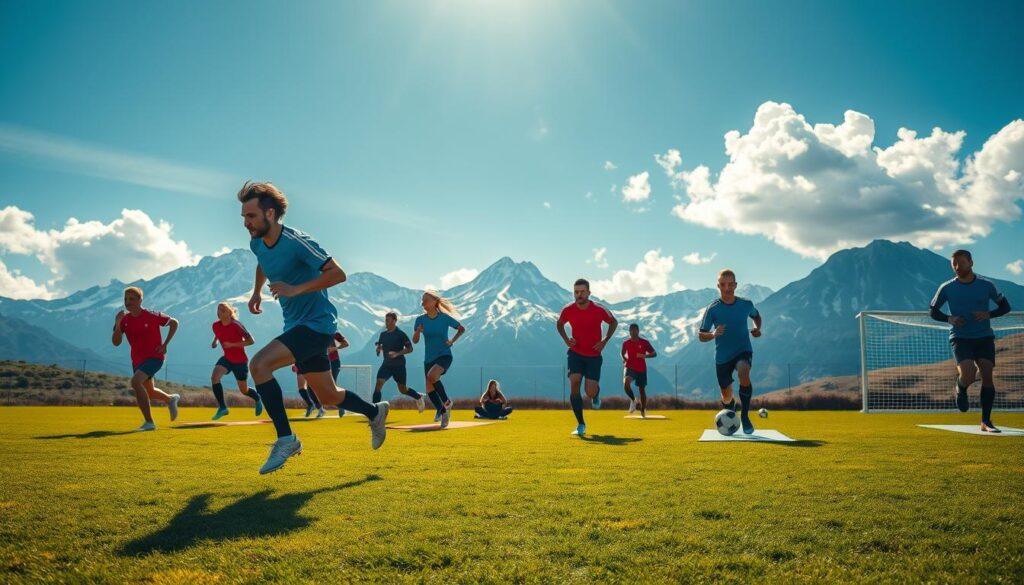
A dynamic scene showcasing fitness habits specifically for soccer players, with a focus on altitude training, speed drills, endurance workouts, and recovery routines. In the foreground, a group of athletes in professional soccer attire engaged in intense training activities, such as sprinting and interval runs on a grass field. The middle ground features a serene recovery area with yoga mats and hydration stations, symbolizing balanced routines. The background captures a striking mountain landscape representing altitude training, under a bright blue sky. Dramatic sunlight filters through clouds, illuminating the athletes and creating a vibrant, energetic atmosphere that inspires dedication and teamwork. The image should evoke passion for fitness and the spirit of the game, with a focus on professionalism and dedication.

Drills to copy for each move cones ladders partner plays cues

To master soccer, break down pro moves into drills. Use cones and ladders to practice these moves. They help you copy the pros’ amazing skills.

Set up a cone 25 yards out with another cone for a defender. Add a ladder before it for quick footwork. This setup helps you learn moves like Arjen Robben’s cut inside. It’s about mastering quick stops and starts.

Cone and Ladder Patterns

Replicating the Iso Cut Inside

The iso cut is a key move. Practice with cones and ladders to add it to your skills. The more you practice, the more natural it becomes.

Partner Play Cues

Partner plays are all about communication. The wall pass is like a secret language. It’s about quick signals and understanding each other.

Verbal and Non-Verbal Triggers for the Give-and-Go

Practice cues to improve your teamwork. It’s like planning a party, with each move scripted. With the right drills, you’ll play better.

Cultural notes leadership styles celebrations fan rituals

Soccer is more than a game; it’s a colorful mix of cultures. Players bring their skills and cultural backgrounds to the field. This is true for global women soccer icons, who show different leadership styles.

Leadership Styles

On the field, two leadership types stand out: the vocal organizer and the stoic technician. These styles tell us a lot about their cultures.

The Vocal Organizer vs. The Stoic Technician

  • The Vocal Organizer: Megan Rapinoe is a great example. She leads with activism and passion. Her style fits American culture, focusing on empowerment and community.
  • The Stoic Technician: Japan’s Homare Sawa shows quiet, effective leadership. Her calm and flawless play reflect Japan’s values of discipline and teamwork.

These leadership styles are not just personal traits. They are cultural stories that shape team dynamics and fan connections.

Celebrations and Fan Rituals

Let’s explore the world of celebrations and fan rituals. Every goal is a moment filled with cultural meaning.

What a Knee Slide Says About National Identity

  • Knee Slides: A knee slide is more than a celebration. It’s a show of joy and national pride. It captures the game’s excitement.
  • The Samba Dance: In Brazil, the samba dance is a burst of joy. It symbolizes unity and celebration among fans.
  • The German Handshake: A simple handshake and jog back to the center circle show German efficiency. It reflects their focus on the next challenge.

Fan rituals, like Borussia Dortmund’s tifos or South American superclásicos, show community spirit. Understanding these cultural aspects makes our fan experience richer. Every action on the field communicates our cultural identities.

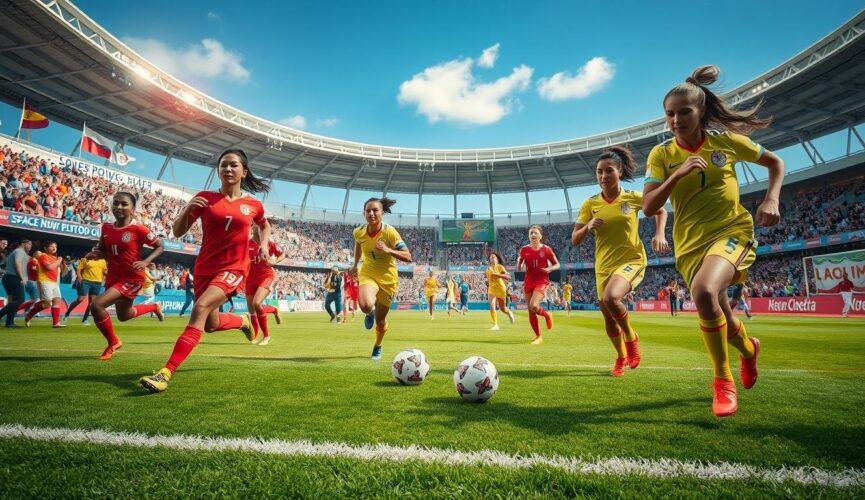
A vibrant scene capturing iconic women soccer players from around the globe, exuding confidence and camaraderie. In the foreground, three diverse players in professional soccer attire celebrate a goal, showcasing distinct cultural elements through their jerseys and hairstyles. The middle layer features a lively crowd of enthusiastic fans adorned with flags and wearing team colors, contributing to a festive atmosphere. In the background, a spectacular soccer stadium filled with colorful banners under bright stadium lights. The image is shot from a low angle, emphasizing the players’ joyous expressions against a stunning sunset sky. The overall mood is energetic and uplifting, focusing on unity, celebration, and leadership in women's soccer.

Integrate lessons into adult rec schedules 2x week plan

Want to boost your weekend soccer game? You need a smart plan and a bit of finesse. You have work, family, and Netflix to keep up with. How can you fit pro training into a twice-a-week schedule without losing your mind? The answer is to be efficient.

Plan your week like you would a kid’s birthday party. Tuesday is for technical skills. Focus on one move, like the Robben cut, for 20 minutes. Then, end with a light game to practice what you learned.

The Tuesday Technical Session

Isolating One Move for 20 Focused Minutes

Use this time to perfect a signature move. It’s like a mini-lab for experimenting with angles and techniques. Here’s a simple plan:

Time (Minutes) Activity Focus
5 Warm-up Drills Get your body ready
20 Move Isolation Robben Cut Practice
15 Light Scrimmage Apply the move

Thursday is for tactics. It’s not just a free-for-all. Try playing with a rule, like a two-touch limit or goals from late runs.

The Thursday Tactical Run

Small-Sided Games with a Specific Constraint

Think of this as your tactical test. By focusing on technique and tactics, you’re not just playing soccer. You’re improving yourself. Here’s how to set it up:

Time (Minutes) Activity Focus
5 Warm-up Engage and stretch
20 Small-Sided Game Implement Constraints
15 Debrief Discuss what worked

By following this plan, you’ll improve your game. Every practice and game is a chance to get better. For more tips, check out this resource.

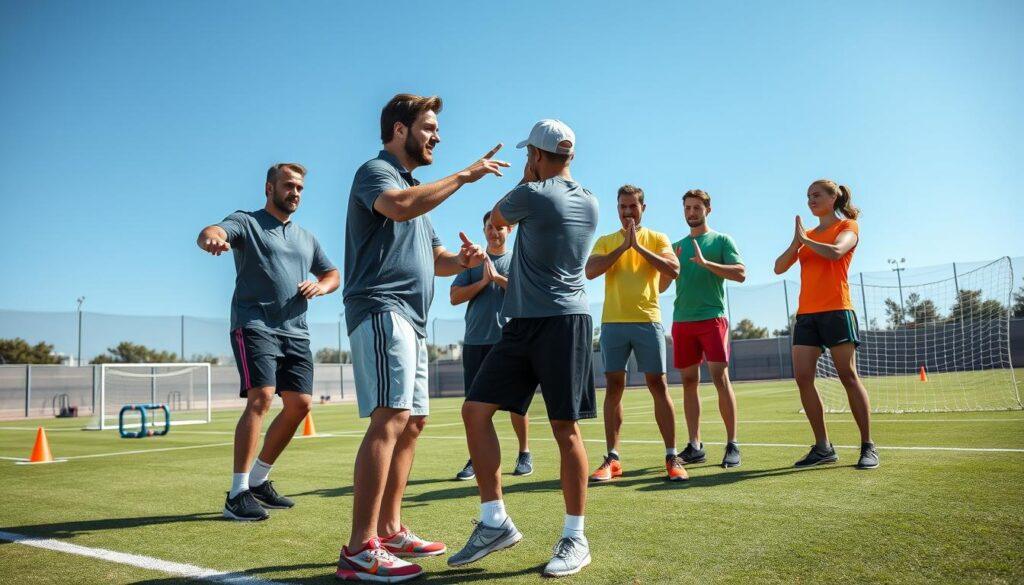
A vibrant sports training scene depicting a diverse group of adult players engaged in a focused, energetic practice session on a sunny afternoon. In the foreground, a male coach, wearing a polo shirt and shorts, demonstrates proper warm-up techniques to a group of four adults dressed in casual athletic wear, emphasizing camaraderie and learning. The middle ground features various training equipment like cones, balls, and nets, arranged neatly around the field. In the background, a clear blue sky fills the scene with natural light, illuminating the refreshing atmosphere of an outdoor sports complex. Capture the sense of motivation and teamwork, showcasing the essence of integrating professional training habits into regular recreational schedules. The angle of the shot should be slightly elevated, providing a comprehensive view of the action while creating an engaging, inspiring mood.

Where to watch leagues streaming quick guide

Finding soccer streams can feel like a maze. With so many platforms and subscriptions, it’s easy to get lost. But don’t worry, I’ve got a quick guide to help you find the leagues you love.

Premier League and Champions League

The Premier League and Champions League are soccer’s biggest stages. You’ll need a few subscriptions to watch them all. Peacock offers great Premier League coverage, while Paramount+ brings the Champions League to life. Don’t forget ESPN for Bundesliga games. It might cost a bit, but the lessons you learn are worth it.

Peacock, Paramout+, and the cable labyrinth

Each streaming platform has its own charm. Peacock is easy to use and reliable, while Paramount+ has exclusive matches. But, if you’re stuck with cable, it can be confusing and expensive. Simplifying your streaming can make watching soccer more enjoyable.

NWSL and Liga MX Femenil

The women’s game is where the real magic happens. The NWSL is now on Amazon Prime and Scripps Sports, making it easy to watch. Liga MX Femenil streams on Facebook and Instagram. These leagues offer a unique view of soccer’s greatest talents.

The rise of niche streaming for the global game

Niche streaming offers unique tactical lessons. The women’s game often shows soccer’s purest form. So, why not cut down on streaming services and focus on the beautiful game? Your weekend will be better for it.

Gear picks boots shin guards recovery tools inspired by pros

Choosing the right equipment is key for serious players. It’s not just a trend; it’s a must. The best gear can improve your game and prevent injuries.

Boot selection by playing surface

First, let’s talk about boots. Don’t wear firm ground (FG) cleats on artificial grass (AG). It’s not just a bad look; it’s risky. AG cleats have conical studs for better grip.

  • Biomechanics: Wrong boots can hurt your knees.
  • Performance: Right boots help you run faster and control better.
  • Durability: AG boots last longer on artificial surfaces.

AG vs. FG plates and the injury connection

AG plates are better for your joints than FG plates. They help prevent injuries on synthetic fields. It’s about playing safely and long-term.

The portable recovery kit

Now, let’s talk about recovery. You don’t need an expensive Normatec system. A simple recovery kit works great. Here’s what I suggest:

  • Massage gun: Great for easing muscle tension after games.
  • Normatec knockoffs: Affordable for compression therapy.
  • Foam roller: Essential for improving recovery.

Massage gun, Normatec knockoffs, and the foam roller

These tools may not be flashy, but they’re vital. Elite-level protection, like shin guards with carbon-fiber, boosts your confidence. It’s about taking care of yourself to stay on the field.

Inspiration board quotes songs visualization prompts

Success on the field starts in your mind before the game. You’ve worked hard, studied your opponents, and practiced a lot. But if doubt fills your mind, you might struggle before the game even starts. That’s why we create an inspiration board to boost your mental game.

The Pre-Game Mental Script

Imagine having the confidence of a top soccer player. Take Marta, for example, who said, “I don’t have idols. I am the idol.” This isn’t just pride; it’s a mindset shift. When doubt hits, let Marta’s words guide you.

Visualization is more than just seeing yourself score. It’s about feeling every part of the game. Imagine the grass, hear your teammate’s call, and see yourself making a late run.

Borrowing a Mantra from a Global Icon

A mantra can be your mental anchor. It’s your personal battle cry, reminding you of your strength. Choose a quote that speaks to you, like Marta’s, and repeat it to fuel your game.

The Audio-Visual Trigger

Sound has a powerful effect on your mind. A 3-song playlist can change your mindset. It’s not just for show; it’s a mental prep for focus and aggression. Pick songs that energize you and listen to them before every game.

Building a 3-Song Walkout Playlist for Your Mind

Here’s a table to help you make your perfect playlist:

Song Title Artist Vibe
Fight Song Rachel Platten Empowering
Stronger Kanye West Motivational
Can’t Hold Us Macklemore & Ryan Lewis Uplifting

As you make this playlist, remember: your body will do what your mind believes. Start building that belief today.

Share your progress challenge and hashtag campaign

Action speaks louder than words. It’s time to put the insights from international icons training into practice. For the next four weeks, embrace the challenge. Choose one move from this article—like the cut inside, late run, or pressing trigger.

Document your journey as you go from clumsy drills to executing it in a game. Start by filming your cone work on Tuesday. Capture that glorious moment when you pull it off during a Sunday match.

This isn’t about gaining followers; it’s about accountability. Use the hashtag #WeekendIcon on social media platforms like Instagram or Facebook. Together, we can create a feed that celebrates real progress, not just highlight reels.

The 4-week skill acquisition challenge

Each week, focus on refining your chosen move. Break it down into manageable parts. Share your successes and setbacks. This process fosters growth and keeps motivation high.

By sharing your experiences, you invite others into your journey. Building a community that thrives on shared learning.

Documenting one move from drill to game execution

Track your progress visually. Film your drills from multiple angles. This practice not only aids in self-evaluation but also showcases your development.

As you improve, share your clips with the community. Watch how others respond, and engage with their journeys too.

The community hashtag

Engagement matters. Tag your rec team and rivals. Let’s build a network of adult amateurs who aspire to play with wit and intelligence.

As you participate, you’ll find camaraderie among those who share your passion. Remember, this journey is about growth, culture, and fun.

#WeekendIcon and the power of public accountability

Public accountability is a powerful motivator. It transforms practice into a shared experience. As you embrace this challenge, reflect on how international icons training can enhance your game.

Together, we can redefine what it means to play soccer, moving beyond just kicking and running.

Ready to take the plunge? Let’s make this journey memorable. For more insights, explore this resource and elevate your skills further.

Student-Athlete Dual Careers: Balancing Academics and Competitive Sports Success

dual career student athletes

Being a student-athlete is often seen as glamorous. But the truth is, it’s a mix of early morning practices, tough exams, and constant family calls. It’s a tough balancing act that many don’t get until they’re in it.

Looking back, I see it’s not just about winning games or getting good grades. It’s about managing five key areas of our lives: school, travel, training, family, and rest. These areas all connect, making up our daily lives.

Picture this: you’re rushing from class to the gym, trying to keep up with family messages. It’s not the perfect Instagram post everyone sees. It’s a messy, exciting journey. In this section, I’ll share my experiences, hoping you’ll see your own struggles in this story.

Three Profiles Majors Study Habits Match Routines

Tessa Brown is a dual career student athlete who balances school and sports perfectly. She’s a senior at the University of Georgia, studying Public Relations. She also runs a Pen Pal Program for UGA athletes and fourth graders at Barrow Elementary School. This program teaches kids about health, balance, respect, and happiness.

Tessa has won many awards, including being named Top Female Athlete of the 2026 class by the Atlanta Area Council, Scouting America. She competes in Fences and Flat for Georgia’s equestrian team. Her team’s Associate Head Jumping Seat Coach, Anna Becker, calls her a captain and leader.

To excel as a dual career student athlete, you need to understand three profiles: the Grinder, the Strategist, and the Integrator. Each profile handles academics and athletics differently.

The Grinder focuses on hard work and persistence. They often skip social events to study and train. The Strategist plans and organizes their time using tools like planners. The Integrator blends their academic and athletic lives seamlessly, like Tessa with her pen pal program.

Choosing a major affects your study habits and how you balance school and sports. Public Relations majors, for example, develop strong communication skills. Research shows these skills help manage the demands of being a student athlete.

In conclusion, dual career student athletes like Tessa Brown show the power of combining education and sports. Knowing your profile can help you succeed in both areas. So, how will you write your own dual career story?

Productivity Toolkit Planners Block Scheduling Phone Hygiene Sleep

Dual career student athletes are like Olympic champions in productivity. But even the best need a solid plan. The right tools can turn chaos into order, making it easier to balance school and sports. Here’s a look at the essentials that really work.

Planners are back in style, and for good reason. In a world full of digital distractions, nothing beats the feel of crossing off tasks on paper. A well-organized planner helps you see your day, making sure you don’t miss anything. Plus, it’s always there when Wi-Fi isn’t.

Block scheduling is like a survival tool. It helps you plan your day, making sure you have time for studying, practice, and rest. This method helps you focus on what’s important and creates a routine that’s key to success.

Now, let’s talk about phone hygiene. Yes, you heard that right. Doom-scrolling at midnight can hurt your grades. Set limits on your phone to keep it from distracting you. Use apps to control your screen time or leave your phone in another room while you study. A little discipline helps keep your mind clear.

Lastly, don’t overlook the importance of sleep. It’s not just a luxury; it’s a performance booster that’s legal. Student athletes often don’t realize how important sleep is for recovery and thinking clearly. Aim for 7-9 hours of quality sleep each night to stay sharp.

Tool Benefits Tips
Planners Visualize tasks, stay organized Use color coding for subjects
Block Scheduling Maximize time, reduce stress Set specific goals for each block
Phone Hygiene Improve focus, reduce distractions Limit usage during study hours
Sleep Enhance recovery, boost performance Establish a consistent sleep routine

By adding these strategies to your daily routine, balancing school and sports becomes enjoyable. Remember, being productive is an art, and you’re the artist.

A productivity toolkit designed specifically for dual career student athletes, arranged neatly on a modern wooden desk. In the foreground, various planners and scheduling books with colorful tabs and notes spread open, showcasing a well-organized study session. A smartphone lays beside them, displaying a calendar app with reminders. In the middle, a sleek laptop emits a warm glow, casting soft light over the workspace, suggesting a dedicated study environment. In the background, a wall-mounted corkboard with pinned motivational quotes and schedules emphasizes the balance between academics and athletics. The atmosphere is bright and inspiring, with natural light streaming in from a window, creating a focus-enhancing ambiance. The scene captures dedication and productivity without clutter, perfect for showing the tools used in time management and self-care.

Campus Nutrition Smart Cafeteria Picks Budget Snacks Meal Prep

Going to the cafeteria can feel like a challenge. It’s about doing well in school and sports. For dual career student athletes, eating right is key. It’s not just about eating; it’s about fueling your success.

When you go to the cafeteria, don’t get drawn to the pizza. Choose meals with lean proteins, whole grains, and lots of veggies. It’s like playing Moneyball with your meals—get the most out of your food for top performance.

Snacks are important too. The vending machine might look tempting, but it’s expensive. Instead, pick affordable snacks like nuts, yogurt, or fruit. These are healthier and save money. Aim to keep your energy up without spending too much.

Meal prep is real, not just for Pinterest. With a mini-fridge and microwave, you can make quick, healthy meals. Try stir-fries, overnight oats, or steamed veggies. These can help you stay focused and avoid weight gain.

In short, getting good at campus nutrition means making smart choices. Pick the right foods, skip pricey snacks, and prep meals. This way, you’ll stay energized and focused in school and sports. Remember, you can’t out-train a bad diet!

Mobility Quick Dorm Room Routines with Bands and Bodyweight

Forget the gym; let’s talk about how to maximize mobility right in your dorm room. You don’t need a fancy facility to keep your body moving. As a dual career student athlete, your time is precious. Sometimes, you have to squeeze in workouts between classes, practices, and Netflix.

Mobility work is the unsung hero of athletic performance. It’s not just about avoiding injuries; it’s about showing your body some respect. After all, wouldn’t you feel like a well-oiled machine instead of a rusted hinge when you step onto the field or court? Here are some quick routines that require little to no equipment, making them perfect for your dorm room.

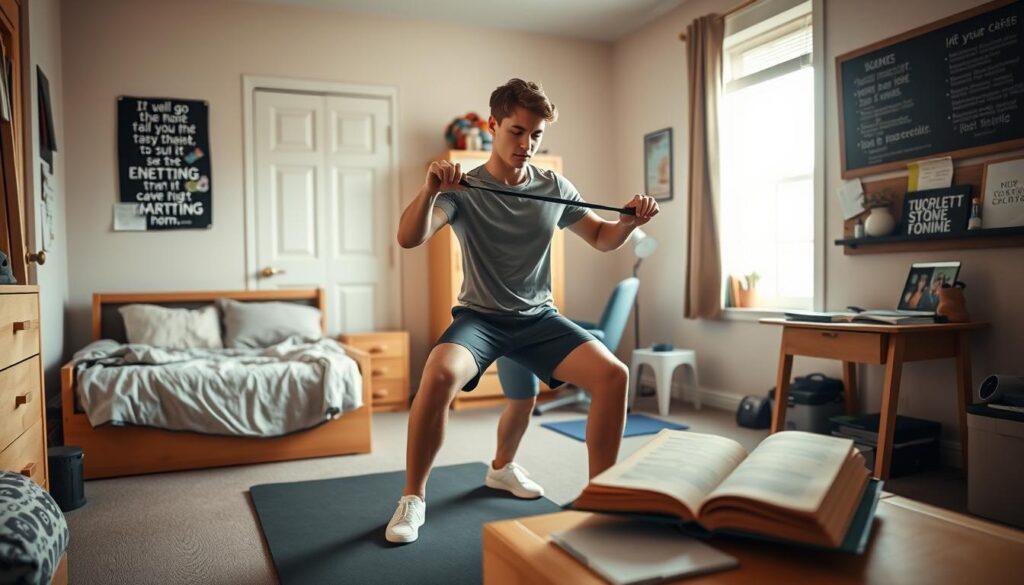
A cozy dorm room setting with a dual-career student athlete performing mobility exercises. In the foreground, a young adult in modest athletic wear, such as a fitted t-shirt and shorts, is using resistance bands while demonstrating a stretching routine. The middle ground features workout mats and an open textbook with notes, indicating a balance between academics and athletics. The background showcases a small desk with study materials and a bulletin board filled with motivational quotes. Soft, natural light streams through a window, creating a warm and focused atmosphere, with a shallow depth of field emphasizing the athlete in action. The overall mood is inspiring and dynamic, reflecting the dedication of student athletes managing both studies and fitness.

Routine Duration Equipment Focus Area
Hip Circles 5 minutes None Hip Flexibility
Resistance Band Squats 10 minutes Resistance Band Leg Strength
Bodyweight Lunges 5 minutes None Lower Body Mobility
Seated Torso Twists 5 minutes None Core Stability

Each of these routines can be done in the time it takes to scroll through social media. Think about it: 15 minutes between classes or 8 minutes when you can’t sleep. It’s all about time management and making the most of every opportunity. You might even impress your roommate with your newfound flexibility while they’re deciding what to watch next.

Incorporating these mobility exercises into your daily routine not only enhances your performance but also cultivates a sense of self-respect. So, the next time you find yourself in your dorm room, don’t just sit there—get moving!

Mental Health Study Groups Counseling Identity Beyond Sport

Mental health is more than just a buzzword for student athlete women. They face huge pressure balancing classes, practices, and games. The talk has moved from “it’s okay to not be okay” to really understanding mental wellness. But, putting this into action is slow.

Study groups can turn into unofficial therapy sessions. When athletes get together, they bond over their academic stress. This shared struggle creates a safe space to talk about grades and performance. It’s key for keeping their mental health strong.

Campus counseling services are now more aware of dual career student athletes. They’re working to offer support that fits their schedules. This change is important because mental health shouldn’t be an afterthought. It’s time for these services to reflect the real lives of student athletes.

There’s a deeper question: who are you after the season ends? What happens when you’re no longer competing? The UC Davis equestrian team’s tribute to their entire herd shows this beautifully. These horses are more than athletes; they’re teachers and quiet supporters. Their impact lasts long after any competition.

Tessa Brown’s Pen Pal Program is another great example. It teaches fourth graders about balance and happiness. It shows that helping others can help you find yourself. This highlights the value of community and support, both in sports and life.

Aspect Importance Example
Mental Health Awareness Crucial for performance Access to counseling
Study Groups Builds community Informal therapy sessions
Identity Beyond Sport Encourages self-discovery Tributes to equestrian herd

A serene setting featuring a diverse group of student-athlete women engaged in a supportive mental health study group. In the foreground, three women, dressed in smart casual attire, are seated at a table covered with notebooks and cups of herbal tea, discussing their thoughts. One woman is taking notes, another is listening intently, while the third is encouragingly contributing. In the middle ground, a whiteboard filled with positive affirmations and goal charts is prominently displayed, symbolizing their journey beyond sports. The background reveals a sunlit university study lounge, with plants and soft cushions that create a warm, inviting atmosphere. Soft natural lighting pours in through large windows, casting gentle shadows, enhancing the mood of connection and support.

Recruiting and Scholarships Realistic Timelines Financial Aid Basics

Recruiting is not a simple path but a complex journey with many twists. For dual career student athletes, knowing the recruiting timeline is key to getting scholarships. It might seem daunting, but with the right help, you can tackle it confidently.

The recruiting timeline starts early, often in the sophomore year. Yes, it’s sooner than you might think. Families often find out too late that the best chances are gone by senior year.

At Educated Rider, founded by Raegan Rast, a former Division I NCEA athlete, we make this journey easier. We focus on clarity and confidence, ensuring you’re ready for recruiting. We’ve helped over 30 riders commit to top Division I equestrian programs.

Now, let’s talk about financial aid basics. It’s important to know the difference between equivalency and head-count sports. Many athletes think a “full ride” means all costs are covered. But, that’s not always true. Here’s a quick comparison:

Type of Aid Coverage Example Sports
Head-Count Sports Full scholarships for all athletes Football, Basketball
Equivalency Sports Partial scholarships distributed among athletes Track, Soccer
Academic Scholarships Based on academic performance All sports

Timing your official visits is also key. It’s not just about showing up; it’s about making a good impression. Ask important questions early. What does the scholarship cover? How many athletes are competing for the same spot? This info is critical.

In summary, the recruiting world is complex, but with the right insights and prep, dual career athletes can succeed. For more tips and strategies, check out this guide. Remember, the journey is as important as the destination.

Internships and Early Career Networking Alumni LinkedIn Tips

Internships are more than just a stepping stone for dual-career student athletes. They are a key launchpad. Your athletic eligibility may end, but your LinkedIn profile can last forever. This section explores the internship world, where “summer break” is filled with training, work, and building a résumé that shows more than just winning games.

Networking can seem like a chore. No one wants to be the awkward person at alumni events, handing out business cards. But, it doesn’t have to be awkward. It’s about making real connections. Think of it as finding your tribe, not just collecting contacts.

Tessa Brown is a great example. She’s a Public Relations major who got involved in the Pen Pal Program. This shows her commitment to community and career readiness. Her Peach of an Athlete Award from the Atlanta Area Council, Scouting America, highlights her achievements in and out of sports. Tessa shows how athletic leadership can be seen as professional experience.

LinkedIn is more than just corporate jargon. It’s a powerful tool when used genuinely. Make your profile show your journey as a dual-career student athlete. Show off your unique skills and experiences. Remember, alumni connections are not just for donations. They can lead to amazing job opportunities.

Many dual-career student athletes don’t realize the value of their professional network. This is a goldmine of connections waiting to be explored. Use it wisely! Connect with alumni, share your story, and ask for advice. You might be surprised at how eager they are to help.

Sample Weekly Plan Class Practice Lifts Study Social Battery

Creating a weekly plan as a dual career student athlete is like solving a Rubik’s Cube. It’s colorful, complicated, and often frustrating. But, a well-structured schedule can turn chaos into clarity. Below is a sample weekly plan that balances class, practice, lifts, study sessions, and social battery management.

Day Class Practice Lifts Study Social Battery
Monday 9 AM – 11 AM 3 PM – 5 PM 6 PM – 7 PM 8 PM – 10 PM 10 PM – 11 PM
Tuesday 10 AM – 12 PM 4 PM – 6 PM 7 PM – 8 PM 8 PM – 10 PM 10 PM – 11 PM
Wednesday 9 AM – 11 AM 3 PM – 5 PM 6 PM – 7 PM 8 PM – 10 PM 10 PM – 11 PM
Thursday 10 AM – 12 PM 4 PM – 6 PM 7 PM – 8 PM 8 PM – 10 PM 10 PM – 11 PM
Friday 9 AM – 11 AM 3 PM – 5 PM 6 PM – 7 PM 8 PM – 10 PM 10 PM – 11 PM

This plan is not just a template; it’s a living document. You’ll find gaps that might seem empty, but they’re often the most important. They’re for reflection, a quick chat, or even staring at a wall. Yes, rest is productive. And managing your social battery is key.

Whether you’re an introvert or an extrovert, knowing your energy levels is vital. Downtime isn’t just a luxury; it’s a necessity. So, embrace those moments of quiet. They’re just as important as your study or practice times.

Time management for dual career student athletes isn’t about filling every second. It’s about creating a balanced life that allows for achievement and enjoyment. So, take this plan, adjust it to fit your rhythm, and remember: it’s okay to take a breather.

Tools Apps and Printable Semester Planner

Being a dual career student athlete is tough. The right tools can help a lot. It’s not just about managing time; it’s about finding balance. Let’s explore some key apps and a handy printable semester planner to make your life easier.

Apps are a must. Google Calendar is great for planning. It works on all your devices and lets you color-code your activities. MyFitnessPal is perfect for tracking your food. It helps you eat right for your body.

Headspace is great for your mind. It offers guided meditations that fit into your busy schedule. Communication is also key. Slack is good for team talks, and Zoom is essential for online study groups.

Don’t overlook a printable semester planner. There’s joy in crossing off tasks with a pen. It makes your goals real and helps you see your week clearly.

With the right tools, you can turn chaos into order. Use these tips to excel in school and sports.

Mothers in the Game Balancing Family Career and Football

mothers in womens soccer

The idea that an athlete mom can easily balance a Champions League match and a PTA meeting is a myth. This myth ignores the real chaos and complexity of motherhood. We aim to reveal the truth about being an athlete mom in competitive sports.

Football teaches us important lessons like leadership, teamwork, and balancing emotions. These skills are not just for players but also for women who are both athletes and parents. The cognitive dissonance between being an elite athlete and managing family life is real.

In this pre-game huddle, we’ll look at the logistics, guilt, and joys of being a mother in sports. Forget the idea of “having it all.” We’ll share real stories where professional careers and childhood memories meet. Join us as we explore the unique challenges and victories of these remarkable women.

For more on the rights and challenges of female athletes, check out this guide on female footballers’ rights.

Postpartum return timelines floor core impact ladders PT clearances

Going back to work after having a baby is more than just waiting six weeks. The idea that you can bounce back in six weeks is too simple. It’s about rebuilding a body that has changed a lot.

Comparing a cesarean section to an ankle sprain is unfair. The journey back to work needs a careful, step-by-step plan. Starting with the initial floor core connection is key. It’s the base of your health.

As you move forward, you’ll start with small steps. These steps can lead to bigger challenges. Remember, each step is important, and rushing can cause problems. Also, getting physical therapy clearances is a big deal, not just a formality.

The Myth of the Six-Week Bounce-Back

The idea that you can get back to your old fitness in six weeks is harmful. It makes women think they should be back to their old selves quickly. But, the journey back is different for everyone.

Instead of following a set timeline, focus on what feels right for you. Everyone’s recovery is unique. It should reflect your personal journey.

Why Your Pelvic Floor Doesn’t Care About Your Contract Year

Your pelvic floor health is more important than your sports schedule. It’s vital for everyone, not just athletes. It needs care, no matter what others say.

Remember, the journey back is about more than just getting fit. It’s about your strength and willpower. Let’s focus on health, not just getting back to work fast.

Childcare travel sitters team family networks club policies

Traveling with kids to tournaments is like planning a big operation. Parents have to find urgent care and keep milk cool. It’s a big challenge.

Being part of a “team” means more than just playing sports. It’s about a family network where everyone helps. Tournament nannies are key, helping parents and keeping kids happy.

The Tournament Nanny Economy

Tournaments are happening more often, and families need childcare. They want someone who knows tournament life. A good nanny keeps kids busy and cheers them on.

Clubs that understand this have formal family networks and travel policies. They see kids as part of the team, not just extra luggage.

When the Team Bus Becomes a Daycare on Wheels

Imagine a team bus that’s also a daycare. It’s happening for many teams. The bus is now a place for families to connect and share.

These efforts build community and make sports parenting easier. When a center-back’s partner feeds your baby, it shows the team is really a family.

Club Childcare Policy Support Offered
Team A Formal nanny program On-site childcare during tournaments
Team B Informal arrangements Parent-led support groups
Team C No childcare policy Minimal support

In conclusion, improving childcare at tournaments is key. It helps teams support families better, making sports a family activity.

A vibrant scene at a football tournament's childcare area, showcasing mothers balancing family and sports. In the foreground, a cheerful mother in modest casual clothing plays with her young child, enriching the playful atmosphere. The middle ground features a cozy tent set up by the tournament, where other children are engaged in creative activities with attentive sitters, exhibiting a supportive network among the mothers. In the background, a lively football match unfolds, with a clear sunny sky, highlighting the energetic spirit of the event. The lighting is bright and warm, capturing the joy and community spirit of family-oriented support in sports. The angle is slightly elevated, enriching the view of the interconnected childcare environment, emphasizing teamwork and belonging.

Three mothers’ stories favorite stroller workouts and support systems

For athlete moms, the playground is a place of strength and resilience. We look at the lives of three amazing women. Each story shows how they balance motherhood with their love for fitness.

The veteran striker is facing a surprise pregnancy in her final contract year. She turns park benches into gyms, showing fitness is possible while watching her child play. With resistance bands on her BOB stroller, she finds ways to stay active, even with hill sprints.

The goalkeeper is a multitasking mom, often doing one-handed catches while holding a toddler. She shows strength in many ways, from catching balls to managing her time. Her workouts mix agility drills with fun play with her child, showing fitness can be enjoyable.

The young midfielder lives with her mother, creating a strong family bond. They support each other in their fitness journeys. Their walks and workouts show the power of community and teamwork.

The striker, the goalkeeper, and the midfielder walk into a playground

These athlete moms share a love for sports and support each other. They have networks that offer encouragement and help. They prove that community is more important than fancy equipment.

Jogging strollers, judgment, and joy

They face judgment while using jogging strollers, but they find joy in their workouts. They celebrate every victory. Their determination and laughter on the playground inspire others.

Nutrition and sleep when nights are short practical wins

For mothers in sports, finding a balance between nutrition and sleep is key. It’s not about being perfect but finding practical solutions. When you’re dealing with a toddler’s midnight snacks and a 7 a.m. training, traditional meal prep is out the window. We turn to quick fixes, like cold brew and banana economy, to get by.

Forget about perfect quinoa bowls. Sports science doesn’t cover fueling for 3 a.m. snacks and early workouts. We’re in survival mode, where overnight oats are eaten one-handed while nursing. Hydration strategies must account for sweat loss and milk production.

The Cold Brew and Banana Economy

In this economy, coffee is a lifeline. Cold brew and bananas are quick energy sources. They help when sleep debt is high. Here are some practical tips to thrive:

  • Overnight oats: Prep them in advance for a quick breakfast.
  • Bananas: Easy to grab and packed with potassium.
  • Hydration: Focus on fluids that replenish both sweat and milk supply.

Eating for Two: Performance and Production

As a sports mom, you must consider your performance and breastfeeding demands. You need protein for muscle repair and milk production. Every bite is important.

Here’s a quick reference table to help you navigate your nutritional needs:

Food Item Protein (g) Calories Benefits
Greek Yogurt 20 150 High in protein and probiotics
Peanut Butter 8 190 Healthy fats and energy
Chickpeas 15 120 Great source of fiber and protein

In the chaos of motherhood and sports, focus on avoiding bonking. It’s about survival, not peak performance. Use these hacks to find your rhythm.

A serene kitchen setting during early morning light, showcasing a mother dressed in modest active wear preparing a nutritious breakfast. In the foreground, a breakfast table is set with colorful fruits, whole grains, and a smoothie, symbolizing healthy nutrition. In the middle, the mother is focused, looking content as she prepares a meal, while a soccer ball rests nearby, hinting at her athletic lifestyle. Soft sunlight filters through a window, casting gentle shadows and highlighting the warmth of the scene. In the background, a glimpse of family photos and a soccer jersey hangs on the wall, evoking the theme of family and sports. The overall mood is calm and nurturing, reflecting the balance between health, family, and athletic commitments.

Equipment hacks carriers pumps coolers privacy tips and checklists

Packing for a match as a mom is like preparing for a small-scale evacuation. The gear bag of an athlete mom is like a NASA launch checklist. We explore the essential equipment that makes the impossible seem easy.

The wearable pump revolution is a game-changer. Devices like the Elvie and Willow let mothers pump discreetly. They are not just products; they are tools that help moms manage their time.

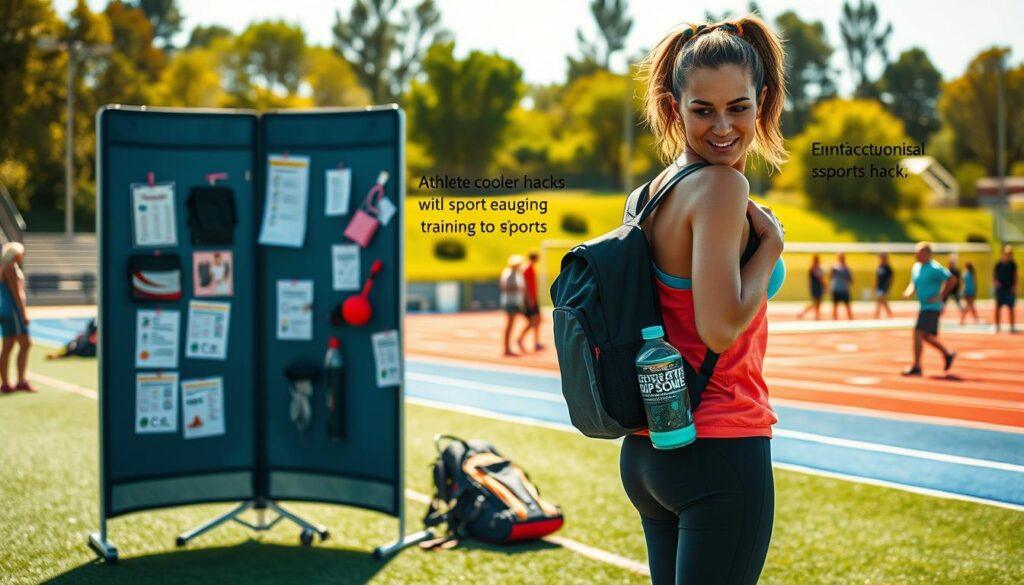
A dynamic scene depicting an athlete mom in a vibrant sports environment, showcasing innovative equipment hacks. In the foreground, she is casually dressed in a tank top and comfortable leggings, demonstrating a clever cooler hack that keeps sports drinks chilled, while using a stylish backpack with compartments for sports gear. The middle ground features essential athletic equipment like a portable pump, various checklists pinned to a sports bag, and a privacy screen set up for changing. In the background, a sunny sports field with people training creates a lively atmosphere. The lighting is warm and bright, simulating late afternoon sun, with a slight lens blur to emphasize the foreground. The mood is one of resourcefulness and energy, capturing the essence of balancing motherhood and sports.

Packing for a game is tough, even more so with a toddler and a breast pump. Here’s a checklist every mom should have:

Item Purpose Notes
Spare pump parts Essential for emergencies One will inevitably be left behind in a hotel bathroom.
Multi-functional carrier For both baby and gear Works for a six-month-old and a post-match ice bath setup.
Pop-up privacy tent For pumping on the go More useful than some substitute players.
Temperature-controlled cooler For storing pumped milk Holds the liquid gold safely.

These aren’t just “hacks” for fun; they are essential. Mastering these hacks can greatly improve a mom’s experience at matches.

Advocating for family friendly spaces leagues and parks

It’s time to demand better than just janitor closets for family-friendly sports spaces. We need proper facilities like lactation rooms and changing tables. These are key for an inclusive environment.

It’s not just about being convenient. It’s about recognizing the role of families in sports. We must demand spaces that meet our needs. This means learning how to communicate our demands well.

The Lactation Room is Not a Storage Closet

Imagine a facility with a real lactation room, not just a janitor’s closet. It should be clean, private, and have an outlet. Why are there five beer gardens but no changing tables at a major tournament? It’s time to make our demands clear.

How to Write an Email That Gets a Changing Table Installed

Writing a persuasive email is a great first step. Start by addressing the facility manager directly and clearly state your needs. Here’s a quick guide:

  • Be direct: State your request upfront.
  • Include data: Mention the number of families attending events.
  • Propose solutions: Suggest specific improvements, like installing changing tables.

By using Title IX and workplace accommodation laws, we can make a stronger case. Together, we can change these spaces into welcoming places. It’s not just about playing the game; it’s about being comfortable while doing it.

For more resources on advocating for family-friendly environments, check out AYSO.

How teammates and leagues can help inclusive culture checklist

Creating a supportive environment for athlete moms is a team effort. It starts with understanding. Culture eats strategy for breakfast, and that’s true in sports. It’s not enough to have a “bring your kid to work” day; inclusivity thrives in the micro-moments.

Think about the 22-year-old teammate who instinctively grabs the baby carrier. Or the veteran who normalizes pumping breaks as casually as hydration breaks. These actions speak volumes.

To build a truly inclusive culture, we need to shift our focus from performative allyship to genuine support. It’s about asking the right questions and being present for one another. Instead of asking, “How do you manage?” let’s change the narrative to “What do you need right now?” This simple shift can make all the difference.

From performative allyship to actual support

Teammates and leagues can implement practical strategies to foster inclusivity. Here’s a checklist to get started:

  • Establish a “family liaison” role within the league.
  • Create a database of vetted local childcare options.
  • Include maternity leave and travel support for dependents in contracts.

For child-free teammates, it can be tricky to offer help. Avoid infantilizing language and focus on genuine offers of support. Instead of saying, “You’re so inspiring,” which can sometimes land as a microaggression, try, “How can I help you today?” This approach fosters a more supportive atmosphere.

The 22-year-old teammate’s guide to not being weird about it

So, you’re a young teammate looking to support athlete moms? Here are some tips:

  1. Be present. Sometimes, just showing up makes a world of difference.
  2. Listen actively. Understand their needs without jumping to conclusions.
  3. Offer specific help. Instead of a vague, “Let me know if you need anything,” say, “Can I take your shift this week?”

By embracing these practices, we can create a culture where everyone feels valued. Remember, it’s not just about being nice; it’s about building a community that supports all its members. After all, the experience of a true team family opens our eyes to the beauty of shared struggles and triumphs.

20 minute pram friendly workout and kid ball play

Let’s get practical with a 20-minute workout that fits a toddler’s short attention span. You’ll need a pram, a resistance band, and some grass. It’s perfect for when you want to stay fit while keeping your little one entertained.

The playground as a performance center idea is genius. You don’t need a gym to stay active. Imagine walking lunges with the pram as your ballet barre. It’s a great way to work your legs while your child enjoys the view.

Drills that Include a Toddler (Willingly or Not)

Now, let’s do incline push-ups on a park bench. As you move up and down, your baby can have fun on their tummy next to you. It’s a great way to bond and get a workout. Banded lateral walks can also turn into a fun crab dance for your toddler.

In the second part of our workout, we make it fun for the child. Simple ball-play drills help them develop their motor skills. They also let you sneak in some plyometric exercises. It’s a fun duet, not a solo act. You’ll be amazed at what you can do in just 20 minutes.

This workout is perfect for when you have just enough time for a Peppa Pig episode. It’s not about beating your pre-baby PRs. It’s about finding fitness in everyday life and enjoying the journey of your postpartum return.

Community resources groups grants podcasts and mentors

Being an athlete mom can feel isolating. Finding your tribe can make a big difference. It’s about connecting with others who get the challenges of balancing family and sports.

Local community resources offer grants for childcare during games. The Women’s Sports Foundation is a great place to start. They help moms manage the financial side of sports, so they can focus on cheering for their kids.

Podcasts are also a great resource. Shows like “The Female Athlete Mission” talk about motherhood and elite sports. They offer insights and a sense of belonging. You’ll find tips and hacks to help manage your schedule.

Group chats and social media communities are powerful too. They share advice on everything from carpooling to mosquito spray. These chats make being an athlete mom less daunting.

Finding your soccer mom tribe means connecting with those who truly understand. They’ve survived the tough times and have the humor and wisdom to share. Together, they celebrate the chaos of motherhood.

Train Like the Best with Fitness Routines from Championship Teams

women's World Cup training

When we hear “fitness philosophy,” we often think of trendy yoga or expensive green juices. But the USA Women’s National Team is different. They use a unique mix of science and confidence in their training.

This section will explore the key ideas that made the USA a soccer giant. They use advanced technology like GPS to track every detail of their training. It’s like something out of a sci-fi movie.

But the real secret is their mindset. They see fitness as a must, not just something to do. This approach is debated, but it clearly works. Just look at their four stars.

We’ll look at how the USWNT’s approach has changed over time. From Mia Hamm’s era to today, they’ve added strength and strategy. We’ll also see how they compare to the rest of the world, where women’s soccer is getting more respect.

European Powerhouses: Training Methods from England, Germany, and Netherlands

Looking into the World Cup training of England, Germany, and the Netherlands shows a deep focus on athlete growth. These countries have built training spots that take the game beyond just physical skills. They use a tactic-focused approach in their training plans.

The English Football Association has put a lot into the Women’s Super League. This has created a special place where sports science meets traditional English toughness. This mix helps players grow their skills and physical strength. It makes them well-rounded for international games.

Germany is all about being efficient in training. Every drill, from rondo to small-sided games, is planned with a specific goal in mind. This careful planning makes sure players are not just fit but also smart tactically.

The Netherlands keeps spreading its Total Football idea. Their training mixes skill work with conditioning. This way, players learn to blend their skills with fitness, showing that *fitness comes from football*. This fresh view challenges old ideas and pushes what athletes can do.

What ties these European giants together is their focus on periodization. They know the tight schedules can be tough, even for well-prepared teams. By mixing fitness into football, they make sure players are ready both physically and mentally for big games.

Physical Preparation: Strength and Conditioning Programs from World Cup Teams

Rangers FC’s training shows the secret to elite soccer fitness. They play 65 matches a season and keep up with strength training. It’s not just lifting weights; it’s managing fatigue, avoiding injuries, and boosting performance.

In the 2021/22 season, Rangers FC showed how top teams handle soccer’s demands. They played many games, including eight in April, with two going into extra time. Their strength and conditioning programs are carefully planned for each player, whether they start or not.

They check players’ physical performance four times a year. This helps tailor training to each athlete’s needs. For example, they use isometric exercises before games to prepare the muscles.

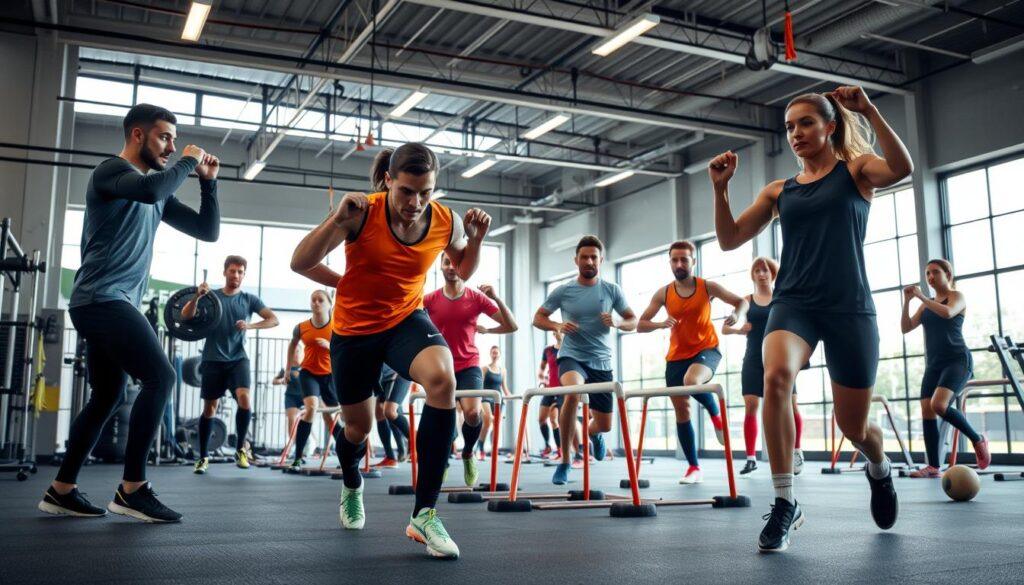
A dynamic scene showcasing elite soccer fitness, focused on a group of athletes engaged in intense strength and conditioning drills. In the foreground, a diverse team of male and female soccer players, dressed in professional athletic wear, performs various exercises such as weightlifting, plyometrics, and agility drills. The middle ground features state-of-the-art gym equipment and training tools like resistance bands and hurdles, emphasizing a modern training environment. The background displays a bright, spacious training facility with large windows allowing natural light to flood in, creating a motivational atmosphere. The image captures a sense of determination and teamwork, with an emphasis on physical endurance and dynamic movement, shot from a low angle to highlight the intensity of the workout. The ambiance is energetic and inspiring, ideal for showcasing the peak physical preparation of elite athletes.

The French Contrast method is also used to improve power. After games, players who played over 45 minutes do strength training. This includes exercises like squats and calf raises to build strength.

These methods have paid off. Rangers FC saw a big drop in soft-tissue injuries, like hamstring strains. This shows the effectiveness of their training methods, which combine science and practice.

In conclusion, the training methods used by World Cup teams are essential. They’re not just trends; they’re a must for teams to stay competitive. The real question is, will you dare to try these methods in your training?

Training Method Description Benefits
Isometric Work Static muscle contractions to enhance strength Improves muscle and tendon quality
French Contrast Method Combines heavy lifting with explosive movements Boosts power development
Eccentric Loading Focus on lengthening muscles under tension Builds resilience and reduces injury risk

Technical Skills: Daily Practice Routines That Separate Elite from Average Players

In soccer, the gap between top players and others is mainly about practice. It’s not just any practice. It’s a constant effort to get better, often in ways that feel like playing a game.

World Cup clubs don’t do boring drills like you might remember from youth soccer. Their training is all about detailed exercises. Every move is planned with the care of a top choreographer who knows a lot about how the body works.

What makes elite players stand out? It’s not just how much they practice. It’s the quality of attention they bring to their training. They focus intensely, processing information and reacting quickly, all while doing technical skills under pressure.

Here are some daily routines used by World Cup teams:

  • Passing Patterns: They practice precise passes to improve their accuracy.
  • Receiving Exercises: They work on their first touches to set up the next play.
  • First-Touch Progressions: These drills help them control the ball better, even when it’s hard.

The lesson is clear: there are no shortcuts to championship training. Anyone promising a quick fix is just trying to make money off your eagerness. The path to becoming a great player is long and requires a lot of focused practice. And remember, every top player was once just as good as you, but they worked harder.

If you want to improve your game, learn more about skill-building secrets here.

Mental Preparation: Psychological Training Techniques from World Cup Champions

Did you know the secret to World Cup success might not be physical training alone? The mental game has evolved into a complex strategy. It’s like an optimization algorithm for human performance under pressure.

Today’s top teams have sports psychologists who are like performance engineers. They create mental training programs as detailed as physical ones. This is where the magic begins:

  • Simulated Pressure Environments: Teams practice penalty shootouts with real stakes, getting used to high-pressure situations.
  • Communication Drills: Players learn to communicate well, even in chaotic moments, through special exercises.
  • Decision-Making Exercises: They face cognitive fatigue tests to ensure they can make quick decisions when it matters most.

The blend of mental and physical training is intriguing. Now, teams design sessions that mimic real games under mental stress. Picture practicing penalty kicks with your heart racing and the crowd cheering—this is the new standard.

This method isn’t just about getting pumped up; it’s about building mental toughness. By facing discomfort, players become more resilient. The techniques used are diverse and effective:

  • Breathing Protocols: Inspired by special forces, these help players stay calm in tough situations.
  • Attention-Control Training: Based on fighter pilots’ training, it improves focus and mental clarity during key moments.

World Cup preparation now focuses on the brain’s role in performance. This ensures players stay focused when the stakes are high. It’s not just about physical strength; it’s about mental strength that can win or lose a championship.

Recovery Protocols: How Elite Teams Maintain Peak Performance Throughout Tournaments

Recovery isn’t just an afterthought; it’s the backbone of elite performance. In the high-stakes world of soccer, recovery is key to success. It’s not just about resting. Elite teams see recovery as a critical part of their training.

Rangers FC is a great example. They carefully plan their recovery into their weekly schedule. Starters do recovery exercises on Match Day +1 and +2. These include isometric exercises to get ready for the next training.

Non-starters focus on full isometric and activation work. This helps them stay strong while managing fatigue.

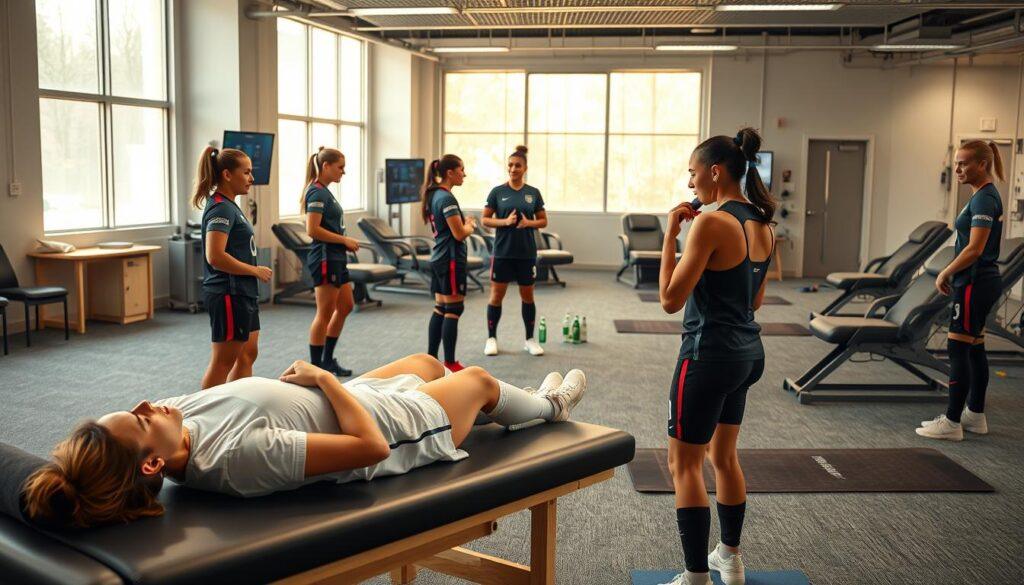
A dynamic scene showcasing diverse female soccer players in a state-of-the-art training facility, engaged in various recovery protocols post-match. In the foreground, one player relaxes on a therapy table, receiving treatment with a foam roller, while another performs stretching exercises on a yoga mat, both wearing professional athletic attire. In the middle ground, a small group of players hydrate and discuss recovery strategies near a hydration station, with sports drinks and healthy snacks visible. The background features a high-tech rehabilitation area with massage chairs and monitors displaying player data, illuminated by soft, natural lighting streaming through large windows. The atmosphere conveys focus, determination, and the essence of teamwork as elite athletes prioritize their recovery and well-being during a prestigious tournament.

Recovery sessions happen right after home games, within 15-20 minutes. Players do short strength sessions. This keeps their lower body strength up. It’s simple yet effective.

The 2021/22 season showed Rangers FC’s recovery efforts paid off. They had the lowest soft-tissue injury rate in four years. This proves proactive recovery strategies work.

Recovery is often overlooked for flashy training. But top teams know recovery is just as important. They do light isometric work and mobility right after games. It’s an unusual approach but it works.

In conclusion, recovery is a vital part of training. It’s not just what you do when you’re not training. For more on recovery strategies for female athletes, check out this insightful article. Effective recovery is key to success in the women soccer World Cup.

Tactical Fitness: Position-Specific Training That Improves Game Intelligence

Imagine a training plan that boosts your body and mind. Welcome to tactical fitness. It’s changing how top teams train, blending physical work with game strategy. It’s not just about getting faster or stronger; it’s about mastering each field position.

Rangers FC shows how it’s done. They use gym workouts that focus on each player’s role. They use the French Contrast method for lower body power. This method changes based on the player’s role, improving strength for each position.

The sled push and trap bar deadlifts are adjusted for each player. This ensures they’re strong and can move like their role demands.

Isometric running exercises target the hip, knee, and ankle. They help players perform better in games. These exercises strengthen the weakest parts of movement, helping players move more efficiently.

Tactical fitness combines physical and tactical training. It makes players stronger and smarter. For example, a center back gets stronger while learning defensive moves. This training makes players more than just athletes; they become strategic thinkers.

Teams that use this approach win championships. They become better at outsmarting opponents. Tactical fitness turns players into game-changers.

Training Method Focus Area Position Example
French Contrast Method Power Development Fullback
Sled Push Strength & Endurance Defender
Isometric Running Joint Stability Midfielder

Nutrition Strategies: World Cup-Level Meal Planning and Hydration Techniques

World Cup nutrition is not just about eating well. It’s a science that elite athletes follow. They plan their meals and hydration with precision, unlike the average gym-goer. No longer is it just about eating veggies; it’s about timing and individual plans.

World Cup teams analyze athletes’ needs with great detail. They focus on macronutrient timing to match training. It’s not just about protein; it’s when to eat it.

The pre-match meal is not pasta and chicken anymore. Athletes follow a carbohydrate loading protocol for energy. It’s a meal designed to boost energy levels.

Post-match nutrition is key. Athletes refuel within 30 minutes to recover. This is called the “metabolic window.” It’s vital for recovery, important for elite athletes.

Tournament play demands careful planning. Athletes use carbohydrate periodization to stay energized. This method helps them avoid energy overload.

Hydration is not just about drinking water. World Cup teams use individualized electrolyte protocols. They also plan caffeine and fluid intake for performance.

The difference between healthy eating and World Cup nutrition is huge. It’s like the difference between a casual jog and an Olympic marathon. So, if you want to improve your training, think about changing your diet.

Adaptation Training: How to Modify Elite Programs for Recreational Players

You’re not in the World Cup, and that’s a blessing. You have a job, family, and maybe friends to hang out with. Trying to follow a pro athlete’s training plan? That’s a recipe for burnout or injury.

Rangers FC shows us that success comes from more than just exercises. It’s about getting everyone on board. Players saw the value in gym work for football, thanks to their coaches. These coaches listened, fixed doubts, and made programs fit each player’s needs.

Your training should match your life, not the other way around. The idea of minimum effective volume is key here. It helps elite teams deal with busy schedules, and it can help you too.

Think about this: doing two sets of a movement with full effort is better than six half-hearted sets. It’s about quality over quantity, not how many you do.

Stick to the basics: focus on eccentric movements, isometric exercises, and training for your specific position. This approach is easier on your body and helps you improve without overdoing it. It’s about being smarter, not trying to be someone you’re not.

Tournament Mentality: Applying World Cup Mindset to Personal Fitness Goals

World Cup prep isn’t just about drills and diets. It’s about seeing training as a journey, not just a goal. Elite teams show a calm, consistent approach that many miss. They don’t freak out over missed workouts or celebrate small wins.

They see each session as data, valuable info for future training. This mindset builds resilience. When setbacks happen, they’re seen as chances to learn, not failures.

The World Cup mindset expects challenges, not as pessimism but as strategic realism. You plan for low energy days or sudden life changes. You adapt, not give up on your goals.

Think of your fitness journey as a long-term experiment. Each workout adds to your understanding of your body and limits. You’re both the scientist and the subject, gathering data over time. This new view can change everything.

Adopting this tournament mentality means valuing the process over quick wins. The true value of fitness isn’t avoiding obstacles but navigating them with grace and determination. This is the heart of World Cup preparation.

Whistleblowers Women Referees and Officials Leading the Game

referees and officials women

Every Sunday, I see a show that rivals reality TV: how match officials are treated. It’s not just about following rules; it’s about who has the whistle. The stats are shocking. In basketball, illegal head contacts are punished only 3% of the time. Rugby? A high tackle gets a slap on the wrist just 6% of the time. Is this really a game, or are we just signing away our rights?

Talking about female match officials is more than just checking a diversity box. It’s about a big failure in sports leadership. Representation isn’t charity; it’s key for keeping players safe. Women bring a fresh view to the chaos of officiating, facing doubts about their authority.

Imagine a world where following the rules really cuts down on injuries. Maybe the solution isn’t more tech, but who’s making the calls. It’s time for a change, one that puts safety and respect first, not old norms.

Pathway Grassroots to Pro: Badges, Assessments, and Camps

Starting as a woman referee is like finding your way through a tricky maze. It starts with the grassroots badge. This might sound simple, but it’s not. You’ll face parents who think the offside rule is a government plot.

Then, there are the assessments. These are formal tests where every call is checked by an expert. It’s not just about knowing the rules. It’s about making tough decisions under pressure.

Camps are like boot camps with a twist. They teach you to manage the game, not just follow the rules. You learn to handle the people involved, which is harder than the rules themselves.

The journey is tough, testing your body and mind. Women often face doubts about their place. But those who make it through change what it means to be in charge, one call at a time.

Stage Description Challenges
Grassroots Badge Initial certification for local officiating. Dealing with parental criticism.
Assessments Formal evaluations of decision-making. High-pressure scrutiny.
Camps Intensive training and psychological management. Balancing knowledge and interpersonal skills.

Day in the Life: Fitness Test Prep, Travel Kit, and Mental Focus

Referees start their day with a test that’s as tough as the games they watch. The referee fitness test is fair to all, focusing on your fitness level and endurance. I’ve seen top women officials beat men in sprints, only to face doubts about their ability to keep up.

Now, let’s talk about the basics. My travel kit is all about keeping it simple. It has:

  • Two whistles (one backup, because fate has a funny way of testing us)
  • Cards that feel heavier than they look
  • A snack that won’t stage a rebellion mid-sprint

Each item is chosen for a reason, making sure I’m ready for anything. But the real challenge is mental focus. It’s about ignoring the crowd’s doubts and staying sharp during the game.

Being a referee isn’t just about physical strength; it’s a mental battle too. It’s about keeping calm in the chaos of the game. Here’s how I manage:

Aspect Description Importance
Fitness Test A rigorous assessment of physical endurance Ensures readiness for high-pressure situations
Travel Kit Essential gear for officiating Prepares for unexpected challenges
Mental Focus Ability to concentrate amidst distractions Crucial for making accurate decisions

Being a referee means embracing the chaos and staying in control. It’s a tough job that needs both physical strength and mental sharpness. That’s what a day in the life of a referee is all about.

VAR, Tough Calls, and Captain Communication Tips

VAR was meant to change the game for referees, but has it really made a difference? Many thought it would end disputes and pub arguments. But, it often seems like a Rorschach test for our own biases. Even referees can’t agree on some calls, even after reviewing slow-motion replays.

Women officials face extra challenges. They get a lot of attention and must make tough calls with confidence. The key is to communicate well with team captains. This is an art that needs both authority and diplomacy.

When making a tough call, staying calm and firm is key. Saying “I saw it differently” can help ease tensions and show respect. Treat captains as respected colleagues, not just opponents. This way, you can have clear talks without getting defensive.

Referees do more than just enforce rules; they also help prevent injuries. As the pressure grows, being able to communicate well becomes even more important. If you want to learn more about female footballers’ rights, check out this guide for young athletes.

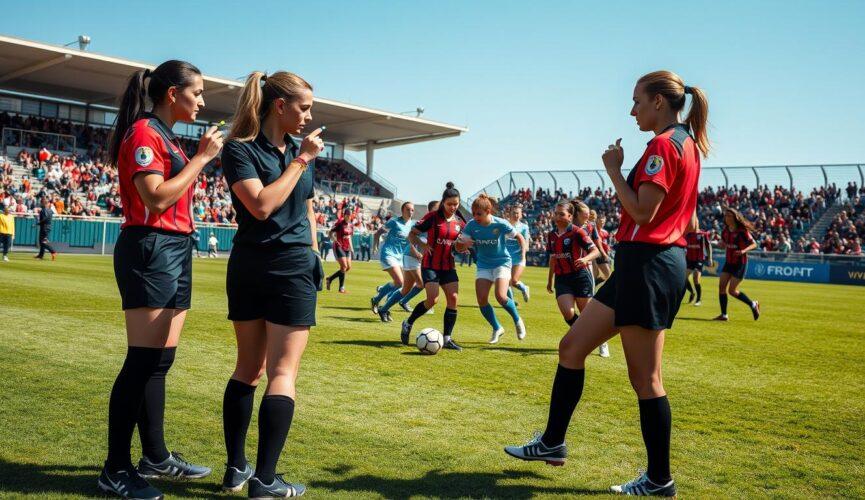
A dynamic and engaging scene depicting the "laws of the game" in a football context. In the foreground, a confident female referee in a professional black and yellow uniform is demonstrating VAR technology on a tablet, while a group of players in colorful team jerseys communicate with their captains. In the middle ground, a diverse group of officials is gathered, discussing the rules, with focused expressions. The background features a well-lit football field under a clear blue sky, with goalposts and an enthusiastic crowd in blurred motion. The atmosphere is tense yet collaborative, capturing the essence of teamwork and decision-making in sports. Bright lighting enhances the mood, emphasizing the importance of communication in the game.

How Rec Players Can Help: Respect, Language, and Self-Officiating

Imagine if every recreational player became a champion of respect. It’s a bold idea, but the respect campaign should be more than just a poster. It should be a rule that players enforce themselves. In the wild world of recreational leagues, players need to take charge.

Many leagues have only one referee and little support. This can lead to a lot of arguing. Women referees often face extra disrespect, hidden as helpful advice. Players can change this by being mindful of their words and actions.

By calling their own fouls, players can help fix the low penalization problem. It’s not just about being kind; it’s a real solution. When players show they’re accountable, it makes the game safer. Without strict rules, injuries can happen more often.

Action Description Impact
Audit Language Be mindful of how you speak to referees. Promotes a respectful atmosphere.
Self-Officiate Call your own fouls during play. Reduces pressure on referees.
Encourage Peers Foster a culture of respect among teammates. Creates a unified front against dissent.

Your attitude in Sunday league games matters a lot. It’s not just about playing; it’s about public health. For more tips on creating a respectful game environment, check out this resource.

Fitness for Refs: Interval Protocol and Agility Set with Cues

Think a referee’s fitness test is just a casual jog? Think again. These tests are tough, simulating the intense demands of a real match. The referee fitness test isn’t just a walk around the pitch. It’s high-intensity sprints, agility drills, and quick recovery periods.

The interval protocol is where the magic happens. Imagine sprinting at full speed, then resting for a short time. This mimics the stop-start nature of a game, where referees must stay sharp and responsive. It’s a carefully calibrated form of torture, ensuring that when the whistle blows, the official is ready for anything.

For women officials, the standards are no different from their male counterparts. Why? Because physiology doesn’t discriminate, and neither should we. The training is intense, and the expectations are high. A fatigued referee can lead to leniency in decision-making, which can have serious consequences on the field.

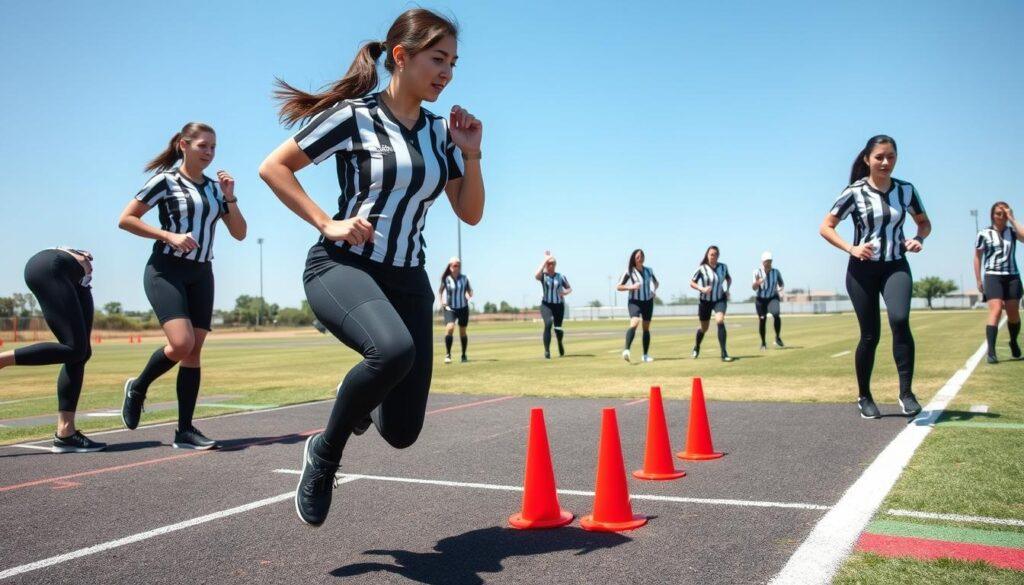
A group of determined women referees in professional athletic wear participating in a fitness test on an outdoor track field, emphasizing interval sprints and agility drills. In the foreground, one referee is sprinting energetically towards a set of colorful agility cones, while another is timing the activity with a stopwatch. The middle ground features additional referees engaged in various exercises, such as lateral shuffles and high-knees, showcasing their strength and focus. The background includes a clear blue sky and a well-maintained grassy field, adding a sense of openness and vitality. The lighting is bright and natural, casting soft shadows, capturing an energetic and inspiring atmosphere, highlighting their commitment to fitness and excellence in officiating.

Now, let’s talk about agility sets with cues. This isn’t just about fancy ladder drills for social media clout. It’s about training your body to react to visual triggers. Picture a sudden change of direction or a flailing arm from a player. Your brain must be three steps ahead, anticipating the next move while your body responds instinctively.

  • Interval Training: Short bursts of high-intensity running.
  • Agility Drills: Focus on quick footwork and reaction time.
  • Mental Resilience: Decision-making under physical strain.

Ultimately, these fitness tests are not just gatekeeping exercises; they serve as vital safety mechanisms. Studies show that decision-making degrades under physical load. A fatigued referee is a lenient referee, and that leniency can result in illegal plays going unpenalized. So, yes, those shuttle runs are saving someone’s frontal lobe.

Breaking Barriers: Stories of Firsts and New Prospects

Every whistle tells a story of courage and the fight for equality. Women referees today are not just officials but trailblazers in a field once seen as male-only. They carry the legacy of those who fought to be seen on the field.

The documentary Whistleblowers sheds light on these women’s experiences at the 2023 Rugby World Cup. It shows the challenges they face, where every decision is scrutinized, not just for its correctness but also for how they look or act. This is their everyday reality.

A powerful scene showcasing women referees breaking barriers in sports. In the foreground, a confident female referee in a crisp black and white uniform holds a whistle, her expression determined and focused. She stands with authority on a bright, freshly marked field, signaling a call during an intense game. In the middle ground, other women officials of diverse backgrounds actively engage with players and coaches, fostering teamwork and respect. The background features a vibrant stadium atmosphere with cheering fans, colorful banners, and bright floodlights shining down, illuminating the scene. Capture the excitement and empowerment within this moment, highlighting resilience and progress in sports leadership. The image should convey a sense of determination and hope, with a dynamic composition that emphasizes action and camaraderie.

The first woman to referee a men’s professional game faced incredible challenges. She had to be incredibly fit and composed. The focus on her gender was often more than her skills as a referee. These moments are not just trivia; they show the deep-seated resistance to change.

We celebrate these pioneers, but the fight is far from over. The next step is not just getting more women involved but ensuring they are judged fairly. The true victory will come when a woman referee’s mistake is seen as just that, not a reflection of her gender.

Newcomers now have role models who have faced the initial shock of being a woman in the game. They prove that the sport is changing. For more inspiring stories, check out Desiree Abrams’ journey or see how former women soccer players are making a difference off the field.

Getting Certified: Steps, Costs, Time Commitment, and Benefits

So, you want to become a referee? It’s a journey that requires patience and dedication. First, you’ll take a course that teaches you the laws of the game over a weekend. It’s like cramming for exams, but with more focus on rules and less on sleep.

The cost can vary a lot, from a few dollars to a few hundred. It depends on the sport and where you are. You’ll also spend time on ongoing education and attending clinics. It’s not just about officiating games; it’s about learning and growing.

Women in this field face extra challenges. They often have to prove themselves in a male-dominated world. It can be emotionally draining to assert your authority.

But the rewards are worth it. You get to see sports in a new light, learn from others, and develop strong decision-making skills. It changes how you watch games forever.

Getting certified is more than just a badge. It’s a way to see the world differently. It’s a journey that can be rewarding in many ways.

Spectator Guide: What to Shout and What to Skip

Spectators often think they can judge referees, but do they really get the game? Let’s be honest, most fans can’t pass a simple quiz on the game’s rules. Yet, they feel they can give real-time reviews at top volume, like they’re trying out for a foghorn.

The respect campaign is for everyone, not just players. So, what should you shout? Here’s a hint: skip anything that starts with “Hey ref” and ends with a bad word. And skip sentences with “always” or “never.” If you’re thinking in absolutes, you’re missing the point.

Women officials often face sexist heckling. Comments that would get you fired in any workplace are okay from the stands. Remember, if you wouldn’t say it to a male ref, don’t say it to a female one. That’s pretty basic.

Referees already face a lot of physical and mental strain. Your jokes about their eyesight aren’t helping. They just add to the noise that makes it harder for them to make fair calls.

So, be like a Stoic. Cheer for the good calls and groan at the bad ones. And remember, the person in the middle is doing a tough job you’d fail at in five minutes.

What to Shout What to Skip Why It Matters
“Great call!” “You never get it right!” Encouragement boosts referee confidence.
“Keep it up!” “Hey ref, are you blind?” Positive feedback fosters respect.
“Let’s go, team!” “You always miss that!” Support your team, not the negativity.

Resource List: LOTG Updates, Video Libraries, and Quizzes

Knowing the laws of the game is key for any referee. The official LOTG app is a must-have. It may not be the easiest to use, but it has the official text.

Understanding these laws is critical. With updates from IFAB coming often, it’s like trying to catch a bus that never stops.

Video libraries are a goldmine. FIFA’s training clips and World Rugby’s decision-making breakdowns offer valuable insights. For a deeper dive, check out the *Whistleblowers* documentary on rugbypass.tv.

It gives a raw, human look at the pressures of elite officiating. It’s not just about rules; it’s about the heart behind the whistle.

Quizzes are often overlooked but are very important. Platforms like AreYouReadyRef test your knowledge in real-world scenarios. They challenge your understanding and make you rethink the rules.

For women referees, these resources act as armor against stereotypes. Knowing the laws of the game cold is your best defense against any doubters.

Education and resources are vital. The editorial on injury prevention emphasizes the need for training opportunities. This helps bridge the gap between policy and enforcement.

Use this resource list as your toolkit. In a world where a single misinterpretation can spark outrage, being well-informed is not just beneficial; it’s necessary.

Women’s Soccer Development: Coaching, Drills, and the Culture Behind Success

coaches and mentors shaping

There’s a special magic on the soccer field, more so in women’s soccer. It’s not just about drills or tactics. It’s about the people guiding us. I remember Coach Alvarez’s whistle—two short blasts that meant, “reset your brain, not just your feet.”

It’s common to say a coach changes your life. And it’s true in women’s soccer. The mentor effect goes beyond teaching better plays. It’s about seeing you as a whole person, not just a player.

Research shows one caring adult can change a kid’s life. But what’s the secret? It’s high expectations, specific feedback, and really paying attention. A great coach doesn’t just teach to scan the field. She teaches to scan your own possibilities.

Think about the cultural impact. Imagine Mr. Miyagi with more tactics and less bonsai trees. For women’s soccer, mentors play a huge role. They counter society’s lack of investment in female athletes. A coach who demands professionalism builds a team and a society where leadership is learned through action, not words.

Four Coach Profiles: Pathways, Philosophies, Signature Sessions

Welcome to the coaching jungle, where four distinct profiles reign supreme in women’s soccer. Each coach has a unique pathway, philosophy, and signature session. These shape their approach to leadership and practice design.

Coach Profile Pathway Philosophy Signature Session
Academic Sport Psychology Master’s Learning through dialogue Rondel as group therapy
Old-School Tactician Traditional Coaching The ball doesn’t get tired 4v4+3 pressing drill
Player-Turned-Coach Professional Player Empathy and understanding Game day minus one walkthrough
Innovator Modern Coaching Techniques Democratic leadership Positional play grids

The Academic coach is a master of sport psychology. She crafts practice sessions that feel like TED Talks. Her warm-ups often turn into Socratic dialogues about spatial awareness.

Her signature session—a rondel morphing into a group therapy exercise—ensures that players not only develop skills but also connect on a deeper level.

In contrast, the Old-School Tactician embraces a no-nonsense approach. With a philosophy that the ball doesn’t tire, he designs grueling drills that push players to their limits. His 4v4+3 pressing drill is notorious for turning athletes into strategic thinkers, akin to chess grandmasters on the field.

Then we have the Player-Turned-Coach, who brings a fresh perspective to leadership. With her cool demeanor and deep understanding of modern athletes, she leads sessions that feel more like jazz improvisation than rigid drills. Her game day minus one walkthrough is a blend of strategy and creativity, allowing players to visualize success.

Lastly, the Innovator challenges the status quo. Known for her democratic leadership style, she encourages every player to voice their thoughts during debriefs. Her practice design, featuring complex positional play grids, could baffle even a NASA engineer, yet it fosters a collaborative environment where creativity thrives.

Understanding these coaching pathways isn’t merely an exercise in observation; it’s a blueprint for effective leadership in women’s soccer. By dissecting these profiles, we can appreciate the diverse approaches that contribute to the growth of the game.

Practice Architecture: Warm Up, Technical, Tactical, Competitive, Cool Down

Imagine a practice session as structured as a Broadway show. It should be both a science and an art. But often, it feels like a buffet with too many drills. Let’s make it precise and engaging.

The warm-up is key. It’s not just jogging and stretching. In 2024, we need dynamic movements. A good warm-up gets players ready physically and mentally.

The technical block is where coaches can really make a difference. Skill work is important, but it must relate to the game. This keeps players engaged and learning.

The tactical phase is all about strategy. It involves games with rules and small teams. This is where players learn to read the game and make decisions.

The competitive segment should be intense. But often, it’s just a free-for-all. Coaches need to provide feedback and ensure players apply what they’ve learned.

The cool down is vital for reflection and recovery. It’s a chance for players to discuss what they’ve learned. But sometimes, it’s overlooked.

For more insights on effective drills, check out 10 Must-Try Soccer Drills for Beginner.

A dynamic soccer training scene featuring women coaches conducting a practice session in a well-designed sports facility. In the foreground, two women in professional athletic attire are demonstrating drills to a group of eager young female athletes, showcasing their coaching techniques with clear communication and enthusiasm. The middle ground includes cones, goals, and agility ladders set up for a structured warm-up and tactical drills, reflecting a well-thought-out practice architecture. The background reveals a bright and modern soccer field, with natural daylight illuminating the scene and creating an energetic atmosphere. The angle captures the action from slightly above, allowing for a comprehensive view of the practice layout, highlighting the coaches’ leadership and the collaborative learning environment. The overall mood is motivational and empowering, illustrating the culture of women’s soccer coaching.

Fitness Blocks for Amateurs: 2-Day Week Plan, Load Management

For weekend warriors, balancing work, family, and soccer is key. It’s a tightrope walk to stay fit for soccer and avoid injuries. Amateur women’s soccer teams often train just two days a week. This means they need a practice design that’s super efficient.

Coaches sometimes try to pack a pro preseason into just two hours. This leaves players hobbling for days, feeling sore and defeated. Load management is more than just a term for top athletes. It’s vital for keeping a season going without a flood of injuries.

So, what’s a winning 2-day plan? Day One is all about high-intensity interval runs, disguised as small-sided games. No one likes a beep test! Day Two focuses on building endurance through tactical drills. Each drill is carefully planned to maximize every minute.

Think of it like meal prepping for the week. You need the right mix, not just a bunch of kale. Here’s a sample week that sports scientists would approve of:

Day Focus Activities Duration
Day 1 High-Intensity Small-sided games 60 minutes
Day 2 Aerobic Capacity Tactical drills 60 minutes

And yes, there’s that teammate who always forgets her running shoes. Balancing fitness with life is tough. But with the right strategy, we can make it work.

Culture Builders: Feedback Language, Inclusion, Role Clarity

Imagine culture as the air we breathe on the field—essential yet often overlooked. It’s not just a catchy phrase on a poster; it’s the invisible force that binds a team together. In women’s soccer, establishing a high-performance culture requires a leadership style that balances diplomacy, psychology, and a dash of humor. Let’s dive into the critical elements that shape this culture.

First, let’s talk about feedback language. Coaches often confuse brutal honesty with effective communication. Saying “that was terrible” isn’t honest feedback; it’s verbal vandalism. Instead, effective feedback should be specific and actionable. Think of it as a feedback loop where players first self-assess. This method not only fosters accountability but also encourages a growth mindset.

Next up is inclusion. It’s not merely about giving everyone equal playing time; it’s about ensuring every voice in the huddle is heard. Consider this: if a coach consistently speaks to the loudest extrovert, what happens to the quieter players? Their insights and talents remain untapped. Subtle language choices, like using “we” instead of “you” after a loss, can significantly shift the emotional climate of the team.

Now, let’s address role clarity. This is the unsung hero of team cohesion. A player who doesn’t understand her role is like an actor on stage without a script—chaos ensues. To illustrate, let’s reference the beloved show “Ted Lasso.” Imagine if Lasso’s relentless positivity met the tactical rigor of a Champions League coach. That’s where magic happens! A vague “just play your game” speech leads to confusion, much like a Jackson Pollock painting on the field.

To sum it up, building a culture in women’s soccer requires a nuanced approach to feedback, a commitment to inclusion, and a clear understanding of roles. The best leaders recognize that culture is crafted through countless small interactions. Below is a table summarizing these key components:

Component Description Impact on Team
Feedback Language Specific, actionable feedback that promotes self-assessment. Encourages accountability and growth.
Inclusion Ensuring every player’s voice is valued. Fosters a sense of belonging and team unity.
Role Clarity Clear understanding of each player’s responsibilities. Enhances cohesion and performance on the field.

In conclusion, effective leadership in women’s soccer is about creating a culture where feedback is constructive, every voice matters, and roles are crystal clear. This approach not only elevates individual performance but also strengthens the team as a whole.

A diverse group of women soccer coaches in a dynamic training session, showcasing teamwork and leadership. In the foreground, a female coach in professional business attire discusses strategies with her players, emphasizing feedback language with friendly facial expressions. The middle ground features young female athletes in action, executing drills that illustrate inclusion and clarity in roles, with varying ethnicities and body types. The background captures a vibrant soccer field under warm, golden-hour lighting, with cheering teammates and supportive spectators. The atmosphere is empowering and collaborative, reflecting a strong culture of mentorship and inclusivity in women’s soccer. The composition uses a slightly lower angle to emphasize the coaches' leadership and the athletes' determination.

Parent Education: Sideline Codes, Hydration, and Safety

The sideline is a stage for drama, filled with well-meaning parents and questionable advice. It’s a theater where every cheer can either uplift or undermine a young athlete’s spirit. Have you ever witnessed a parent yell “boot it!” at their daughter? That’s a surefire way to instill panic.

This is where a sideline code of conduct becomes essential. It’s not just a list of dos and don’ts; it’s a social contract. It ensures we don’t turn a U-14 match into a scene from the Colosseum.

Equally important are the topics of hydration and safety. Let’s face it, water breaks aren’t optional in July. Dehydration can significantly impact a player’s performance.

Parents need to understand the science behind hydration. When kids are running around in the heat, a simple water break can be the difference between a great game and a heat-related emergency.

And let’s not overlook safety protocols. Concussion guidelines aren’t just suggestions; they’re vital for protecting our young athletes. Ignoring them can lead to serious consequences.

As a coach, extending your influence to the car ride home is vital. This is where the real post-game analysis happens. Effective mentorship programs equip parents with the knowledge they need to support their children positively.

In parent meetings, I recommend using scripts that blend humor with critical information. This approach can help ease the tension while educating parents. Think of it as a guide to transforming the sideline from a liability into a supportive asset. One awkward conversation at a time, we can make a difference.

Find a Mentor: Directory, Clinics, and Certification Path

Looking for a mentor in women’s soccer is like going on a treasure hunt. You’ll find many chances, from official directories to weekend clinics. I’ll help you navigate this journey, making it clear and easy to follow.

The U.S. Soccer Learning Center is your go-to place for coaching. Here, you can get licenses from the basics to the top A-Senior level. It might need some tech skills, but the knowledge is worth it.

A diverse group of women soccer coaches gathered on a training field, engaged in a dynamic discussion about drills and strategies. In the foreground, one coach demonstrates a drill with a soccer ball, wearing professional athletic gear and a whistle around her neck. The middle ground features two coaches taking notes and observing the demonstration, dressed in modest casual clothing, exuding a sense of commitment and teamwork. In the background, a soccer goal and cones mark the field, under a clear blue sky with soft sunlight illuminating the scene, creating a vibrant and inspiring atmosphere. The image captures the energy and camaraderie of women shaping the future of soccer.

Then, there are in-person clinics where you meet experienced coaches. Imagine talking to someone who has been where you are now. That’s what mentorship is all about.

Directories like the United Soccer Coaches Association are like a big network for coaches. They help you find mentors and connect with others in the field. This network is super helpful as you grow in your coaching career.

Getting certified is more than just a formality. It’s a way to learn important skills. You’ll learn about practice design, leadership, and even dealing with parents. It’s not just about learning from the game; it’s about learning from experts.

So, finding a mentor in women’s soccer is like creating your own adventure. It’s like a “choose your own adventure” book for your coaching career. With the right tools and a sense of humor, you’ll find a mentor and maybe even become one yourself.

Interview Questions to Choose Your Next Coach

Finding the right coach is like dating. It’s about chemistry, capability, and commitment. You need someone who understands the game and can inspire and lead. Asking the right questions can show their leadership philosophy.

Here’s a list of questions to cut through the usual coach-speak. Forget the clichés like, “I develop the whole player.” Instead, ask:

  1. Describe a time you managed a conflict between two key players. If they say, “I told them to sort it out themselves,” it’s time to run. True leadership means guiding and mediating, not giving up.
  2. How do you design a practice session for a team that’s low on confidence? Their answer will show if they’re a tactician or a therapist. Today’s game needs both.
  3. What role does inclusion play in your coaching style? If they say, “I play the best eleven,” that’s a red flag. Leadership should value diversity and make every player feel important.

These questions help you see if the coach is a true leader or just another clipboard holder. I once asked a coach about team dynamics, and they said, “I let the players figure it out.” That’s not leadership. A good leader engages, inspires, and builds a winning culture.

Remember, hiring a coach is like pitching for a CEO role in a small, sweaty company. You want someone who can handle ups and downs, inspire their team, and build resilience. So, choose wisely!

Sample 60-Minute Practice PDF for Teams and Pickup Groups

Ever seen a practice plan that looks like a quick sketch? This 60-minute PDF is your solution. It’s perfect for competitive teams and flexible for pickup games. It focuses on minimum viable structure, maximum engagement.

The warm-up is a dynamic passing circuit that also breaks the ice. It’s not just for warming up muscles. It’s about building team spirit.

The technical block uses a constraints-based approach. Think small grids and specific targets. It makes you feel smart when it works.

Then, we move to the tactical segment: a 4v4+2 possession game. This teaches shape without needing a lecture. It’s better to let the game teach them.

The final part is a conditioned scrimmage with double points for goals from combination play. This encourages teamwork and strategy.

The cool down is brief but important. It includes sharing the “highlight of the session.” It’s about learning and growing together.

So, download the PDF and get ready for a session that’s ready to be printed. Or maybe ignored for a full-field scrimmage. But you’ll have a solid plan just in case.

Coach Shoutouts: Nominate the Next Feature

Every great mentorship program needs recognition. It’s the kind that truly makes a difference, not just sits on a shelf. It’s time to highlight the women soccer coaches who make a real impact.

Think of the coach who stays late to help a player. Or the one who sends a text that really motivates. These heroes need our spotlight.

Nominate a coach who has made a difference in your life. Share their story, and I’ll share it with the world. It’s a chance to celebrate the unsung heroes of soccer.

This effort is all about recognizing the strength of mentorship programs. It’s a small act of leadership that can inspire many.

Before you nominate yourself, remember, true mentorship lifts others up. It’s like “The Great British Bake Off.” Coaching is a mix of science, art, and sometimes, emotional moments. Let’s celebrate those who add sweetness to the game.

Join the conversation. Your shoutout could inspire another coach to keep going and innovate. Let’s shape women’s soccer together, one nomination at a time.

Life After Football: Former Players Creating Impact Beyond the Pitch

former players off field impact

In sports, the story often stops when the game ends. But what’s next? Too many athletes fade into obscurity, leaving a legacy that feels unfinished. Moving from the excitement of competition to the quieter world of business and charity can be tough. Yet, for some, it’s a chance to make a new kind of impact.

Warren Creavalle is a great example. As a former Dynamo midfielder, he didn’t just stop playing. He started something new. During a pandemic and a time of big change, he co-founded Black Players for Change. This group gives Black voices a platform in soccer. His story shows that even when a career ends, influence doesn’t have to.

These retired athletes are not just looking back at their past glories. They’re actively shaping the future. They’re going into business, starting new ventures, and leading projects that challenge the usual ways of doing things. It shows that the skills they learned playing sports—like teamwork, resilience, and strategy—are very useful in the real world.

Five Stories Coach Startup Founder Nonprofit Leader Media Voice Advocate

These retired women soccer players are not just looking back; they are changing the game. They move from the field to roles that inspire others. This shows that ex-athletes can do more than just play sports.

Here are five distinct archetypes reshaping the landscape:

  • Coach: Forget the old idea of coaches. Today, they focus on making athletes feel safe. They create spaces where young athletes can grow without stress.
  • Startup Founder: Creavalle is a brand started by a retired player. It was launched while they were playing. This shows that the drive to start something new doesn’t wait for retirement.
  • Nonprofit Leader: This isn’t just about giving to charity. It’s hard work, like starting after-school programs. Kids design their own soccer jerseys, learning while being creative.
  • Media Voice Advocate: Retired players now shape stories. They use their platforms to push for change and support athlete activism.
  • Advocate: This role combines all the others. Former players fight against big barriers with the same drive they had on the field.

These five stories are not just exceptions; they are the new standard for retired athletes. The drive that fueled them on the field now fuels change in their lives.

Transferable Skills Leadership Teamwork Resilience Communication

Ever thought that teamwork from the sports field could boost your career? The skills you learn in sports are gold in the professional world. Let’s explore how these skills help former players in their careers.

Leadership is more than just giving orders. It’s about being strong in your beliefs, even when it’s tough. Remember when players stood together in silence to protest? That quiet power can change things in a corporate setting, too.

Teamwork means combining talents to form a strong team. This skill is perfect for the workplace, where working together is everything. It’s about seeing how your own strengths help the whole team, even when it’s hard.

Resilience is key for athletes. It’s not just about getting back up after losing. It’s about being ready to work even harder the next day. Startups talk about “failing fast,” but athletes have been doing this their whole lives. They see every failure as a chance to get better.

Lastly, communication is more than just yelling on the field. It’s about sending messages that really connect, like a visual that speaks volumes. Think of how an athlete might change from ranting on social media to making big changes in the league. That’s strategic thinking at its best.

The great thing about these skills is they can be used anywhere. You might not be able to run a 4.3-second 40-yard dash in a meeting, but the discipline of training? That’s a game changer. The challenge is to use these skills in new places, seeing that a scouting report and a market analysis are similar.

Lifestyle Blueprint Alumni Workouts and Healthy Habits

When your playing days end, it’s time to start a new chapter. Moving from athlete to civilian can seem tough. But, it doesn’t have to be a sad story. It’s about keeping your health in check, not chasing old glory.

Many retired athletes forget about their health after they stop playing. But, the smart ones keep it in mind. They switch up their fitness routine, like trying Pilates instead of squats. This change is not a punishment but a new way to care for your body.

Creavalle is a great example. While others binge-watched, he worked on a Black Lives Matter armband for the MLS. This creative project helped him stay mentally healthy. It shows how former players can make a difference and stay well.

Healthy habits for retired athletes aren’t just about food. They’re about finding a new sense of self. When the structure of a professional team goes away, you need to build a new routine. Remember, rest is not a weakness. A short walk with a podcast can be as good as a pre-game meal.

The main goal is to live a long, fulfilling life, not just to look back at highlights. It’s about enjoying the journey and finding new ways to live well after sports.

A group of former athletes engaged in a vibrant outdoor exercise session, showcasing their commitment to health and community. In the foreground, two diverse individuals in professional athletic wear demonstrate partner stretches, embodying teamwork and encouragement. The middle ground features a small circle of participants performing a dynamic workout, radiating energy and motivation, with a focused expression on their faces. In the background, a sunny park scene filled with trees and a clear blue sky enhances the atmosphere of positivity and wellness. The lighting is warm, casting gentle shadows, creating a welcoming and inspiring mood. The angle captures the action from a slightly elevated perspective, emphasizing the collaborative spirit of the alumni in their fitness journey.

How Ventures Support Girls in Sport Scholarships Safe Fields Coaching Ed

To truly support girls in sports, we must build foundations that encompass safety, education, and empowerment. Investing in women’s sports and underserved communities is a game changer. It’s easy to write a check; it’s hard to build a safe field. Today, philanthropy has evolved from guilt-ridden charity galas to high-impact ventures that focus on real outcomes.

Scholarships are no longer just about covering camp fees. They now fund STEM education alongside dribbling drills, preparing young women for a future where they can excel both on and off the field. The “safe fields” movement emphasizes not just softer turf, but creating psychological safety zones where girls can learn without the pressure of a win-at-all-costs culture.

Take Creavalle’s after-school program in Chester, Pennsylvania. On the surface, it’s a jersey design workshop. Yet, on a deeper level, it’s a Trojan horse for design thinking, entrepreneurship, and self-expression. He’s not just teaching kids to kick a ball; he’s equipping them with the tools to create the apparel they wear. This approach is the new coaching education. It’s not about the 4-4-2 formation; it’s about teaching young women to navigate a world that often excludes them.

These ventures recognize that a soccer pitch is just a green rectangle until you layer it with mentorship. The return on investment for these projects isn’t measured in goals scored, but in confidence gained and cycles of poverty broken. It’s the ultimate long-term play. For more inspiring stories of former women soccer players creating impact beyond the pitch, check out this link.

Career Advice for Rec Athletes Networking Certifications Portfolio Building

So, you’ve played in weekend matches and now want a career in sports. You’re in good company! Many recreational athletes are making this move. But, they often miss some key steps. Let’s explore the basics: Networking, Certifications, and Portfolio Building.

Networking is your first step. It’s not just about collecting business cards. It’s about making real connections. Ian Babcock, from *Chat By The Pitch*, built his platform by having meaningful talks with soccer stakeholders. This way, you build relationships and learn more about the industry.

Now, let’s talk about Certifications. In today’s world, having a coaching badge is like having an MBA. If you want to run a coaching business, you need more than passion. Parents want to see your credentials, like safeguarding badges and first-aid training. The modern parent-coach relationship demands it.

Lastly, let’s look at Portfolio Building. Your portfolio should show your analytical skills, not just your athletic prowess. Start a blog or substack to analyze youth tactics. Record podcasts with local club heroes. Show that you can think critically about the game, not just play it. The barrier to start a coaching business is low, but credibility is key.

In conclusion, becoming a successful coaching business owner is more than just playing sports. It takes strategy in networking, getting the right certifications, and building a strong portfolio. For more on how former college athletes make this transition, read this article on career transition programs in the NCAA.

A dynamic scene showcasing a diverse group of former athletes in a modern office environment, actively engaging in coaching and networking activities. In the foreground, two well-dressed individuals, a male in a tailored suit and a female in smart business attire, are having a focused conversation, exchanging ideas amidst a spread of colorful portfolios and certification papers on a sleek conference table. In the middle, a small group is collaborating, one person using a laptop to create a professional website, while another presents a visually appealing digital portfolio on a tablet. The background features a large window with motivational sports posters and greenery, illuminated by warm, natural sunlight to evoke a positive and inspiring atmosphere, capturing the essence of building a successful post-athletic career.

Volunteer Donate Attend How to Plug into Impact Projects

Are you ready to turn your love for soccer into something bigger? Getting involved in impact projects is more than just giving back. It’s a way to use your resources to make a difference. Here are three steps to get started: volunteer, donate, and attend.

Volunteer. If you have free time, use it to help out. Don’t just play soccer; use your skills to make a difference. If you’re an accountant, help with the finances of a local coaching program. If you’re a lawyer, help a nonprofit with their legal needs.

Donate. If you can’t give time, your money can help too. But don’t just give to big organizations. Look for local nonprofits where former players are making a difference. Your $50 could change a child’s life.

Attend. Your presence is important. Go to community meetings, fundraising events, or listen to podcasts like Chat By The Pitch. These events show that former players’ work is valued. It’s not just about learning; it’s about being part of the change.

So, raise your hand and join the movement. The future of soccer is being shaped in local communities and online. Don’t just watch; be part of this exciting change!

A series of diverse former athletes, both men and women of varying ethnicities, are engaged in impactful community service activities in a vibrant urban park. In the foreground, two players in professional business attire are volunteering at a food drive, sorting donations with smiles on their faces. In the middle, a diverse group gathers around a community art project, painting murals that promote social unity, while others assist local children in a skill-building workshop. In the background, banners promoting community events flutter in the gentle breeze, and trees provide a lush, green backdrop under a warm golden hour light. The atmosphere is uplifting and collaborative, conveying a sense of hope and social responsibility, captured with a wide-angle lens to embrace the collective energy of the scene.

Book and Podcast Picks from Each Alumna

What do retired women soccer icons read and listen to after they retire? Their choices show a wide range of knowledge and insights. Each book or podcast they recommend tells a part of their story and the lessons they’ve learned.

For example, the podcast *Chat By The Pitch* is a favorite. Hosted by Ian Babcock, it explores soccer in-depth. Topics include:

  • The realities of youth soccer culture
  • Coaching philosophy and player development
  • Leadership and communication strategies
  • Parenting athletes in today’s environment
  • The mental side of competition
  • Building healthy club culture
  • Technology’s impact on the game
  • Grassroots to elite pathways

This podcast stands out from the usual quick opinions. It offers in-depth talks that are both informative and fun. It’s like a mental workout that’s sometimes tough but always worth it.

These athletes also have varied reading interests. For example:

  • The founder of a nonprofit might be engrossed in lean startup methodologies.
  • The advocate could be tuning into legal podcasts focused on civil rights.
  • The coach might explore breathing techniques and nervous system regulation.

These books and podcasts not only make their lives richer but also help them lead and inspire others. As the saying goes, “You are what you read.” These women are reading to grow and lead.

Impact Tracker KPIs and Success Snapshots

Measuring the impact of former players off the field needs data-driven decisions. Warm feelings alone can’t build fields or provide scholarships. We must analyze social outcomes as seriously as we do sports stats. Welcome to the Impact Tracker.

The KPIs here are clear and important. Let’s look at some key metrics:

  • Scholarships awarded: How many girls got scholarships?
  • Safe fields built: How many safe fields were made in food deserts?
  • Coaches educated: How many coaches learned about trauma-informed practices?

These numbers show real changes in lives. We’re focusing on real impact, not just “impressions.” A success snapshot is more than a photo with a big check. It’s a study showing kids in after-school programs graduate 20% more often. That’s a story worth telling.

Creavalle’s journey shows us the importance of qualitative KPIs. He moved from designing for himself to designing for others. This change is what we should track.

We need to see the effect of a single armband on TV. Did it change policies? Did it influence corporate spending? The Sage archetype wants proof. We’re done celebrating intentions; now we check the results. For more on this, see this KPI comparison discussion.

Action Steps Join Mentor or Sponsor a Program

The final whistle on this article signals a call to action. It’s time to shift from passive observation to active participation. Former players off field impact is profound, and you can be part of that change.

First, join the conversation. Engage with podcasts like Chat By The Pitch, where real discussions take place. These platforms focus on the nuances of player development and leadership. Listening to these voices can reshape your understanding of the game beyond just scores.

Next, consider mentoring. You don’t need to have a trophy cabinet to offer guidance. If you have expertise in finance, marketing, or law, your insights can empower a former athlete. A simple hour-long Zoom call can help them navigate the challenges of starting a coaching business or a nonprofit. Your experience is invaluable.

Lastly, sponsor a program. This is where your financial support can create tangible change. Many corporate budgets allocate funds for wellness and diversity initiatives. Redirecting these resources to ventures led by retired women soccer players can amplify their efforts on the ground. Buy the armband, fund scholarships, and invest in the future of the game.

Remember, the legacy of a player is not measured by goals scored but by the infrastructure built for future generations. The ball is at your feet. What will you do with it?

Comeback Stories From Injury to Inspiration in Women’s Soccer

comeback stories women soccer

In sports, the journey from hard times to victory is deeply moving. It captures the hearts of fans and anyone who has faced challenges. Athletes who overcome injuries inspire many, showing mental strength and determination.

These athletes show incredible resilience, turning setbacks into opportunities. What drives them to keep going through tough times? Their stories are worth exploring.

We’ll look at their struggles and victories. Each tale shows the power of the human spirit. It reminds us that inspiration can come from anywhere.

The emotional arc from diagnosis to first minutes back

Injuries hit hard, not just physically but emotionally too. They can make an athlete question their dreams. At first, they might feel like they’ve lost everything. Denial, anger, and a wish to change fate follow. But slowly, acceptance grows, and the healing starts.

Alex Morgan’s story is a great example. She tore her ACL in high school, a huge setback. Fans felt her pain too. But Morgan showed incredible mental resilience. She had surgery and came back in just five months. It was a win for her mind as much as her body.

The journey from diagnosis to first steps back is full of ups and downs. Here’s a look at what it might feel like:

Stage Emotional Response Key Actions
Diagnosis Shock, Denial Seek second opinions, research
Acceptance Frustration, Bargaining Set realistic goals, start rehab
Rehabilitation Hope, Determination Physical therapy, mental exercises
Return Joy, Anxiety Gradual reintegration into play

Every comeback story, like Morgan’s, shows the journey is just as important as the end. The hard work and small wins during rehab are key. They tell a story of overcoming, inspiring others to do the same.

Three comeback profiles timelines setbacks breakthroughs

In sports, comebacks are epic tales of grit and willpower. Today, we look at three athletes whose battles with injury have shaped their careers and inspired fans worldwide.

Alex Morgan hit a big roadblock early on with an ACL tear. Her recovery was truly remarkable. After surgery, she threw herself into ACL rehab with unmatched commitment. Just five months later, she was back on the field, showing her spirit was as strong as her will. Morgan went on to win two World Cups and an ESPY for Best Female Athlete, proving setbacks can lead to success.

Maria Sharapova suffered a rotator cuff tear in 2008. This injury could have ended her career, but it turned into a turning point. After a tough recovery, she returned to the court and became world #1 in 2011. Her story shows that the hardest challenges can lead to the greatest victories.

Lastly, Serena Williams faced shoulder and knee injuries from 2015 to 2016. Many doubted her comeback, but she won the Australian Open in 2017 while pregnant. Williams’ journey is a lesson in overcoming adversity, showing us how to turn challenges into triumphs.

These athletes show us the complex mix of setbacks and breakthroughs. For soccer players, Morgan’s hamstring return teaches a key lesson. Recovery is not just healing; it’s about rebuilding your body to avoid future injuries.

Athlete Injury Recovery Time Major Achievements
Alex Morgan ACL Tear 5 Months 2 World Cups, ESPY Award
Maria Sharapova Rotator Cuff Tear 3 Years World #1 Ranking
Serena Williams Shoulder/Knee Injuries 2 Years Australian Open Title (2017)

Rehab pillars strength ROM plyos field progressions psychology

Rehabilitation is more than just a list of tasks. It’s a journey that athletes like Alex Morgan and Maria Sharapova show us. It’s not just about doing exercises; it’s a complex process that needs both hard work and mental focus.

The first step is strength. After an injury, getting stronger is key. Morgan started with isometric holds, which might seem dull but are vital for her recovery.

Next, we have range of motion (ROM). This part is like trying to move a stiff hinge. Athletes need to regain flexibility to perform well. Without it, even the strongest can’t move right.

Plyometrics come next. This is about jump training. A player who can’t jump well is at a disadvantage. Plyometric exercises help athletes get the explosive power they need.

Then, we have field progressions. This is where athletes start to get back to their game. It begins with simple running, then moves to more complex drills. This helps them regain confidence and skills.

The real hero of rehab is sports psychology. It’s the mental side that keeps athletes going. It’s about visualizing success, overcoming fear, and staying positive even when things get tough. Treating the mental side as an afterthought is a big mistake.

Sharapova’s shoulder rehab also followed these pillars, focusing on band exercises and serving drills. Each part of rehab is connected, showing the need for a complete approach.

Pillar Description Example from Athletes
Strength Building muscle post-injury Isometric holds by Alex Morgan
ROM Restoring flexibility Bending exercises
Plyometrics Explosive jump training Jump drills for strikers
Field Progressions Gradual return to play Linear running to full practice
Sports Psychology Mental preparation and recovery Visualization techniques

The main point is, rehab is a complete process. Skipping the mental part means you won’t fully recover. Each pillar is important, and together they form a solid plan for getting back to top form.

A serene training environment focusing on sports psychology in women's soccer. In the foreground, a determined female athlete in modest athletic wear practices mental visualization techniques, surrounded by motivational posters. In the middle ground, a sports psychologist guides her in deep breathing exercises, emphasizing calmness and recovery. The background features a soccer field illuminated by golden hour sunlight, highlighting the importance of rehabilitation and mental strength. The mood is hopeful and inspiring, showcasing resilience and dedication to overcoming injuries. Soft focus on the field creates a sense of depth. The scene captures the essence of strength, recovery, and psychological empowerment during the rehabilitation process, symbolizing progress and inspiration in women's sports.

What rec players can borrow warm ups strength buckets rest rules

Want to get some pro secrets without spending a lot? Most of us can’t afford personal trainers or fancy cryotherapy. But, we can use some pro strategies in our own workouts.

First, let’s talk about warm-ups. Alex Morgan doesn’t just walk onto the field without getting ready. She does dynamic stretching, activation drills, and sport-specific movements. Forget old-school toe-touches; we’re talking about lunges and high knees that get your heart going.

Now, let’s look at strength buckets. It’s not just lifting weights; it’s about dividing your work into push, pull, and stabilize. This targets all muscle groups. A strong posterior chain, like hamstrings and glutes, protects your knees.

Lastly, let’s talk about rest rules. Sue Bird’s career shows the importance of listening to your body. If your knee hurts, maybe skip that third game. Recovery days are just as important as playing days.

Strategy Description Example Exercises
Warm-Ups Dynamic stretching and activation drills Lunges with a twist, high knees
Strength Buckets Divide workouts into push, pull, and stabilize Squats, deadlifts, single-leg balance
Rest Rules Listen to your body and prioritize recovery Active recovery days, stretching

Red flags when to see a pro and build a support team

Knowing when to call in the pros can be the difference between a minor setback and a major injury. Athletes often try to push through discomfort. But there’s a fine line between doing so and risking injury. A physical therapist can spot this line.

Red flags aren’t just about pain. They can show up in many ways. Like a joint buckling during a simple task or swelling that lasts for days. These signs mean your body is trying to tell you something’s off.

Sue Bird knew this when she had a loose body in her knee. She didn’t try to fix it herself. Instead, she got a knee scope and built a team of experts.

Creating your support team is like gathering the Avengers. You need a surgeon, a physical therapist, and a sports psychologist. Mental resilience is key for recovery. Your team might also include a nutritionist and a strength coach.

So, when should you see a pro? If you’re Googling symptoms at 2 a.m., it’s time. Your future self will be grateful. For more on overcoming setbacks, check out real stories and proven strategies.

A serene and inspiring scene depicting mental resilience, featuring a diverse group of women in professional athletic wear, standing together on a soccer field. In the foreground, focus on one woman, her expression determined and hopeful, while in the middle ground, two others engage in supportive gestures, such as offering a reassuring touch on the shoulder or sharing an encouraging smile. In the background, a soft sunset casts warm golden light, symbolizing hope and recovery, with faint silhouettes of soccer goals and a cheering crowd that evoke a sense of community. The shot is taken from a slight low angle, emphasizing the strength and unity among them, creating an uplifting atmosphere that resonates with empowerment and encouragement on the path to overcoming challenges.

Recovery fueling protein timing hydration sleep rituals

Proper recovery is as important as scoring a winning goal, for hamstring returns. It’s not just about using a foam roller. It’s a detailed mix of nutrition and sleep. Elite athletes like Morgan and Sharapova follow strict recovery plans, and they do it for a reason.

Let’s talk about protein timing. You need 20-30 grams of high-quality protein within 30 minutes after training. This is not just a tip; it’s essential for muscle repair. Morgan likely eats lean meats, eggs, or plant-based foods at the right time. This careful timing is key to making every minute count in recovery.

Then, there’s hydration. It’s not just about drinking water; it’s about keeping the right balance of electrolytes. Dehydrated muscles are more prone to injury. Staying hydrated helps your muscles recover well, after a tough workout.

And don’t forget sleep. Sweet sleep is a hero in recovery. Growth hormone peaks during deep sleep, helping repair tissues. Sharapova values her sleep highly, and so should you. To improve sleep, try avoiding screens before bed, taking magnesium, and keeping your room dark.

In summary, for those recovering, protein, hydration, and sleep are key. They can make the difference between a lingering tweak and a strong comeback. Treat recovery like a science experiment, and see how it boosts your performance.

Recovery Element Importance Recommended Practices
Protein Timing Kickstarts muscle repair 20-30 grams within 30 minutes post-training
Hydration Prevents muscle strain Electrolytes + water throughout the day
Sleep Enhances recovery No screens, dark room, magnesium supplements

A determined female athlete performs a hamstring return exercise, showcasing strength and resilience. In the foreground, focus on her powerful leg in motion against a soft, blurred background of a training facility. She wears professional athletic attire, reflecting a commitment to recovery and fitness. The middle ground contains elements of a well-organized gym with hydration stations and protein recovery snacks. Natural lighting filters through large windows, casting an inspiring glow that highlights her focused expression and sweat glistening on her skin. Capture the essence of rehabilitation and dedication through a low-angle shot, emphasizing her strong posture and determination, evoking a sense of hope and motivation in her journey from injury to recovery.

Confidence rebuild graded contact journaling visualization

Rebuilding confidence after an injury is a slow process. It’s like adjusting a dimmer switch, not flipping it. In sports psychology, three key techniques help: graded contact, journaling, and visualization. These methods are essential for both physical and mental recovery.

Graded contact means slowly getting back into the game. For soccer players, it might start with simple drills. Then, it moves to 50/50 challenges and eventually full tackles. Each step is a victory over fear.

Journaling is more than just for teens. It’s a powerful tool for athletes. It helps track progress, release frustrations, and find patterns. For example, you might realize why you hesitate during certain moves.

Visualization is another key technique. Serena Williams used it to overcome injuries. She mentally rehearsed every move before stepping back onto the court. This mental practice is essential for building confidence.

Using graded contact, journaling, and visualization together is powerful. It’s not just about fixing a joint; it’s about rebuilding your confidence. With time and effort, you can shine brighter than ever before.

Technique Description Benefits
Graded Contact Gradual exposure to game scenarios Reduces fear, builds confidence
Journaling Tracking progress and emotions Enhances self-awareness, identifies patterns
Visualization Mental rehearsal of skills Prepares the mind, boosts performance

Balancing family work and training during rehab

Managing family, work, and training during rehab is tough. It’s not just about getting better physically. It’s also about staying mentally strong to keep everything balanced. Many athletes face the extra challenges of family and work while recovering.

Take Serena Williams, for example. She came back to tennis after having a baby. Alex Morgan also showed it’s possible to be a top athlete and a mom. Their stories teach us about managing time and staying mentally tough.

Here are some tips to balance everything:

  • Schedule Rehab Like a Board Meeting: See your rehab sessions as must-do appointments. This helps you focus on your recovery.
  • Involve Your Family: Get your kids involved in your fitness goals. They might enjoy doing planks or stretching with you, making it a fun family activity.
  • Let Go of Perfectionism: Understand that some days will be chaotic. Missing a workout for a school play is perfectly okay. Your comeback is about integrating your recovery into a busy life.

The journey of recovery is more than just the time on the field. It’s about embracing the whole experience, even when life gets tough. Mental resilience is about handling chaos with grace, adapting, and knowing every small step is important.

Community resources PT directories grants support groups

Finding support during ACL rehab is as important as the exercises. You don’t have to face it alone. The internet offers both good and bad advice, but it also has valuable resources for recovery.

Start with PT directories to find specialists for female athletes. Our bodies are different, and so should our care. Dr. Sterett’s site, The Female ACL, is a great resource. It explains why women’s knees need special attention.

Also, look for local soccer clubs with injury support networks. Online communities like the ACL Club on Reddit are great too. They let you share your feelings with others who understand your six-month recovery.

Don’t forget about money. Grants from places like the Women’s Sports Foundation can help with costs. A $200 PT bill is the last thing you need.

Building a resource toolkit is key. It helps you stay strong when you feel weak. Remember, ACL rehab is not just about getting better physically. It’s also about emotional support.

Motivation toolkit quotes playlists and checklists

When things get tough, a good motivation toolkit is key. It’s not just about getting back in shape. It’s about using sports psychology to build mental strength. Think of it as your personal guide to getting past obstacles.

Quotes from champions can spark your inner fire. Alex Morgan says, “Dream big, because dreams do happen.” It shows that every step in physical therapy brings you closer to your dreams. Serena Williams reminds us, “I’ve had to learn to fight all my life.” This is the heart of mental toughness. These words give you strength when the journey seems long.

Music can change the game. Make a playlist that starts with calm songs for warm-ups, then moves to strong anthems for tough workouts. Finish with songs that make you feel like a hero. Imagine a mix of Rage Against the Machine and Lizzo. Let the music lift your mood and help you get through hard times.

Checklists are often overlooked but are very important. A daily rehab checklist helps you stay on track. Did you do your mobility work? Did you drink enough water? Did you imagine yourself succeeding? Checking off each task gives you a sense of achievement. Keep a timeline of your recovery and celebrate each step. When faced with setbacks, remember how far you’ve come.

This toolkit is more than just getting back to sports. It’s about showing yourself that you can finish what you start. Embrace the journey and let these tools help you through the ups and downs of recovery.

Next Generation Women’s Soccer: Rising Stars You Need to Watch

rising stars womens soccer

Finding the next big stars in women’s soccer isn’t easy. It’s not just about numbers or stats in an office. True talent scouts have a special eye for youth national team prospects and love the game.

We take a unique approach to find talent. We look beyond the highlights, exploring leagues like the NWSL, Frauen-Bundesliga, and Liga F. Age is important, but it’s different when a young player shines in a senior team.

The game is changing fast. Roles are shifting. For example, Sophia Smith moves from the sidelines to the center with ease. What makes a player stand out? It’s the small details, like quick decisions and hard work that count.

Ten prospects snapshots strengths signature moves mindset quotes

Meet the ten prospects who will amaze you with their skills. They are changing the game in women’s soccer. Each player has a unique style that keeps everyone excited.

The goalscorers who redefine positioning

First, we look at the goalscorers. They can find space where it seems impossible. Their skills and training let them score when others can’t.

Finding space where none exists

Sophia Smith is a great example. She can beat defenders with her quick moves. Her ability to anticipate the game is unmatched. Her first World Cup goal showed how she finds and uses spaces.

The creators who see two moves ahead

Next, we focus on the creators. They have a vision that breaks through defenses. Their foresight lets them make plays that leave defenders confused.

Vision that breaks defensive lines

These players can plan attacks with great accuracy. They see the game in ways others can’t. This sets up amazing goals and assists.

The disruptors who change game tempo

Lastly, we have the disruptors. They are experts at changing the game’s pace. Their energy and tactics can change a match quickly.

When pressing becomes an art form

They excel at turning defense into offense. Their aggressive mindset lets them read the game perfectly. This skill makes them stand out as future stars.

How they train ball mastery speed core recovery day in life

Training for women’s soccer stars is more than drills. It’s a lifestyle. They practice endlessly, beyond what you see on social media. Their success comes from hard, repetitive work that’s not always glamorous.

Ball mastery rituals that build touch under pressure

Ball mastery is more than juggling tricks. It’s about a deep connection with the ball. Players do rituals to control the ball in tight spots. This makes their first touch feel like a part of their body.

The 15-minute warm-up that pros swear by

Every session starts with a 15-minute warm-up. It’s not just a routine. It’s a special preparation that gets their muscles ready and their focus sharp. They do dynamic stretches and ball touches to get ready for the game.

Speed work that translates to game situations

Speed is key, but not just straight-line sprinting. Rising stars work on agility and quick changes. This training prepares them for game scenarios, letting them slow down and speed up while thinking tactically.

Why straight-line sprinting is overrated

Many think speed means just sprinting straight. But games need quick speed in all directions. So, athletes focus on agility drills to improve their field performance.

Core stability as the foundation of durability

Core stability is vital but often overlooked. It supports every move on the field. Players who focus on core training can handle the game’s physical demands and lower injury risks.

The plank variations actually worth your time

Plank variations are not just trendy; they’re effective. Different planks in their routines build a strong core. This strength improves performance and career longevity.

Recovery protocols that extend careers

Recovery is key to extending careers. It’s not just ice baths or foam rolling. It’s a full approach that includes sleep and nutrition. Athletes see food as fuel, knowing it affects their performance.

Sleep, nutrition, and the unglamorous truth

Many underestimate the role of sleep and nutrition. It’s not just about working out. It’s about resting well and eating right. This discipline sets the best apart from the rest.

A skill to steal from each player with a drill progression

Why not learn from the best youth national team prospects? Each player has a skill you can steal. This could be a technical move or a way to make quick decisions on the field. Let’s explore drills that can help you master these skills.

Dribbling deception drills from the best one-on-one artists

First, let’s talk about dribbling tricks. Sophia Smith is great at making opponents lose balance. Start with the mirror drill. Find a partner and mirror each other’s moves while dribbling. This improves your agility and ability to read opponents.

Mirror drill variations for reactive agility

Add challenges to the mirror drill. For example, one player can pretend to move while the other reacts. This boosts your reactive agility and prepares you for intense game moments.

Anticipation and timing exercises for penalty box predators

Now, focus on anticipation. Sophia is good at finding open spots in the box. Play small-sided games with a shrinking goal area. This helps you make quick decisions and understand the game better.

Reading the cross before it’s delivered

Practice reading crosses with a partner. Try to guess where the ball will come from. This drill improves your game reading and reaction time.

Positional fluidity training for modern hybrids

Let’s talk about being flexible on the field. Modern players can play wide and then cut inside. Start by practicing on the touchline, beating a defender, and then crossing the ball. This prepares you for game scenarios and boosts your tactical thinking.

The inside-outside winger circuit

Make the drill harder by adding defenders or limiting touches. This not only sharpens your skills but also prepares you for game situations where you need to adapt quickly.

These drills start simple and get more challenging. They help you integrate these skills into your training. Remember, these are the same steps that top youth players take to improve.

A dynamic training session featuring a youth national women's soccer team, focused on skill development. In the foreground, several young female athletes in modest athletic attire practice dribbling and passing drills with orange cones scattered around. In the middle ground, a coach observes and gives feedback, utilizing a clipboard and whistle, while another group of players practices shooting techniques at a goal. The background showcases a vibrant soccer field under bright, natural sunlight with a clear blue sky, creating an energetic atmosphere. Use a wide-angle lens to capture the action, emphasizing teamwork and determination amongst the players. The mood is inspiring and focused, reflecting the dedication of rising stars in women's soccer.

Youth fitness trends plyometrics sprint mechanics microdosing lessons

Training for young soccer players is changing a lot. We’re moving away from simple box jumps. Now, we focus on force absorption instead of just power. This is key, as ACL injuries in women’s soccer are a big concern.

It’s not just about jumping high. It’s about landing safely too.

Plyometrics That Prioritize Force Absorption Over Force Production

Plyometrics help players absorb force better. This is where landing mechanics play a big role. Learning to land right can lower injury risks a lot.

Players need to slow down and keep their knees safe. This helps them play longer and better.

Landing Mechanics as Injury Prevention

Knowing how to land is very important. A soft landing means fewer injuries. It’s like a dance, and the smoother you land, the better you’ll do.

Coaches should teach drills that focus on these skills. This prepares players for the game’s challenges.

Sprint Mechanics for Soccer-Specific Acceleration

Sprint mechanics have also evolved. The idea that arm drive is key to speed is not true. What really matters is the relationship between shin angle and ground contact.

Players need to keep a strong posture. This lets force move well from foot to hip.

The Arm Drive Misconception Everyone Has

Many young athletes are taught to pump their arms for speed. But, it’s the lower body that really matters. Fixing this mistake can make players faster and better on the field.

Microdosing: Training the Art of Accumulated Adaptation

Microdosing is a big change in youth training. It’s about short, focused sessions instead of long, distracted ones. Just ten minutes of daily intent can be more effective than two hours of aimless practice.

Why 10 Minutes of Daily Intent Beats 2 Hours of Going Through Motions

The future women stars are not just those who train the longest. They’re the ones who train smartest. Small, focused efforts can lead to big results over time. It’s all about quality, not quantity.

Balancing school and pressure mental health habits for teens and adults

The pressure on rising stars in women’s soccer isn’t just about the game. It’s about managing life’s demands. Young athletes today face an uphill battle, trying to excel academically while also training like future professionals. This challenge often goes unnoticed, yet it can make or break their mental health.

So, what does this academic-athletic tightrope look like? It’s not just about keeping up with homework while fitting in practice. It’s about mastering time management systems that actually work for travel schedules. Here are some effective strategies:

  • Prioritize Tasks: Identify what must be done daily and what can wait.
  • Set Realistic Goals: Break larger projects into manageable pieces.
  • Use Technology Wisely: Calendar apps can help keep track of both school and sports commitments.

Next up is the social media pressure that fuels performance anxiety. With every scroll, young athletes are bombarded with highlight reels of their peers, leading to the infamous comparison trap. But how do elite prospects escape this? Here are some insights:

  • Limit Social Media Time: Set boundaries to avoid constant comparisons.
  • Focus on Personal Growth: Celebrate your own achievements, no matter how small.
  • Engage in Positive Communities: Surround yourself with supportive peers who uplift, not judge.

Lastly, let’s talk about mental health habits borrowed from sport psychology. These tools are not just fluff; they are proven performance enhancers. Incorporating practices like breath work and visualization can significantly impact an athlete’s routine:

  • Breath Work: Helps in managing stress and anxiety before big games.
  • Visualization: Prepares the mind for success by mentally rehearsing performances.
  • Pre-Match Routine: Establish a consistent routine to foster a sense of control and calm.

A vibrant soccer training scene featuring a diverse group of young female athletes, aged 15-19, practicing on a sunlit field. In the foreground, two players engage in a focused drill, wearing modest, athletic gear. One is dribbling the ball, showcasing determination, while the other is poised to intercept. The middle ground highlights other team members stretching and exchanging tips, their expressions reflecting camaraderie and encouragement. The background reveals lush green trees and a clear blue sky, radiating positivity and energy. The lighting is bright, emphasizing the youthful spirit and resilience of these prospect players, evoking a mood of ambition and teamwork. Captured from a slightly elevated angle to include the expansive field and the dynamic interactions among the athletes.

Ultimately, the goal isn’t just to produce better soccer players. It’s about nurturing healthier humans who excel both on and off the field. By implementing these strategies, young athletes can better navigate the pressures they face, ensuring they thrive in their dual roles as students and rising stars in women’s soccer.

Where to stream schedules and social follows

Finding where to watch future women stars can be tricky. With women’s soccer on the rise, finding the right broadcast can be overwhelming. Let’s simplify it for you to catch every game.

Broadcast platforms carrying youth and senior competitions

To watch the games, you need to know where to look. Here’s a quick guide to platforms for youth and senior competitions:

  • ESPN+ – Great for NWSL and select college games.
  • Paramount+ – Home to the UEFA Women’s Champions League.
  • Peacock – Streaming some U.S. Women’s National Team matches.
  • FuboTV – Offers a range of channels broadcasting women’s soccer.

These platforms might require subscriptions. But they’re worth it to follow rising stars in women’s soccer.

The streaming services worth your subscription dollar

When choosing streaming services, look for value. Consider these factors:

  • Comprehensive coverage: Find services with a wide range of leagues and tournaments.
  • Quality streaming: Make sure the platform offers a smooth viewing experience.
  • Accessibility: Check if they have mobile apps or work with smart TVs.

Tournament calendars and key dates for prospect watching

Timing is key to catch the next big talent. Mark these dates on your calendar:

  • Youth World Cups: U-17 and U-20 tournaments are key for spotting future stars.
  • Qualifiers: Watch the qualifying matches for the senior teams.
  • Showcase events: Local tournaments can also reveal talent.

Youth World Cups, qualifiers, and showcase events

These events are where the magic happens. To see rising stars in action, don’t miss them. Follow the tournament schedules closely.

Social media accounts that provide actual analysis

Social media is more than just highlights. For real analysis, explore these accounts:

  • @TheEqualizer – Offers in-depth coverage and analysis of women’s soccer.
  • @WomenSoccerZone – Focuses on the latest news and player insights.
  • @Tactical_Analyst – Perfect for those who love tactical breakdowns.

Who to follow beyond the highlight accounts

These accounts offer more than just highlights. They analyze plays, discuss strategies, and keep you updated on women’s soccer.

In conclusion, the world of women’s soccer is more accessible than ever. With streaming services and social media, there’s a wealth of information out there. For more on catching NWSL games, check out this guide.

A dynamic scene capturing young women soccer athletes in action on a vibrant soccer field, showcasing their passion and determination. In the foreground, two players in sleek, modern soccer uniforms are intensely focused as they dribble and pass the ball, their expressions determined and energetic. The middle ground features a diverse group of young soccer players cheering enthusiastically, their camaraderie and sportsmanship evident. The background shows a sunny day with a clear blue sky, soccer goalposts, and cheering fans, creating an uplifting and inspiring atmosphere. Utilize soft, natural lighting to enhance the lively setting, with a wide-angle perspective that emphasizes the spirit of teamwork and aspiration in modern women’s soccer.

Tactical evolution these players signal position changes

Forget everything you thought you knew about player positions; women’s soccer is rewriting the rulebook. The game is changing fast, with players taking on new roles. It’s not just about being good at the game. It’s about being smart and flexible on the field.

The death of the traditional winger and rise of the hybrid attacker

Wingers used to stay wide and cross the ball. But now, we have hybrid attackers. Players like Sophia Smith can play wide and then move to the center. This makes them hard to defend against.

How Sophia Smith and others are redefining wide play

Sophia Smith is a great example of this change. She knows when to stay wide and when to move inside. This smart play is the result of hard work and understanding the game.

Center backs who build like midfielders

Center backs are no longer just defenders. They help start attacks with precise passes. This change is making teams play differently.

The ball-playing defender revolution reaches the women’s game

More teams are using this style. Center backs are now starting attacks and creating chances. This shows how important being versatile is in women’s soccer.

Fullbacks as primary creators

Fullbacks are now key in creating chances. They’re not just defenders anymore. They’re making assists from deep positions.

When the assist comes from deeper than you expect

Today’s fullbacks are heroes, making key passes from deep. Their offensive skills show how the women’s game is evolving.

Player Type Traditional Role Modern Role Key Skills
Winger Stay wide, cross Hybrid attacker Dribbling, positional awareness
Center Back Defend Ball-playing defender Passing, game reading
Fullback Defend Primary creator Crossing, assist-making

The players we highlight are not just stars. They’re leading a tactical change that will shape soccer’s future. Watch them closely to understand the game’s next steps.

30 minute combo workout inspired by the class of the year

Ready to elevate your game? Let’s dive into a 30-minute workout inspired by the best in women’s soccer. This isn’t just any fitness routine. It’s a bridge between watching and doing, designed to get you moving like the rising stars you admire.

Warm-up Activation Sequence Borrowed from Pre-match Routines

First things first: we need to get your body ready without exhausting it. This warm-up focuses on dynamic mobility that opens your hips and activates your glutes. Think of it as a gentle nudge to your nervous system, preparing you for the real action ahead.

Dynamic Mobility That Prepares Without Exhausting

  • Leg Swings: 10 each leg
  • Hip Circles: 10 each direction
  • High Knees: 30 seconds
  • Butt Kicks: 30 seconds

Technical Circuit Modeled on Prospect Training Sessions

Now, let’s get to the meat of the workout. This technical circuit combines ball mastery with conditioning. Because, let’s be honest, who has time for separate skill work and fitness? We’re merging them into drills that demand precision while your heart rate climbs.

Ball Work That Doubles as Conditioning

Drill Duration Focus
Dribble through cones 5 minutes Touch and control
Short passing with a partner 5 minutes Accuracy and speed
One-touch shooting 5 minutes Finishing under pressure

Finishing and Decision-making Under Fatigue

Now, we reach the segment that reveals your true character. This is where you’ll work on finishing exercises while feeling the burn. Decision-making scenarios become critical when your legs are heavy, and your brain wants to check out.

The Final 10 Minutes That Separate the Committed from the Curious

In this last segment, you’ll engage in:

  • Timed shooting drills
  • Quick decision-making exercises
  • Small-sided games to simulate pressure

All you need is a ball, some cones, and a willingness to embrace discomfort for half an hour. No gym membership, no excuses. Get ready to channel your inner rising star and transform your training routine today!

For more drills to enhance your skills, check out these must-try soccer drills.

How to support responsibly online and in stadiums

We’ve seen the talents of future women stars in soccer. But our role as fans is just as important. Responsible support goes beyond cheering; it shapes the culture around these athletes.

When we engage online, let’s uplift, not criticize. Remember, those comment sections are not empty spaces. Athletes read what we write. The pressure can be overwhelming, even for young players starting their careers.

Digital fandom that uplifts, not pressures

Positive interactions create a supportive environment. Criticism is okay, but let’s keep it constructive. Young players need encouragement to thrive.

They deserve a community that celebrates their efforts, not just their results.

The comment section and its real-world consequences

What we say online can affect a player’s mental health. Negative comments can overshadow their passion for the sport. Let’s choose our words wisely.

Match-day culture that respects the players as humans

At games, let’s create an atmosphere that acknowledges the players’ humanity. They are not just performers; they are young individuals facing immense pressure. A supportive crowd can inspire confidence, making every match an opportunity for growth.

What young athletes actually want from their supporters

They seek understanding, not just applause. Recognizing that every player has off days can foster a healthier sports culture.

Investing in the ecosystem beyond the stars

Support extends beyond the pitch. Following youth national team prospects or local clubs builds a rich soccer community. It creates depth in the sport, ensuring sustainability.

Following lower divisions, youth leagues, and local clubs

By engaging with every level of women’s soccer, we contribute to a vibrant ecosystem. Our attention helps nurture the next generation of stars, making the sport stronger for years to come.

The Wall A Trailblazing Goalkeeper’s Journey and Training Blueprint

goalkeeper pioneer profile

Every great story starts in an unexpected place. In football, it’s often near the biggest stadiums. David Fairclough, for example, grew up close to Anfield. He turned casual games in Stanley Park into a stage for legends.

Known as Liverpool’s “super sub,” Fairclough scored key goals under pressure. Now, imagine a similar story for a women goalkeeper legend. What drives someone to face a storm of shots? It’s a mix of destiny and determination.

This article looks at how a goalkeeper is made. We’ll see their early days, unique strengths, and tough training. We’ll also compare it to Fairclough’s journey. It shows that pressure can shape many heroes.

Signature strengths reflexes positioning distribution command of box

What makes a goalkeeper stand out? It’s mastering four key strengths. These are the foundation of a keeper’s success. Missing any can lead to trouble on the field.

Reflexes are essential. They’re like a goalkeeper’s sixth sense, reacting fast. A quick choice can turn a save into a showstopper.

Positioning is the unsung hero. It lets a keeper know where the ball will go. This way, they can make saves look easy, like chess moves ahead.

Distribution is about more than just passing. It’s about starting attacks from defense. A smart throw or kick can surprise opponents, changing the game.

Command of the box is about presence. It makes defenders confident and attackers uncertain. A keeper who owns their space can make forwards doubt themselves.

These strengths work together, improving a goalkeeper’s game. When all four are mastered, a player becomes a legend.

Sample week gym field recovery and film study for keepers

Imagine this: while field players are recovering, our goalkeeper is already working hard in the gym. It’s not just any gym; it’s where real work happens. A week in the life of an elite keeper is like a special ops training manual, not a fitness influencer’s highlight reel.

Monday starts strong. Gym sessions focus on explosive power with plyometrics. Your quads will question their existence. Medicine ball slams echo through the facility, and core workouts make Pilates instructors cry. It’s not just exercise; it’s building strength and agility.

Field sessions bring GK drills to life. Footwork ladders improve quickness, and reaction saves become instinct. Claiming crosses under pressure? Do it until your body does it without thinking. This practice is key for game-time skills.

A vibrant training scene showcasing goalkeepers engaged in various drills. In the foreground, two goalkeepers in modest athletic gear concentrate on catching high balls, with focused expressions. The middle ground features a coach demonstrating techniques, accompanied by training cones and rebounders scattered around, reflecting an active training environment. In the background, a gym with gymnastic mats and weights suggests recovery, alongside a large screen displaying recorded game footage for film study. The lighting is bright and dynamic, with sunlight streaming in through large windows, casting subtle shadows. The atmosphere is energetic and dedicated, capturing the essence of a week-long training regimen designed to elevate performance and recovery.

Recovery is a discipline, not an afterthought. Ice baths, compression therapy, and good sleep hygiene are essential. They help your body recover for the next challenge.

Film study is the unsung hero of goalkeeping evolution. Watching your own games frame by frame is vital. You’ll learn about opponents and penalty takers’ tells. It’s not glamorous, but it’s why top keepers always seem to be in the right spot.

For those aiming to improve, check out this skill-building guide for young female soccer players. Every training, recovery, and analysis session adds up. It makes a well-rounded keeper ready for any challenge.

Mental game visualization mistake reset and focus cues

What mental strength lets a goalkeeper stay strong for 90 minutes, even with little action? The secret is mental toughness. It’s not just about grit; it’s building a complex mental setup for top goalkeepers.

Visualization is key. Before games, our top goalkeeper practices different scenarios in their mind. They imagine a deflected shot or a penalty with the season at stake. The brain can’t tell the difference between real and imagined, making the actual moment feel familiar.

Resetting from mistakes is also vital. A goal can bring up feelings of frustration and doubt. But elite keepers have a quick reset: a physical action, a breath pattern, or a word. This helps them move on fast, because the next shot is coming.

Focus cues are also critical. They bring the mind back to the game when it drifts. It’s not just about staying focused; it’s a mental strategy for goalkeepers. For more on the mental challenges of goalkeepers, read this article on mental toughness.

Six keeper drills footwork handling crosses 1v1s distribution kick accuracy

Drill work is where the magic of goalkeeping unfolds, a symphony of sweat and skill. These drills are not just exercises; they are the backbone of a goalkeeper’s training regimen. Let’s dive into six essential GK drills that transformed our trailblazer from promising talent to an impenetrable force.

1. Footwork — Before you can make the save, you have to get there. Think of cone patterns, agility ladders, and shadow movements. They may look deceptively simple, but try doing them at full speed for the twelfth consecutive minute, and you’ll understand their true value.

2. Handling — This is the fine line between a clean catch and a rebound that turns into a tap-in for the opponent. Use tennis balls and reaction balls to sharpen your hand-eye coordination. Trust me, this is the kind of work that would make a juggler envious.

3. Crosses — The aerial duel that separates commanding keepers from those who flap. Timing your jump and reading the flight of the ball is key. And yes, opponents are allowed to challenge you, so prepare for that reality.

4. 1v1s — This is the ultimate psychological showdown. Just you, a striker, and eight yards of grass. Shot stopping in these moments is less about technique and more about presence. Make yourself big. Make yourself inevitable.

5. Distribution Drills — Turning saves into attacks is an art. Work on throws that launch counter-offensives and goal kicks that find teammates like heat-seeking missiles. This skill can change the game.

6. Kick Accuracy Under Fatigue — Anyone can ping a ball in warmups. But can you do it in the 89th minute when your legs are screaming and the score is level? This drill tests your focus and precision when it matters most.

These six drills aren’t a menu; they’re a mandatory curriculum for any serious goalkeeper. Below is a summary table of these drills for quick reference:

Drill Focus Area Key Equipment Outcome
Footwork Agility Cones, ladders Improved movement
Handling Coordination Tennis balls Secure catches
Crosses Aerial control Soccer ball Effective claims
1v1s Presence Soccer ball Shot stopping
Distribution Counter-attacks Soccer ball Quick transitions
Kick Accuracy Precision Soccer ball Reliable kicks

Fitness conditioner ladder plus plyo progression and safety notes

Goalkeepers face a unique challenge in fitness. They need both endurance and explosive power. The fitness conditioner ladder is a key tool for building this strength.

Training isn’t about long-distance running. It’s about quick, intense bursts of energy. Plyometric exercises, like box jumps and depth jumps, are essential. They help goalkeepers build power and stability.

A fitness training scene showcasing a goalkeeper working on exercise drills with a focus on a fitness conditioner ladder and plyometric progression. In the foreground, depict a male goalkeeper in modest athletic attire, executing high knees over the bright orange ladder on a well-maintained turf field. In the middle ground, include various agility cones and plyo boxes arranged for drills, with a water bottle and towel nearby for a professional touch. In the background, show a clear blue sky and distant trees, emphasizing a vibrant outdoor training environment. Lighting should be natural, with the sun casting soft shadows, suggesting a morning workout. The atmosphere should be energetic and motivating, capturing the essence of athletic training.

Safety is a top priority in training. Poor landing techniques can lead to injuries. Goalkeepers must focus on proper landing and controlling their movements.

Our legendary female goalkeeper knew the importance of staying healthy. She trained with great care, focusing on her body’s well-being. This dedication paid off, allowing her to have a long and successful career.

Leadership from the back organizing a defense communication terms

In soccer, the goalkeeper is more than a player; they’re the leader of the defense. They see every gap and every runner not being watched. This makes leadership from the back a non-negotiable job requirement.

Organizing a defense needs clear and simple communication. Every player must understand these commands. Here are some key terms every goalkeeper should know:

Term Meaning Usage
Step Push up the defensive line “Step! We need to close the gap!”
Drop Retreat to a safer position “Drop! We’re too high!”
Away Clear the ball “Away! Get it out!”
Keeper Claiming the ball “Keeper! I’ve got this!”

The best defensive organizers are like air traffic controllers. They are calm, clear, and strict. This requires mental toughness to manage the team’s emotions.

When the defense is shaky, you calm everyone down. If a center back makes a mistake, you help them recover. Your voice is a tactical tool. It must be firm but not harsh.

Our leader was great at this, and it made our defense stronger. So, when you play, remember: leading from the back is about confidence and clear communication.

A focused goalkeeper in professional gear stands confidently in the foreground, embodying mental toughness and leadership. His intense gaze is directed towards a group of defenders, signaling strategic organization on the field. The middle ground features the defenders, dressed in matching team jerseys, positioned to respond to an impending attack, showcasing teamwork and communication. The background reveals a dynamic stadium scene, with blurred fans and vibrant banners, creating an atmosphere of anticipation and excitement. The lighting is dramatic, with spotlights illuminating the goalkeeper, highlighting the intensity of the moment. A low-angle perspective captures the goalkeeper’s commanding presence, while a shallow depth of field emphasizes the action unfolding in the background, encapsulating the essence of leadership and resilience in goalkeeping.

Community impact clinics scholarships and outreach

A goalkeeper’s true legacy isn’t just about winning trophies. It’s about touching lives and making a difference. For a women goalkeeper legend, this means helping others. They create chances for young players who might not have access to resources.

Clinics are more than just teaching skills. They’re where young keepers learn the real game. They hear about failures, struggles, and victories. These clinics teach resilience and the value of hard work.

Scholarships are key to this impact. They open doors for talented players who might be overlooked. Legends fund scholarships to help young goalkeepers grow without financial worries.

Outreach programs are vital but often overlooked. They bring goalkeeping to communities that might not think about it. This work is about making the sport accessible and building a future talent pool.

David Fairclough is celebrated for his European Cup wins. But he’s also known for mentoring. His stories and willingness to help anyone interested in football make him a legend. He showed that being a legend means being open and accessible.

Every clinic, scholarship, and young keeper mentored by Fairclough are his unseen saves. These efforts create a lasting legacy that goes beyond individual achievements. It shapes the future of the sport.

Next chapter coaching pathway and how fans can support

Transitioning from player to coach is a big change. It’s not just a job switch; it’s a deep transformation. When a player retires, they often start a new journey. Coaching lets them share their knowledge with the next generation.

But becoming a great coach isn’t easy. The skills for playing and teaching are different. It takes patience and the ability to explain what was instinctive. Our women goalkeeper legend was very prepared for coaching, just like she was for playing.

Another path is punditry. Like David Fairclough, many former players love to analyze the game. They share insights that make the sport more interesting.

Fans can help a lot in this new chapter. Here are some ways to support:

  • Attend coaching clinics to learn from the best.
  • Engage with content that highlights women’s football.
  • Advocate for goalkeeper-specific training in youth programs.
  • Watch women’s football matches in full, not just the highlights.

Attention is the most valuable thing in sports. Where fans focus, resources will follow. The retired player’s legacy is being built on. To learn more about former women soccer players’ impact, check out this article here.

Takeaway checklist for keepers and field players

As we wrap up our journey, let’s focus on key takeaways. For goalkeepers, it’s all about where you stand. Get your angles right, and saving shots becomes second nature. Remember, it’s not just about how far you kick the ball; it’s how fast.

Quickly moving from defense to offense can turn the game around. Mental toughness is something you can work on. Develop a reset ritual for when things get tough. This habit will help you stay focused under pressure.

For field players, your role is just as important. Try to see things from your goalkeeper’s point of view. The gaps you leave and the players you forget to track are all seen by them. Good communication is key. Listen and respond to your teammates’ signals.

Protect your goalkeeper during set pieces. Teamwork is everything. This guide is just the start. Use it to improve, challenge yourself, and always be ready for the next game.