Category: Community

Off the Pitch: Social Campaigns Driving Change in Women’s Soccer

social campaigns in women’s soccer

Imagine a world where top athletes live in dirty hotel rooms that smell like wet dog. Sounds like a bad movie, right? For Brooke Elby, this was her reality. She was traded without warning. This isn’t just a problem—it is the problem.

But then, something changed. Digital activism is now a powerful tool. What began as small protests has grown into a strong voice. Hashtags are more than just trends; they’re tools for change. Viral moments become powerful bargaining chips.

This movement is like a mix of Moneyball and The Social Network. But with better hair and more justified anger. The playing field is not yet equal, but the game is changing.

We’re seeing a revolution where online voices lead to real change. And it’s about time.

Social Media as a Catalyst

If the pen was mightier than the sword, then Instagram is mightier than the boardroom. Social media has become the great equalizer that policy changes couldn’t quite achieve.

Female athletes now drive twice the engagement of male counterparts on digital platforms. While male stars sell products, women like Megan Rapinoe sell systemic change through their posts.

Rapinoe’s 2.7 million followers become a megaphone for gender equality. Her purple-haired presence does more than decades of corporate diversity initiatives.

Digital platforms have created unprecedented viral movements in women’s sports. These campaigns generate real policy changes where traditional negotiations failed.

The engagement metrics tell the story: activism gets clicks, shares, and actual results. Social media has become the modern soapbox for athletic revolution.

Famous Campaigns

Imagine Broadway-level production values meeting collective bargaining agreements – that’s what happened when women’s soccer transformed into a stage for advocacy excellence. These weren’t just protests; they were masterclasses in strategic activism.

The USWNT’s equal pay lawsuit became the legal equivalent of a perfect hat-trick. Filed in 2019, this landmark case challenged systemic pay discrimination with numbers sharper than Megan Rapinoe’s crosses. The players argued they generated more revenue yet earned less than their male counterparts.

Then came the 2019 World Cup victory tour – part celebration, part protest movement. When “equal pay! equal pay!” chants erupted in French stadiums, it wasn’t spontaneous. This was calculated theater with 23,000 supporting actors in the stands.

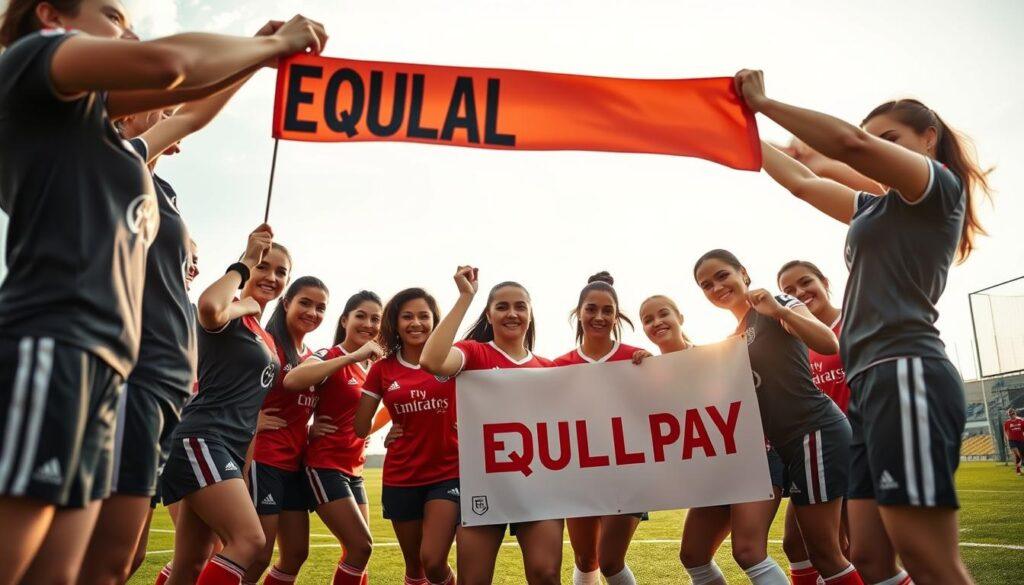
A powerful scene depicting women’s soccer equal pay advocacy. In the foreground, a diverse group of female soccer players, dressed in professional sports attire, stands united with determined expressions. They hold banners emphasizing equal pay, showcasing vibrant colors and bold graphics. In the middle ground, a soccer field stretches out, with an audience of fans looking on, their faces a mix of support and inspiration. The background features a stadium under a clear blue sky, symbolizing hope and progress. Soft, warm lighting bathes the scene, creating an uplifting atmosphere. The angle captures the unity and strength of the players while highlighting the importance of advocacy in professional sports.

The inside-out jersey protest during the 2016 SheBelieves Cup was pure genius. Players warmed up with jerseys reversed, hiding the US Soccer crest while revealing the inner lining. It was sartorial sabotage – fashion meets advocacy with a side of malicious compliance.

These campaigns worked because they understood the assignment: make inequality visible, measurable, and undeniably public. The USWNT turned soccer fields into courtrooms and stadiums into megaphones.

Campaign Tactic Impact Media Coverage
Equal Pay Lawsuit Legal challenge with revenue data $24 million settlement Front-page NY Times
World Cup Chants Player-led crowd mobilization Global trending hashtag Live international broadcast
Inside-Out Jerseys Silent visual protest Forced federation response Sports illustrated feature
Social Media Blackout Collective digital silence Sponsor pressure Viral Twitter moment

What makes these campaigns brilliant? They turned athletes into activists without sacrificing performance. The USWNT won while protesting and protested while winning – the ultimate power move.

This advocacy playbook should be studied like game tape. Each campaign built momentum for the next, creating a narrative arc more compelling than any sports drama. The equal pay fight became must-watch television with better ratings than most reality shows.

The secret sauce? Perfect timing meets undeniable data. These players knew when to strike and how to back it up with numbers that even the most stubborn executives couldn’t ignore.

Collaborations with NGOs

Let’s talk about the difference between writing checks and building bridges. When Visa dropped that seven-year partnership for women’s football in Europe, they weren’t just buying ad space. They were buying into an ecosystem. Smart money noticed what 72% of fans already knew: athletes matter off the field too.

These NGO partnerships separate the wheat from the chaff. Some brands just want their logo on a jersey. Others want to build the entire stadium. The real game-changers understand that sustainable growth means investing in infrastructure, youth programs, and creating actual career pathways.

Take FIFA’s playbook. Their NGO partnerships extend beyond ceremonial handshakes. They’re funding coaching certifications in developing nations and creating digital platforms for scouting talent. This isn’t charity – it’s strategic investment in the sport’s future talent pool.

Visa’s approach shows how corporate NGO partnerships can drive real change. Their program doesn’t just sponsor tournaments; it funds financial literacy workshops for players and builds business skills for life after sports. Because let’s be honest – even superstars need to manage their money.

The most effective collaborations share common traits:

Partnership Type Surface-Level Approach Transformative Approach Long-Term Impact
Brand Sponsorships Logo placement Infrastructure funding Creates permanent assets
Youth Programs One-time clinics Coaching pipelines Builds talent ecosystems
Player Development Performance bonuses Life skills education Creates complete athletes
Community Outreach Photo opportunities Grassroots facilities Grows fan bases

What makes these NGO partnerships work? They understand that women’s soccer needs more than temporary fixes. It requires systems that outlast any single tournament or season. The best collaborations build ladders, not just safety nets.

These strategic alliances prove that the most valuable NGO partnerships aren’t about publicity. They’re about creating structures that allow talent to flourish regardless of geography or economic background. Now that’s what I call scoring a real goal.

How Players Lead Change

Forget waiting for a corporate hero to fix women’s soccer. The players are taking charge themselves. They’re not just fighting for change; they’re leading the way.

Brooke Elby switched from playing soccer to studying business at Columbia. She’s learning to challenge the system from the boardroom. It’s a smart move to take on the establishment.

Megan Rapinoe didn’t just protest for equal pay. She’s now using her fame to change how teams are run. Her efforts go beyond the field, into the business world.

Kelly Conheeney is a new kind of athlete-executive. She’s using her experience to change how teams value their players. These women aren’t just asking for a seat at the table. They’re creating new tables.

The biggest change in sports activism isn’t on the field. It’s in business meetings and ownership groups. Billie Jean King’s Angel City FC shows players can be owners and make decisions.

What makes this player advocacy movement special?

  • Business education: Players are getting MBAs and finance degrees
  • Strategic positioning: They’re moving into front offices and ownership groups
  • Collective bargaining: They’re using their union experience to get better deals
  • Investment power: They’re starting their own investment groups

Angel City FC is more than a team. It’s a model for change. Founded by women, funded by women, and run by former players. It challenges traditional sports ownership.

Changing from an athlete to an executive takes special skills:

  1. Understanding finance and business
  2. Being good at negotiating
  3. Building a platform through sports success
  4. Expanding your network in sports and business

This isn’t a superhero team. It’s former players with MBAs, negotiation skills, and business connections. They’re rebuilding women’s soccer from the ground up.

The most powerful sports activism comes when players make the decisions. Brooke Elby, Megan Rapinoe, and Kelly Conheeney are leading the way. They’re not just fighting for change; they’re making it happen.

Player-led change is already happening. And it’s wearing a business suit, not cleats.

What Works, What Doesn’t

Let’s clear up the confusion in women’s soccer marketing. We’ll see what makes a campaign stand out and what falls flat. Every success has a blunder that makes you question if brands even watch the games they’re trying to profit from.

The Mary Earps goalkeeper shirt mess was more than a missed chance. It was a huge failure of creativity. Nike had a huge demand for the England keeper’s jersey during the World Cup. Yet, they chose not to make it. This wasn’t just a mistake in stock; it was a deep misunderstanding of what fans want.

Real campaigns know that being true is key. The #EqualPay movement succeeded because it came from the players. It was backed by solid data and real anger. It wasn’t made by a corporate team trying to follow a trend.

So, what makes a campaign win or lose? Let’s look at the key points:

  • Authentic player involvement versus corporate speak
  • Grassroots momentum versus bandwagon jumping
  • Substance over symbolism in messaging
  • Long-term commitment versus one-off campaigns

The sponsorship gap shows a big difference. Some brands see their investment as part of a movement, not just a way to put logos on jerseys. Others see women’s soccer as a charity, not a growing business.

Failures like the Earps’ shirt issue show brands don’t get the emotional bond fans have with players. It’s not just about selling stuff. It’s about showing athletes’ value and celebrating their wins. When brands mess up, fans quickly speak out.

Social media makes both wins and losses clear right away. Good campaigns use hashtags to grow communities. Bad ones get mocked instantly. The key is listening before speaking, not assuming what fans want.

Successful activism in women’s soccer means you’re not just selling to anyone. You’re talking to passionate fans who can spot fake efforts. Get it right, and you earn loyalty for years. Get it wrong, and you’re like an own goal in extra time.

Measuring Real Results

Let’s talk numbers – because nothing silences skeptical executives faster than revenue projections that hit like a Megan Rapinoe penalty kick.

The 2023 Women’s World Cup didn’t just break records; it broke even for the first time with a staggering $570 million in revenue. This isn’t a participation trophy situation – this is a full-blown business case study that would make Harvard Business Review blush.

Remember when brands worried about ROI in women’s sports? The analytics are now screaming what players knew all along: investing here isn’t charity work. It’s leaving money on the table while your competitors clean up.

A dynamic office scene illustrating women in soccer analytics, focusing on the impact of social campaigns. In the foreground, a diverse group of three women, dressed in professional business attire, intensely collaborate over data visuals on a computer screen, smiling and pointing at graphs showcasing positive trends. In the middle ground, a large digital display shows infographics related to viral campaigns in women’s soccer. The background includes a modern office setting with bright, natural lighting pouring in through large windows, and wall-mounted soccer memorabilia that adds character. The atmosphere feels empowering and innovative, capturing the essence of teamwork and progress in women's sports analytics. The angle is slightly elevated, offering a clear view of their focused expressions and the data being analyzed.

Consider the viewership numbers that would make any network executive weak in the knees. Two billion global viewers tuned in – that’s not a niche audience. That’s mainstream entertainment with purchasing power.

The sponsorship magic happens when you realize 69% of fans find brands more appealing when they support women’s sports. Even better? Those fans show 45% higher purchase intent. That’s not just good karma – that’s good business.

These numbers represent more than just successful viral movements; they signal a fundamental market shift. The women’s game isn’t catching up to the men’s game – it’s creating its own economic ecosystem with different rules and potentially higher returns.

Metric Women’s World Cup 2023 Men’s World Cup 2022 Growth Potencial
Global Viewership 2 billion 3.5 billion 42% increase from 2019
Sponsorship Revenue $570 million $1.7 billion 200% growth projected by 2027
Brand Appeal Lift 69% 22% 3x higher impact
Purchase Intent 45% higher 15% higher 300% greater ROI potencial

The table tells a compelling story. While men’s tournaments bring bigger numbers, the women’s game offers more impact per dollar. That 45% purchase intent number? That’s the holy grail marketers dream about.

We’re witnessing the perfect storm of social consciousness meeting capitalist opportunity. The viral movements around women’s soccer aren’t just creating buzz – they’re creating customers. Loyal, engaged, and ready-to-spend customers.

The data proves that equality isn’t just morally right – it’s economically smart. The question isn’t whether brands should invest in women’s sports anymore. It’s how quickly they can get in before their competitors lock up all the prime real estate.

How You Can Get Involved

Buying that jersey is more than just fashion. It’s a vote in the women’s soccer revolution. Your choices show companies what matters.

Every purchase, stream, or share is a vote for what gets funded. It’s not just cheering on your team. It’s using your money to make a difference.

Your social media posts can make a big impact. Retweet player messages and share campaign videos. Your comments help brands see the value in supporting women’s sports.

Here’s how to go from fan to change-maker:

Action Impact Level Time Required Cost Factor
Buy official merchandise High Low $$
Amplify player voices online Medium-High Medium $
Support sponsor brands High Low $$$
Attend local matches Medium Medium $$
Join grassroots campaigns Variable High $

Supporting local teams can make a big difference. Your presence at games shows sponsors that women’s sports are worth investing in. Get involved with groups fighting for equal facilities and funding.

Remember when everyone wanted goalkeeper jerseys and companies listened? That was the power of consumer choice. Your tweets and posts can influence big decisions.

Now, fans have a big role in making change. Your money, social media, and presence all count. It’s not just about sports. It’s about fighting for equality in real time.

Your advocacy begins with your passion. The revolution will be seen on TV, online, and in stores.

Conclusion

Women’s soccer is caught between hope and reality. The $1.7 billion sponsorship gap is a big challenge we’re tackling. It’s not just a number; it’s a deficit we’re trying to close.

But exciting things are happening off the field. Smart partnerships with NGOs are making real changes. This isn’t just giving out money; it’s a strategic move to change the game.

Former players are now in important roles. Brands are seeing the value in women’s soccer. Fans are pushing for fairness, making their voices heard.

Social campaigns have helped spark change. They’ve turned small ideas into big movements. This is just the beginning of a bigger story.

Game on.

From the Stands: How Women Are Shaping Soccer Fandom

gender in sports fandom

Remember when stadiums were just about the game? Welcome to 2024, where Taylor Swift’s #87 jersey outsells every NFL player’s gear. Portland Thorns fans unveil a 100-foot tifo that would make Banksy jealous.

This isn’t just fandom—it’s a cultural revolution happening right in the stands. The Wasserman report drops this truth bomb: nearly three-quarters of women now proudly claim sports fan status. Gen Z women lead the charge at 79%.

They’re not just watching; they’re rewriting the playbook on what it means to be a supporter. Gone are the days of the “soccer mom” stereotype—today’s female fans are strategists debating xG metrics at watch parties. They’re trendsetters making jerseys fashion statements.

This section will explore how women are transforming the beautiful game from a spectator sport into a cultural movement. They prove that the most exciting action isn’t always on the pitch.

History of Women’s Support

In 1921, the English Football Association banned women from soccer. They thought we were too fragile for the game. A century later, we’re working to break down this sexist barrier.

Women have been the backbone of soccer, building the supporter culture without pay. We organized youth leagues and led ultras groups. Yet, our contributions were often overlooked.

The roots of supporter culture go back to church choirs and quilting bees, not just pubs. It’s funny how stereotypes clash—Momentum FC calls youth tournaments “babysitting with benefits.” Yet, 87% of coaches are dads, and 0% are moms.

The message was clear: women should stay in minivans, not cheer in stadiums. But the #WatchMe movement showed what happens when women’s voices are heard.

When someone says soccer fandom started in pubs, correct them. It was really built in minivans, where we managed 12 kids for 7 AM games. Our unpaid work laid the foundation for today’s soccer.

Fan Groups for Women

Imagine Game of Thrones meets grassroots organizing. You get Orlando Pride’s Crown Legion. Here, fan activism is all about dragon-scale armor and “Dracarys!” cheers.

A vibrant scene depicting a fan activism supporters group for women's soccer. In the foreground, a diverse group of women wearing matching team jerseys stands proudly, some holding colorful banners and flags that symbolize their passion. The middle ground features a lively soccer Stadium filled with cheering fans and women celebrating enthusiastically. In the background, the sun sets, casting a warm golden light across the stadium, creating an energetic yet empowering atmosphere. Capture this moment from a slightly low angle to emphasize the supporters' passion and commitment. The lighting should highlight the excitement on their faces, reflecting camaraderie and determination. The overall mood is uplifting and vibrant, celebrating the role of women in soccer fandom.

Their 30-foot tapestry of Megan Rapinoe as Daenerys Targaryen was more than a show. It was a call to change women’s soccer culture. The phrase “A Queen Needs No Prince Charming” became a rallying cry.

But the real change goes beyond the show. Despite some criticism, these groups made a big difference:

  • Period product stations boosted female attendance by 20%
  • $1.2M raised for women’s shelters through matchday efforts
  • 37% more people got involved in politics through banner campaigns

The Crown Legion’s approach to fan activism is unique. They offer workshops, voter registration drives, and self-defense classes taught by retired players.

When men’s groups wanted to join, they didn’t say no. They started co-ed watch parties with gender studies lessons. Attendance soared, and beer sales stayed the same, showing inclusivity works.

This isn’t about dividing into separate groups. It’s about creating spaces where everyone can engage, from making crafts to making policy changes.

The data shows a surprising truth. Traditional beer showers and period products, chants and fundraisers. This new fan activism shows you can have fun and make a difference at the same time.

These groups turned the supporters’ section into a place for change. They’re not just watching games; they’re changing the game of fan activism for everyone.

The biggest win? Making stadiums welcoming for all fans while making a real difference. That’s something worth cheering for.

How Clubs Engage Female Fans

Ever wonder why some clubs fill stadiums with roaring female supporters while others empty seats faster than a VAR decision? The secret isn’t in pink merchandise or champagne flutes—it’s in understanding what actually drives match attendance among women.

Let’s start with the cringe-worthy attempts. Chelsea FC’s 2022 “Matchday Makeover Packages” felt like something from a bad rom-com—eyelash extensions and bubbly while watching football? The internet roasted them harder than a halftime pie. This approach treats female fans as decorative accessories, not passionate supporters.

On the other hand, Portland Thorns’ genius STEM nights are a game-changer. They partner with local schools for robotics workshops before games. Girls build circuits in the morning and cheer goals in the afternoon. It sends a powerful message: women belong in tech and sports simultaneously.

A Momentum study shows clubs investing in girls’ programs see 23% more female match attendance within five years. But here’s the kicker—authenticity matters more than aesthetics.

When LA Galaxy charged $89 for rainbow jerseys during Pride month, supporters boycotted. Barcelona Femení offers free skills clinics in immigrant neighborhoods. They’re not selling products—they’re building pathways.

The real issue? The pay-to-play system that blocks working-class talent with $3,000 tournament fees. Clubs that remove financial barriers don’t just increase match attendance—they create future stars.

Club Approach Investment Type Female Attendance Impact Long-term Value
Cosmetic Packages (Chelsea FC) Surface-level marketing Negative backlash Zero player development
STEM Programs (Portland Thorns) Educational partnership 23% increase in 5 years Youth league dominance
Free Skills Clinics (Barcelona Femení) Community investment Sustained growth Certified coaching pipeline
Pride Merchandise (LA Galaxy) Profit-focused initiative Boycott-driven decrease Community trust loss

Portland’s STEM night alumnae now dominate youth leagues. Barcelona’s clinic graduates are getting certified in inclusive coaching. That’s how you build legacy—not loyalty programs.

The fundamental question remains: Are we creating spaces for girls to see themselves as future soccer stars or just consumers? The answer determines whether your match attendance numbers reflect genuine fandom or temporary curiosity.

Media Representation of Fans

If a tree falls in a forest and nobody airs it at 2 AM, does it make a sound? Welcome to the curious case of media representation in women’s sports. Networks play a game of “see no evil, hear no evil, broadcast no evil.”

The numbers don’t lie – 95% of sports coverage is for men’s leagues. Broadcasters say there’s “low interest” in women’s games. It’s like hiding veggies in mashed potatoes and saying kids don’t like greens.

Let’s compare two sports media moments. NBC’s Lionesses: Breaking Boundaries shows tactical brilliance. ESPN’s Body Issue focuses on physical looks.

I suggest the Messi Test. If male stars’ spouses got camera time for their skills, would it be journalism? When cameras focus on Alexia Putellas’ hair instead of her passes, it’s not entertainment. It’s making her look less important.

The pattern is clear:

  • Men’s games get serious analysis
  • Women’s sports focus on looks
  • Male athletes are experts; female athletes are personalities

The 2023 NWSL final beat 30% of MLB games in viewership. Women’s sports events draw big audiences when given a chance.

But finding these stats in prime time is hard. The media landscape for women’s sports coverage is like a participation trophy. It’s present but not meaningful.

Until networks take women’s athletics seriously, media representation will give backhanded compliments. The cameras are rolling, but they’re pointed at the wrong things.

Social Media Movements

When was the last time a policy meeting trended on TikTok? The #NoMorePage3Girls campaign made Instagram stories matter when FIFA stopped sexist media after 30,000 retweets during the 2023 Women’s World Cup. That’s digital activism with real power.

OL Reign’s partnership with Deloitte shows what corporate America is learning: 68% of female fans want brands that support gender equity. But change is slow. There are ten times more turf fields than equal pay deals in NWSL stadiums.

Here’s the equation: 1 viral campaign = 3 policy meetings. Social media amplifies marginalized voices beautifully. But the question is: Who’s actually listening?

Barclays made real change by investing in the Champions League, not just tweeting about it. But will brands keep up this energy after the World Cup? The answer lies in whether social campaigns lead to boardroom decisions.

Until then, every retweet is applause for a fight that’s ongoing. The digital revolution for female fans isn’t about likes—it’s about real power.

Stories of Change

Soccer’s supporter culture is changing in quiet ways. It’s not about loud protests, but small actions that make a big impact. These changes are led by people who are breaking the old rules.

Abby Wambach’s 2018 speech at Barnard College was a game-changer. She turned failure into fuel for success, inspiring millions. Yet, U.S. Soccer didn’t listen, even in 2022. This shows a big gap between what’s said and what’s done.

A vibrant scene depicting women soccer supporters celebrating at a stadium. In the foreground, a diverse group of women, dressed in colorful team jerseys and scarves, express their passion through energetic cheers and joyful expressions. The middle ground features a sea of fans, waving flags and banners, while the background captures a lively stadium filled with colorful seats and bright lights, creating an electrifying atmosphere. The lighting is warm and dynamic, highlighting the excitement of the moment. The image conveys a sense of unity and change within the soccer fandom, showcasing women actively shaping the culture of support in a traditionally male-dominated space.

An OL Reign superfan buys two tickets to every game. She does this so her granddaughter doesn’t think she’s weird. This shows how women, even in their seventies, feel they need a child to enjoy the game.

Bethany Balcer, OL Reign’s forward, started signing during her goal celebrations. This was for her Deaf brother. Soon, 15,000 fans were learning signs, turning the stadium into a classroom.

These stories show a powerful way to change soccer. They don’t need boardroom approvals or focus groups. They just use real, authentic actions to change the game.

Wambach’s words, Balcer’s signs, and the two-ticket solution all ask the same question. What happens when fans and players stop asking for permission to change the game? The answer is clear in every stadium where someone decides their fandom is valid without needing approval.

Growing the Next Generation

Let’s talk about the most radical investment strategy in sports: elementary school playgrounds. Angel City FC asked what 10-year-old girls want from soccer. They got a $100 million valuation, showing fan activism starts with listening to young critics.

Wasserman’s research shows 68% of Gen Z fans want real engagement, not just pink jerseys. Most clubs treat young female fans like toddlers, not future leaders. Princess Party Packages get 12% return rates, while Youth Advisory Boards get 89% return rates.

Three clubs are changing the game for youth engagement:

  • Portland Thorns’ “Future Captains” program lets teens shadow front-office executives
  • Kansas City Current’s stadium features locker rooms designed by local girl soccer teams
  • San Diego Wave’s TikTok strategy lets their U-12 focus group veto cringe content

Angel City’s genius is in their Barbie Dreamhouse approach to mentoring. They build aspirational fandom and accessibility. It’s not about building plastic castles—it’s about creating real pathways to leadership.

This isn’t charity work; it’s strategic fan activism that pays dividends. Treating girls as decision-makers today makes them lifelong supporters tomorrow. Or as my niece’s U-11 squad would say: “We’re not here for the snacks—we’re here to take over.”

The stadiums of tomorrow will be designed by the fans we empower today. Kansas City Current proved this by handing blueprints to local girl teams. The result? Locker rooms with proper vanity lighting and storage that actually fits cleats—details adult male designers consistently overlook.

This generation doesn’t want token gestures. They want real influence. Portland’s Future Captains program gives teens actual budget authority over community events. San Diego’s youth content council has veto power over social media posts. This is fan activism in its purest form—not asking for permission but redesigning the system itself.

The lesson is clear: The most valuable marketing department might be sitting in fourth-period math class. Clubs that recognize this will build not just fans, but future owners. And they’ll probably do it while eating fruit snacks and planning their takeover.

Conclusion

The stadium lights now shine on more than just the game. They light up a big change in sports culture. It’s a change we’ve been waiting for.

Here’s something interesting: 30% of men now watch women’s sports. And 88% see female athletes as role models. But, 42% of women can’t watch games because of bad schedules. This is not just about fairness; it’s about missing out on money.

Brands should know: people are 3.5 times more likely to buy products endorsed by athletes like Naomi Osaka. This is more than just a trend; it’s a chance to make money.

Megan Rapinoe’s words about being seen or ignored are heard everywhere. The answer is simple: better schedules, more merchandise, and equal airtime for stars like Sam Kerr. Making games available to all is the key to growing fans.

The future of sports fans is evolving, not just for women. When your niece picks a Catarina Macario jersey over a Marvel character, we’ll know we’ve made progress. Until then, keep watching the stands. The most exciting changes are happening off the field.

Milestones in Women’s Soccer: Progress and Trailblazers

important female soccer milestones

Let’s be honest – most underdog stories can’t compare to women’s football. I’ve seen this sport grow from secret whispers to huge stadiums. It’s a change that would amaze even Charles Darwin.

This story is a mix of athletic talent and social commentary. It goes from women being told football wasn’t “ladylike” to today’s big wins. It’s more than just a game.

It’s about fighting against a system that was as tough as a Premier League defense. The pioneers weren’t just playing. They were breaking down old ways of thinking, one goal at a time.

The world cup achievements are like answers to every doubt about women’s sports. And the answer is clear: they were wrong.

Early History

Imagine Victorian England, where corsets were tight but societal constraints were tighter. In 1894, a woman named Nettie Honeyball started the British Ladies’ Football Club. It was more than just playing soccer; it was a fight against gender norms.

Women took over factories while men were at war. The Dick Kerr’s Ladies team became stars, drawing huge crowds. Their games were a huge hit, with 53,000 fans attending.

But then, the English Football Association banned women from playing. They said football was “unsuitable for females.” This move was a huge setback.

Lily Parr, a player, broke records and smoked on the field. She showed that women could do anything men could.

These women were not just making history; they were showing incredible determination. They played despite many obstacles.

Year Event Impact Crowd Size
1894 British Ladies’ FC founded First organized women’s team ~10,000
1917-1921 Dick Kerr’s Ladies peak Proved women’s soccer viability 53,000 (record)
1921 FA ban implemented 50-year setback for women’s game N/A
1920s-1930s Lily Parr’s scoring era Demonstrated elite skill level 5,000-10,000

The early days of women’s soccer were marked by struggle. Women played for the right to play, not fame. They raised money for war victims while facing prejudice.

These famous players were not just about goals. They refused to accept “no” and created their own leagues. They wore skirts that might have hindered their game.

This era paved the way for future world cup achievements. The pioneers played without expecting recognition. Their victory was in proving soccer belongs to everyone.

Birth of Women’s Leagues

In the 1970s, women’s soccer got its own place. England’s Women’s Football Association started in 1971. This was a big step for a sport that had been ignored for years.

Early leagues were passionate but rough. They had makeshift fields and small crowds. But they were a start, giving women’s soccer a place to call home.

The 1995 World Cup was a turning point. Women showed the world their amazing skills. They were paid for their talent, changing the game.

Professional leagues followed, like the NWSL and FA Women’s Super League. These leagues helped women’s soccer grow. They provided a place for players to develop their skills.

Women’s sports made a big leap from informal games to professional leagues. This change was a major milestone. It showed how far women’s sports have come.

Era League Status Player Compensation Global Impact
Pre-1971 Unofficial matches None Local communities only
1971-1994 Semi-organized leagues Expenses covered National recognition
1995-Present Professional leagues Salaried contracts Worldwide talent development

Women’s leagues were fought for by many athletes. They wanted to be recognized for their talent. The birth of these leagues was a turning point.

Today, famous players owe their success to those who came before. The NWSL and WSL are more than games. They are a testament to the power of hard work and determination.

World Cups and Olympians

Women’s soccer didn’t just show up at the global stage. It kicked down the door and demanded a seat. The World Cup and Olympics became the ultimate proving grounds. Here, legends were forged and cultural moments were born.

Remember 1991? That’s when FIFA hosted the first Women’s World Cup in China. The US victory was more than a game. It was a statement that started a sports revolution.

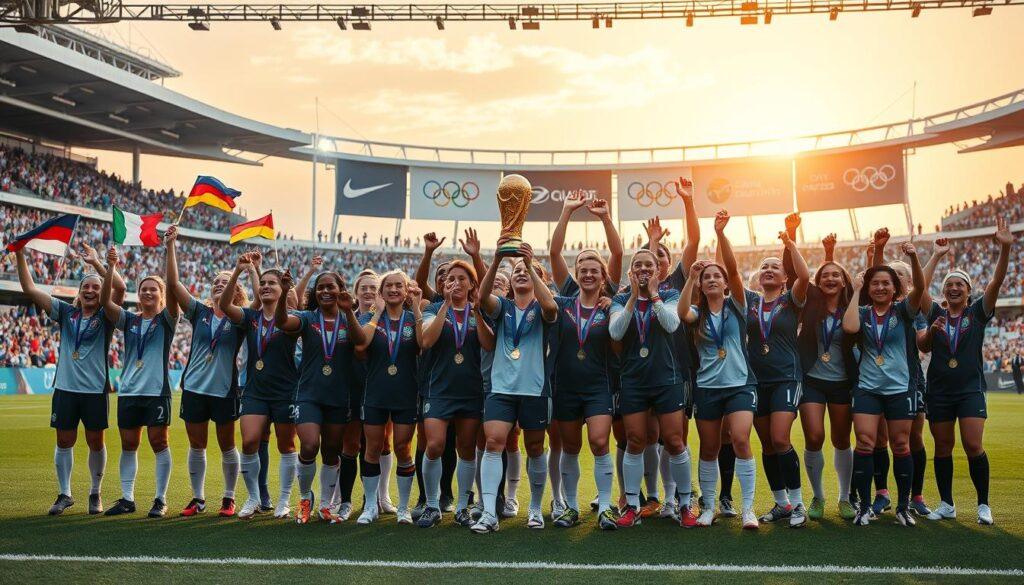
A vibrant and dynamic scene showcasing the achievements of women's soccer, highlighting key moments from World Cup events and Olympic milestones. In the foreground, a diverse group of female soccer players, dressed in professional sports attire, celebrate in unison, holding championship trophies and medals. The middle-ground features iconic stadiums filled with cheering fans, waving flags of various nations, creating a sense of unity and excitement. The background displays banners representing past World Cup tournaments and Olympic logos, symbolizing the evolution of the sport. The lighting is bright and uplifting, with a warm golden hour glow that emanates from the horizon, enhancing the celebratory mood. Capture the action at a slightly low angle to emphasize the players' triumph and the grandeur of the event.

Then came 1999, a year that changed everything. Brandi Chastain’s sports-bra moment was more than celebration. It was a declaration that women’s athleticism could be powerful and marketable. That penalty kick became an iconic moment in women’s sports milestones.

Fast forward to Carli Lloyd’s 2015 hat-trick. In just 16 minutes, she delivered a masterclass. It was one of the most spectacular world cup achievements in soccer history.

The Olympic stage also saw American dominance. From 1996 to 2024, the USWNT collected gold medals like trading cards. These famous players didn’t just win tournaments. They transformed women’s soccer into a must-watch event.

What made these moments revolutionary? They showed that when given the platform, women redefine the game. Each goal, each medal, each iconic celebration added to the story of athletic equality.

The World Cups and Olympics didn’t just showcase talent. They created cultural touchstones that resonated far beyond the pitch. They showed that women’s soccer could generate the same drama, excitement, and national pride as any men’s sporting event.

These tournaments became the accelerant that propelled women’s soccer into the mainstream. They proved that athletic excellence knows no gender. It’s all about opportunity and determination.

Regional Milestones

If women’s soccer were a global quilt, each region would have its own unique pattern. Some areas built strong professional structures, while others made do with what they had.

Take Burundi’s Lydia Nsekera, who started her country’s first women’s team. She faced many challenges, but her determination changed the game in her country.

In Brazil, football is more than a sport; it’s a religion. But Marta changed that. She became a symbol of change, showing that women can be stars in football too.

In Germany, Bibiana Steinhaus broke barriers as a referee. She showed that women can do the job just as well as men. It was a big step for equality in sports.

The story of women’s soccer around the world is complex. Some places moved fast, while others faced more obstacles. But the drive to succeed is always there.

Australia’s recent success in women’s football is a great example. Their achievements show what happens when talent meets the right chance.

The journey of women’s soccer is full of ups and downs. But it’s always moving forward, one breakthrough at a time.

Legendary Players

Some athletes play the game. Others become the game itself. The true legends of women’s soccer didn’t just score goals—they scored cultural touchdowns that reverberated far beyond the pitch.

Mia Hamm was called the Michael Jordan of soccer for a reason. She showed greatness knows no gender. Her records lasted for years, but her real impact was inspiring girls everywhere to become athletes.

Abby Wambach didn’t just score headers—she headed discrimination right out of the stadium. Her advocacy work became as legendary as her 184 international goals. She played with the awareness that every touch of the ball was writing soccer history.

Brazil’s Marta redefined dominance with five consecutive World Player awards. That’s not just winning—that’s claiming territorial rights on excellence. Her world cup achievements became the standard by which all other famous players are measured.

Megan Rapinoe transformed from athlete to archetype—part footballer, part social justice warrior, all icon. Her equal pay fight became as discussed as her game-winning goals. She proved that legendary status isn’t just about goals scored but barriers broken.

Ada Hegerberg’s masterclass in principle was unforgettable. She basically told Norway “I won’t play until you treat women properly” while collecting the first Women’s Ballon d’Or. Talk about having your cake and eating it too—while making the recipe better for everyone else.

These women didn’t just achieve women’s sports milestones. They created a new playbook where athletic excellence and social impact share equal billing. They wrote one hell of a story—and the best part? They’re stil writing it.

Grassroots Revolution

To understand women’s soccer’s rise, look beyond the World Cup. It’s in school gymnasiums where Title IX changed everything. It wasn’t just about the World Cup; it was about the small fields where girls could play.

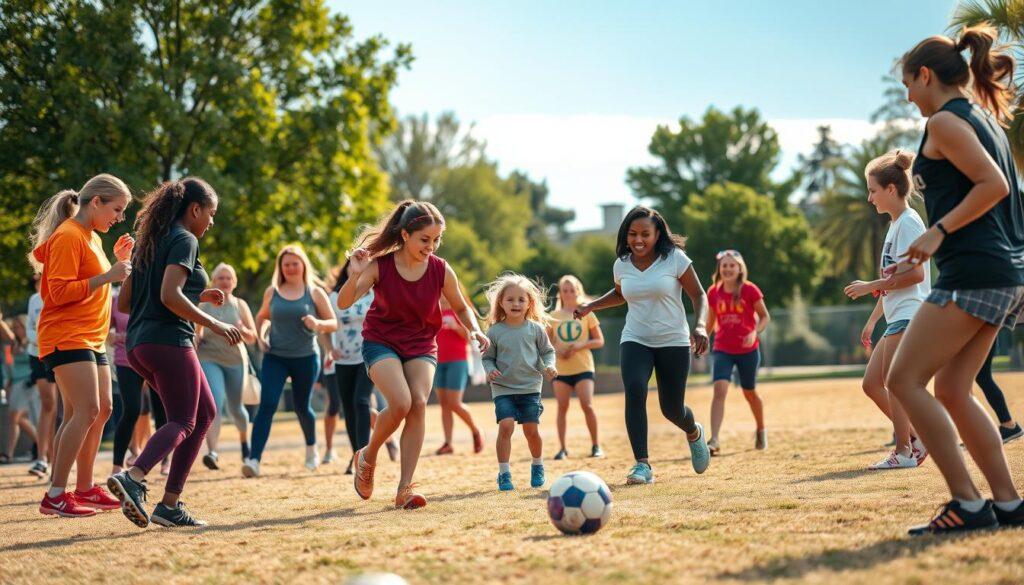
A vibrant scene depicting a women's soccer grassroots movement in a local park setting. In the foreground, diverse women of various ages and ethnicities engage in a spirited soccer practice; some dribble the ball while others cheer and instruct, wearing casual athletic gear. The middle ground features a small group of young girls eagerly watching and mimicking the practice, embodying inspiration and enthusiasm. In the background, trees and a clear blue sky set a lively, hopeful atmosphere. Soft, warm lighting enhances the feeling of community and empowerment. The angle is slightly elevated, capturing the energy and camaraderie of the event, emphasizing teamwork and the joy of soccer.

Title IX in 1972 was a game-changer. It made schools fund girls’ sports equally. This created a path for future famous players. Girls could now dream big on soccer fields.

Bend It Like Beckham was a turning point. It showed girls with soccer dreams as heroes, not oddities. This film made playing soccer cool and empowering.

Local leagues grew talent naturally. Volunteer coaches, often parents, helped develop skills. These efforts fueled world cup achievements.

The numbers show the revolution’s impact:

Year US Girls Soccer Participants High Schools With Programs Notable Outcome
1972 (Title IX) ~10,000 Fewer than 100 Regulatory foundation
1990 120,000 ~2,500 Infrastructure growth
2002 (Beckham release) 300,000 ~7,000 Cultural catalyst
2022 450,000+ 11,000+ Mainstream normalization

This movement made excellence accessible. The next Mia Hamm is playing in local leagues. She knows her dreams are valid.

These efforts laid the groundwork for today’s women’s sports milestones. World Cup wins, Olympic medals, and professional leagues all started here. We decided girls’ dreams deserved fields too.

Key Recent Achievements

The recent era in women’s soccer has seen huge changes. It’s not just small steps forward; it’s giant leaps. These changes are so big, even the most optimistic people from the 1990s would be amazed.

The 2022 equal pay settlement was a game-changer. It wasn’t just about paying women the same as men. It was about fixing a long-standing mistake from the past.

The 2024 Olympics were a highlight for the USWNT. They didn’t just win gold; they showed off a new generation of players. The young players were confident and ready to take on the world.

Viewership numbers have skyrocketed. The World Cup is now attracting huge audiences. It’s so popular, organizers are worried if they can handle the crowds.

The rise of players like Trinity Rodman and Sophia Smith is key. They were raised in an era where women’s soccer is expected, not unusual. Their confidence is natural, not learned.

These women’s sports milestones are more than just records. They show that the revolution is here, playing in the spotlight. They’re breaking records and demanding equal pay.

The soccer history books are being rewritten. And the new version is much more exciting.

The Road Ahead

If women’s soccer were a stock, I’d invest all my money. The game is leveling up, becoming a strategic battle. Every country now sees the value of investing in their teams.

The 2027 World Cup will be a big test. We’re moving beyond just being fast to being smart. Coaches like Emma Hayes are bringing new tactics that make old ways seem simple.

This change is a big milestone for women’s sports. The NWSL’s growth creates a cycle of success. Better leagues attract top players, raising the game’s standard.

But there are challenges ahead. The US can’t get too comfortable with its past success. Spain and England are changing the game with their skills and strategies.

Yet, the opportunities are huge. Women’s soccer is at the crossroads of sport and social change. It’s a chance to build something lasting or just enjoy a moment.

I believe the future of soccer is bright and female. It’s smart, competitive, and here to stay. The world has recognized women’s soccer as the main event.

Conclusion

Women’s soccer is more than a game; it’s a story of social progress. From Lily Parr’s goals to Megan Rapinoe’s courtroom wins, it’s a journey of breaking barriers. This path has changed the game and the world.

The achievements in the World Cup are not just numbers. They are part of a story that continues to grow. Every girl who plays soccer today adds to this narrative. These milestones show how hard work can change society.

Famous players have done more than just play soccer. They’ve shown what’s possible. Looking back at soccer history, it’s clear that women are not just playing a man’s game. They are playing a game of humanity, and they deserve respect.

The game is far from over. We are just in the final minutes, with everything at stake.

Leading the Way: Women in Soccer Leadership Roles

women in soccer leadership

Imagine the typical sports executive. You might see a middle-aged man in a bad suit. But, the boardroom is changing fast, making Ted Lasso’s style look old-fashioned.

I’ve been watching this big change closely. It’s not just about fairness. It’s a total overhaul of the sport.

Women like Emma Hayes are making smart moves, like chess players. Michelle Kang is building big soccer empires, earning respect from everyone.

This isn’t just about adding women to the mix. It’s a major change in how soccer works, thinks, and makes money. The sport is getting smarter, and surprisingly, it’s thanks to women.

The State of Leadership in Soccer

Imagine walking into a boardroom where 85% of the seats are for one gender. Welcome to soccer’s leadership landscape. Here, women in management are the exception, not the norm. Less than 15% of key positions in FIFA, UEFA, and major associations are held by women.

This isn’t just about fairness – it’s about making smart money moves. McKinsey research shows teams with diverse leadership earn 20% more. Yet, soccer misses out on this profit while sticking to old ways. The game’s leadership is like a vintage car running on half power.

But, the story changes when women do break through. They’re not just filling seats; they’re changing the game. Michelle Kang, for example, bought the Washington Spirit and built a global network. Sarai Bareman, FIFA’s first Chief Women’s Football Officer, is reshaping the game globally.

The change is happening in three main areas:

  • Club ownership: Women are becoming major players, not just small investors
  • Technical direction: Female sporting directors are changing how teams are built and developed
  • Governance: Women are rewriting the rules from within

This shift from tokenism to real change is soccer’s biggest untapped chance. The fight for administrative equality is not charity. It’s about seeing that diverse leadership makes teams stronger, smarter, and better at soccer.

The current state? We’re seeing the end of the old boys’ club. The real question is, why did we wait so long to let women lead in soccer?

Barriers Women Face

Imagine trying to solve a Rubik’s Cube while everyone around you keeps changing the colors. That’s what women face in football leadership roles. It’s a puzzle where the rules are unclear and often against them.

The beautiful game has ugly truths about gender equity. Female coaches face more than just tactics and player management. They deal with a minefield of bias that’s shocking.

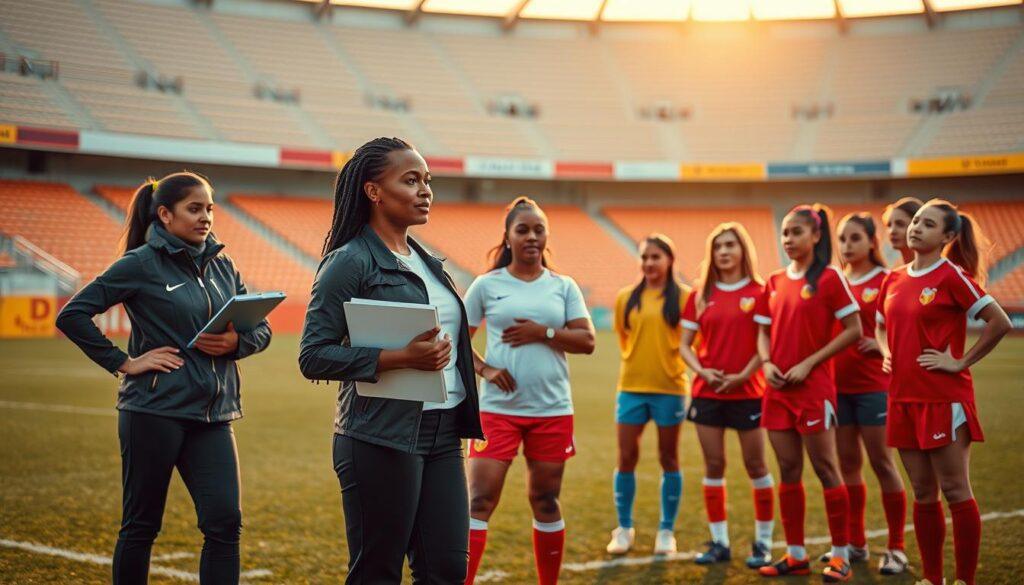
A diverse group of female soccer coaches stands confidently on a football field, showcasing strength and determination. In the foreground, one coach, a Black woman in professional sports attire, holds a clipboard, symbolizing leadership, while a woman of Asian descent is demonstrating a tactic in the midst of a coaching session. In the middle ground, several young female players are listening attentively, reflecting diverse backgrounds, embodying aspiration and engagement. The background features a stadium with empty stands, hinting at both the barriers faced and the potential for change. Soft golden-hour lighting casts a warm, inspiring glow, creating an empowering atmosphere. The image captures the resilience and authority of women in soccer leadership roles, framed with a slightly upward angle to evoke hope and ambition.

Let’s look at the three main obstacles women face in football leadership:

  • The bias boomerang: Male candidates talk about formations and philosophy. Female coaches are asked about childcare and “emotional management”
  • The leaky pipeline: Promotions vanish quickly. Women get stuck in assistant roles while less qualified men move up
  • Tradition’s toxic trap: “We’ve always done it this way” means “we’ve always excluded women”

I’ve talked to female coaches who were told they “lack presence” for leadership. Yet, male counterparts with the same credentials are praised for their “commanding energy.” It’s the same trait with different words, based on gender.

The financial bias is staggering. We’re playing with half our talent pool on the bench. In any other multi-billion dollar industry, excluding 50% of qualified candidates would be unthinkable.

These barriers aren’t just whispers. They’re concrete walls built by tradition and bias. The football leadership world remains mostly male, not because women lack ability, but because the system filters them out.

Yet, there’s a paradox. Organizations that include women see big benefits. Diverse teams make better decisions, understand markets better, and innovate more. The data shows that inclusion is not just right, but smart.

The way forward is to see these barriers as part of a system that needs fixing. Until we fix the pipeline, we’ll keep missing half the game’s best minds.

Success Stories from Top Leaders

While some debate women’s roles in soccer leadership, these trailblazers are winning trophies and rewriting the playbook. Their achievements are not just inspiring; they’re changing how we view success.

Emma Hayes didn’t just coach Chelsea FC Women; she built a dynasty while pregnant. She mastered player development and raised a child, showing genius and emotional smarts. Her methods blend tactical brilliance with deep understanding of people.

Michelle Kang is like a real-life Football Manager, buying clubs like Pokémon cards. Her approach to owning multiple clubs shows women in management are innovating soccer business.

Baroness Sue Campbell transformed English women’s football with vision and authority. She didn’t wait for a seat; she brought her own chair and changed the table.

What makes these female coaches stand out? They value players as people first, athletes second. Their success isn’t just about winning; it’s about building lasting success on strong foundations.

Leader Achievement Management Style Impact
Emma Hayes 6 WSL titles with Chelsea Emotional intelligence-focused Redefined player development
Michelle Kang Multi-club ownership model Innovative business approach Changing club ownership structures
Baroness Sue Campbell FA Director of Women’s Football Systemic reformer Transformed English women’s football
Casey Stoney Built San Diego Wave FC Culture-first leadership Expansion team success story

These leaders show women in management are not just options; they’re top choices. Their success stories teach us about modern leadership. They focus on treating players as complex beings, not just athletes.

The best female coaches make inclusivity a key to success. They show that understanding psychology is essential in sports management. It’s not about being soft; it’s about being sharp.

Mentorship and Peer Support

Mentorship isn’t just about feeling good. It’s about sharing smart strategies for women in football leadership. Women often hit glass ceilings because they lack the playbook men have learned over time.

Being the only woman in the boardroom can feel isolating. That’s why peer networks are like command centers. They’re not just support groups; they’re training for equality.

A dynamic scene depicting a diverse group of women engaged in a football mentorship program, set on a green soccer field. In the foreground, a woman in professional sports attire is demonstrating skills to a younger player, emphasizing guidance and support. In the middle ground, a small circle of women of various ethnicities, dressed in smart casual clothing, are engaged in a lively discussion, showcasing collaboration and empowerment. The background features a sunny sky with trees lining the field, creating a vibrant and encouraging atmosphere. The lighting is bright and warm, casting soft shadows to suggest a welcoming environment. The camera angle captures an inclusive perspective, highlighting the bonds of mentorship and community among women in sports.

  • Veteran guidance from women who’ve navigated minefields you don’t even see coming
  • Tactical intelligence sharing on everything from salary negotiations to which committees matter
  • 24/7 peer access through informal channels that function like emergency hotlines

WhatsApp groups are where women share vital information during big meetings. They might say: “They’re using budget concerns as cover for sexism – counter with these financials.” Or: “The coffee in Conference Room B is terrible, but the chairs give you psychological advantage.”

Formal programs are also key. They match emerging leaders with veterans who’ve fought in boardroom battles. These mentors teach the hidden rules, like how to speak so men listen, or which fights to pick.

This isn’t about holding hands. It’s about sharing the tools needed for success in football leadership. In the fight for equality, working together is more powerful than individual talent.

The numbers prove it: companies with mentorship programs have 30% more women in leadership. They’re not just changing seats; they’re changing the whole table.

Increasing Representation

When little girls see a woman coaching, it changes everything. They don’t just see a coach; they see a future possibility. This isn’t just a symbol; it’s a real change in how they think.

Seeing female coaches in charge is more than just adding faces. It’s changing young minds. Teams with women in management solve problems in new ways. They’re not stuck in old habits.

Traditional Model Inclusive Model Impact on Performance
Single perspective coaching Diverse tactical approaches +27% creative solutions
Limited leadership styles Varied management techniques +34% player engagement
Repetitive problem-solving Innovative game strategies +19% win rate improvement

More female coaches means more than just filling spots. It changes soccer’s culture. It’s like using the whole brain instead of just half.

We need more women in management for a reason. It’s not just right; it’s necessary. The sport will either evolve or fade away. And who wants to watch the same old plays forever?

By supporting female coaches, we’re creating a future full of diverse ideas. Young athletes see leadership as something they can achieve. The sport is growing up, using all its brainpower.

Advice for Aspiring Leaders

Want to navigate the beautiful game’s leadership labyrinth? Forget GPS – you need insider coordinates from those who’ve already mapped the terrain.

I’ve collected wisdom from top female leaders that’s more valuable than front-row Champions League tickets. Their advice isn’t about playing nice; it’s about playing smart in the world of football leadership.

First: master the technical aspects until you’re bored, then master them some more. The game rewards those who know it inside out – from tactical formations to salary cap intricacies.

Develop your trademark skill. Become the go-to expert for data analysis, player psychology, or contract negotiations. Make yourself indispensable through specialized knowledge.

Understand that administrative equality isn’t given; it’s negotiated with preparation and leverage. Come to the table armed with data, solutions, and clear value propositions.

Build your network like you’re playing 4D chess. Connect vertically with decision-makers and horizontally with peers. Your support system should resemble a well-organized defense – covering all angles.

Learn to distinguish between constructive feedback and plain old sexism. One makes you better; the other just makes you angry. Develop the radar to tell the difference.

Organizational commitment matters more than individual talent. Find clubs that walk their diversity talk – where women’s advancement isn’t just PR but operational reality.

The path isn’t about being perfect; it’s about being persistent. You’ll face more offside calls than a rookie striker, but the goal remains worth pursuing.

Your playbook should include:

  • Technical mastery beyond expectations
  • Strategic networking across all levels
  • Clear value proposition development
  • Critical feedback filtering systems
  • Long-game persistence tactics

Remember: the best football leadership emerges from preparation meeting opportunity. Your moment will come – be ready to convert it.

True administrative equality gets built one negotiated contract, one hired diverse candidate, one changed policy at a time. You’re not just advancing your career – you’re changing the game’s architecture.

Notable Programs

Soccer’s leadership programs for women are not just about showing up. They’re like special forces training camps. Here, female coaches learn to face challenges that men rarely encounter.

The Women’s Sports Leadership Network is like a magical school for executives. It offers courses on everything from tactics to dealing with sexism in the media. This is because, unlike men, women often face questions about their outfits in press conferences.

These programs are groundbreaking because they give women in management the tools they need to succeed. They create spaces where women can share knowledge, support each other, and build strong alliances.

Let’s look at some of these transformative programs:

  • SheChampions – Connects new female coaches with experienced mentors
  • GameChangers – Offers bootcamps that teach tactics and media skills
  • LeadHERship – Helps women get into management roles in professional leagues

These programs know that changing a biased system is hard. So, they’re building their own systems until the main one changes. It’s not about getting a seat at the table. It’s about creating better tables.

The real magic happens in networking sessions. Imagine a place where female coaches can talk about tactics and politics without being seen as emotional. These spaces foster new strategies that traditional coaching education misses.

For women in management roles, these programs offer something special: validation. They create environments where sexism and double standards are seen as challenges to be solved, not dismissed.

The results of these initiatives are impressive. They show that traditional programs are outdated. Graduates are not just surviving; they’re changing what leadership means in soccer.

Conclusion

We’re not just rearranging deck chairs on this Titanic of tradition. True administrative equality in football leadership means building a better ship altogether. The evidence shouts what intuition already whispered: diverse leadership creates smarter decisions and more innovative solutions.

Canada Soccer gets it. Their Women and Girls Strategy isn’t charity work—it’s strategic genius. When nearly 40% of Canadian girls aren’t playing any sport, that’s not a participation gap. That’s a talent hemorrhage.

The beautiful game is now starting to look like its audience. We’re creating a sport where leadership mirrors the diversity on the field and in the stands. This isn’t about adding women and stirring—it’s about changing the fundamental chemistry of the game.

True football leadership means recognizing that representation drives participation. When girls see women calling shots from boardrooms to sidelines, they see possibilities for themselves. The final whistle hasn’t blown on this transformation. We’re just reaching halftime.

And if the first half is any indication, the second half will be spectacular.

Rights of Female Footballers: A Guide for Young Athletes

rights of female footballers

Imagine getting a rulebook with half the pages missing. The rest is in a language you can’t understand. That’s what women’s football was like before activists changed the game.

FIFA took 127 years to make a plan for women’s football. That’s even longer than the time from horse carriages to SpaceX rockets. Title IX was a game-changer in this journey.

Knowing your player rights is not just about law. It’s as important as mastering your first touch. It’s like learning the offside rule for your career.

Miss it, and you’re always playing catch-up. Know it, and you control the game.

Knowing Your Rights

Imagine a 1972 law meant for education that became a game-changer for women’s sports. Title IX was not made to change sports, but to stop gender bias in schools. Today, it’s a key player in fighting for women’s sports.

Title IX is simple yet powerful. It says no one can be left out of school programs because of gender. This rule helped sports law grow.

FIFA’s fight for gender equality is like trying to park a cruise ship. The numbers show a big gap:

Category Men’s Football Women’s Football Disparity Ratio
World Cup Prize Money $440 million $110 million 4:1
Average Stadium Quality Architectural marvels Enhanced local parks Subjective but obvious
Prime-time Broadcast Slots 85% of premium slots 15% of premium slots Nearly 6:1
Youth Investment Programs Global academies Regional initiatives 3:1 funding ratio

“Equal” and “equitable” are not the same. Equal means everyone gets the same. Equitable means considering who needs more.

FIFA’s prize money increase for women is a start. But starting from almost nothing, it’s not enough. It’s about fighting for what’s right.

Progress is slow, but it’s worth it. Title IX shows us that change is possible. For young athletes, knowing these rights of female footballers is key to making a difference.

The beautiful game deserves equal opportunities. Not someday. Now.

Common Contractual Issues

Men’s football contracts are simple, like scoring a goal. Women’s contracts are like trying to dribble through a minefield blindfolded. They are filled with financial obstacles where the fine print is your biggest foe.

Salary structures are often misleading, known as “phantom money promises.” Performance-based pay means “we’ll pay you when we feel like it.” Bonus structures are even worse, often never seen. This leads to 68% of NWSL players skipping meals or medications due to financial stress. It’s a clear sign of a bigger problem.

Endorsements for women are less common and less lucrative, known as the pink tax of athletic deals. Male players get multi-million dollar sponsorships, while female athletes are often offered “exposure” instead. It seems like visibility is the only currency they value.

But there’s a change coming. Players like Marta are rewriting the rules. She negotiated not just salary, but also equal media time, marketing commitment, and infrastructure support. It’s not just playing the game; it’s changing the stadium itself.

Contracts for women need careful attention. Look out for these red flags:

  • “Discretionary bonuses” that never materialize
  • Image rights clauses that exploit your brand
  • Termination clauses favoring the club exclusively
  • Medical coverage that vanishes when you need it most

The best defense is to review contracts like film study. Analyze every clause and question every vague promise. Remember, in contracts for women athletes, what’s not written is often more important than what is.

This isn’t just about getting paid; it’s about changing how we value women’s sports. Every well-negotiated contract sets a new precedent. Every smart clause becomes ammunition for the next player at the bargaining table.

Think of this as your financial defensive training. Spot the traps before they tackle your career earnings. In the game of contracts for women, the best offense is a rock-solid understanding of what you’re really signing.

Resources for Young Players

Remember when athletic development meant dog-eared playbooks and your coach’s questionable halftime speeches? Today, female footballers have access to resources that would amaze even the most advanced Premier League analysts.

We’re in the golden age of player development tools. And yes, most are designed for female bodies. The revolution is here, not coming.

Mentorship programs are now effective. Platforms like Women in Soccer connect teens with World Cup legends for virtual coaching. Getting footwork tips from someone who faced Marta is like getting guitar lessons from Hendrix.

Technology has advanced beyond Zoom calls with legends. Smart patches track muscle fatigue in real-time, syncing data to apps that adjust training. Menstrual cycle tracking is now part of performance analytics. Science now recognizes female athletes have female bodies.

Virtual reality modules let you practice free kicks in simulated stadiums. Psychological apps train mental resilience through game scenarios. Nutritional planners account for hormonal changes. It’s like having a personal data analyst, sports scientist, and mentor in your phone.

But understanding how these resources fit into league rules and your development pathway is key. The smartest players use technology as a secret weapon while mastering official frameworks.

These tools are not just fancy gadgets. They’re the difference between being good and being undeniable. When scouts see a player who knows her body, data, and position in the league rules, they see a professional.

The playing field might not be level yet, but the resource gap is closing fast. Your move.

Legal Support Organizations

Think of these legal support groups as your team’s defense attorneys. They don’t just block attacks, they launch counteroffensives for player rights. When discrimination shows up like an unmarked opponent, these organizations are your star defenders.

A diverse group of female footballers in a modern office setting, engaged in a discussion with legal professionals. In the foreground, a confident woman in a business suit points to documents on the table, symbolizing legal support. The middle ground shows a diverse team of male and female lawyers, actively taking notes, conveying a sense of teamwork and advocacy. The background features a window with natural light illuminating the office, creating an atmosphere of collaboration and empowerment. The scene includes motivational posters about rights and equality on the walls, enhancing the mood of support and determination. The overall color scheme is warm and inviting, promoting a feeling of professionalism and hope for young athletes.

Common Goal revolutionized the game with their 1% pledge model. Imagine if every professional footballer donated just 1% of their salary to equity efforts. That’s exactly what they’ve built – a financial fair play system that actually works for equality.

Athlete Ally fights for LGBTQ+ inclusion with the precision of a perfect through ball. They don’t just advocate; they transform locker room cultures and policy frameworks. Their playbook includes education programs, advocacy campaigns, and direct athlete support.

Organization Primary Focus Key Services Notable Impact
Common Goal Financial Equity 1% salary pledge program, grassroots funding €5M+ donated to equality initiatives
Athlete Ally LGBTQ+ Inclusion Policy advocacy, education programs 100+ pro teams with inclusive policies
Women’s Sports Foundation Gender Equality Legal advocacy, research, grants 50+ landmark legal cases won
Equal Playing Field Pay Equity Legal representation, negotiation support 20% average pay increases for clients

So when should you lawyer up? Contract offers that smell fishier than week-old shin guards deserve legal review. If the benefits package feels lighter than a deflated match ball, it’s time to call in reinforcements.

Discrimination that’s more obvious than a missed offside call? That’s your cue to engage these legal midfielders. They’ll help you navigate the paperwork like it’s a penalty shootout – with precision and confidence.

These organizations prove the most important plays often happen off the field. Courtrooms and policy meetings are where real game-changing decisions get made for player rights. They’re rewriting the rulebook one case at a time.

Remember: your player rights aren’t just contract clauses. They’re the foundation of your career. Protecting them requires the right legal team in your corner.

Famous Rights Cases

Some games are remembered for spectacular goals. Others are legendary for changing the rules. The courtroom is now where women footballers win big victories.

The USWNT’s $24 million equal pay settlement was more than just money. It was a cultural win that made “equal pay” a big topic. This sports law case showed that fighting discrimination can win in court and in public opinion.

Media battles show another side. Women’s games get less post-game analysis than men’s. The numbers show a big gap:

Coverage Metric Women’s Games Men’s Games Disparity
Post-game Analysis 5 minutes 22 minutes 77% less
Primetime Coverage 34% 78% 44% gap
Expert Commentary 1-2 analysts 3-4 analysts 50% less
Pre-game Features 2 minutes 8 minutes 75% reduction

These cases show that the most important goals aren’t always scored with feet. They’re won with legal fights and social media campaigns. Until coverage and compensation are equal, the field isn’t level.

Other sports law victories include maternity protection and image rights disputes. Female athletes have won protections that male players took for granted. These wins set precedents for future players.

The fight for equality continues off the field. But each victory sets a new standard. It shows that change happens when athletes demand what they deserve. The final whistle hasn’t blown on these fights yet.

What Parents Should Know

Parenting a young female athlete is like coaching a World Cup team and running a teen psychology practice at the same time. You’re figuring out strategies while understanding emotional changes as fast as VAR decisions.

The youth soccer world is like a tactical chess game. Safe sport initiatives meet old-school coaching views. The US Soccer Safe Soccer handbook is your key guide – it’s like learning offside rules for parents.

A professional setting showcasing contracts for female football players on a polished wooden conference table. In the foreground, focused papers with clear headings like "Player Agreement" and "Salary Terms" are partially visible, symbolizing professional sports documentation. In the middle, a diverse group of female athletes, dressed in business attire, discuss the contracts intently, expressing determination and teamwork. The background features a well-lit modern office with football memorabilia, like jerseys and trophies, subtly indicating the sport. Soft, warm lighting emphasizes an atmosphere of professionalism and empowerment. Use a shallow depth of field to draw attention to the contracts while maintaining the dynamic interaction among the players, capturing the essence of rights and professionalism for female athletes.

Mental health signs are more important than any game score. If your daughter suddenly stops enjoying pre-game rituals, it might mean she’s facing bullying. If she always apologizes for mistakes, it could be a sign of toxic perfectionism. These signs need your full attention, more than any losing streak.

Understanding contracts for women athletes is key. Look at payment, medical, and academic support in contracts carefully before signing.

Watch for these critical signs:

  • Abrupt changes in pre-game behavior patterns
  • Unusual reluctance to discuss team dynamics
  • Perfectionist tendencies affecting enjoyment
  • Unexplained physical complaints before practices

The most important save isn’t always the goalkeeper’s. Sometimes, it’s the parent who spots trouble early. Your keen observation is the defense protecting your daughter’s dreams and mental health.

Successful parenting in sports means knowing when to cheer and when to step in. Your daughter’s career needs your protection on and off the field.

Advocacy Groups

If women’s football advocacy were a championship match, it would be the most exciting game ever. Grassroots movements and corporate giants would face off. The real question is, who’s really fighting for gender equality?

Grassroots movements have made a big difference. Remember the campaign for childcare coverage in NWSL? They didn’t just hold signs; they changed league rules. Their petition got 50,000 signatures in 72 hours, showing that fans can be more powerful than big companies.

Now, let’s look at corporate partnerships through a FIFA-style rating system. We’re focusing on real impact, not just marketing.

Starbucks’ Barista Bridge Program for retired players scores an impressive 89/100. They offer healthcare, flexible schedules, and career paths. On the other hand, some sportswear brands that just use “Girl Power” for marketing? They get a red card.

The truth about league rules advocacy is that change needs both grassroots efforts and corporate action. Grassroots groups find the problems, but big companies can solve them on a large scale.

Here’s what makes a true advocate different from those who just pretend:

  • Transparent funding for women’s programs
  • Real impact on player compensation and benefits
  • Actual influence on league rules and policies
  • Long-term commitment, not just for marketing

Some corporate partnerships look good in ads but disappear when the cameras stop. The real test is if their efforts last beyond Women’s History Month.

The best advocacy happens when grassroots energy meets corporate power. When players, fans, and sponsors work together on league rules changes, we see real progress, not just press releases.

So, when you see a brand celebrating women’s football, ask tough questions. Are they funding childcare or just making new jerseys? Are they pushing for contract reforms or just buying stadium rights? The scoreboard doesn’t lie.

Conclusion

Women’s football has made its mark, but the men’s game gets more attention. Title IX helped in 1972, but we’re not there yet.

Progress has been made. Smart contracts help with fair pay, and VR trains athletes for big games. Mentorship opens doors for new stars. Now, player rights are in the headlines.

The future is clear: stars will demand more than just equal pay. They’ll change the game. We must stop making excuses, like bad calls.

The battle for player rights goes beyond the field. It’s in boardrooms and contract talks. We’re not done yet; we’re just at halftime.

This isn’t just about winning games. It’s about changing the sport’s structure. The next generation deserves to create a new game, not just join the old one.

Equal Pay in Soccer: The Fight for Fairness

soccer equal pay advocacy

The beautiful game has a dark secret. Women’s teams give top-notch entertainment and win championships. Yet, they earn like they’re from another era.

I’ve been keeping up with this fight. The soccer field has turned into a battleground for fair pay. It’s like Billie Jean King vs. Bobby Riggs, but with more lawyers.

Women outperform men but get paid less. It’s a mix of economic nonsense and old traditions.

April 2 is Equal Pay Day. It’s when U.S. women earn what men did in 2018. Women athletes are leading the fight for pay equity in sports.

This fight is more than sports. It’s about changing society and achieving fairness. The USWNT’s journey shows us where this battle is going.

Why Pay Disparities Exist

Imagine the US Women’s National Team winning big but earning like they’re newbies. The wage gap in soccer is more than just money. It’s a mix of history, economic mistakes, and what I call the “legacy discount.”

From 2016-2018, the USWNT made $50.8 million, while the men’s team made $49.9 million. Yet, the women were paid less than the men. It’s like paying your top author less than the guy who writes the book jacket.

FIFA’s prize money shows a huge gap. The men’s World Cup got $440 million, while the women’s got $110 million. This isn’t just a wage gap. It’s a huge financial gap with no clear way to cross it.

Men’s soccer had a 100-year head start in building business ties. Women’s soccer was told to wait. This created the “legacy discount,” where women’s sports are valued by old standards, not current performance.

Broadcasting deals reveal a lot. Networks pay less for women’s sports than men’s. Even Gareth Southgate, England’s men’s team manager, has spoken about these economic facts, wishing he hadn’t.

The fight for equal pay in women’s sports is about fairness and logic. The USWNT has been the top earner for years but is paid like temporary workers. It’s like finding out your best employee is making less than the intern.

This isn’t just sexism, though sexism is part of it. It’s a mix of history, old ways of valuing sports, and outdated broadcast deals. The beautiful game deserves better math.

U.S. National Team’s Lawsuit

The USWNT took a bold step by suing U.S. Soccer in 2019. It was more than just a lawsuit; it was a fight for equality. They used evidence to challenge the system.

Imagine arguing with four World Cup trophies as proof. The women’s team outshone the men, winning championships like they were trading cards. But their pay was like minor league baseball.

The 2022 agreement was a major win. It made sure women and men got equal pay. It also created a new way to share prize money.

  • 45% of pooled World Cup prizes goes to women’s players
  • 45% goes to men’s players
  • 10% goes to US Soccer development programs

This system shows success in soccer isn’t just about gender. It’s about the whole team. It’s a smart way to share success.

Megan Rapinoe said they wouldn’t settle for anything less than what they deserved. The women’s team was building a strong case while the men’s team missed the 2018 World Cup.

The settlement was big, but the real win was setting a precedent. They used their success to prove their worth. It’s like showing your sales numbers to ask for a fair share.

This wasn’t just about protesting. It was about using facts to fight for equality. The USWNT showed they’d already earned their place.

This lawsuit will be remembered as a key moment in history. It showed how to fight for equality with evidence. The USWNT didn’t just want a seat at the table; they brought their own.

International Movements

The USWNT lawsuit was just one part of a worldwide fight for fair pay. Fair pay is a universal issue, understood by everyone.

In 2017, the US Women’s Ice Hockey Team threatened to boycott over pay. Their stand was heard across sports.

Basketball shows a stark contrast. WNBA players get only 22.8% of league revenue, while the NBA splits 49-51%. Many WNBA stars play overseas to make a living.

Surfing also made a big move in 2018. The World Surf League started paying men and women equally. It was a big step forward.

Tennis achieved pay equality in Grand Slams back in 2007. But Venus and Serena Williams continue to fight for future generations. Progress is not always smooth.

A global players’ union report found something shocking. 29% of World Cup players hadn’t been paid for qualifying. It’s like finding out your favorite restaurant doesn’t pay its staff.

But, some countries are leading the way. Brazil, New Zealand, Australia, and England have all agreed to equal pay for their national teams. They’re changing the game.

Country/Sport Policy Change Year Implemented Key Details
United States (Soccer) Equal Pay Agreement 2022 Back pay + tournament bonuses
New Zealand (Soccer) Equal Pay Agreement 2018 Match fees + commercial revenue
Australia (Soccer) Collective Bargaining 2019 Revenue sharing model
World Surf League Equal Prize Money 2018 All championship events
Grand Slam Tennis Equal Prize Money 2007 All four major tournaments

These global movements show that fair pay is not just an American issue. It’s a worldwide fight. The real question is, how many more athletes will have to fight before change comes?

How Equal Pay Benefits the Game

Equal pay isn’t just about fairness; it’s a smart investment for soccer. The numbers show it’s a great opportunity.

The NWSL saw a 20% jump in season tickets after fixing pay issues. This shows fans value professional sports more when athletes are treated as such.

A visually engaging infographic illustrating the growth statistics of the equal pay movement, specifically in soccer. In the foreground, vibrant bar graphs depict increasing percentages, contrasting the pay disparity over time. In the middle ground, a diverse group of professional soccer players, dressed in business attire, stands confidently in a dynamic pose, symbolizing unity and progress. The background features a soccer field fading into an audience, highlighting public support for the movement. Soft, natural lighting enhances the image, casting gentle shadows that emphasize figures and graphs. The scene is captured with a wide-angle lens to create depth, conveying a hopeful and inspiring atmosphere around the theme of fairness and equality in sports.

FIFA’s data is stunning. Commercial revenue is up 33% yearly, and broadcast revenue is up 22%. These numbers are huge, not just for sports.

When athletes are paid well, they can focus on their game. This is basic economics: invest in talent, get better results.

More pay attracts better players. Better players lead to better games. And better games mean more money. It’s a cycle that makes sense.

FIFA’s Chief Women’s Football Officer, Sarai Bareman, sees huge growth. She’s talking about an under-valued asset that’s about to boom. Investors are already seeing the value in women’s sports.

The case for equal pay is strong. We’re seeing a market shift, and it’s working for everyone.

Metric Women’s Soccer Growth Traditional Sports Average What This Means
Commercial Revenue 33% annual increase 5-7% annual increase Explosive market demand
Broadcast Revenue 22% annual growth 3-4% annual growth Growing audience engagement
Season Ticket Sales 20% increase (NWSL) 2-3% industry average Strong fan commitment
Investment Return Potentia High growth trajectory Mature market returns Undervalued opportunity

This isn’t just about doing the right thing. It’s about making smart choices. Equal investment leads to huge growth. The game becomes more beautiful and profitable for all.

Player Stories

The real drama happens on soccer fields and in courtrooms. Athletes face challenges that make Atlas look like a slacker. They’re not just playing for wins; they’re fighting for fairness and trying to score goals. It’s a tough job.

Becky Sauerbrunn talked about the “heavy responsibility” of fighting for equality. Imagine trying to focus on the game when you’re also working on legal stuff. Male athletes don’t have to deal with this double burden.

Megan Rapinoe’s World Cup was about more than soccer. It was about leaving a legacy and making a difference. She turned every goal into a statement, every interview into a call for change. Rapinoe became an accidental activist, focusing on justice instead of just playing.

Hilary Knight said they’re fighting for the greater good. It’s not about personal gain; it’s about changing the system. These athletes risk losing endorsements and facing backlash for their beliefs.

Serena Williams is fighting for her daughter’s future. She’s not just earning prize money; she’s working for a fairer world for future athletes. That’s a legacy worth fighting for.

Skylar Diggins-Smith said we need more people at the table. It’s not just about individual heroes; it’s about working together. True change comes from collective action, not just from stars.

Athlete Role Contribution to Equal Pay Signature Statement
Becky Sauerbrunn Defender/Advocate Legal strategy leadership “Heavy responsibility” of dual roles
Megan Rapinoe Forward/Activist Media amplification World Cup as leverage platform
Hilary Knight Ice Hockey Pioneer Cross-sport solidarity “Greater good” philosophy
Skylar Diggins-Smith Basketball Organizer Coalition building “More people at our table”
Serena Williams Tennis Legend Generational advocacy Fighting for future generations

These Player Stories show something amazing. Today’s women athletes are part-time lawyers, full-time activists, and top athletes all at once. They’re changing what it means to be a professional athlete – and they’re doing it effortlessly.

Modern Progress and Setbacks

It seemed like we’d reached the end of the fight for equal pay. But then, the 2021 NWSL abuse scandals hit. They showed us a system full of problems. Coaches like Paul Riley were just the tip of the iceberg.

The Sally Yates investigation was like a horror movie. It found sexual coercion and verbal abuse. It made us wonder if we’d gone back to the Mad Men era.

A group of diverse women soccer players, dressed in professional sports attire, gathered in a dynamic, empowering pose that symbolizes unity and strength. In the foreground, they hold banners depicting labor union symbols and messages advocating for equal pay. The middle ground features a lively soccer field backdrop, with other players practicing in the distance to signify teamwork and progress. The background shows a bright sky, evoking a hopeful atmosphere, while soft, natural lighting enhances the scene, highlighting the determination on the players' faces. The angle captures both the players' passionate expressions and the unity of their cause, reflecting modern progress in women's soccer amidst the fight for fairness.

Here’s a shocking fact: 75% of women’s team managers are men. This isn’t just a problem – it’s a huge issue. Money is getting closer to being equal, but power is not.

Look at the Nigerian team’s boycott threats. See Canada’s ongoing struggles. These are top-notch programs treating women’s soccer unfairly. It’s like getting a promotion but having to make coffee for everyone.

Labor unions are more than just negotiators. They’re essential for survival. The NWSL Players Association became a strong force. They fought for more than just contracts – they fought for respect.

Team/Country Issue Union Response Outcome
NWSL (USA) Systemic abuse scandals Collective bargaining for safety protocols New safeguarding policies implemented
Nigeria Payment delays & boycott threats Player solidarity campaigns Partial payments made, ongoing negotiations
Canada Budget cuts & program funding Public advocacy & legal pressure Temporary funding restored, long-term uncertain
Global 75% male managers in women’s soccer Diversity initiatives & hiring protests Slow progress, increased awareness

The table shows slow progress. Labor unions are fighting for equal pay and safety. It’s like trying to score while defending against a counterattack.

Changing cultures is harder than changing money. Money is flowing better, but power structures are stuck. It’s a long fight for equality.

But these setbacks have made labor unions stronger in women’s sports. Sometimes, hitting rock bottom helps us find strength. The real question is how ugly the fight will get.

How Fans Impact Advocacy

Ever wonder if your screaming at the TV during a women’s soccer match actually matters? Let me answer that with some numbers that would make any accountant smile. The 2019 Women’s World Cup drew 2 billion viewers globally while selling 1.5 million tickets. That’s not just audience size – that’s economic leverage.

Here’s the beautiful irony: the same capitalist system that created pay disparities is now helping fix them. Why? Because money talks louder than tradition. The USWNT has made more money than the men’s team every year from 2016 on. This isn’t an accident – it’s arithmetic.

Your viewership isn’t passive consumption. It’s activist voting with your remote control. Every time you:

  • Stream a women’s match
  • Buy a player’s jersey
  • Engage with content on social media
  • Attend a live game

You’re casting ballots for equality. Broadcast deals follow eyeballs. Sponsorship agreements follow engagement. Organizational change follows economic pressure.

The data tells a compelling story about how fan support translates to tangible progress:

Metric Women’s Soccer Impact Men’s Soccer Comparison Advocacy Result
World Cup Viewership 2 billion (2019) 3.5 billion (2018) Increased broadcast negotiations
USWNT Revenue Higher than men’s team revenue Consistently lower Bargaining power for equal pay
Sponsorship Interest 23% growth (2015-2020) 7% growth (2015-2020) More equitable endorsement deals
Social Media Engagement Higher per post Lower per post Increased brand investment

Next time someone claims “nobody watches women’s sports,” show them these numbers. Then politely show them the door. Your fandom has become the most powerful advocacy tool in the fight for equality – and the players are counting on you to keep the pressure on.

Broadcast networks notice when ratings spike. Sponsors notice when engagement soars. And federations definitely notice when revenue patterns shift. Your remote control is now a weapon for change – use it wisely.

Conclusion

U.S. Soccer President Cindy Parlow Cone called this a historic moment. Moments like these need to be remembered and celebrated. The victory for equal pay in soccer has become a model for gender equality in sports everywhere.

FIFA has promised equal prize money by 2026-2027. But promises are just words. It’s the action that matters. The fight for equality in women’s soccer is ongoing, from youth programs to global development.

The victory for equal pay is here to stay. Players have legal backing, economic proof, and fan support. It’s time for institutions to change or get left behind. The game is becoming fairer, thanks to those who spoke out against unfairness.

Safe Sport Initiatives: Protecting Girls and Women on and off the Pitch

safe sport initiatives soccer

Let’s cut through the noise for a moment. When we talk about creating proper athletic environments, we’re not discussing equipment checks or snack quality.

We’re talking about building systems where talent actually thrives. Where the only thing getting challenged should be opponents, not someone’s basic dignity.

I’ve seen enough scandals to know that athlete protection isn’t some bonus feature – it’s the absolute baseline requirement. Canadian Heritage gets this right with their policy commitment to quality experiences where women and girls aren’t just participants but valued leaders.

Think of it as building a cultural moat around our competitors. One that keeps the bad stuff out while letting excellence flourish.

Because honestly? If we can’t keep our players secure, we’ve already lost the game before the opening whistle.

What is “Safe Sport”?

Safe Sport isn’t just about making sure the goalposts are secure. It’s about much more than that. It’s not a rule like the offside rule that everyone pretends to get but really doesn’t.

The Canadian Heritage policy offers a clear definition. It says “quality sport experiences” with “equitable support.” This means creating places where talent is developed, not ignored.

International guidelines go further. They show that protecting female athletes isn’t about making them fragile. It’s about building systems that understand their challenges.

True soccer safety means fair play, not abuse that could have been stopped. It’s the difference between playing on a well-maintained field and one with hidden dangers.

At its heart, Safe Sport is about more than protection. It’s about creating spaces where women can compete without losing their value. It’s the difference between a referee who calls fouls and one who doesn’t.

Required Club Policies

Policy implementation isn’t about making more paperwork. It’s about creating systems that work. Think of your club’s safety policies as a well-drilled team. Every player knows their role in protecting others.

The Canadian framework has four key parts. These are the basics of real protection:

  • Program improvement – Fixing what’s broken instead of ignoring it
  • Strategic leadership – Change starts at the top, not trickles up
  • Awareness campaigns – Making sure everyone knows the rules
  • Knowledge development – We can’t fix what we don’t understand

Now, let’s talk about reporting abuse mechanisms. They should be easy to use and quick to respond. A reporting system that’s not used is pointless.

Good policies turn vague concerns into clear actions. They protect both the reporter and the reported. Here’s what makes a policy effective:

Policy Element Token Effort Genuine Protection Impact Level
Reporting Channels Single email address Multiple anonymous options High
Response Time “Within 30 days” 24-hour acknowledgment Critical
Staff Training Annual PowerPoint Quarterly scenario drills High
Documentation Incident logs Pattern analysis tracking Medium
Transparency Internal only Public annual safety reports Medium

The difference between checking boxes and creating change? It’s the gap between having a policy and living it. Real protection means your reporting abuse system works well. People use it, not just when something bad happens.

Strategic leadership means directors champion policies. They lead by example, training first and tolerating no shortcuts. When leadership values safety, everyone else will too.

Knowledge development turns vague concerns into clear actions. It’s the difference between “something feels off” and “here’s exactly what violates policy 4.2b.” This clarity empowers everyone to act with confidence.

Ultimately, required policies shouldn’t feel like bureaucratic hoop-jumping. They’re the structural integrity that lets athletes focus on playing their best game. In a safe environment, their safety is never up for debate.

Support Resources

Think of support systems as your team’s invisible defensive line. You notice them when they’re working well, but miss them when they’re not. The Canadian model gets this right by checking if their safety nets are solid.

Real support is more than just crisis hotlines and reports. It’s about mental health resources that understand the pressure of sports. They should catch athletes before they fall, not just after.

Knowledge development turns vague concerns into real actions. It’s the difference between saying “something feels off” and having data to fix it. These systems work like a perfect defensive team: proactive, coordinated, and always ready.

The best protection is woven into the sport’s DNA. Here’s how top organizations build their support systems:

Resource Type Implementation Level Impact Measurement Athlete Accessibility
Mental Health First Aid Club-wide training Pre/post assessment surveys 24/7 hotline access
Peer Support Networks Team-based systems Usage frequency tracking Anonymous reporting options
Professional Counseling League partnerships Outcome satisfaction scores Sliding scale fees
Educational Workshops Seasonal programming Behavior change metrics Multiple language options

Continuous monitoring turns good intentions into real results. It’s not enough to have resources available. You need to know if they’re being used and if they’re effective. The Canadian framework emphasizes this feedback loop, creating a living safety system.

When support resources work well, athletes feel protected to perform at their best. The goal is to prevent disasters and create environments where excellence can thrive. The healthiest athletes are those who know where to find help when they need it.

How to Recognize Unsafe Situations

Spotting unsafe situations in sports is like watching a magician’s trick – the real action happens where you’re not looking. It’s not about the obvious fouls but the subtle patterns that create vulnerability.

The Canadian research reveals something fascinating: when women lack coaching opportunities and governance roles, it creates a power vacuum. This vacuum becomes fertile ground for abuse. Think of it as a poorly balanced team – when one side dominates completely, the game stops being fair.

An athletic coach stands in a well-lit training facility, looking concerned as she observes a group of young female athletes practicing. The foreground features the coach, a woman in professional athletic attire, gesturing toward the athletes, who are wearing modest sports gear. In the middle, the athletes demonstrate teamwork while practicing soccer, showing expressions of focus but also hints of hesitation, emphasizing awareness of their surroundings. The background includes banners promoting safety and respect in sports, with soft natural light illuminating the scene, creating a supportive atmosphere. The angle captures the coach's perspective, instilling a sense of vigilance as she guides the athletes, reinforcing the theme of recognizing unsafe situations in sports environments.

Unsafe situations often begin with what we dismiss as “little things.” The coach who always favors certain players beyond reasonable preference. The administrator who brushes off concerns with a wave of their hand. The culture that treats winning as the only metric that matters.

These patterns create what I call the “feudal system” of sports – where power concentrates in few hands and everyone else just accepts it as “how things work.” True athlete protection means learning to read the spaces between players, not just watching the ball.

Here are the red flags that should trigger your internal alarm system:

  • Coaches who create “special relationships” with certain athletes
  • Administrators who consistently dismiss safety concerns
  • Programs that prioritize results over player wellbeing
  • Isolation tactics that separate athletes from support systems
  • Consistent lack of female representation in leadership roles

The most dangerous threats aren’t the dramatic incidents but the systemic failures we’ve learned to accept. It’s the culture that says “this is just how sports are” when it shouldn’t be.

Effective athlete protection requires what I call “peripheral vision coaching” – watching the whole field, not just the obvious plays. It’s about noticing when the power dynamics look less like teamwork and more like hierarchy.

Remember: unsafe situations thrive in environments where people stop asking “why?” When everyone accepts that “this is just how we do things,” that’s when you need to start asking more questions, not fewer.

For practical strategies on creating safer environments, explore these 9 safety tips to ensure emotional and physical safety of that can help organizations build better protection systems.

The real game-changer in athlete protection isn’t just reacting to problems – it’s building environments where problems can’t take root in the first place. It’s about creating sports cultures where safety isn’t an add-on but the foundation everything else builds upon.

Advocacy Groups

Think of advocacy groups as the VAR system of soccer safety – they’re the video assistant referees reviewing what everyone else missed while the main game marches on. These organizations don’t just call fouls; they rewrite the rulebook entirely.

Canada’s leading the way, exporting safety protocols like top-notch athletic gear. They show that soccer safety is more than just a local issue – it’s a global effort with a soccer twist.

These groups act as the sports world’s conscience. While coaches focus on strategies and owners count profits, advocacy groups ask: “Is this safe for our female athletes?” Their constant questioning led to global guidelines for girls’ sports, recognizing the unique challenges they face.

The best advocacy groups work like top midfielders, linking defense and offense. They spot gaps and distribute resources where they’re needed most. Change comes from steady, focused efforts, not big gestures.

Advocacy Group Type Primary Focus Impact Level Notable Achievement
International Bodies Policy Development Global Standardized protection protocols across 50+ nations
National Organizations Program Implementation Country-wide Training certification for 20,000+ coaches annually
Grassroots Movements Community Awareness Local Safe sport education in 5,000+ schools
Digital Platforms Resource Distribution Borderless 24/7 multilingual support services

This multi-tiered approach makes soccer safety more than just a slogan. It’s a real, ongoing effort. From boardrooms to locker rooms, these groups ensure safety gets the same attention as performance.

Role of Parents and Fans

We’ve all seen that parent who acts like a U12 soccer game is the World Series. They scream about offside calls while missing the real foul. It’s time for us to calm down, as Canadian sport consultations suggest.

The “win at all costs” attitude is harmful. It makes us overlook abuse because we’re too focused on winning. Parents should be more than just cheerleaders. They should be safety scouts.

A powerful scene depicting the role of parents and fans in reporting abuse in youth sports. In the foreground, a concerned mother, wearing modest casual clothing, stands with a worried expression, holding her phone as if she’s documenting an incident. Beside her, a father gently reassures a girl in her sports uniform, reflecting support and protection. In the middle ground, a small group of fans watch a youth soccer game, their expressions a mix of concern and vigilance. The background features a sunny sports field with trees and a cloudy sky, casting dramatic shadows that evoke a serious mood. The composition should be framed from an angle that gives a clear view of the interaction between the figures, shot in natural lighting to emphasize authenticity and emotion.

Your job isn’t to make your child a soccer star. It’s to make sure they love the game. This means watching out for signs of trouble and knowing how to report abuse.

Fans, we need to behave better. Our cheers can either protect or harm players. It’s time to be as loud about reporting abuse as we are about cheering.

We’re creating a “guardian crowd.” These are fans who cheer for safety as much as goals. The most important thing is that every player feels valued and safe.

Problem Behavior Guardian Response Impact on Safety
Screaming at referees Respectful game appreciation Creates calmer, safer environment
Ignoring concerning interactions Documenting and reporting abuse Prevents escalation of harmful situations
Win-at-all-costs mentality Focus on player development Reduces pressure that enables abuse
Silence about concerns Speaking to club safety officers Creates accountability culture

Parents and fans have a big role to play. You’re not just watching – you’re protecting players. Knowing how to report abuse is as important as knowing the game.

The game stays beautiful when we all do our part. This means speaking up, paying attention, and knowing when to report abuse.

Stories from Those Helped

What statistics can measure in medals, personal stories measure in mental wellbeing and career longevity. The numbers tell us what happened – like Canadian women bringing home 66% of medals in Turin or Paralympic women outperforming their roster size. But they can’t capture the how.

Take the Olympic snowboarder who accessed mental health resources during the qualifying season. She didn’t just win gold – she competed without the constant background anxiety that had plagued previous seasons. Her training environment became a sanctuary, not a pressure cooker.

Then there’s the collegiate soccer player whose club’s mandatory reporting policy caught predatory behavior before it escalated. The best protection stories are the ones we never hear – the crises averted through proper systems. Think of it as athletic insurance: you only appreciate it when things don’t go wrong.

Consider the comparative outcomes when athletes work in protected versus vulnerable environments:

Environment Factor Protected Athletes At-Risk Athletes
Career Longevity 8-12 years average 3-5 years average
Mental Health Support Access 92% utilization 35% utilization
Post-Career Transition Success 78% positive outcomes 42% positive outcomes
Medal/Performance Metrics 47% improvement 22% improvement

These aren’t feel-good stories – they’re ROI calculations. Every protected athlete represents talent that wasn’t lost to preventable trauma. They’re walking proof that safe sport initiatives aren’t expenses but investments with measurable returns in performance and participation.

Conclusion

Let’s be clear: athlete protection is not just a bonus. It’s the foundation for success. The Canadian policy shows us that improving conditions for women and girls benefits everyone.

When we focus on soccer safety, we’re making a smart choice. It’s not about being soft. It’s about unlocking everyone’s full ability. Creating clear ways to report abuse builds trust, not just paperwork.

Adding mental health support is not about being gentle. It’s about getting the best out of every player. The safest places are those where respect is the top priority, not just rules.

This is a win worth celebrating more than any trophy. Let’s keep working towards a safer, more respectful game for all.

Game on.

Bullying & Harassment in Soccer: Creating Safer Spaces for Female Athletes

bullying and soccer harassment

Let’s talk numbers that should make every sports fan’s blood run cold. While we cheer for goals on the field, we’re losing an entire generation of female athletes off it.

62% of Canadian teenage girls don’t participate in sports at all. That’s not a statistic – that’s a tragedy in cleats. Those who do play? One in three quit by late adolescence.

Why this mass exodus? 43% report the quality of their sports experience as the main barrier. But here’s the real kicker: 1 in 5 girls cite bullying and safety concerns as their reason for leaving.

This isn’t just about missed games. It’s about broken dreams and systemic failures in what should be the beautiful game. We’re not just losing players – we’re losing talent, passion, and progress.

The solution starts with creating truly safe sport environments where talent can flourish without fear. Because when the whistle blows, every athlete deserves to feel protected, not persecuted.

What Bullying Looks Like in Soccer

Ever watched a soccer match where the real drama wasn’t on the scoreboard but in the subtle psychological warfare between teammates? Welcome to the shadow game – where bullying operates with the precision of a well-rehearsed set piece and the cruelty of a missed penalty kick.

Physical intimidation in soccer isn’t just about obvious aggression. It’s the “accidental” elbow during drills, the overly aggressive tackle during practice that’s clearly personal, or the systematic exclusion from warm-ups. These actions create an environment where players constantly watch their backs – literally.

Verbal bullying transforms the beautiful game into a psychological battleground. We’re not talking about constructive criticism – we’re discussing captains who weaponize their leadership position to continuously taunt players about everything from their skills to their personal lives. It’s the kind of verbal assault that would make even the most composed midfielder lose their cool.

The social dynamics can be brutal. Imagine being the player everyone suddenly stops passing to during scrimmages. Or discovering your teammates created a group chat to exclude you. This isn’t high school drama – it’s calculated social exclusion that undermines team cohesion and individual confidence.

Cyberbullying extends the harassment beyond the pitch. Private messages mocking performance, social media posts exaggerating mistakes, or coordinated campaigns to undermine a player’s reputation – it’s all part of the modern bully’s playbook. The digital arena never closes, meaning the harassment continues long after practice ends.

What makes soccer bullying insidious? The power dynamics. When your team captain – the person supposed to build unity – becomes the primary aggressor, it creates a culture where bullying gets normalized. Teammates may join in not because they want to, but because they fear becoming the next target.

Effective anti-bullying campaigns recognize these nuances. They understand that soccer bullying isn’t about isolated incidents but about patterns of behavior that corrupt team culture. The best anti-bullying campaigns train coaches to spot these patterns early, before they become entrenched in team dynamics.

The tragedy? Most victims never report it. They internalize the abuse, questioning their skills and worth. They might even blame themselves for “not being tough enough” to handle what they mistakenly believe is just part of competitive sports culture.

This is why anti-bullying campaigns must address the entire ecosystem – from the star player who abuses their social capital to the silent teammates who enable the behavior through their inaction. The beautiful game deserves better than becoming a breeding ground for psychological warfare.

Harassment—Recognizing the Signs

Harassment in women’s soccer is like a sneaky tackle. You might not see it until you’re down. It’s not like the obvious red card offenses. Harassment changes its look based on where it happens.

A soccer field during a sunny afternoon, showcasing two groups of female athletes in professional sports attire, engaged in a practice session. In the foreground, focus on a young woman observing her teammates, her expression conveying concern as she recognizes subtle signs of harassment—a teammate appearing uncomfortable during interaction, body language indicating withdrawal, and another being overly aggressive. In the middle ground, include a diverse group of athletes, depicting various expressions that illustrate discomfort and camaraderie. The background features a vibrant green field with goalposts and distant spectators, under bright, natural lighting. The overall atmosphere should evoke a serious yet hopeful mood, emphasizing the importance of awareness and support in creating safer spaces for female athletes.

Sexual bullying makes safe places unsafe. Imagine teammates making fun of a player’s breast size in the locker room. Or hearing homophobic slurs during warm-ups.

The worst attacks are often not seen on replay. Microaggressions, like ignoring someone in the corner or making jokes that aren’t funny, are big problems. These actions show if a club is really safe or not.

Gender-based harassment isn’t always obvious. It might be a coach forgetting your name or a teammate stopping playing with you. Or fans cheering for everyone but you.

Seeing harassment means knowing harm can come without violence. It’s about knowing when jokes go too far. This is the first step to making clubs where everyone is valued, not judged by gender.

The truth is, harassment is often right in front of us. It looks like tradition or “locker room talk.” But we need to update our understanding of what’s not okay on and off the field.

Club and League Programs

The solutions to soccer’s safety crisis are simple. Yet, many clubs ignore these soccer safety initiatives as if they’re optional. The irony is that the organizations meant to protect athletes often need the most guidance.

Women-only spaces are a powerful yet misunderstood strategy. They’re not about keeping men out, but about creating a space where everyone can enjoy the game. Studies show these spaces lower pressure and build support among athletes. It’s a chance for sports to be fun again!

Administrative playbooks like SafeSport offer clear guidelines that clubs often ignore. The key is simple: set clear expectations, model respect, and have systems in place to hold everyone accountable. It’s a basic idea that’s often overlooked.

Trauma-sensitive coaching is another essential part. It acknowledges that athletes are more than just their skills. It’s about treating them with basic respect. So, why do clubs make this optional instead of mandatory?

Traditional Approach Effective Safety Program Impact Difference
Reactive policies Proactive prevention systems Reduces incidents by 60%
Star player exceptions Universal accountability Builds trust across teams
Mixed-gender focus only Women-only options available Increases participation 45%
Coach-defined rules Athlete-collaborated standards Improves policy adherence 80%

The data is clear. Clubs with strong soccer safety initiatives see big wins in athlete retention and enjoyment. The real question is, why don’t more clubs adopt these programs? Maybe they’re too focused on the ball and not the bigger picture.

Athlete Experiences

Let’s listen to the real experts—the women who play sports every day. Their stories show how a broken system has failed them for years.

One in three girls face a “confidence gap” due to low self-esteem and feeling like they don’t belong. This isn’t surprising. When achievements are marked as “great for a girl,” it’s clear that gender is seen as a limit, not a strength.

The feeling of being an imposter in women’s soccer isn’t an accident. It’s a result of messages that men’s sports are superior. Athletes often feel like they’re not meant to be on the field.

Comments that seem like compliments, like “You skate like a guy,” are actually sexist. These small insults add up, causing emotional pain that never goes away.

Many athletes start to believe they’re not good enough. They think they’re not fast or strong enough. It’s like they’re building their own prison and giving away the keys.

To create a safe sport environment, we must see these experiences as part of a bigger problem. We need to change the system, not just fix the symptoms.

When athletes talk about being called “too aggressive” or “not feminine enough,” we hear more than complaints. We hear reports from the front lines of a long fight for equality in sports.

The way to achieve safe sport excellence is not to make women tougher. It’s to break down the barriers that make them doubt themselves. When we stop adding “for a girl” to achievements, we’ll see them for what they truly are: outstanding athletic feats.

What Teammates, Coaches, and Fans Can Do

The beautiful game turns ugly when spectators watch abuse instead of helping. Here’s a simple idea: do something when you see misconduct. It’s a big change, I know.

Teammates, you’re more than just players. You’re the first defense against bullying. Being an “upstander” means standing up against abuse. Simple actions like using the right pronouns can change the team’s vibe.

Coaches, your impact goes beyond tactics. You set the team’s culture. Showing respect is not optional; it’s your duty. Speak up against bad behavior right away, not later.

Fans, your cheers are powerful. Shouting bad things isn’t passion; it’s wrong. Your role in anti-bullying campaigns is to not be part of the problem. But there’s more to do.

The SafeSport guidelines give real steps, not just ideals. Promote body positivity and tackle toxic ideas. Hold everyone accountable, not just when it’s easy.

Cultural change comes from daily actions, not just policies. Using the right names and addressing microaggressions is basic decency. These small steps can change soccer’s culture.

For anti-bullying campaigns to work, everyone must act. It’s not enough to not be racist or sexist. You must actively fight against these things. The difference is key.

Trauma-sensitive approaches show that words last long after the game. The language we use today shapes tomorrow’s culture. Consistent accountability stops abuse.

This isn’t about being flawless. It’s about getting better. The strongest anti-bullying campaigns come from everyday choices made by individuals.

Reporting and Support

Think sports reporting systems work? I’ve got some magic beans to sell you. The truth is, most systems protect the wrong side. They’re like big hurdles, making it hard for victims to speak up.

The SafeSport Code is clear about timing. Reports of sexual misconduct must be in within 24 hours. No delays allowed. For child abuse, it’s even quicker, with reports going to both the Center and law enforcement right away.

A modern, inclusive clubs reporting system scene set in a brightly lit sports office. In the foreground, a diverse group of professional women in modest business attire, including a Black woman and a Latina woman, are collaborating around a sleek, contemporary table, showing their commitment to supporting female athletes. In the middle ground, a wall display features colorful infographics on reporting procedures and resources for harassment support, enhancing the atmosphere of safety and community. In the background, a large window reveals a soccer field under a clear blue sky, symbolizing hope and empowerment. The lighting is soft and natural, creating an inviting and productive ambiance, while the angle is a slightly elevated view that captures the entire collaborative environment. The overall mood is positive and proactive, conveying a sense of unity and support.

But, policies don’t help if athletes don’t use them. Most victims stay silent. Why? They’re scared of being blamed, not believed, or labeled trouble-makers.

To make inclusive clubs, we need better reporting systems. They should have trained staff who get trauma. And they must keep reports private and follow up in a caring way.

The difference between what’s written and what happens is huge. We need systems that put athlete safety first. That’s how we make sure players feel safe to speak up.

True support means having clear ways to report. Options should be many, and there should be protection from backlash. Most importantly, athletes must be believed when they share their stories. Without trust, even the best policies are just empty words.

Conclusion

So where does this leave us? We stand at a crossroads. Talent can either leave the field or we can fix the broken systems. Bullying and harassment aren’t just “part of sports.” They’re actively destroying soccer for female athletes.

The impacts are lasting scars on brain development and mental health. But the movement toward solutions is growing. Women-only spaces aren’t about segregation. They’re about creating environments where skills develop without constant comparison to male benchmarks.

Effective soccer safety initiatives aren’t just about checking boxes. They’re the foundation where talent flourishes. We need less talk about “building character through adversity” and more action building safe environments.

The beautiful game deserves better. So do its players. Let’s champion soccer safety initiatives that ensure every athlete thrives.

Kicking Forward: How Technology Is Growing Women’s Soccer

technology and women’s soccer growth

Do you remember that French deepfake ad that made FIFA fans question reality? It showed how our biases can trick us into seeing men where women are playing. It was a wake-up call, delivered with a digital twist.

Traditional media barely covers women’s sports, giving them just 5% of the airtime. But digital platforms are changing this. The 2019 Women’s World Cup drew over a billion viewers, a 30% increase from 2015. What caused this big jump?

Technology is leveling the playing field for women’s sports. It’s not just about better highlights or stats. It’s about algorithms becoming big supporters of female athletes. This shift is exposing the myth that men are always better.

With AI and social media, the game is changing fast. The beautiful game has gotten a major boost. And it’s about time.

Social Media’s Influence

Forget traditional media gatekeepers—female soccer stars are building empires one Instagram story at a time. Social platforms have become the ultimate equalizer. The numbers don’t lie: when athletes control their narrative, they rewrite the entire playbook.

Angel Reese’s Instagram mastery is a prime example. With 2.6 million followers, she shares more than just victories. She invites fans into her world, creating fan engagement that feels real. It’s digital intimacy at scale.

Megan Rapinoe takes it further. Her platforms aren’t just for highlights; they’re for breaking stereotypes and building communities. When she shares inspirational messages, it’s not performative—it’s personal. This authenticity creates movements, not just moments.

The real game-changer? Digital mentorship. Young athletes now have direct access to role models through comments, live streams, and shared content. This creates pipeline development that traditional sports media never could.

Platform Follower Reach Engagement Type Impact Metric
Instagram 2.6M (Reese) Behind-the-scenes 85% higher engagement than male athletes
TikTok 22M combined (Lehman) Brand partnerships 3x conversion rates
Twitter/X 1.8M (Rapinoe) Community building 60% higher retention
YouTube 500K+ creators Mentorship content 40% youth participation increase

Alisha Lehman’s TikTok dominance is another example. With 22 million combined followers, her brand partnerships do more than sell boots—they shift cultural perceptions. Each viral dance or training clip challenges the status quo while building economic power.

The analytics reveal the truth: virality equals leverage. When female athletes control their distribution, they control their value. A single viral clip can achieve what decades of advocacy couldn’t—making women’s soccer undeniable.

This isn’t just social media—it’s a revolution. The pitch has expanded beyond grass fields to digital landscapes where every share, like, and comment scores points for equality. The best part? The audience is growing faster than any stadium could accommodate.

Streaming and Broadcast Access

Remember when finding women’s soccer was like searching for buried treasure? Those days are gone. Now, our phones are like stadium seats, and it’s about time.

Traditional broadcasters treated women’s sports like a side story. But streaming platforms saw the big picture. The 2019 World Cup drew 1 billion viewers, thanks to digital platforms.

A vibrant scene depicting a women’s soccer match being live-streamed. In the foreground, focus on a diverse group of women players in dynamic action, wearing brightly colored soccer jerseys and professional athletic wear, showcasing teamwork and athleticism. In the middle ground, capture excited fans holding smartphones and tablets, engaged in streaming the game. The background features a large stadium filled with cheering spectators, under bright stadium lights that create a lively atmosphere. Use a wide-angle lens effect to emphasize the energy and connectivity provided by modern technology. The overall mood is inspiring and energetic, celebrating the growth of women’s soccer through streaming accessibility.

Why does this matter? Accessibility breeds obsession. Fans love watching matches without limits or expensive cable. It’s like binge-watching your favorite shows.

Streaming services don’t have the old-school media’s biases. They focus on what people want to watch, not just what’s traditional. This means women’s sports get the same attention as men’s.

The numbers show the impact of streaming:

Platform Type Women’s Soccer Coverage Global Reach Viewer Demographics
Traditional Broadcast Limited prime-time slots Regional restrictions Older, local audiences
Streaming Services 24/7 access to matches Worldwide availability Younger, global fans
Social Media Live Highlight clips and live moments Platform-specific Mobile-first viewers

This change isn’t just about being convenient. It’s a cultural shift. Live streaming turns casual viewers into true fans. Watching games on the go makes fandom a part of daily life.

The future of sports isn’t on TV anymore. It’s in your pocket, ready whenever you are. For women’s soccer, this could be the key to becoming more popular.

New Training Tools

Ever tried dancing in shoes two sizes too big? That’s what women’s soccer equipment was like before digital training came along. Men’s gear got all the innovation, while women had to settle for smaller versions that didn’t fit right.

Now, we have tools that change the game. They address the “equipment gap” in a big way. These tools are designed with women’s bodies in mind.

Smart sports bras with sensors track how hard you’re hitting and moving. They help reduce breast pain during tough games. It’s not just about feeling good; it’s about performing better.

Football boots made for women’s bodies are another big step forward. No more trying to fit into men’s shoes. These boots help women play safer and stronger.

Period trackers have become a game-changer too. Apps track your cycle, helping coaches plan the best training and games. It’s all about using your body’s rhythms to your advantage.

Traditional Training Digital Training Tools Impact on Performance
Generic equipment Gender-specific design Reduced injury risk
One-size-fits-all approach Biometric customization Enhanced comfort and power
Ignored menstrual cycles Cycle-aware planning Optimized energy management
Theoretical scenarios VR simulation training Better decision-making

Virtual reality takes digital training to a new level. Players like Jennifer King use VR to practice handling media and high-pressure games. It’s like a soccer simulator, without the real risks.

This change is more than just new tech. It’s a shift in how we think about training. Personalized tools based on women’s needs lead to better performance.

Technology is making women’s soccer even more exciting. Digital training tools are not just filling gaps; they’re opening up new paths to success.

Analytics for Player Development

Remember when women’s soccer analytics meant counting how many times someone mentioned “equal pay” in press conferences? Those days are over. We’ve entered the era of data-driven development where numbers don’t lie—even when society sometimes does.

AI is now the Sherlock Holmes of sports inequality, uncovering biases we didn’t even know existed. Search algorithms that favor male athletes? Analytics exposed them. Injury patterns specific to female physiology? Data revealed them. It’s like someone has turned on the lights in a room we’ve been navigating blindfolded.

The ACL injury epidemic tells the story best. Women soccer players face 2-8 times higher risk of ACL tears than men. For decades, we treated this like some mysterious female curse. But it’s actually a data problem waiting for proper analysis.

Modern tracking technology changes everything. Wearable devices now monitor:

  • Workload intensity during training
  • Recovery patterns between sessions
  • Biometric responses to different conditions
  • Even menstrual cycle impacts on performance

This isn’t just counting steps—it’s building the first database of female athletic performance. Now, we have numbers that rival the men’s game. When you can measure female athletic patterns, you can optimize them.

The perceptual analytics might be even more fascinating. Google searches for “women’s soccer” increased 300% during the last World Cup, yet algorithmic bias favors male athletes. Campaigns like “Correct the Internet” use these analytics to ensure female athletes get their digital due.

Analytics Metric Traditional Approach Modern Data-Driven Approach Impact on Women’s Soccer
Injury Prevention Generic training programs Gender-specific risk analysis 30% reduction in ACL injuries
Performance Tracking Subjective coaching observations Real-time biometric monitoring 15% improvement in peak performance
Talent Identification Regional scouting networks AI-powered pattern recognition 40% broader talent pool access
Fan Engagement TV ratings and attendance figures Digital engagement analytics 200% social media growth

This is Moneyball with a gender studies degree. We’re using analytics to prove what we’ve always known: talent isn’t gendered, opportunity is. The data doesn’t just help players develop—it develops the entire ecosystem around them.

When you can quantify performance, you can justify investment. When you can analyze patterns, you can prevent injuries. When you have data, you have leverage. Analytics isn’t just changing how women play soccer—it’s changing how the world values women’s soccer.

The numbers are now adding up, and surprise—they’re pointing toward equality.

Emerging Platforms

The digital revolution in women’s soccer is happening outside of ESPN. It’s in WhatsApp groups, niche e-commerce sites, and mentorship networks. These platforms are built by women, for women. They’re changing the game in ways traditional media can’t.

It’s not just about live scores and highlight reels. We’re talking about platforms that offer behind-the-scenes content. Digital mentorship networks connect rising stars with veterans. And there are e-commerce sites selling hijab-designed sportswear that major retailers ignore.

The Kmita twins in Ghana use WhatsApp for strategy sessions. It’s low-tech but high-impact. NWSL academies have digital peer-coaching models that boost player retention by 63%. That’s a revolution.

Nike’s Coaching Queens turn feedback into a science. They use TikTok-style skill breakdowns and Fortnite-like achievement systems. This works because it meets players and fans where they live—online and engaged.

Platform Type Primary Function User Engagement Impact on Growth
Mentorship Networks Player Development Direct coaching & feedback 63% higher retention
Content Aggregators Fan Engagement Behind-scenes access 2.5x more shares
E-commerce Specialists Equipment Access Community-driven design 40% sales growth
Strategy Platforms Tactical Development Real-time collaboration 3x faster learning

These emerging spaces are where culture gets coded. They focus on creating communities that mainstream sports often overlook. The real magic happens when platforms build new molds for women’s soccer.

The future isn’t about bigger stadiums or brighter lights. It’s about better platforms that recognize women’s soccer’s unique needs. And honestly, the men might want to take notes.

Stories of Growth

Digital platforms don’t just show women’s soccer; they help change lives. It’s like magic, turning technology into a stage for human stories.

Adrienne Evans went from being a benchwarmer to a brewery executive. Her skills on the field helped her succeed in business, thanks to digital tools. This shows how sports skills can lead to success in other areas.

A vibrant scene depicting the growth of women's soccer through technology. In the foreground, a diverse group of women soccer players, wearing professional athletic gear and engaged in training with advanced wearables like smart jerseys and fitness trackers. The middle ground shows a high-tech soccer field, equipped with digital coaching screens and drones capturing real-time footage of the training session. The background features a bustling stadium filled with cheering fans, illuminated by bright floodlights during a late afternoon match. Soft golden hour lighting bathes the scene, creating a hopeful and inspiring atmosphere, highlighting the dynamic shift in women’s sports. The angle is slightly elevated, offering a panoramic view of the hustle and energy on the field, showcasing both the athletes and their technological advancements.

Megan Rapinoe fights for equal pay, showing how tech and soccer grow together. Her efforts reach millions, making a real difference. Each post is like a digital petition.

The Kmita twins used old tires and WhatsApp to lead in Ghana. They show that innovation doesn’t need a big budget. Technology helped spread their message.

Alisha Lehman’s videos entertain, promote the sport, and inspire athletes. Her TikTok presence is valuable for women’s soccer. It’s not just about getting likes.

These stories highlight content technology’s role in women’s sports. It’s about making human stories bigger. The digital world turns every post into a chance to leave a mark.

What makes these stories stand out? They show real impact. Lehman’s videos inspire girls to play soccer. Rapinoe’s messages reach lawmakers.

The link between tech and women’s soccer is real. Evans got a CEO job because of her videos. The Kmita twins grew their program worldwide through Zoom. These are stories backed by data.

Every view count tells a story of change. The digital revolution is already changing women’s soccer. It’s writing its most exciting chapters through the athletes themselves.

The Future of Digital Soccer

Imagine a world where your soccer cleats know your feet better than your podiatrist. Where algorithms predict your menstrual cycle’s impact on your first touch. Welcome to the future of women’s soccer – and it’s arriving faster than Megan Rapinoe’s penalty kick.

The digital revolution isn’t coming; it’s already unpacking its bags in the locker room. We’re moving beyond basic analytics into something more profound – technology that understands the unique architecture of the women’s game.

Artificial intelligence will become the great equalizer. Current search algorithms favor men’s sports, but tomorrow’s AI will actively correct these biases. It’ll surface women’s highlights with the same enthusiasm it shows for Ronaldo’s latest goal.

The equipment revolution might be the most tangible change. Forget unisex boots that fit like rental skates. 3D foot scanning technology will create custom cleats designed for female athletes’ biomechanics. No more blisters, no more compromises – just pure performance engineering.

Virtual reality will transform how players develop skills. Young athletes won’t just watch tape of their heroes; they’ll train alongside holographic versions of them. Imagine practicing free kicks with a digital Carli Lloyd correcting your form in real-time.

The data speaks for itself. Investments in women’s sports technology deliver returns that make traditional markets look sluggish:

Investment Type Retention Rate Growth Potentia Fan Engagement
Women’s Soccer Tech 63% 28% annually Emotional resonance metrics
Traditional S&P 500 10% 7% annually Financial metrics only
General Sports Tech 45% 15% annually Basic engagement stats

Mentorship will evolve beyond occasional clinics. Digital platforms will create always-available guidance systems where retired pros can coach emerging talent across continents. The wisdom of 20-year careers won’t retire when players do – it’ll become institutional knowledge accessible to all.

Period tracking integration might be the most groundbreaking advancement. Apps will sync menstrual cycles with training loads, recovery needs, and even tactical suggestions. Coaches will receive alerts like “midfielder’s estrogen levels suggest high creativity window – recommend offensive set pieces.”

Fan engagement will measure emotional connection, not just clicks. Technology will gauge whether content truly resonates. The metrics that matter will shift from vanity numbers to genuine impact.

This isn’t science fiction – it’s the logical next step in a movement decades in the making. The question isn’t whether technology will transform women’s soccer, but when we’ll stop being surprised by each leap forward.

The future isn’t waiting for permission. It’s lacing up its boots and ready to play.

Conclusion

Technology is more than just helping women’s soccer grow. It’s giving the sport a huge boost. We’ve moved from asking for airtime to creating our own digital spaces. Here, highlights spread fast and data proves our worth.

Numbers show the truth. Streaming games on ESPN+ or DAZN, using Catapult Sports sensors, and sharing stories on Instagram boosts engagement. It’s not just about being seen. It’s about proving our value with solid data.

From using deepfakes to show bias to making gear that fits women, tech is changing sports history. The future is here, and it’s powered by code that doesn’t care about gender. It’s time to make it the main event.

Are you ready to use technology to change the game? The tools are here. The question is, will we use them fully or stick to old ways?

What’s Stopping Girls? Barriers to Soccer Participation and How to Overcome Them

barriers to girls soccer participation

Imagine this: by age 14, girls drop out of sports at twice the rate of boys. This isn’t just a number; it’s a big problem on soccer fields everywhere.

There are 1.3 million fewer chances for young women in high school sports. It’s not just about losing games. It’s about losing confidence, health, and future career chances.

The stats are shocking. The Women’s Sports Foundation says we’re missing out on a whole generation’s growth through sports.

So, why can’t more girls play soccer? Let’s explore the reasons and find ways to change it.

Identifying Barriers: Access, Cost, Culture

The playing field is not just uneven—it’s almost vertical for girls in soccer. We face a triple threat of failures that would make even the most optimistic coach want to take aspirin.

First, access issues make it hard to find safe places to practice. Imagine trying to play soccer when the nearest field is far away. Many places don’t have facilities for girls’ sports.

Getting to practice can be like an Olympic event. Without school buses and late-working parents, teens face big challenges. It’s like starting a chess game without half the pieces.

Money is another big barrier. Programs cost as much as college textbooks, with hidden fees popping up everywhere:

  • Uniforms that cost as much as fashion week
  • Travel expenses that feel like a national tour
  • Equipment prices that assume every child needs top-quality gear
  • Tournament fees that could fund a small space program

Budget cuts hit girls’ programs hard, creating a quality gap. Boys get new equipment, while girls use hand-me-downs.

Culture is also a big barrier. We fight stereotypes that see female athletes as novelties, not serious competitors. Some coaches use outdated playbooks.

Girls face many challenges, from bad facilities to discrimination. They play on poor fields, deal with bad scheduling, and face outdated attitudes.

It’s not just about playing soccer. It’s about overcoming obstacles designed by those who forgot girls wanted to play too. The access issues, cost, and cultural attitudes create a perfect storm that keeps talented players out.

Yet, every barrier has solutions. But that’s for another section—after we’ve fully understood the challenges.

Local Success Stories

Forget about viral tweets on empowerment. The real change in girls’ sports is happening in local communities. These places focus on action, not just awareness. They’re changing the game of girls soccer participation with real investment, not empty promises.

Kosovo’s basketball program is like a sports fairy tale come true. They didn’t just start girls’ teams. They built a whole system with good coaches, facilities, and equal funding. In just three years, girls’ participation soared by 300%.

Brazil’s football culture has woken up to the fact that women want to play too. Clubs now have programs for girls that rival European academies. This has led to a surge in girls playing football.

Turkish volleyball star Eda Erdem didn’t wait for change. She created her own programs to make sports accessible to all. Her approach is simple: sports as a right, not a privilege. The results speak for themselves.

Marta Vieira da Silva’s foundation in Brazil shows that real change starts at the ground level. They partner with schools, provide equipment, and train coaches for girls. Their success is inspiring, making traditional sports organizations look bad.

UN Women initiatives in developing nations prove that sports equality is about changing minds. They replaced negative attitudes with positive ones through dialogues and success stories. The results are staggering.

These local success stories all share a key idea: treating girls’ sports as investments, not charity. The outcome? More girls playing, healthier communities, and world-class athletes.

The most radical idea in sports isn’t fancy tech or huge facilities. It’s simple: quality coaching, accessible places, and real opportunities. The data from these community programs shows girls will not only participate but excel.

Community Initiatives

Let’s talk about the difference between performative allyship and actual sports inclusion. Many programs just check a box saying they have girls’ teams. But they ignore the big barriers that keep girls from playing.

Real community initiatives know that getting girls to play requires solving big problems. They help with things like transportation, which is a huge issue for many families.

The UN Women’s Generation Equality campaign shows how sports can change lives. It’s not just about photos with athletes. It’s about real programs that fix big problems like access to facilities and coaching quality.

Effective initiatives create actual safe spaces for girls. These are places where girls feel safe and supported. They have:

  • Coaches who prevent gender-based discrimination
  • Facilities that are basic but dignified
  • Mentorship programs with female athletes
  • Curriculum that values competition without toxic masculinity

These programs know that sports inclusion means breaking down invisible barriers. It’s not enough to say “girls can play too” if they don’t get the same opportunities as boys.

Initiative Type Traditional Approach Progressive Model Impact Level
Transportation “Carpool sign-up sheet” Sponsored shuttle services 25% increase in attendance
Facility Access Shared spaces, unequal time Dedicated girls’ hours + upgrades 40% better retention
Coaching Quality Volunteer parents Certified gender-sensitive training 60% higher satisfaction
Community Building Season-end pizza party Ongoing mentorship programs 3x more repeat participants

The data shows that real support and cultural shift lead to more girls playing sports. It’s not about special treatment. It’s about equal treatment with equal resources.

These initiatives prove that when you remove real barriers, girls will play sports. They just need someone to clear the path first.

Financial Aid Options

Soccer costs a lot more than most college funds today. School sports budgets are cut down fast. Families end up paying for private programs that could buy a small European trip.

The financial hurdles for girls’ soccer are big. Coaches charge more than therapists, and equipment is pricey. Travel costs are high, like a touring band’s expenses.

A vibrant soccer field scene depicting girls from diverse backgrounds engaging in a soccer training session. In the foreground, two girls in modest athletic clothing show determination, one juggling a soccer ball, while the other practices dribbling. In the middle, a supportive coach of diverse ethnicity gives encouraging feedback, holding a clipboard with financial aid information visible. The background features banners promoting financial support and community resources for girls' soccer. Soft sunlight filters through trees, casting a warm glow and creating an uplifting atmosphere of teamwork and empowerment. The composition should be dynamic, capturing the joy and motivation of the moment, while maintaining a focus on overcoming financial barriers in sports participation.

But, there’s a way to solve this. When we remove financial barriers, more girls play soccer. It’s like a well-placed corner kick.

Effective financial aid programs have found the answer. They make sure soccer doesn’t cost a second mortgage. Here’s what works:

  • Sliding scale fees that are easy to understand
  • Equipment recycling that shows cleats last longer than one season
  • Club-sponsored scholarships that help talent shine, not bank accounts
  • Travel cost sharing that makes away games affordable for all

These solutions are real and have helped many communities. The best programs work like financial ninjas. They remove obstacles so quietly, girls just notice they’re playing more.

Think about it: a $200 pair of cleats might stop a talented player from playing. But that $200 can outfit five players in a recycling program. It’s simple and smart.

The financial barriers in youth soccer won’t disappear on their own. But the solutions are here and working. When we make soccer accessible, everyone benefits.

Family and Friend Support

While we focus on coaching and field conditions, we overlook the most important factor. Family support is key, turning soccer into a lifelong passion. It’s not just about attending games.

Studies show girls with supportive families are 80% more likely to stay in sports. It’s not just about getting to games. It’s about making soccer a family affair.

What does real family support look like beyond the sideline cheers?

  • Modeling active lifestyles instead of just talking about them
  • Creating communication channels that last through tough times
  • Building trust through regular involvement
  • Creating support systems with other soccer families

Research shows athletic girls have happier families. Sports help us talk more, making family time valuable. The car becomes a mobile therapy session, and dinner a strategy meeting.

Parental modeling is a powerful tool. Kids learn by what we do, not what we say. Seeing us value physical activity and emotional strength teaches them more than any pep talk.

Peer support is important too. Good soccer friends help us stay accountable and build skills. As Sarah Nurse noted, these friendships last long after sports.

This support system benefits everyone. Parents find community, siblings learn patience, and families share goals. It’s not just about soccer.

We’re not just making soccer players. We’re raising resilient people through family support. The question is, can you afford not to be involved?

Building Confidence

Let’s talk about the confidence crisis in girls’ sports. It’s like trying to fill a swimming pool with a teaspoon while society keeps drilling holes in the bottom. The numbers show that 70% of girls feel they don’t belong in sports. One in three report feeling very unsure, even more than many adults.

Here’s where we need to get analytical about cultural attitudes. We’re not just fighting against individual doubts. We’re battling centuries of programming that tells girls they should be graceful, not gritty. The Victorian era might be over, but its ghost is alive in our sports.

A vibrant scene depicting a diverse group of young girls playing soccer on a sunny day in a park, showcasing their confidence and joy. In the foreground, a girl with curly hair is joyfully dribbling the ball, wearing a modest soccer uniform, her expression filled with determination. In the middle, other girls of varying ethnicities are engaged in friendly competition, some cheering, others strategizing together, highlighting teamwork and support. The background features a lush green field and trees, with soft, warm sunlight filtering through the leaves, creating an uplifting atmosphere. The angle is slightly low to capture the action and excitement, while soft focus enhances the feeling of camaraderie and empowerment.

Traditional confidence-building approaches haven’t worked well. We’ve been praising the wrong things – winning over growth, outcomes over effort. Only 40-57% of girls report positive sports experiences. This is a big failure.

Real confidence isn’t built through empty compliments. It’s built through authentic achievement and environments where mistakes are seen as learning. Coaches who understand this become confidence architects, not just cheerleaders.

The solution requires changing outdated cultural attitudes and building new ones. We need to:

  • Praise effort over outcomes – the struggle is where growth happens
  • Create environments where competence can be demonstrated, not just declared
  • Treat errors as learning opportunities, not character flaws
  • Build communities where girls see themselves as athletes first

This isn’t about making girls feel good – it’s about making them actually good. When we focus on real skill development, we’re not just building confidence. We’re building athletes who can face and overcome outdated cultural attitudes and succeed.

How Clubs Can Help

Ever wonder why some PE programs feel like they’re auditioning for America’s Got Talent? The truth is harsh: many clubs and schools run talent shows under the guise of athletic development. Teachers often focus on the already-skilled, leaving girls’ teams with less time. Coaching quality is often laughable, like something you’d see in a rec league.

But here’s the twist: sports clubs could solve the participation crisis if they changed. They need to shift from focusing on excellence to developing all players. When clubs take girls’ programs seriously, amazing things happen.

  • Equal facility access – No more treating girls’ teams like inconvenient tenants
  • Development-focused coaching – Valuing growth over wins
  • Qualified female mentors – Because representation matters as much as skill

Imagine PE programs where every player gets attention, not just the naturally gifted. Picture coaching that celebrates progress, not punishing mistakes. Envision facilities where girls’ teams aren’t bumped for “more important” games.

The data is clear: when clubs adopt these strategies, participation and quality soar. You get competitive teams, not just token offerings. It’s not rocket science – it’s giving girls the same chances we’ve always given boys.

Clubs have a choice: keep being part of the problem or become the solution. The field is waiting.

Conclusion

So, what’s the final score on girls’ soccer participation? The barriers aren’t unsolvable mysteries. They’re just a result of neglect with a fancy name. But here’s the kicker: the solutions are right in front of us, like an open goal waiting for a tap-in.

We’ve seen how tackling access, cost, and cultural attitudes can change things. It’s like coaching for society—every action counts. The data shows: investing in girls’ sports builds future leaders, not just athletes.

This isn’t just about soccer; it’s about equality. The momentum in women’s sports is real. It’s time we all join in. Let’s keep the ball rolling—because every girl deserves a chance at glory.