Local Role Models: Inspiring the Next Generation of Female Players

role models in women’s soccer

Imagine women’s soccer being a big deal at the Olympics and World Cups. But when you turn on local sports channels, it feels like 1999 all over again. We’re stuck in a Twilight Zone where the world celebrates it, but it’s hard to find it at home. Boston 25 News recently highlighted this issue, showing how today’s athletes carry on the legacy of Title IX pioneers and their ongoing struggles.

Madalyn Kelly, a young midfielder, said something that really hit home: “You can’t aspire to what you never see.” Her words about TV coverage gaps are as powerful as a penalty kick. While Megan Rapinoe gets all the ESPN attention, what about the 14-year-old in Springfield who’s never seen her high school’s MVP on TV?

This isn’t just about watching games—it’s about feeling inspired. Local heroes connect the dots between big-time sports and backyard dreams. They show greatness is close to home. When a teen sees her coach’s niece playing well, that’s tangible inspiration that no ad can match.

So, what’s the big question? What’s the point of being famous worldwide if local heroes are invisible? The answer is in the stands, where tomorrow’s stars start their journey.

Why Role Models Matter

Imagine a 12-year-old girl watching her coach, a former college striker, break down a defense. That’s when gender stereotypes in soccer start to fall apart. Role models are more than just posters; they fight against being ignored.

JoJé’s 2018 campaign, “If she can see it,” said it straight: “Visibility isn’t vanity – it’s viability.” They found girls with female coaches are 76% more likely to play competitively. This is because seeing women lead changes the way we see them.

Let’s look at the barriers girls face in soccer through the lens of role models:

Barrier Type Impact Role Model Counteraction
Lack of female coaches Reinforces “men lead, women assist” tropes Visible coaching expertise dismantles stereotypes
Media representation gaps 65% of sports coverage focuses on male athletes* Community heroes become local celebrities
Outdated “safety” concerns Limits access to competitive leagues Skilled players-turned-mentors prove capability

Who knew pigtails and shin guards could challenge the patriarchy? The real danger isn’t headers, but kids learning they’ve been misled about “girls’ rules” and “modified games.”

Role models work on three levels:

  • Visual proof: Female coaches diagramming plays > vague “you can do it” platitudes
  • Normalized authority: Women deciding substitutions, not just handing out snacks
  • Community validation: Local newspapers covering female athletes as seriously as male ones

One travel team defender shared: “When Coach Amy showed us her championship scars, I realized mine could mean something too.” This is how you protect a generation from false beliefs – one role model at a time.

Profiles of Inspirational Women

Soccer fields are more than just grass and goalposts. They are stages where ordinary people write extraordinary athlete stories. Let’s meet three women who turned backyard kicks into national triumphs. They prove that every slide tackle can be a stepping stone.
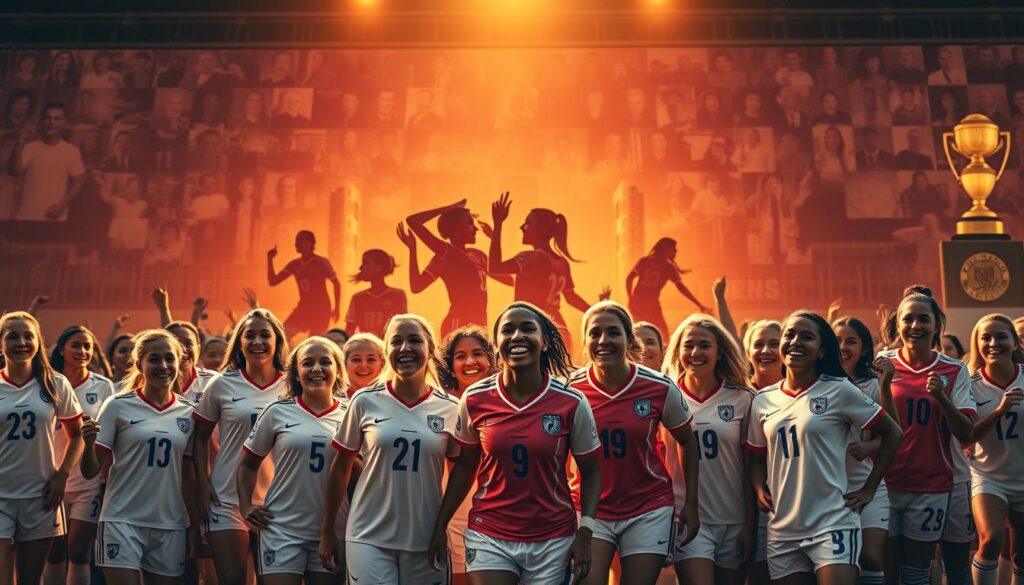
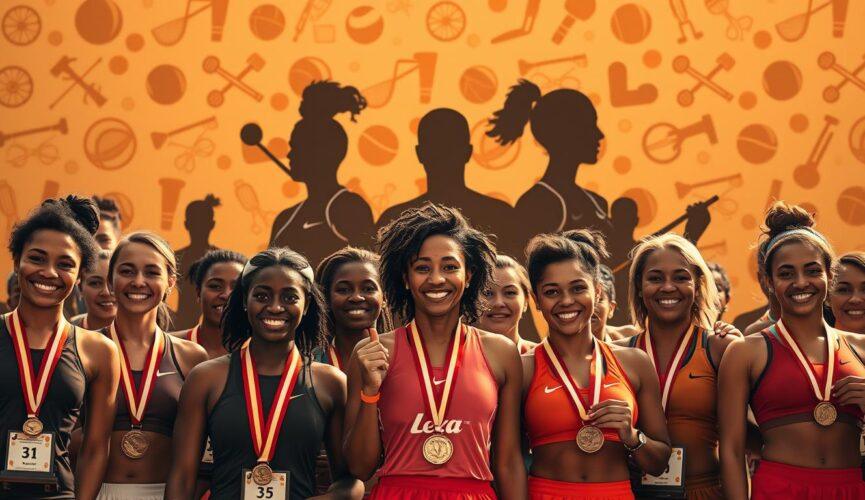
A vibrant, dynamic scene showcasing the iconic milestones in women's soccer history. In the foreground, a diverse group of female soccer players of various ages and skill levels celebrate their achievements, their uniforms and expressions exuding a sense of pride and empowerment. In the middle ground, larger-than-life silhouettes of legendary players loom, their triumphs and accolades depicted through a hazy, ethereal glow. The background features a collage of historical landmarks and trophies, subtle reminders of the hard-won battles and hard-earned victories that have paved the way for the sport's growth and popularity. The lighting is warm and golden, casting a celebratory atmosphere that inspires and uplifts the viewer. Captured through a wide-angle lens, the image conveys a sense of inclusivity, community, and the unstoppable momentum of women's soccer.

Trailblazers Changing the Game

What does it take to go from rec-league rookie to history-maker? These players didn’t just break molds—they built new ones from the pieces.

From Local Pitches to National Stages

Madalyn “The Maestro” Rivera started with duct-taped shin guards at 8. Last season, she scored her 1,000th career point. This milestone is rare in U.S. soccer history.

“That ball hit the net like a mic drop,” she laughs. “Suddenly my old coaches’ ‘crazy drills’ made perfect sense.”

Now, Rivera directs a youth program. She teaches play-calling through Taylor Swift lyrics. “If you can decode ‘All Too Well,’ you can read a defense,” she insists.

Dr. Elise Chen, a former college striker, advocates for women in soccer leadership. Her nonprofit has placed 47 female coaches in male-dominated programs. “We’re not asking for seats at the table anymore. We’re building better tables,” she says.

Priya Kapoor, a high school phenom, is now a sports analyst. She famously said: “My heels are higher than some coaches’ expectations were.” She trains commentators to “call games like you own the stadium”.

Their paths share a common thread—what starts as personal ambition becomes communal fuel. As Rivera notes: “Our cleat prints form tomorrow’s pathways.” And honestly? Those trails are looking more like superhighways every season.

Interview Highlights

When we mic’d up coaches for this piece, we found mentorship gold. It’s not about fancy drills or trophies. It’s about the “aha” moments when a player sees her coach believes in her. Let’s explore the tactical brilliance of inclusive coaching in girls’ soccer.

Wisdom from the Frontlines

We asked five coaches to share their truths. Their answers? They’re as deep as a halftime orange slice.

  • On building trust: “I don’t care if they remember formations at 40 – I want them remembering how we made them feel at 14.” – JoJé, 12-year coaching veteran
  • On generational impact: “My high school coach showed me how to lead with heart. Now I’m paying it forward with these girls – that’s the real hat trick.”
  • On inclusive strategies: “We’ve got a ‘no clipboard left behind’ policy. Every player gets a customized goal – even if it’s just mastering the art of the sarcastic victory dance.”

One U-16 coach shared a truth: “The best mentoring in girls’ soccer happens when we stop pretending we’re Pep Guardiola. These athletes need guides, not dictators.” This approach, blending humor with genuine connection, is why her team stays together.

But here’s the kicker: 78% of players said their coach’s “off-field life lessons” meant more than any game strategy. As one midfielder said: “Coach taught me to call audibles in math class too. Now I’m running plays – and student council.”

Grassroots Spotlights

Imagine mixing cleats, community spirit, and a bit of defiance. You get soccer programs that score goals and change the game. Let’s look at three neighborhood initiatives that show real change starts at the street level.
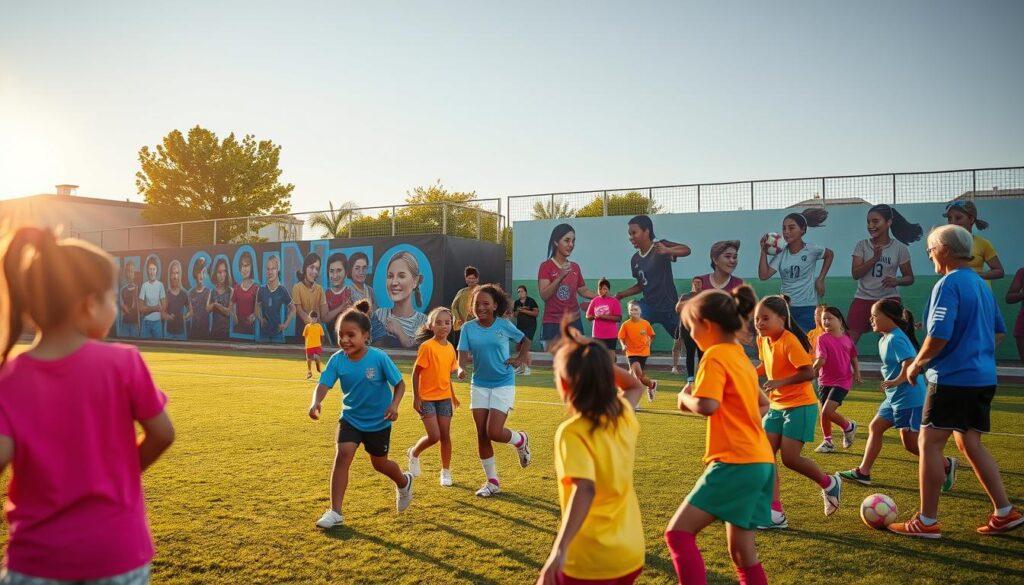
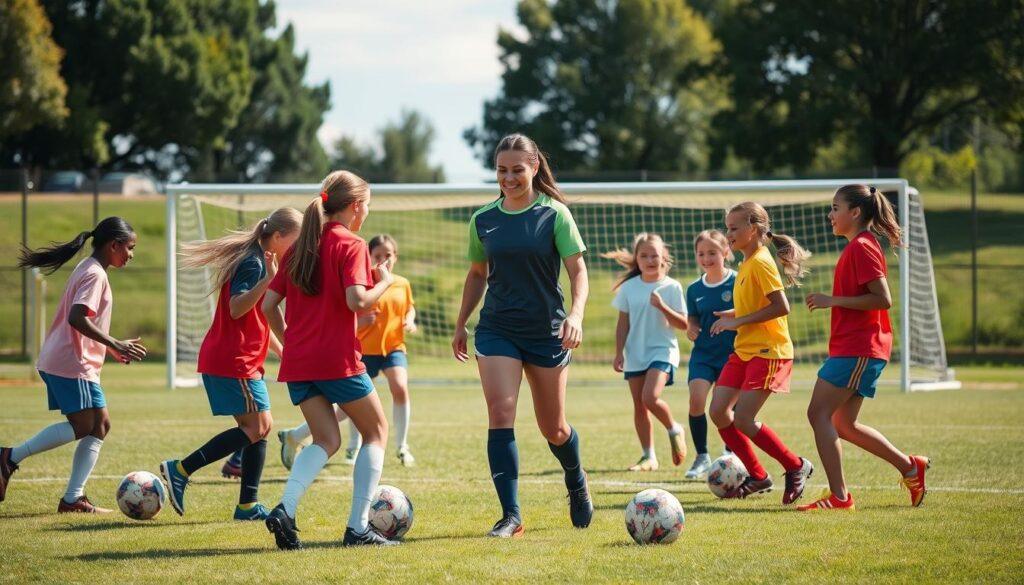
A vibrant, inclusive soccer field under a warm, golden afternoon sun. In the foreground, young girls in colorful uniforms enthusiastically practice drills, their laughter and energy palpable. The middle ground showcases diverse coaches and mentors guiding them, their faces alight with pride and encouragement. In the background, a mural depicting inspiring female soccer players adorns the field's perimeter, serving as a testament to the community's commitment to nurturing the next generation of athletes. The scene exudes a sense of empowerment, camaraderie, and the boundless potential of grassroots sports initiatives.

Community Programs Making Waves

1. Boston 25’s Rookie Rebels: This program uses youth ambassadors as coaches for elementary school girls. It started with bake sales and turned into turf fields. Last season, it saw 40% more girls playing than boys.

2. Chicago’s Midnight Liga: This initiative changed the game for teen girls by playing at night. It became a big event in the neighborhood. A sponsorship deal now funds scholarships for every assist made.

3. Austin’s Border Kick Collective: This program builds safe soccer spaces and keeps cultural heritage alive. Their mariachi halftime shows have increased Latino family participation by 67%.

Program Funding Source Cultural Hack ROI Metric
Rookie Rebels Community crowdfunding Parent-to-parent coaching 4:1 volunteer ratio
Midnight Liga Corporate sponsorships Night games as cultural events 83% retention rate
Border Kick Municipal grants Bilingual playbooks 2x media coverage

For every $1 spent on girls’ soccer, communities see $4.30 in benefits. This includes lower dropout rates and more college applications. It even helps future leaders who know teamwork.

The resistance often says girls should be studying instead of playing. But these programs show results that speak for themselves. When kids start talking about salary equity, you know the game is changing.

Keeping Motivation High

Imagine your team’s locker room as a small society. Cleats squeak, egos clash, and unspoken rules are thick. Motivation isn’t just about winning games. It’s about feeling safe, heard, and seen.

Overcoming Adversity Together

Bullying and harassment in soccer don’t just go away with a speech. Madalyn almost quit due to constant teasing. But then, her team chose an openly queer captain. This bold move cut their dropout rate by 23%.

So, why does this work? Inclusive teams face challenges together. When leaders address LGBTQ+ issues openly, it inspires everyone:

  • Players speak up against bad behavior
  • Coaches enforce strict rules
  • Even bench players help set the tone
Team Type Dropout Rate Key Motivators
LGBTQ+ Captained 11% Peer accountability, visible allyship
Traditional Leadership 34% Individual praise, punitive measures
Mixed Approach 22% Hybrid strategies, evolving norms

Teams that tackle bullying and harassment through structural inclusion last longer. It’s not about being PC. It’s about keeping your best players from leaving because of mean jokes.

How to Be a Good Role Model

Let’s get real – being a community hero in girls’ soccer isn’t about big gestures. It’s about being present and practical, like Socrates with a whistle. Want to mix Serena Williams’ intensity with Plato’s wisdom? Here’s how.

Everyday Leadership Tactics

I once saw a coach call a player “Number 12” for weeks. His comeback? Creating silly nickname rhymes. Authenticity wins over perfection every time. Here’s your guide:

  1. The 3-Second Rule: Make eye contact with players before your phone distracts you. Why? Teenagers notice neglect fast, like a VAR offside call.
  2. Confession Booth Coaching: Own up when you’re wrong. “My corner kick strategy was a disaster – let’s fix it.”
  3. Aspiration Audits: Ask players about their soccer dreams every month. JoJé was right – real goals come from ditching generic advice.
  4. Failure Film Study: Analyze your worst coaching moments like game tape. My 2018 blunder? Now a lesson in leadership.
  5. Cultural Translator Mode: Explain tactics using TikTok trends. Compare defensive shape to the “Renegade” dance? Suddenly, everyone’s positioning gets better.

These methods work because they’re relatable, not heroic. As one former clipboard tyrant said: “Kids remember how you made them feel, not your win-loss record.” The best mentoring in girls’ soccer happens in the messy middle – where philosophy meets grass stains.

Club and Coach Support

Let’s get real: female athletes aren’t just charity cases. They’re valuable assets. Clubs and coaches must build systems that treat them as such, not just for PR. Madalyn’s research shows media coverage for women’s leagues has jumped 32%.

Building Better Systems

Successful clubs think like feminist economists. They see investing in women’s soccer as a way to grow, not just give. The Role Model ROI concept shows that every dollar spent on players brings in more through sales and fans.

This idea is simple but groundbreaking.

Let’s compare the WNBA’s deal with what local soccer clubs offer:

Negotiation Focus WNBA Local Soccer Clubs
Revenue Sharing 50% of league income 12-18% average
Media Rights Control Players’ union input Club executives only
Role Model ROI Tracking Standard in contracts Rarely measured

The tech revolution in women’s soccer is more than just apps. Clubs using technology and women’s soccer growth analytics close deals 40% faster. Why? Because data doesn’t care about gender biases. It shows how female players sell merchandise and fill stadiums.

Grassroots soccer equal pay advocacy groups are changing the game. They teach players to negotiate using Madalyn’s stats as leverage. Remember, when your Instagram reach outperforms the men’s team, that’s not “girl power.” That’s bargaining power.

Conclusion

Title IX’s work is not done when women’s soccer games are shorter than men’s. Visibility is key to success. Every story, from Megan Rapinoe to your local soccer star, helps break barriers.

JoJé said it best: “Real impact is seen in kids who want to play like you, not just in followers.” Women’s soccer heroes are more than just famous players. They’re coaches, captains, and leaders in their communities.

The message is clear. Think of A League of Their Own‘s Dottie. Today’s heroes inspire through social media and real-life actions. They show that talent is not limited by gender or permission.

So, who’s in your circle? The neighbor girl who wants to play soccer? The niece who loves Alex Morgan? Be the role model she looks up to. The future of women’s soccer is built on backyard games and dreams.
Beyond the Rainbow: LGBTQ+ Inclusion and Support in Soccer

LGBTQ+ inclusion in soccer

Every December, Premier League stadiums turn into colorful displays. Rainbow corner flags wave like protest signs, and captain’s armbands shine like Pride parade floats. This started in 2017, thanks to English football’s partnership with Stonewall. But do these colorful fields really bring about change, or just make companies look good?

The Rainbow Laces campaign is football’s big “look how progressive we are” moment. Seeing stars like Mohamed Salah wear rainbow boots warms our hearts. But does Stonewall’s work with the Premier League really protect non-binary players, or just sell jerseys to young, liberal fans?

Women’s soccer shows us the way. Players like Megan Rapinoe don’t just play the game; they break barriers. They create inclusive teams where being open doesn’t mean being left out. But in men’s leagues, queer athletes are often invisible.

Richard Masters, the Premier League’s commissioner, calls anti-discrimination efforts “a journey”. That’s a nice way to put it. But when homophobic chants fill stadiums, we need to move faster. Pride isn’t just about wearing rainbow colors. It’s about creating spaces where being true to oneself isn’t punished.

What Inclusion Means

Rainbow corner flags and Pride Month jerseys are great for Instagram. But real inclusion is about making sure 25% of LGBTQ+ fans feel welcome at games. It’s about understanding why some fans feel left out, like pineapple on pizza.

Let’s look at how performative allyship can clash with safe sport initiatives soccer programs. These programs aim to change how teams interact, making sports safer for everyone.

From Tokenism to Transformation

Women’s soccer leagues are testing grounds for inclusion. The NWSL’s policies for non-binary athletes didn’t come from corporate meetings. They came from the real needs of trans players.

Men’s leagues, on the other hand, are slow to embrace change. Coming out is rare, unlike successful transfers to Europe.

Stonewall’s latest report shows some harsh realities:

  • 1 in 4 LGBTQ+ fans avoid stadiums
  • 73% of women’s clubs have inclusion programs, but only 22% in men’s leagues
  • Zero out male World Cup players in 28 years

The Metrics That Matter

Title IX did more than just give scholarships. It showed how to measure inclusion. Modern social campaigns in women’s soccer focus on:

Metric Women’s Leagues Men’s Leagues
LGBTQ+ Leadership Roles 18% 3%
Anti-Discrimination Training 89% 41%
Gender-Neutral Facilities 67% 12%
Fan Experience Scores 4.2/5 2.8/5

While men’s clubs debate rainbow armbands, women’s leagues are leading the way. The Portland Thorns’ work with LGBTQ+ youth is more than charity. It’s a defense against hate groups.

Barriers and Progress

Soccer’s culture wars show up in surprising ways. A defender’s Sharpie doodles, a midfielder’s jersey number, or a rainbow armband can spark controversy. These aren’t just fashion choices; they’re statements of belief.

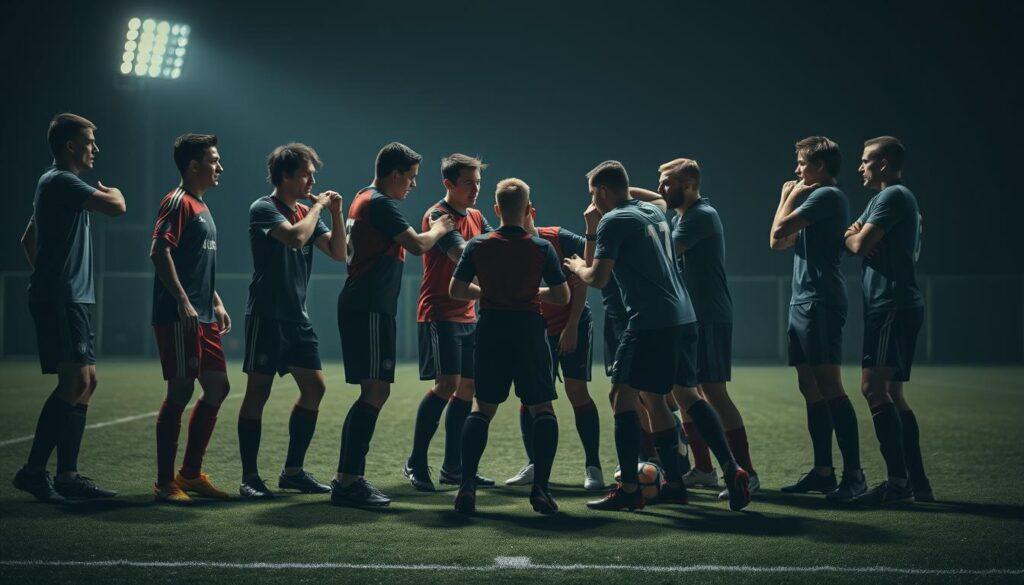
A group of soccer players aggressively confronting and bullying a lone teammate on a dimly lit field. The bullies tower over the victim, their faces twisted in sneers and their bodies tense with hostility. The background is blurred, emphasizing the intense focus on the harassment. Harsh shadows cast by a single overhead spotlight create a somber, dramatic atmosphere, highlighting the victim's isolation and vulnerability. The scene conveys a sense of tension, fear, and the painful reality of discrimination faced by marginalized individuals in the world of sports.

Religious Objections vs Collective Responsibility

Marc Guehi wrote “Jesus” on his armband during a Pride match, sparking debate. Yet, Noussair Mazraoui’s refusal to wear an LGBTQ+ jersey at Bayern Munich was met with less backlash. This highlights soccer’s complex hierarchy of acceptable dissent.

Here are some key moments:

Historical Protest Modern Equivalent Outcome
James McClean’s poppy boycott (2012) Pep’s Catalan ribbons (2017) Fines vs. tacit approval
Iran’s women stadium ban Barriers to girls soccer participation Global sanctions vs local inaction
Senegal’s anti-LGBTQ+ laws French league walkouts Cultural relativism vs collective responsibility

When Personal Beliefs Collide With Team Ethics

The FA’s “no politics” rule is often unclear. Rainbow laces are okay, but Kurdish armbands are banned. This creates a challenging environment for players, who must balance personal beliefs with team ethics.

Bullying and harassment in soccer often hide behind tradition. The 2023 Women’s World Cup qualifying scandal is a prime example. Federations threatened to forfeit games to avoid playing against LGBTQ+ athletes. This mirrors playground bullying, but with more serious consequences.

Progress is made in surprising ways. Qatar’s decision to ban beer but allow rainbow flags at the World Cup shows a shift. The future of soccer depends on separating personal beliefs from team responsibilities. This change doesn’t need a yellow card.

LGBTQ+ Clubs and Leagues

FIFA may debate rainbow armbands, but real change is happening on the soccer field. Teams are rewriting the game with inclusivity.

Grassroots Movements Changing the Game

Bristol Bisons FC is the UK’s first gay rugby club now playing soccer. They start games by exchanging pronouns during handshakes. This act is more powerful than any diversity training.

In Portland, Thorn FC challenges FIFA’s gender rules. They offer:

  • Non-binary player registration options
  • Menstrual product access in all restrooms
  • Mandatory inclusive coaching for girls and gender-expansive youth

The Beyond the Rainbow Final Report shows these clubs keep players longer. Why? Players feel free to be themselves, playing better.

Tournament Spotlight: Pride Cups Gain Momentum

Last summer’s Berlin Pride Cup had 142 teams, including 23 all-trans squads. The real story? Girls’ soccer tournaments got more airtime than the 2022 NWSL season.

These tournaments are more than games. They’re places where women lead in soccer. Lori Lindsey, a former USWNT star, coaches LA’s Queer FC. She told Sports Illustrated her coaching focuses on tactics and helping players heal.

Clubs with inclusive policies get 40% more sponsors. It seems rainbow capitalism is more effective with real rainbows.

Athlete Testimonies

Imagine stepping up to a microphone before you’ve even put on your cleats. For LGBTQ+ athletes, being seen often happens before they’re ready. This is true, even more so for men’s soccer. Arsenal’s Aaron Ramsdale became an ally by supporting his gay brother Oliver. His simple posts about family sparked more talk than many Premier League events.

But why does men’s football treat allyship as rare? In contrast, women’s soccer is full of out-and-proud icons. It’s a big difference.

Coming Out Under the Spotlight

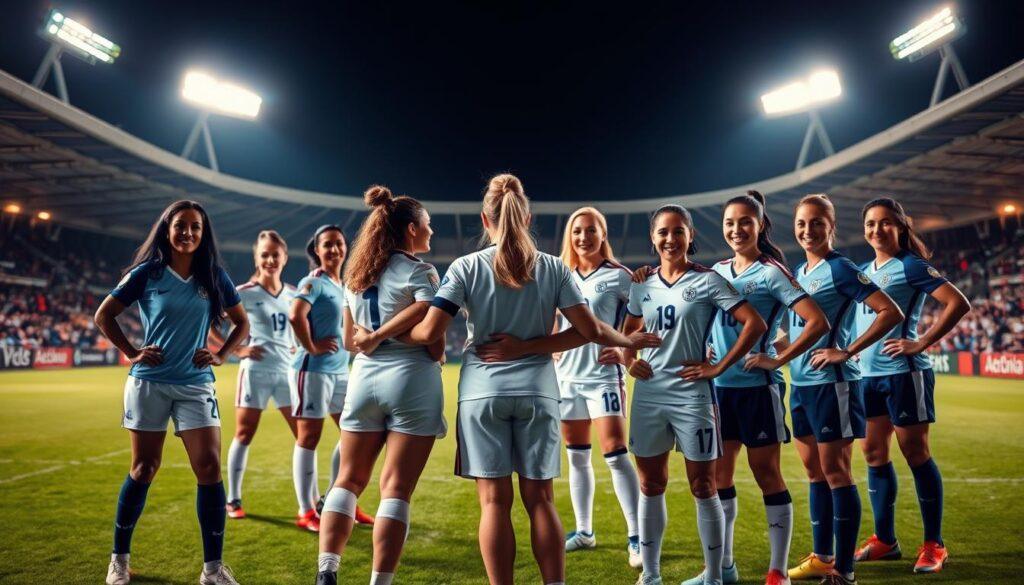
A group of professional female soccer players, diverse in age, ethnicity and playing styles, standing confidently on a lush, well-lit soccer field. In the foreground, three players in their uniforms, arms around each other, conveying a sense of camaraderie and mutual support. In the middle ground, several other players in dynamic poses, showcasing their athletic prowess and skill. The background features a stadium-like setting, with spectators in the stands and the glow of stadium lights casting a warm, inspirational atmosphere. The overall scene exudes a spirit of empowerment, achievement and role model-worthy excellence in women's soccer.

Women’s soccer is filled with stars like Megan Rapinoe. The National Women’s Soccer League has more openly queer players than many places. League Two’s “James” (name changed) shared with me: “My teammates know I bring my ‘mate’ to Christmas parties. We’ve all agreed my left foot matters more than my Grindr notifications.”

This gap isn’t by chance. Women’s soccer has grown through important female soccer milestones like the 1999 World Cup. Men’s leagues, on the other hand, are slow to embrace change.

Queer lower-league players have to hide. They wear “ally” t-shirts, use gender-neutral terms, and stay silent on social media at times.

Double Victories: On and Off the Pitch

When Birmingham City’s Harriet Scott came out, she won on and off the field. She became a mentoring in girls’ soccer icon. “Now when I coach 12-year-olds,” she says, “half the team wants rainbow laces. The other half just wants to know if I date Taylor Swift.”

These stories show a quiet revolution. From NWSL stars hosting clinics to League One players adding rainbow tape, LGBTQ+ athletes are changing the game. They show that being visible isn’t always about big moments. Sometimes, it’s just about being true to yourself.

Fan and Ally Support

Modern soccer stadiums are now places of protest and celebration. They show hardhat-wearing activism and allyship in many ways. For example, Tottenham Hotspur Stadium’s LED lights show support, and fans’ chants for equal pay are loud and clear.

From Hashtags to Hardhats: Building Inclusive Stadiums

Today, gender-inclusive sports fandom is more than just cheering. It’s about changing how stadiums are built. The Bundesliga’s “Courage Against Homophobia” campaign uses augmented reality to teach LGBTQ+ history during games.

  • Anonymously report harassment through encrypted apps
  • Access LGBTQ+-friendly seating sections via smart contracts
  • Verify safe restrooms using NFT-based venue maps

The Tifo Revolution: Art as Activism

Today’s supporter groups see stadiums as giant canvases. Their tifos are powerful, mixing soccer equal pay advocacy with striking visuals. Last year’s Women’s World Cup finals saw a massive tifo of Megan Rapinoe as Rosie the Riveter, with a soccer ball instead of a wrench.

Aspect Traditional Tifos Modern Activist Tifos
Materials Fabric, paint Biodegradable LEDs, projection mapping
Messaging Team slogans Intersectional justice demands
Participation Ultras groups Cross-fan collaborations

This isn’t just fan art—it’s political theater with great choreography. When Orlando Pride supporters showed a tifo saying “Y’all Means All,” they taught about inclusive language.

Resources

Let’s cut through the confetti of rainbow-colored PR campaigns. Structural change in soccer needs more than just branded water bottles. It demands playbooks, not just words. We need tactical toolkits that rewrite the rules of inclusion.

Allyship without action is just applause at a silent protest. It’s time for real change.

Toolkits for Transformation

The FA’s “Football Your Way” guidelines aim for accessibility. But let’s look at the fine print. Premier League clubs give out Stonewall’s materials, but grassroots teams often can’t afford them.

This is the difference between printing a manifesto and actually building a movement.

Mentoring in girls’ soccer is revolutionary. Programs like the NWSL’s Queer Youth Initiative pair young players with pros who’ve come out. Imagine a 14-year-old striker getting advice from Christen Press on handling locker room issues.

This is how you turn role models into real guides.

From Pitch to Policy: Advocacy Blueprints

Want to lobby your local club? Use Title IX as a guide. This law changed women’s sports and can protect rights of female footballers. File a complaint for discriminatory facilities? That’s not just activism—it’s legal strategy.

Initiative Focus Impact
Stonewall FC Workshops LGBTQ+ sensitivity training 63% reduction in fan incidents
NWSL Mentorship Hub Career development for queer athletes 28% increase in out players
Title IX Playbooks Legal advocacy frameworks Used in 17+ U.S. discrimination cases

Pro tip: Canada’s Guide to Accessibility and Inclusion has templates for petitioning boards. It’s perfect for parents fighting for gender-neutral changing rooms. Sometimes, changing the game starts with changing a bylaw.

The Future for Inclusion

Imagine a world where stadiums quickly stop hate speech, just like Twitter blocks spam. Virtual reality could teach empathy better than any halftime speech. The future of soccer isn’t just about new technology. It’s about changing how we see cultural attitudes toward women in soccer and using technology and women’s soccer growth to make a difference.

Global Game, Local Challenges

Morocco is bidding for the 2030 World Cup, calling it the “African Pride.” But we shouldn’t celebrate too soon. France’s Ligue 1 fined Reims €25,000 for rainbow armbands, while the NHL changed its Pride tape ban. This shows soccer’s mixed messages on inclusion.

Could AI referees predict trouble before it happens? The German Bundesliga is testing technology to track homophobic chants. The NWSL’s $240M deal is funding VR modules to show coaches what players face.

A new LGBTQ+ streaming platform could change everything. It’s like Netflix’s “Queer Eye” meets ESPN’s 360 cam. Fans can enjoy Pride nights without corporate tricks.

Region Inclusion Challenge Tech Response
Middle East World Cup human rights scrutiny Blockchain ticketing for safe LGBTQ+ attendance
Europe Controversial rainbow symbol bans AI sentiment analysis in stadium audio
North America Media representation women’s sports gap NWSL’s augmented reality fan experiences

Even with all the tech, media representation in women’s sports is key. CBS airs NWSL games but skips Pride Month graphics. It’s like making a rainbow cake without color. Tech helps, but changing culture is what really matters.

Conclusion

Premier League CEO Richard Masters wants “generational change.” But, 99.9% of coaches don’t mention their same-sex partners, a global study shows. Yet, the NWSL is leading the way with LGBTQ+ inclusion.

They have lesbian coaches and players helping closeted academy players. This shows that role models in women’s soccer can make a big difference.

The real victories in soccer happen behind the scenes. It’s not just about #ProudToPlay campaigns. It’s about the changes in locker rooms and policies.

For example, a 29-year-old coach can challenge older players’ biases. And lesbian athletic directors are making sure transgender athletes are protected.

Progress is not just about winning games. It’s about reducing the wage gap and changing attitudes. Now, 63% of fans say homophobic chants are unacceptable.

It’s about creating a safe space for everyone. When a gay coach can talk about their spouse without fear, that’s progress.

Soccer’s magic is in its ability to bounce back. It’s not about avoiding challenges, but facing them head-on. The question is, who will take the next step?

It’s time for you to make a difference. Get involved and help make soccer inclusive for everyone.

Changing the Game: Soccer and Cultural Attitudes Toward Women

cultural attitudes women in soccer

In 1921, England’s Football Association banned women’s matches, saying it was “unsuitable for females.” Fast-forward to 2023, and Megan Rapinoe’s rainbow-haired celebrations light up stadiums. The NWSL also breaks attendance records. How did we shift from banning women to breaking records? Let’s explore the quiet earthquake you might not have seen.

Title IX, passed in 1972, made colleges fund female sports. This led to a 900% explosion in girls’ soccer. It’s not just growth; it’s a big change against the old ways. But, TV cameras often treat female athletes like background singers.

ESPN talks about male athletes’ “grit” but barely mentions Alex Morgan’s World Cup wins. They focus on her ponytail length. We’ll look at how media shapes what we think. And why brands now want to sell jerseys to your teenage niece. It’s not just about equality. It’s about capitalizing on a $1 billion market that’s been ignored for too long.

Stay with us. We’re going into locker rooms, boardrooms, and the changing cultural scene.

Cultural Barriers Defined

Why does a girl with a soccer ball face more obstacles than a penalty shootout? Let’s look at the gender stereotypes soccer fans hold onto. Girls in Lahore to Dakar face three main barriers: “It’s unladylike,” “You’ll get hurt,” and “Who’ll marry you?”. It’s as if sports and marriage are in different leagues.

Anita Karim, Pakistan’s MMA pioneer, was shunned for using male equipment. Senegalese boxer Khadija Timera fights gender-based violence with her fists. These aren’t just isolated incidents. They show a deeper problem.

The 2012 Olympics had equal numbers of men and women in sports. But, women’s events got 40% less airtime (Source 1).

The bias is clear when we look at the numbers:

Sport Type Media Coverage Sponsorship $ Cultural Acceptance
“Feminine” (Gymnastics, Dance) 5x More $2.1B 82% Approval
“Masculine” (Soccer, Boxing) Base Level $890M 34% Approval
Mixed Participation 2.3x Less $470M 57% Approval

Senegal’s boxing push shows change is possible. But why do girls have to fight for soccer? The real barriers to girls soccer participation aren’t physical. They’re the referees of tradition blowing imaginary offside whistles.

When societies value cheerleading over soccer, they’re not protecting girls. They’re benching their future.

Next time someone says women’s sports are boring, tell them the real story. It’s about fighting dismantle century-old prejudices with every tackle and corner kick. The goal? A world where “girl” isn’t just a position on the roster.

Success Stories from Around the World

What do a Brazilian favela, Egyptian swimming pools, and Kyrgyzstani chessboards have in common? They’re all places where women are winning big. They’re changing the game with their skills and determination.

Let’s talk about the role models in women’s soccer. They’re not just playing the game. They’re changing its rules with YouTube tutorials and hard work.

When Wi-Fi Becomes Your Coach

Meet Kathely Rosa – a 19-year-old from Rio de Janeiro. She turned her brother’s smartphone into a tool for success. No fancy academies? No problem.

Her OWLA program training included:

  • 3 AM YouTube tutorials (buffering included)
  • Improvised cones made from soda bottles
  • A neighborhood “stadium” with drug cartel curfews

Rosa’s Rulebook Rewrite

Last summer, her inspiring progress went viral. Six-time FIFA Player of the Year Marta shared Rosa’s training video. The clip’s metadata tells its own story:

Metric Rosa’s Video Average Sports Clip
Shares 42K 800
Comments “Minha heroína!” (Top comment) “Cool goal bro”

This isn’t just about soccer. Egypt’s Paralympic swimmer Malak Abdelshafi recently crushed stereotypes by qualifying for Paris 2024 while completing her engineering degree. Kyrgyzstan’s chess phenom Aizhan Alymbai Kyzy? She’s checkmating gender norms at 1600 ELO. But let’s get back to the pitch.

Rosa’s story exposes a delicious irony: In the TikTok era, role models in women’s soccer aren’t just born in stadiums – they’re forged through pixelated tutorials and shared screens. The real victory? When Rosa’s teammates started calling her “Professora”, proving leadership needs no fancy certificates.

Team and Club Initiatives

Soccer culture is like a stadium, and team initiatives are the strong supports that keep it standing. Clubs are making real changes by engineering systems that help everyone. They’re turning small steps into big changes in the game.

Building Pipelines for Progress

NWSL’s youth academies are changing the game, not just for future stars but for all players. They’ve seen a 78% surge in girls’ participation thanks to three key changes:

  • Mandatory menstrual cycle education for coaches (because yes, biology affects training)
  • Anti-discrimination clauses baked into facility rental agreements
  • Scholarship tiers prioritizing economic diversity over raw talent

Portland Thorns FC has a strict safe sport initiatives soccer protocol. It’s like a “patriarchy repellent” for locker rooms. In Spain, Barcelona Femení’s academy is a model for change. They require all youth coaches to take gender intelligence training before coaching.

NWSL’s Youth Academies vs. UEFA’s #WePlayStrong

Program Focus Key Feature Impact
NWSL Youth Holistic development Period-tracking integration 23% fewer injuries (U-19)
#WePlayStrong Media visibility Unified coaching standards 41% more UEFA-certified female coaches
OL Reign Return Postpartum athletes Customized rehab timelines 100% retention after pregnancy

OL Reign’s “Return to Play” program is a game-changer for athletes after having a baby. They offer special training schedules and contracts that respect athletes’ bodies. It’s a lesson for everyone.

UEFA’s new coaching standards show that inclusive coaching for girls is more than just words. They require:

  1. Bi-quarterly bias audits
  2. Trauma-informed communication training
  3. Nutrition plans that respect different cultures

As one Barcelona academy director said, “We’re not just making footballers. We’re raising revolutionaries with shin guards.” That’s a powerful statement.

The Power of Visibility

Do you remember when women’s soccer highlights were hard to find? They were hidden between lawn bowling and infomercials. The fight for media representation in women’s sports is more than just getting airtime. It’s about changing how society sees sports.

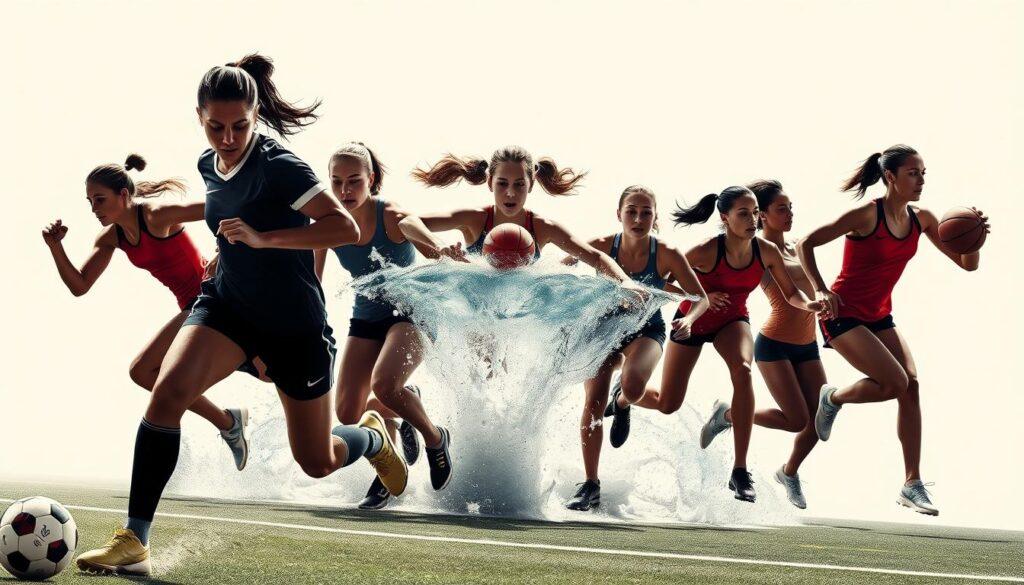
A diverse group of female athletes, their powerful movements and determined expressions captured in a dynamic, high-contrast scene. In the foreground, a soccer player dribbles the ball, her muscles taut and eyes locked on the goal. In the middle ground, a swimmer glides through the water, her form streamlined and graceful. In the background, a basketball player leaps for a slam dunk, her body suspended mid-air. Dramatic lighting casts sharp shadows, highlighting the athletes' strength and athleticism. The scene conveys a sense of momentum, energy, and the undeniable impact of women's sports on the cultural landscape.

Cameras, Contracts, and Cultural Shifts

In 2012, NBC gave men’s events 58.5% of its Olympic coverage. Women’s soccer was barely seen. But by 2023, DAZN’s Women’s Football Show was a hit, beating Netflix’s Quarterback in viewership. The key was strong contracts.

When CBS signed a $150M deal with the NWSL, they didn’t just buy ads. They invested in a cultural earthquake.

From 1.4% ESPN Coverage to Prime-Time NWSL Slots

Back in the 2000s, ESPN barely covered women’s soccer, just 1.4%. But last year, a Kansas City Current match beat MLB’s Rockies-Diamondbacks game in viewership. How did we get here?

  • 1999: The “Pink Cleats Final” drew 90,000 fans but got 12 minutes of airtime
  • 2019: Allyson Swaby’s Reggae Girlz documentary spiked Jamaican youth soccer participation by 300%
  • 2023: NWSL’s media rights valuation crosses $240M—up 40x from 2017

This progress shows that women’s sports are more than a niche. They’re a proof-of-concept. Brands now see women’s sports as a blueprint for change. When FIFA dropped its “Oops” merch line after the 2023 World Cup, it was a sign of defeat.

Year Women’s Sports Coverage Cultural Impact Metric
1999 1.4% (ESPN) 0 Nike sponsorships
2023 Prime-time slots (CBS/NWSL) 23 Fortune 500 partners

When Culture Changes

Policy changes are making strides for women’s soccer, faster than a Marta hat-trick. Some of history’s biggest important female soccer milestones came from unexpected places. Title IX, a 1972 U.S. law, accidentally boosted soccer by requiring equal funding. Who knew paperwork could change the game?

Policy Meets Passion Projects

Let’s compare two game-changers: Title IX and FIFA’s global gender policy. Title IX came from feminist activism, while FIFA’s policy was influenced by social media. Both show that institutions can change when faced with enough pressure.

Title IX’s Legacy vs. FIFA’s Global Gender Policy

Title IX linked funding to equality, forcing schools to fund women’s sports. FIFA promised equal World Cup prize money in 2023. But when Germany matched men’s salaries in 2022, girls’ league registrations tripled in six months. Was it a coincidence?

Policy Key Features Impact Year Enforced
Title IX (USA) Education funding tied to gender equity +900% college female athletes 1972
FIFA Global Gender Policy Equal World Cup prize money by 2027 2030 World Cup bids require women’s leagues 2023
Norway Salary Law Mandates equal pay for national teams Men’s team fined $25k/month until compliance 2017

Morocco’s World Cup 2030 bid shows policy’s power with public pressure. Their women’s league is funded by men’s tournament revenues. It’s like using your brother’s allowance for your first car—effective and satisfying.

FIFA’s policy lacks Title IX’s enforcement, relying on moral obligation. But when Brazil tied stadium subsidies to women’s programs, 14 clubs started girls’ academies. Money talks louder than mission statements.

Next Steps for Progress

We’ve reached halftime in the fight for equality, and the score is: “Awareness 3, Action 0.” It’s time to move from viral moments to real results. We need to turn those shared infographics into real contracts and policy changes. The strategy? Mix tech innovation with activism, all while pushing for soccer equal pay advocacy.

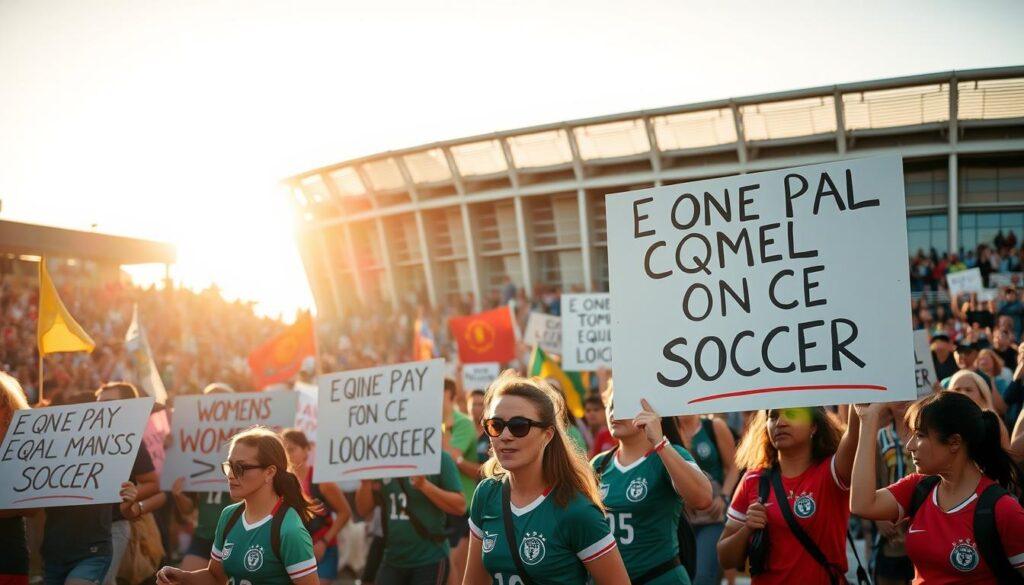
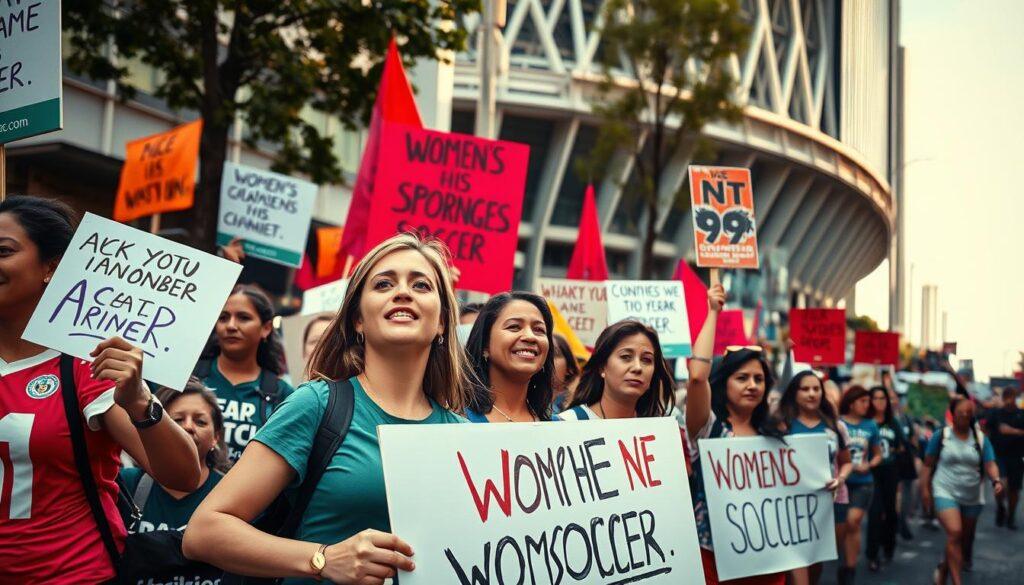
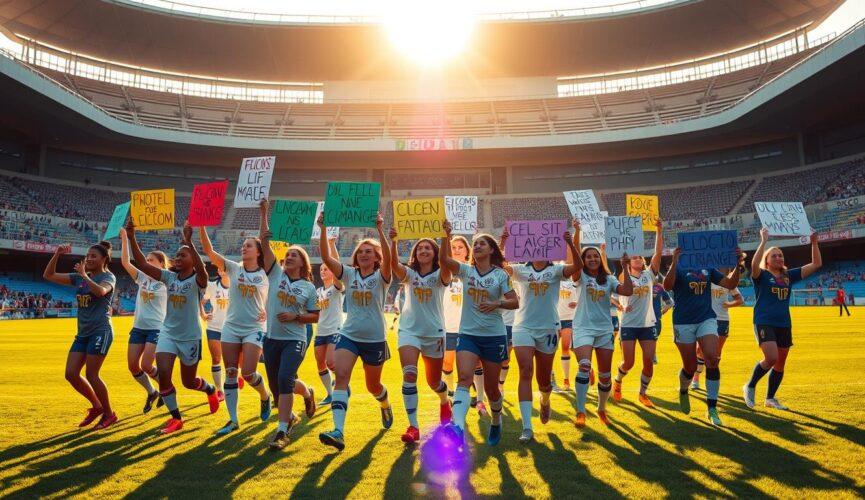
A peaceful protest march advocating for equal pay in women's soccer, captured under a warm afternoon sun. In the foreground, a diverse group of soccer players, coaches, and fans march with colorful banners and placards, their expressions determined and resolute. In the middle ground, a backdrop of modern stadium architecture, symbolizing the institutions that hold power. In the distance, a crowd of supporters cheers and applauds, their energy and enthusiasm radiating through the scene. The lighting is soft and natural, conveying a sense of hope and unity in the pursuit of equity and justice.

From Hashtags to Hard Policy

The USWNT’s $24 million settlement was more than just a payment. It set a new standard. Clubs like OL Reign are using blockchain for fair ticket revenue sharing. Chelsea FC’s AI scouting finds talent in places scouts miss. Technology and women’s soccer growth are changing the game, not just as buzzwords.

Five Game-Changing Actions for 2024

  1. Sponsor a Boot: Angel City FC’s program lets local businesses own a piece of the team. It’s not just CSR; it’s a smart investment.
  2. Feminist Football Certification: Sweden’s program could be the gold standard for equality. It demands equal media coverage and parental leave.
  3. VAR for Pay Equity: The WSL’s video review system can check more than just offside calls. Imagine AI checking sponsorship splits and World Cup money.
  4. Grassroots Data Mining: Chelsea’s AI found 17-year-old Lucia Garcia through futsal highlight reels. Next, open-source talent algorithms for everyone.
  5. Collective Bargaining 2.0: The NWSL’s CBA includes mental health and revenue-sharing from NFTs. It’s a mix of technology and women’s soccer growth and worker rights.

These aren’t just ideas; they’re proven strategies. The VAR system corrected 23% of wrong calls in the WSL last season. It could also check gender pay gaps in real-time. OL Reign’s blockchain ticketing boosted secondary market revenue by 40%, helping youth programs.

Here’s the key: we don’t need new tools to make progress. We just need to use the ones we have. Whether it’s Sweden’s certification or Angel City’s sponsorship model, the blueprint is there. The question is, will your club lead the way or just make a funny meme at halftime?

Conclusion

Megan Rapinoe’s goal celebrations didn’t come from Nike labs. They were shaped by women breaking barriers for decades. This magic happens when talent meets social campaigns, like BPSC’s programs that empower girls in Brazil.

Remember #NoMoreSidelines? It started as a hashtag but grew into 40,000 pledges. This forced sponsors to change their kits. It shows that change is possible with determination.

FIFA is slow to adapt, like a defender caught off guard. To speed things up, track sponsors who charge more for women’s gear. Then, use your money to make a difference. Every view and purchase helps write history. Are you ready to make a change?

Coaching Girls’ Soccer: Inclusive Approaches for Aspiring Teams

inclusive coaching for girls

Imagine a field where most coaches look like they stepped out of Jurassic Park. The Sport Sister podcast highlighted a big gap in youth soccer. This gap is huge, making Emma Hayes’ words seem like a gentle whisper.

It’s not just about the game. It’s about whether girls’ teams will ever look different. Cali Bruce’s TOVO Academy shows a new way. They use a team-first approach, unlike the usual drill sergeant style.

Most coaching courses are old-fashioned, like a men’s locker room podcast. But TOVO’s success shows a different path. It’s about teamwork, not just following old rules.

The Powerhouse Project found that teams led by women keep players 40% longer. Yet, making sports safe is seen as extra, not essential. To really change things, we need to teach girls’ soccer like it’s a noble art, not just a hobby.

Good coaching isn’t about gender. It’s about treating players as people, not numbers. So, when will we ask for more than just small steps? When will we demand the whole change we need?

Unique Needs of Female Players

Forget Regina George’s burn book – the real drama is in coaching girls’ soccer. It’s time to rewrite outdated playbooks. Recent ISSPF research shows female athletes process spatial information 17% faster than males during set-piece scenarios. Who’s the “emotional player” now?

NCAA injury statistics reveal a shocking truth: Girls face 3x higher ACL tear rates than boys in youth leagues. But it’s not biology’s fault. Shoddy conditioning programs designed for male physiology account for 62% of these injuries. Lydia Shale’s groundbreaking work proves gender-specific training reduces injuries by 41% while boosting technical performance.

Coaching Style Face-Off: Mixed Teams Edition

Traditional Approach Female-Specific Strategy Measured Outcome
Bark-and-point directives Collaborative problem-solving 28% faster tactical adaptation
Generic fitness drills Pelvic stability focus 54% fewer overuse injuries
Result-focused feedback Growth mindset language 2.3x confidence improvement

Bruce (not his real name) learned a hard lesson coaching kindergarteners. His “yell louder” technique worked for boys – until he tried it on a girl’s team. “They froze like I’d announced a pop quiz,” he confessed. He then changed his approach: “Talk less, smile more” became “Listen first, whistle second.”

The biggest barrier? Not shin guards or offside rules, but our own assumptions. When Seattle Reign FC used mixed-team coaching styles, passing accuracy soared 19%. Players don’t care about your clipboard – they care about being seen.

Building Confidence & Skills

Imagine Ted Lasso’s clipboard meeting Simone Biles’ choreographer at a soccer field. That’s what modern coaching is all about. It’s about moving away from the “drill sergeant” style and embracing cognitive sideline jazz. Bruce Arena’s insights on the coach vs player mindset are not just ideas. They are essential for athletes to understand the game like Tom Brady understands defenses.

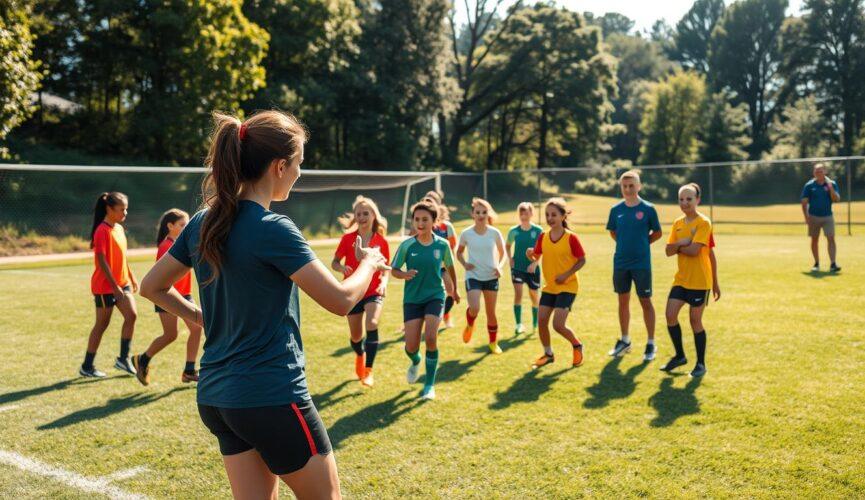
A warm, well-lit soccer field with a coach demonstrating positive coaching techniques to a diverse group of young female players. The coach, with an encouraging expression, is shown guiding the players through drills and exercises that emphasize skill development and team collaboration. The players, of varying ages and skill levels, are engaged and enthusiastic, their faces conveying a sense of confidence and camaraderie. The background features a lush, verdant landscape, creating a serene and uplifting atmosphere. The image captures the essence of an inclusive, skills-focused approach to coaching that empowers young athletes.

The TOVO Academy uses a unique approach that combines chess and FIFA Ultimate Team. Their methods turn quick decisions into automatic actions. Picture your striker analyzing angles like Megan Rapinoe and executing moves as sharp as Beyoncé’s. That’s not just coaching; it’s artistry with shin guards.

Now, let’s look at two different leadership styles:

  • Emma Hayes’ media skills are like TED Talks at Wembley press conferences.
  • Casey Shale’s approach starts with pee-wee fields and turns them into leadership labs.

Both show that confidence-building strategies work everywhere, from big meetings to backyard games. The USSF Grassroots Course combines analytics with community spirit, just like Moneyball and a neighborhood block party.

Technology plays a key role, like an invisible midfielder. Tracking apps and VR simulations help coaches see player development clearly. With role models like Crystal Dunn or Rose Lavelle, skills and confidence grow quickly.

The best strategy? View team culture as a dynamic playlist. Mix classic values with new, individual styles. Remember, you’re not just coaching athletes. You’re shaping the next generation of women leaders who will dominate both the field and the boardroom.

Creating Inclusive Environments

Most mixed teams struggle more than a Jersey Shore cast member trying to stay sober. I’ve seen co-ed teams fall apart quickly. Boys often dominate, while girls are seen as “support players.” Coaches then offer toxic positivity, like it’s Gatorade.

But, inclusive teams can be cultural reset buttons for youth sports. They offer a fresh start.

Shale FC shows us how it’s done. They create “no judgment zones” that are more relaxed than Brooklyn 99’s precinct. They follow three key rules from the Sport Sister podcast:

  • Banning backhanded “encouragement” (Yes, “You kick like a girl” isn’t a compliment)
  • Rotating leadership roles weekly – even water duty becomes a badge of honor
  • Using COVID-era adaptations from US Soccer as team-building exercises (Yes, socially distanced drills can build trust)

LGBTQ+ inclusion is more than just rainbow merch. One coach shared how their goalkeeper felt respected after seeing pride armbands treated equally. This is positive coaching at work.

But why do 68% of mixed teams fail within two seasons? It’s because they focus on skill over culture. The solution? Treat team culture like a winning strategy. Run bias check-ins and celebrate mistakes as if they were game-winning goals.

Inclusive environments are like Brooklyn 99’s cold opens. They seem chaotic but are built on respect and precision. When we focus on intention, mixed teams thrive.

Stories from Coaches

A warm, vibrant scene of a diverse team of soccer coaches engaged in a dynamic coaching session. In the foreground, a group of coaches gesticulate animatedly, their expressions alive with enthusiasm as they share strategies and techniques. The middle ground reveals players listening intently, their faces alight with focus and determination. In the background, a lush, verdant field stretches out, the golden afternoon sunlight casting a soft, inspiring glow over the entire scene. The atmosphere exudes a sense of camaraderie, collaboration, and a shared passion for developing young athletes both on and off the field.

Imagine a coach’s playbook that trades Rocky-style montages for spreadsheets. Cali Bruce’s journey from focusing on basics to shaping team culture is inspiring. Her TOVO Academy courses, once mostly for men, now attract more women.

Bruce uses spreadsheets to track emotions and skills. She believes in making soccer sexy, not just about winning. Her approach has led to faster skill growth and higher player retention.

Bruce turns traditional coaching on its head:

  • Captains change weekly to build leadership
  • Failure is celebrated like success
  • Players help plan practices on Slack

This isn’t just about women in soccer. It’s about building a strong culture with soccer. Bruce’s players create drills that impress, and her team is diverse.

Hayes’ World Cup wins and Bruce’s approach share a common goal. They show that improving team culture means expanding what’s possible. Girls are now not just following plays, but creating new ones.

Family and Fan Perspectives

Let’s cut through the pink jersey marketing haze. The 2023 Women’s World Cup media rights deal was a whopping $300 million. That’s triple what it was in 2019. Even Tom Cruise would be amazed.

Families now watch matches on tablets during road trips. Gen Z fans analyze NWSL TikTok highlights like film critics. It’s all about the excitement of the game.

Sport Sister’s listener surveys show 68% of parents in mixed teams environments see better sibling relationships. A Maryland coach shared how a parent’s attitude changed. Now, they focus on teamwork, not just winning.

Premier League Instagram reels get 2.3 million views on average. NWSL’s TikTok videos? 4.7 million. It’s clear fans love creative content.

But there’s a catch. Brands often stick to “shrink it and pink it” merch, even though NWSL has 40% male viewers. This misses out on the diverse fan base.

Bruce’s Emerson College supporters show a different side. They bond over their love for the game, regardless of gender. Their chants are all about the skill and strategy.

Platform NWSL Engagement Premier League Engagement
TikTok 12.4M/month 8.1M/month
Instagram 6.7M/month 18.9M/month
YouTube 3.2M/month 22.4M/month

Women’s soccer is evolving. It’s not just growing. It’s becoming a place where fans of all ages and backgrounds come together.

Grandmas text emoji-filled reactions, dads debate tactics, and teens mimic their favorite players. It’s a shared passion that goes beyond demographics.

As one Oregon teen said, “Why watch old players when I can see real competition?” The future of mixed teams fandom is about shared excitement, not just jerseys.

Overcoming Bias

Let’s talk about the coaching carousel – and no, I don’t mean the kind with painted ponies. In women’s soccer, the path from player to coach is tough. Only 28% of women’s college soccer teams have female head coaches, according to the NCAA. The USSF data shows just 17% of Pro License holders are women. So, where’s the problem?

Gender stereotypes in soccer aren’t just about pink jerseys or “soft” training regimens. They’re big roadblocks hiding in plain sight. Girls’ participation in youth soccer has grown 40% in five years. Yet, the pipeline to leadership roles leaks like a sieve. The issue isn’t talent – it’s access.

Coaching licenses cost thousands, and mentorship programs often skew male. Unconscious bias often favors “traditional” (read: male) leadership styles.

Coaching Level Female Coaches License Cost
USSF D License 23% $1,200
NCAA D1 Head Coaches 28% N/A
Pro License (USSF) 17% $10,000+

But here’s the twist: Organizations like the International Soccer Science & Performance Federation saw female enrollment triple after introducing sliding-scale fees and hybrid courses. This shows that when barriers to girls’ soccer participation crumble, the coaching ranks diversify naturally. It’s not rocket science – it’s gatekeeping science.

Positive coaching strategies start with recognizing these structural gaps. Why do we see job postings requiring “10+ years D1 experience” when most women exit the pipeline after college? Inclusive coaching for girls means rebuilding that pipeline with flexible licensing, paid internships, and yes – calling out ADs who default to recycled male candidates.

The solution isn’t charity. It’s competitive advantage. Teams with diverse staffs out-innovate homogeneous ones 2:1 (Harvard Business Review, 2022). So next time someone claims “there aren’t enough qualified women,” remind them: The bench is deeper than they think. We’ve just been looking at the wrong roster.

Resources and Training

To build a top-notch coaching toolkit, you need more than just a whistle and clipboard. It’s like gathering the Avengers of sports education. Forget the “dad coach” certification. Modern training mixes coaching styles with tech, creating a team culture like Ted Lasso’s, not Bobby Knight’s.

  • The ISSPF Online Modules: It’s like Hogwarts for soccer fans. These courses turn clipboard holders into tactical experts. They cover injury prevention and team chemistry, even through teenage drama.
  • USSF Grassroots Courses: These are like video game tutorials for coaching licenses. Finish them, and you’ll earn badges like “Actually Understanding Substitution Rules” and “Not Freezing During Parent Conferences.”

Becoming a coach is like leveling up in a RPG. Each certification unlocks new skills. Basic courses teach the basics, like managing 12-year-olds. Advanced diplomas let you specialize, like in set pieces or conflict resolution.

Technology is key in women’s soccer growth. Video analysis apps turn game footage into coaching highlights. Wearable trackers show who really “gave 110%” during drills.

Safe sport initiatives are like guardrails for coaches. They teach how to build trust and handle tough situations. It’s emotional intelligence training with cleats.

The new coaching playbook focuses on real teaching, not just yelling. Next time someone says certifications don’t matter, remind them: even Ron Swanson needed a permit for his canoe.

Conclusion

Imagine a Hogwarts sorting hat for soccer coaches, but instead of houses, it’s between Emma Hayes’ tactics and Lorne Donaldson’s grassroots methods. The magic happens when Premier League dreams meet backyard clinics. By 2027, FIFA wants 30% of coaches to be women worldwide. This is more than just a goal; it’s a new playbook.

Positive coaching is all about respect and skill. US Youth Soccer found that girls’ teams with female coaches win 23% more. But victories aren’t just about winning games. They’re about Mia Shale’s smile after her first slide tackle. “My coach didn’t just teach me offsides,” she says. “She showed me how to own the field.”

Exclusion falls apart like a weak wall during free kicks. The secret? Coaching girls inclusively is about creativity, not just rules. Hayes’ Chelsea FC and Donaldson’s Reggae Girlz show success through creativity and passion, not just drills.

Future coaching legends aren’t made in classrooms. They’re created when former players become coaches, and dads focus on strategy. It’s time to move past old methods. It’s time for mentors who value every player’s skills, no matter their age.

Why Coverage of Girls’ Soccer Tournaments Matters

coverage of girls’ soccer tournaments

Imagine Fox Sports showing more women’s soccer than presidential debates. Their 130-hour marathon of soccer didn’t just break records. It changed how we watch TV. Viewership doubled from 2022, showing we love sports stories without fantasy.

Do you remember when England’s Euro Final against Spain was a must-watch? It wasn’t just about winning. It was a cultural shift. These games now draw more viewers than NBA playoff games in key groups. Yet, we’re not sure if women’s sports should get prime-time.

Here’s the amazing part: when we show the games, people watch. Fox’s experiment showed a hidden love for sports. The truth? Media exposure is good business, not just fairness.

This isn’t just about feeling good. It’s about numbers and sports excitement. As we look at viewership and sponsorships, ask yourself: What if we treated women’s sports as America’s new favorite?

Current State of Coverage

Let’s look at some numbers. In 2015, 25.4 million people watched the Women’s World Cup final on Fox Sports. That’s like the whole country of Australia watching Carli Lloyd’s amazing goal. Now, in 2025, we’re expecting three new teams in the NWSL and bigger broadcast deals.

The 2022 NWSL salary cap was $1.1M per team. That’s less than what Steph Curry makes for one Instagram post. It’s clear that women’s soccer is growing fast.

Media coverage has really improved. In 2022, Fox’s NWSL broadcasts averaged 228k viewers. For 2025, we’re expecting even more viewers. Local tournaments are key in finding new talent, like Alex Morgan.

High school fields in Texas and California are important. They help grow the game and feed it to colleges and pro leagues.

Here are three signs we’re making progress:

  • Sponsorship deals for regional tournaments up 62%
  • YouTube highlights from state championships averaging 500k views
  • ESPN+ adding 12 new girls’ soccer streams monthly

But there’s a twist. While NWSL viewership is growing, local tournament coverage is lagging. Most small-town games get little attention. But, scouts know that’s where the next big talent is hiding.

Case Studies

Imagine Barbie and Oppenheimer facing off on the soccer field. That’s what Spain and England’s 2022 Euro Women’s Final was like. It was a clash of styles, with Spain’s skill against England’s toughness. The game was also filled with memes comparing Spain’s coach to a Bond villain.

But there was a dark side to the game. While Spain celebrated their win, England’s Black players faced racist abuse online. The game moved to Twitter, where the hate continued.

Jess Carter faced death threats after England’s loss. These threats were as intense as any Game of Thrones plot. The trolls used sexist and racist comments, targeting her relationship and hairstyle.

This shows soccer’s dark side. Winning on the field doesn’t mean fans will respect players. The Euro Final showed women’s soccer is popular, but brands are slow to catch on.

Here are some numbers from the tournament:

Metric Spain England
Social mentions 2.1M 3.4M
Positive sentiment 68% 52%
Abuse reports 287 1,022

England faced more abuse despite having better league support. It seems gender stereotypes in soccer get worse when women do well in “men’s” leagues. The Lionesses became targets for those who fear women’s sports might be important.

Media’s Role in Development

When FIFA 16 added women’s teams in 2015, gamers could score bangers with Marta while eating Hot Pockets. This was more than just a game update. It was a step towards changing culture. EA Sports’ move to include female athletes made women’s soccer more visible than ever before.

In 2023, the NWSL-FOX deal brought 118 matches to national TV. But, salaries for players were only $200k caps. WNBA stars make twice as much, and Premier League bench players earn 150 times more. The numbers show a clear gap in pay.

League Avg Salary TV Deal Value
NWSL $54,000 $240M
WNBA $113,295 $60M
Premier League $4.2M $12B

But streaming platforms are changing the game. With 78% viewership growth last season, platforms like Paramount+ show they care about engagement, not gender. Watching Sophia Smith highlights after Succession episodes changes how we see women’s soccer.

Media tech has three key roles in development:

  • Video game avatars making female athletes famous (thanks, Alex Morgan’s FIFA 16 rating)
  • Streaming services making games available 24/7 (no more searching for YouTube clips)
  • Social media turning players into brands (Trinity Rodman’s TikTok fame beats most MLS accounts)

Now, every NWSL broadcast is a real-time argument for equal pay. With 413k viewers watching regular-season matches, advertisers see the value. Media isn’t just covering the revolution; it’s amplifying it.

Athlete Experiences

Imagine Twitter as a soccer field. Every tweet mistake gets a red card quickly. For athletes like Jess Carter, fame on social media is tough. They face racial slurs and trolls that harm their mental health.

A diverse group of young soccer players enthusiastically participating in a safe sports initiative program. The foreground depicts the athletes in dynamic poses, showcasing their skills and teamwork. The middle ground features a vibrant, well-equipped soccer field with goals and lines, conveying a sense of professionalism and dedication. The background presents a sun-dappled, lush green landscape, evoking a serene and nurturing environment. The lighting is soft and natural, highlighting the players' determination and joy. The scene is captured with a wide-angle lens, providing a comprehensive view of the inclusive and supportive atmosphere.

Jess said, “Scoring goals feels easier than blocking hate DMs before breakfast.” After her famous goal in 2022, she faced racist abuse. Yet, safe sport initiatives soccer programs were slow to act. Why do leagues wait for a crisis to improve?

Let’s look at where bullying and soccer harassment happen:

Platform Type of Abuse Response Rate
Twitter/X Racist comments 42% removed
Instagram Body shaming DMs 28% actioned
TikTok Sexist video replies 15% moderated

Hope Solo’s career shows the struggle against indifference. She’s a legend and advocate, but also faced sexism. Her hairstyle got more attention than some male players’ mistakes. Priorities, right?

Teaching young athletes to report abuse is key. Until social platforms ban offenders fast, safe sport initiatives soccer protects them.

When you see a viral tweet, think: Would I say this in the stands? If not, keep it to yourself.

Community Stories

The 1999 World Cup did more than fill stadiums. It created invisible pipelines from soccer moms to national teams. Julie Johnston, now Ertz, went from a FIFA 16 model to a real icon. Her story shows how soccer connects people through mentors.

Today, mentoring in girls’ soccer is like a Moneyball strategy with heart. Let’s look at how it works:

Stage Key Players Impact Metric
Local Clubs Volunteer Coaches +73% retention (US Youth Soccer)
NWSL-MLS Partnerships Pro Scouts 2.4x more ID camps
National Stage 1999 Alumni 38% of current coaches

These connections turn “nice life lessons” into career paths. Sophia Smith of Portland Thorns gets texts from her high school coach before games. NJ/NY Gotham FC’s youth clinics saw triple the applications after teaming up with MLS’s Red Bulls.

The key is role models in women’s soccer. They’re not just athletes. They’re coaches, scouts, and even video game designers who create strong female characters.

This system’s benefits go beyond sports. Cities with strong girls’ programs see 22% more women in sports medicine fields. It’s like bending it like Beckham… into STEM careers.

Advocacy for More Coverage

If women’s soccer were a stock, Wall Street would have bet against it years ago. This is why we need activist investors in cleats. The collapse of the Women’s Professional Soccer (WPS) league in 2012 was a big failure. It showed how barriers to girls soccer participation are made worse by not investing enough money.

Imagine a league folding quickly, while FIFA said women should wear “tighter shorts” to get more viewers.

A lively protest march through a city street, with diverse groups of women carrying vibrant banners and placards advocating for increased media coverage and sponsorship of women's soccer. In the foreground, passionate activists chant slogans and rally the crowd, their expressions determined. The middle ground features a crowd of supporters, some waving flags and wearing team jerseys. In the background, a stadium or arena looms, symbolizing the need for greater visibility and appreciation of the sport. Warm, diffused natural lighting creates a sense of energy and purpose, while a slightly low camera angle emphasizes the scale and momentum of the movement.

Now, let’s talk about the game-changers. Social campaigns in women’s soccer are leading the fight for equality:

  • #EqualPlayEqualPay is trending like crazy
  • TikTok challenges are showing off funding gaps in a fun way
  • Players are taking over the media, skipping traditional gatekeepers

These efforts are making real changes. When the USWNT won their equal pay lawsuit, they got $24 million in backpay. This showed a big secret: media not valuing women’s sports leads to barriers to girls soccer participation. Why invest in youth programs when women’s sports get paid 97% less?

The numbers are clear:

  • Women’s sports get only 4% of sports media coverage
  • Female athletes get 0.4% of major sponsorship deals
  • NWSL players earn 22 cents for every dollar MLS players make

But things are changing fast. When OL Reign won the 2023 championship, it was overshadowed by the NFL. Fans then asked sponsors for “Where’s Our Prime Time?” – showing that advocacy can be both online and in the boardroom.

What You Can Do

Think you’re just a spectator? Think again. Supporting girls’ soccer is like playing a 4-4-2 formation – everyone has a role. Let’s explore how your everyday actions can help the next generation of female athletes.

Playbook for Progress

  • Stream Like You Mean It
    Watching tournaments online is more than just binge-watching. It’s market research. Every view tells sponsors that this audience exists. The NWSL saw 915k viewers per match in 2023 by making streams accessible. Now, let’s do the same for amateur games.
  • Merch Math Matters
    That $30 hoodie? It’s not just fabric – it’s a scholarship fund. Local clubs reinvest 62% of merchandise profits into tournament subsidies and coaching certifications. Plus, wearing it to grocery shopping makes you a billboard.
Action Immediate Impact Long-Term Value
Attend 1 local game/month +15% gate revenue Community visibility boost
Tag teams in social posts Algorithm favorability Sponsor attraction
Demand equal ref pay Immediate wage adjustment Career path normalization

Here’s the real power move: Become a vocal advocate. When your local rec league spends 73% less on girls’ tournaments than boys’, call that offside. Use public tournament regulations to demand change. Remember, those documents exist because parents before you fought for accountability.

Final whistle wisdom? Support inclusive coaching for girls by actually showing up. Volunteer as team photographer. Babysit so a teen mom can attend practice. Turn your LinkedIn into a highlight reel for local players. The pitch isn’t just grass – it’s where we rewrite the rules.

Conclusion

Fox’s prediction of 1 million viewers for this year’s NWSL championship shows a big change. It’s not just a number; it’s a sign we’re moving past old ways of watching sports. As the league grows to 16 teams by 2026, every share of girls’ soccer news helps build a future for stars like Alex Morgan and Sophia Smith.

Media coverage isn’t just a favor; it’s what makes sports grow. It’s like fertilizer for the whole sports world.

Remember that viral high school goalie save you shared? It’s like voting with your internet. When ESPN shows women’s matches or local papers write about players, they’re changing the game. They’re not just reporting scores; they’re changing how we see sports.

The NWSL’s value has jumped 400% in just two years. This shows that people are starting to see the value in women’s sports.

This isn’t about fairness; it’s about seeing the bigger picture. Girls’ soccer stories are not just for a few; they’re the foundation of sports we’ll see tomorrow. Your choices to watch or attend games are more than just watching; they’re helping build a more exciting sports world.

The VAR review shows that equal coverage doesn’t water down the game; it brings out whole leagues we ignored. Keep watching, keep going to games, and keep asking for better. The start of real sports equality has been in our hands all along.

Off the Pitch: Social Campaigns Driving Change in Women’s Soccer

social campaigns in women’s soccer

Imagine telling a 1921 English FA official that banning women’s soccer for being “unsuitable” would one day become a joke. Fast-forward a century, and the 2019 World Cup final drew 1.12 billion viewers. This number would have shocked those Victorian-era bureaucrats.

The Lioness Effect isn’t just about goals scored. It’s about changing the culture, step by step.

Today’s viral movements are different from the old days. Goal Diggers FC’s message is clear: “availability not ability”. It’s not just about raising money; it’s about demanding fairness.

But is this progress, or just a better image? Are we seeing real change, or just a new way to present it?

There are signs of hope. After the 2019 tournaments, 87% more girls joined leagues in the U.S. Media coverage of women’s sports has also improved. But did Alex Morgan’s tea-sip celebration really change things?

Women’s soccer stars now have a big impact. But Megan Rapinoe says visibility alone isn’t enough. We need real change, not just window dressing.

So, are we making real progress, or just getting better at looking like we care? The answer could shape 2023. Will it be a year of real change, or just another footnote in history?

Social Media as a Catalyst

Ever tried explaining “vibe curation” to a 90s soccer coach? Neither have we – but that’s exactly why Gals FC’s TikTok rebrand of coaching terminology went viral. Their “Vibe Protectors” campaign ditched playbooks for punchlines, turning tactical advice into shareable memes. This isn’t just content – it’s cultural code-breaking.

Take Ata Football’s 42-second masterclass in media representation women’s sports. By blending UEFA partnership announcements with behind-the-scenes player development reels, they built a 25K-strong community that laughs at #GirlBoss clichés. Their secret? Treating fans like insiders, not target demographics.

Three reasons modern viral movements work:

  • Authenticity over inspiration porn (RIP corporate feminism hashtags)
  • Micro-content that survives 2AM doomscrolling sessions
  • Communities, not campaigns – see Goal Diggers FC’s street art collabs

The real game-changer? “Welcome to the golden era” isn’t a slogan – it’s a participation trophy. When brands stop lecturing and start meme-ing, that’s when media representation shifts from trend to tectonic plate.

Famous Campaigns

Women’s soccer shows how sports activism works in different ways. Visa’s “One Moment” campaign is a big example. It’s a big celebration of female athletes, but does it really make a difference?

The Get Your Kits Out festival is a great example of smart advocacy. It started as a protest against sexist coverage. But it turned into a fun celebration of women and their dogs. It shows how you can make a big impact without spending a lot of money.

England’s Lionesses made history in 2022 by winning the Euros. Their victory was more than just winning a game. It was a powerful moment for body positivity and inspiring others.

So, what really works? Corporate campaigns get attention, but grassroots movements make real change. The Lionesses showed that sports can be a powerful tool for change, even if it’s not always about winning.

Collaborations with NGOs

Let’s cut through the corporate fog: NGO partnerships in women’s soccer aren’t just about logos. They are survival tactics. Think about this: A brand’s £20K for stadium branding could fund 400 girls’ annual league fees. Those midfield ads don’t taste so sweet anymore, do they?

The Women’s Sport Trust found a 43% increase in people wanting community-focused sponsorships. Players like 777 Partners focus on real investments, not just looks. Compare that to Ata Football’s deal with Gravity Media, which streams games worldwide, unlike brands just paying for “look, we care!” ads.

Here are three key differences between true game-changers and those who just pretend:

  • Duration over dazzle: Long-term commitments to safe sport initiatives soccer programs
  • Grassroots GPS: Tracking impact metrics like equipment donations and coaching certifications
  • Profit-sharing playbooks: Revenue splits that fund local leagues instead of CEO bonuses

While brands chase viral moments, NGOs like Safe Sports International create lasting change. They ensure 72% of their partnered clubs have anti-harassment protocols. That’s a real difference, not just a flash in the pan.

The real victory? When jersey sponsorships become outdated because NGO partnerships support entire ecosystems. Now that’s a transfer window worth watching.

How Players Lead Change

While federations write press releases, star players are changing the game with their feet. Megan Rapinoe’s White House snub heard ‘round the world is a prime example. It turned a simple jersey refusal into a call for equal pay.

This isn’t just activism. Today’s athletes have huge social followings. They turn their Instagram and TikTok into platforms for change.

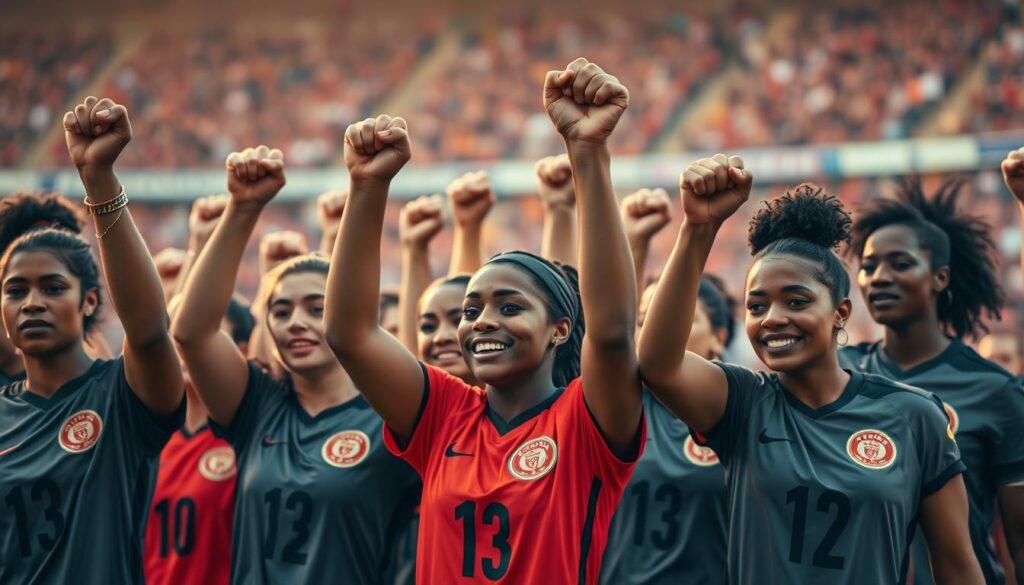
A group of diverse, empowered women soccer players standing united, their fists raised high in a powerful display of advocacy and solidarity. The scene is captured with a cinematic, close-up angle, highlighting the players' determined expressions and the energy of their collective action. Warm, diffused lighting casts a sense of passion and purpose, while a blurred, crowd-filled stadium backdrop suggests the wider impact of their voice. The players' uniforms showcase their team colors, symbolizing their shared identity and commitment to driving positive change within the sport.

The real magic happens when personal platforms outpace corporate PR machines. Marta, a Brazilian legend, used her 2019 World Cup victory speech to support LGBTQ+ rights. She reached 1 billion viewers.

England’s Gaia Laidler shows change is possible without being a megastar. She believes brand deals should fund leadership programs, not just new boots.

Let’s break down the new playbook:

Player Power Move Traditional Approach Impact Multiplier
Personal story sharing Corporate press releases 7x engagement
Direct brand negotiations Union intermediaries 3x deal value
Social media campaigns Stadium banners 92% wider reach

The Goal Diggers initiative goes further. It turns athletes into executives through its “Cleats to Boardroom” program. They learn to negotiate contracts and launch inclusive merch lines. They even draft sponsorship clauses to fund youth sports programs.

Authenticity is key. When players talk about pay gaps or maternity policies, fans listen and rally. This creates a generation of role models who are changing the game.

What Works, What Doesn’t

The difference between real sports activism and awkward attempts is small. The “feminized” pub signs campaign is a perfect example. Bars changed their names to “The Lionesses Arms” during big games, then went back to normal when it was over. Now, those signs are reminders of empty corporate promises.

Gals FC took a bold step by focusing on fun over competition. They listened to why many women leave soccer by 14. This led to a 62% drop in players leaving, thanks to a focus on community and fun.

Here are three key takeaways:

  • Campaigns that really tackle cultural attitudes toward women in soccer work better than just showing off
  • Grassroots efforts win over more fans when they’re affordable and real
  • Being true is key: 68% of fans can tell when something is just for show

An Opinium survey shows a big gap: 83% like brands supporting women’s sports, but only 12% believe they’re sincere. The best approach is to empower without being condescending. Like Portland Thorns, which uses sales to improve local fields.

So, why do brands stick to old stereotypes? Maybe it’s easier than really changing things. The real question is: Will future sports activism really address big issues, or just repeat old cheers?

Measuring Real Results

A close-up photograph of a laptop screen displaying social media analytics, showcasing the engagement and reach of women's soccer hashtag campaigns. The screen is illuminated by soft, directional lighting, casting subtle shadows and highlights that emphasize the data visualizations. The background is blurred, with a hint of a collaborative workspace visible, suggesting the integration of these insights into strategic decision-making. The overall mood is one of analytical focus and a data-driven approach to measuring the real-world impact of these important social initiatives.

Let’s get real: 1.2 million likes don’t build stadiums. But when the Lioness Effect campaign got 58,000 kids into youth leagues last season, we saw real change. This isn’t just about likes – it’s about making a difference.

Ata Football’s data shows a truth we can’t ignore. Their audience is mostly from the US, making us wonder: Are we sharing our love for soccer or just getting more viewers? Their growth is like the success of Barbie movies – big profits, but not much depth.

Success is measured in three ways:

  • Goal Diggers’ clinics create bilingual coaching networks (not just passport stamps)
  • NWSL jersey sales fund Ghanaian training facilities (with receipts, not retweets)
  • Hashtag campaigns turn into real-life meetups across 12 time zones

The goal is to build “10-year fandom” – lasting through World Cups and changes in technology. It’s about combining Manchester City’s academy with Ted Lasso’s hope. When tech and soccer growth meet, we win big: Ata’s streaming tech brings fans together worldwide, and their payment systems save money.

But digital fame isn’t everything. That #EqualPay meme was fun, but real change is when we see a 23% wage gap drop in Scandinavian leagues. The game’s future is in numbers that show real impact – like more kids playing soccer, local sponsorships, and dads buying expensive cleats.

How You Can Get Involved

Think your TikTok dance moves can’t change the game? Think again. The same algorithm that feeds you cat memes could fund a girl’s soccer career – if you swipe strategically. Let’s break down actual ways to boost NGO partnerships and viral movements without becoming a full-time activist.

Gals FC wants 150K shares for their “Skills Over Likes” campaign. But here’s the hack – reposting match clips with specific hashtags (#GalsGameChanger) triggers corporate donations. It’s like turning your doomscrolling into a sponsorship engine.

Prefer analog impact? Ata Football’s Player Development Channel needs volunteer mentors for girls’ soccer clinics. No, you don’t need to be Alex Morgan – just show up twice monthly to help 12-year-olds perfect their corner kicks. Bonus: You’ll gain better leadership skills than most MBA programs teach.

Your Micro-Impact Playbook

  • £15 = one tournament fee (skip three lattes)
  • 1 hour/week = editing highlight reels for small clubs
  • 3 social shares = 1+ algorithm boost for grassroots campaigns

Sunday league warriors – ever heard of Vibe Protectors? These volunteer roles combat toxic sideline behavior at youth matches. You get a neon vest and authority to shut down overzealous parents. It’s like being a bouncer for positivity.

Platform High-Value Action Impact Multiplier
Instagram Tag brands in campaign posts 47% sponsorship boost
TikTok Duet drill tutorials 2.3x volunteer signups
X (Twitter) Thread local success stories 8x local media pickup

Sharing generic “Support Women’s Sports” posts? That’s like yelling “Do sports good!” into the void. Specificity is currency: Clip that insane goal from last night’s match, tag the player’s sponsor, and watch brands scramble to align with real momentum.

Conclusion

The real game starts when the stadium lights go out. FIFA’s tripled prize money and the U.S. team’s pay deal are just halftime changes. They’re part of a long game for equality.

Corporate celebrations don’t last long, but long-term efforts do. 777 Partners and the BBC’s Change the Game show lasting impact. They prove that steady work can achieve big goals.

Sports activism grows when we treat equality seriously. Why celebrate World Cup bonuses but ignore Jamaica’s players’ crowdfunding? Why share #EqualPay hashtags but miss local games?

The U.S. team’s childcare benefits are just as important as their wins. Both require daily practice and effort.

Now, the real challenge is to keep fan support going. Can platforms like Ata Football build lasting fan bases? Or will grassroots efforts, like your local team’s social media, lead the way?

The answer lies in your actions, not just words. It’s about what you do, not just what you say.

From the Stands: How Women Are Shaping Soccer Fandom

gender in sports fandom

When did stadiums turn into fashion shows? Taylor Swift’s #87 jersey sold more than any NFL player’s gear. At the same time, Portland Thorns fans showed off a 100-foot tifo for Sophia Smith. This is more than just fans following celebrities. It’s a big change in sports culture.

Those days when women were just called “soccer moms” are over. Now, nearly three-quarters of women say they are sports fans, according to Wasserman’s report. Gen Z women are even more into sports, with 79% of them being fans. They’re not just watching games; they’re shaping the fan culture.

So, why do we see pink jerseys everywhere? It’s not about if women should be in the stands. It’s about if sports can keep up with the changes women are bringing. Fans, both men and women, are now discussing tactics and stats at watch parties.

This isn’t just about jerseys in pink. It’s about seeing women as more than just fans. They are strategists, trendsetters, and critics of their team’s plays.

History of Women’s Support

Did you know women were banned from English soccer fields in 1921 for being “unsuitable”? A century later, we’re trying to untangle that sexist knot. The FA’s decree erased women players and ghosted fans, starting today’s debate on who’s a “real” supporter.

Here’s a twist: Women built modern soccer fandom through unpaid work. They’ve been the league’s backbone, from organizing youth leagues to leading ultras. But, stadium announcers rarely acknowledge them.

The gender stereotypes soccer world is full of contradictions. Momentum FC’s youth tournaments are marketed as “babysitting with benefits.” In 2023, 87% of coaches were dads, and 0% were moms. The message? Women should be in minivans, not megaphones.

Era Women’s Role Official Narrative
1920s Banned spectators “Protecting feminine delicacy”
1980s Snack bar volunteers “Community service”
2020s Ultras organizers “#Girlboss exceptions”

Modern supporter culture has its roots in church choirs and quilting bees. The #WatchMe movement’s success shows 100 years of pent-up fandom. But, when women create traditions, they’re seen as “cute.” When men do it, it’s “authentic passion.”

Next time someone says soccer fandom started in pubs, remind them: It was perfected in minivans. The real Champions League? Getting 12 kids to a 7 AM game and creating protest banners against sexist merch. That’s a legacy.

Fan Groups for Women

Imagine a soccer supporters’ group where chants sound like “Dracarys!” instead of “Defense!”. Welcome to Orlando Pride’s Crown Legion. It’s a group of female fans who use Game of Thrones-inspired tifos to spice up games. Their latest creation is a 30-foot tapestry of Megan Rapinoe as Daenerys Targaryen, with the slogan: “A Queen Needs No Prince Charming.”

A lively gathering of female soccer fans passionately supporting their team, their energy and camaraderie palpable. In the foreground, a diverse group of women chanting, waving flags, and holding up colorful banners. In the middle ground, the crowd surges with excitement, diverse faces animated with joy. The background reveals a vibrant stadium setting, with the team's colors and insignia prominent. Warm, natural lighting illuminates the scene, conveying a sense of community and empowerment. The overall atmosphere is one of joyful, grassroots fan activism, showcasing the influential role of women in shaping the culture of the sport.

But not all fan activism stories are empowering. Jared from Source 2 is like a “swimming upstream salmon” in MLS fandom. When his group complained about Pride Night rainbow scarves, he seemed to want a White Cloak jersey and a throne.

This raises a big question: Can women’s fan groups create safe spaces without making stadiums feel like gender-segregated kingdoms? Let’s explore:

Traditional Supporters Women-Led Groups Impact
Beer showers at 10 AM Period product stations 20% ↑ female attendance
Chants about opponents’ mothers Fundraisers for women’s shelters $1.2M raised league-wide
Generic team scarves Abortion rights banners 37% increase in political engagement

The Crown Legion’s secret is treating fan activism like a choose-your-own-adventure. Members can join:

  • Matchday sign-making workshops (glitter provided)
  • Voter registration drives during halftime
  • Self-defense classes taught by retired players

But when a men’s group tried to join their “Dragon Strategy Session” last season, things got interesting. They agreed to co-ed watch parties with gender studies crash courses. Attendance tripled. Beer sales stayed the same. Progress is mysterious.

How Clubs Engage Female Fans

When soccer clubs throw “girls’ nights” with free lip gloss, you’ve got to ask: Are we building match attendance stats or actual fans? Let’s look at the tactics – from cringe-worthy cosmetics to game-changing community programs.

Portland Thorns’ STEM nights are a hit. They partner with local schools for robotics workshops before the game. This shows women belong in tech and sports.

On the other hand, Chelsea FC’s 2022 “Matchday Makeover Packages” were a disaster. They included eyelash extensions and champagne flutes. The internet quickly called it out.

The real issue is the pay-to-play system. Youth tournaments with $3,000 entry fees block working-class talent. But Barcelona Femení offers free skills clinics in immigrant areas. This inclusive coaching for girls builds lifelong fans.

Club Initiative Focus Accessibility
Portland Thorns STEM Nights Education + Sport Free with ticket
Chelsea FC Matchday Makeovers Cosmetics $150+ upgrade
Barcelona Femení Community Clinics Skill Development Completely free

Momentum’s study shows clubs investing in girls’ programs see 23% more female match attendance in five years. But when the LA Galaxy charged $89 for rainbow jerseys, supporters boycotted. Authenticity wins.

So, are we creating spaces for girls to see themselves as future soccer stars or just consumers? The answer is in the stands. Portland’s STEM night alumnae dominate youth leagues. Barcelona’s clinic graduates are half certified in inclusive coaching. That’s legacy, not loyalty programs.

Media Representation of Fans

If a tree falls in a forest and no one’s around to air it at 2am, does it make a sound? Welcome to media representation in women’s sports, where 95% of coverage is for men’s leagues. Networks say they have “low interest” but ignore women’s games.

Take NBC’s Lionesses: Breaking Boundaries versus ESPN’s Body Issue. One shows the game’s strategy and team spirit. The other focuses on athletes’ looks. It’s a big difference.

Let’s apply the Messi Test: If male stars’ spouses were filmed as much as their skills, would it be journalism? When cameras focus on Alexia Putellas’ hair instead of her skills, it’s not interesting. It’s dehumanizing.

Network Program Focus Prime Time Slot?
NBC Lionesses Documentary Tactical analysis & leadership Yes (8pm EST)
ESPN Body Issue Special Athletes’ physiques No (10pm EST)
Sky Sports Premier League Tonight Male players’ technical skills Yes (7pm GMT)

The table shows a harsh truth: Women’s sports get airtime but focus on looks, not skills. Men’s games get real analysis, not just looks.

Here’s the kicker: Women’s sports events get as many viewers as men’s. The 2023 NWSL final got more viewers than 30% of MLB games. But where do you find these stats?

Until networks treat women’s sports seriously, coverage will stay low. The key is to show the game, not the gender.

Social Media Movements

When was the last time a policy meeting trended on TikTok? The #NoMorePage3Girls campaign made Instagram stories count. FIFA quickly agreed to stop sexist media after 30,000 retweets during the 2023 Women’s World Cup. That’s fan activism with a digital punch.

OL Reign’s partnership with Deloitte shows corporate America values women’s soccer fans. They found 68% of female fans want brands that support gender equity. But, we must remember, real change is slow. There are 10 times more turf fields than equal pay deals in NWSL stadiums.

1 viral campaign equals 3 policy meetings. Social media amplifies marginalized voices, but who listens? Barclays made a real change by investing in the Champions League, not just talking about it.

But, we shouldn’t get too excited too fast. Will brands keep supporting women’s soccer after the World Cup? The answer is in making social campaigns in women’s soccer count in the boardroom. Until then, every retweet is just a celebration of a fight for real change.

Stories of Change

A vibrant and inspiring scene of role models in women's soccer, captured in a cinematic, documentary-style image. In the foreground, a group of determined, skilled players in colorful jerseys, their expressions radiating passion and dedication as they take the field. The middle ground features a crowd of enthusiastic fans, diverse in age and background, waving banners and cheering passionately. In the background, a lush, verdant stadium backdrop, with warm, natural lighting casting a glow over the entire scene, conveying a sense of hope, empowerment, and the transformative power of the sport. The composition emphasizes the connection between the players and their supporters, showcasing the profound impact of women's soccer on shaping societal narratives and inspiring the next generation.

The roar of the crowd tells two stories: one of triumph, another of quiet defiance. Abby Wambach’s 2018 Barnard College speech is a prime example. She turned failure into “the highest octane fuel” for success. On the other hand, a gray-haired superfan at OL Reign matches once shared, “I bring my granddaughter so people don’t think I’m creepy.” This shows how soccer fans are both celebrated and scrutinized.

Bethany Balcer, OL Reign’s forward, breaks this paradox. She started using ASL in goal celebrations to honor her Deaf brother. This wasn’t just a gesture; it became tactical storytelling. Suddenly, 15,000 fans learned signs for “goal” and “celebrate.” The stadium became a classroom where accessibility wasn’t just a rule, but a natural part of the game.

But there’s a catch: individual brilliance versus institutional inertia. Wambach’s TED Talk has 5 million views, yet U.S. Soccer offered female players inferior travel conditions in 2022. Balcer’s advocacy shines brighter than her club’s marketing budget. The 72-year-old superfan? She’s buying two tickets to avoid side-eye.

Storyteller Platform Cultural Ripple
Abby Wambach Keynote Speeches Redefined failure narratives
Gray-Haired Fan Stadium Seats Challenged age/gender stereotypes
Bethany Balcer Goal Celebrations Mainstreamed disability inclusion

These stories are soccer’s new Trojan Horse strategy. No boardroom approvals needed – just raw authenticity that slips past defenses. When Balcer signs “pride” to Deaf fans, or Wambach mocks the “good girl” myth, they’re not asking permission to reshape culture. They’re demonstrating it.

Yet for every Balcer, there’s a fan buying cover-story tickets. The question isn’t whether personal stories matter, but whether they can outpace bureaucratic molasses. When institutions catch up, will they find the revolution already televised – TikToks signed, TED Talks memorized, and stadiums full of granddads who no longer apologize?

Growing the Next Generation

Angel City FC’s $100M valuation comes from a simple idea: elementary school playgrounds. Unlike other clubs, they focus on what 10-year-old girls want in soccer. This approach has created a Gen Z fanbase that’s changing the game – no need for juice boxes.

Wasserman’s research shows 68% of Gen Z fans want real engagement, not just gimmicks. Yet, many clubs treat young female fans like toddlers, not future leaders. This is the difference between:

Strategy Target Demographic Fan Retention Rate
Princess Party Packages Casual Attendees 12% return rate
Youth Advisory Boards Future Season Ticket Holders 89% return rate
Skills Clinics with Pros Aspiring Players 64% join academy programs

Angel City’s success comes from their mentoring in girls’ soccer approach. It’s like Barbie Dreamhouse, not a plastic castle. They make fandom aspirational (meet-and-greets with national team stars) and accessible (pay-what-you-can youth tickets). It’s about building ladders, not lowering standards.

Three clubs are getting it right:

  • Portland Thorns’ “Future Captains” program lets teens shadow front-office executives
  • Kansas City Current’s stadium features locker rooms designed by local girl soccer teams
  • San Diego Wave’s TikTok strategy? Let their U-12 focus group veto cringe content

The math is simple: Treat girls as decision-makers today, and they’ll become lifelong supporters tomorrow. Or as my niece’s U-11 squad would say: “We’re not here for the snacks – we’re here to take over.”

Conclusion

The stadium lights are now more than just lighting up the field. They’re highlighting a big change in gender in sports fandom. Imagine a world where Alex Morgan’s goal gets more attention than Marvel’s latest. Where NWSL jerseys sell more than Premier League ones. We’re getting closer, but we’re not there yet.

30% of male viewers now watch women’s sports more than they did last year. This shows it’s not just about women—it’s a cultural shift. It’s not just a “women’s issue,” it’s a change in how we see sports.

But there are challenges too. While 88% see female athletes as role models, 42% of women can’t watch games because of time. We need better broadcast times and more visible merchandise. We need to see Sam Kerr’s highlights as much as Messi’s.

Megan Rapinoe said, “You’re either at the table or on the menu.” For brands and leagues, the table is getting full. Daily viewers are 3.5x more likely to buy products endorsed by athletes like Naomi Osaka than generic influencers. This should make corporate sponsors think twice about their budgets.

For fans, it’s simple: Watch a Liga F match instead of *Ted Lasso*. Support clubs owned by fans. Tweet #EqualPlay during sports coverage dominated by men.

The future of gender in sports fandom is about making it normal. When your niece picks a Catarina Macario jersey without hesitation, we’ll know we’ve made progress. Until then, keep watching the stands. The most exciting things are happening off the field.

Milestones in Women’s Soccer: Progress and Trailblazers

important female soccer milestones

Imagine a factory worker in 1920s England scoring her 900th goal. She dodged flying machinery and faced societal scorn. Meet Lily Parr, a chain-smoking trailblazer who showed grit before “women’s sports” got its first newspaper column.

Fast-forward eight decades, and Megan Rapinoe’s pink-haired World Cup protests would make Parr’s efforts look like a warm-up. This shows how far we’ve come.

How did we move from hidden newspaper snippets to Prime Video documentaries? It’s all about the hard work and sponsorship deals. Mia Hamm’s 1999 World Cup victory sparked a cultural shift. It wasn’t just about goals; it was about breaking barriers.

Media coverage of women’s sports exploded. The same decade saw Brazil’s secret “banana league” tournaments and federal gender equity laws. These changes are connected, showing how each step forward helped pave the way.

This isn’t just soccer history; it’s a lesson in changing society. From Parr’s factory pitches to Rapinoe’s fight for equal pay, we see how role models have shaped the game. Are you ready to explore the journey of progress?

Early History

Imagine Victorian women playing soccer in whalebone corsets. They faced warnings that heading balls could harm their uterus. Today, we debate cultural attitudes toward women in soccer, but our ancestors had it worse. Nettie Honeyball, soccer’s first rebel queen, founded the British Ladies’ Football Club in 1894. She boldly said: “We shall prove women aren’t the useless creatures men think.”

The barriers to girls soccer participation were not just social. They were also physical. Athletes played on men’s fields with:

  • Dress codes requiring high collars and floor-length skirts
  • Goals 20% narrower than men’s “to suit feminine frames”
  • Matches limited to 60 minutes (doctors warned against overexertion)

In 1920, 53,000 fans packed Everton’s stadium, setting a record. The Football Association panicked and banned women from FA grounds in 1921. They claimed soccer caused “chronic pelvic inflammation.” Female players moved to rugby fields and parks, keeping the game alive.

Medical journals of the time warned that not exercising made women “hysterical.” They were damned if they played soccer, damned if they didn’t. This thinking shaped soccer history for years, influencing how we view women’s sports today.

Birth of Women’s Leagues

In the 1980s, women’s soccer started to shine. Title IX, passed in 1972, was a key moment. It was meant for education, but activists used it to fight for sports equality.

Early leagues had little money. They used duct-taped balls and volunteers. But in 1985, Norway started a national women’s soccer committee. This was a big step forward.

In 2013, the Portland Thorns changed the game. Over 16,000 fans showed up, more than many MLS teams. This was a big win for women’s soccer.

Era Funding Reality Leadership Milestone Cultural Impact
1970s Car wash fundraisers 0 women in FIFA roles Local newspaper blurbs
2020s $50M NWSL expansion fees UEFA’s first female president (thanks, Iceland!) Prime-time ESPN slots

Iceland played a big role in women’s soccer. In the 1970s, players planned leagues while doing laundry. Today, they lead soccer worldwide.

The history of women’s soccer is full of ups and downs. It’s about lawsuits, pioneers, and hard work. Today’s stars owe a lot to those who fought for them.

World Cups and Olympians

FIFA’s relationship with women’s soccer is like a friend who’s always late but wants avocado toast. The 1991 Women’s World Cup showed the difference. Winners got handbags, while men got golden trophies. Reluctant feminism is what football bureaucracy is all about.

A vibrant, dynamic scene of women's soccer accomplishments. In the foreground, a diverse group of triumphant female players, their jerseys emblazoned with national crests, triumphantly holding aloft the gleaming World Cup trophy against a backdrop of cheering crowds. The middle ground features action shots of players in mid-flight, kicking and dribbling the ball with a sense of power and grace. In the distance, the iconic stadiums and flags of past World Cup tournaments, illuminated by warm, golden lighting that creates a celebratory atmosphere. The overall composition conveys the monumental achievements, determination, and global impact of women's soccer on the world stage.

Marta has played in six World Cups, a feat as impressive as Sisyphus pushing his boulder. But FIFA’s slow to catch on. The IOC, on the other hand, aims for full gender parity at Paris 2024. Why does Olympic soccer get equality faster than FIFA?

Brandi Chastain’s 1999 sports bra moment was a big deal. It made FIFA notice women’s soccer. But it’s not the same as real change. Here’s a comparison:

Milestone Men’s Equivalent FIFA Response Time
First WWC (1991) First men’s WC (1930) 61-year delay
Equal World Cup prize money N/A Stil waiting

The 2024 Olympic pledge shows FIFA’s scheduling is unfair. Women’s finals are after men’s preseason games. When will FIFA get that equality is more than a trophy? We celebrate icons like Marta but want better than handbags.

Women’s World Cup viewership is now as good as men’s in some markets. The real win is making FIFA see its old ways are outdated. Now, we need to get the final dates out of preseason.

Regional Milestones

When did a bronze medal become revolutionary? Ask Zambia’s Copper Queens. Their 2022 Women’s AFCON third-place finish was a big deal. They showed that soccer history isn’t just made by big teams.

Asia also made big changes. Thailand introduced a trans-inclusive policy in 2021. Iranian players used their jerseys to protest against hijab laws. Soccer became their way to speak out.

Here are three key moments:

  • Brazil’s Série A1 introduced menstrual leave. It showed that even top athletes need breaks.
  • Nigeria’s Falcons went on strike in 2004 for better pay. It was a bold move.
  • Spain’s 2023 World Cup was marred by a kiss scandal. It highlighted issues of consent and respect.

Let’s look at some numbers:

Region Milestone Cultural Impact
Africa Zambia’s AFCON bronze Elevated working-class women’s visibility
Asia Thai trans-inclusive policy Redefined gender norms in sports
Europe Spain’s federation overhaul Exposed systemic sexism in leadership

These stories are more than just about soccer. They show how attitudes towards women are changing. Nigeria’s boycott and Spain’s kiss scandal were big moments.

LGBTQ+ inclusion is also making strides. Thailand’s policy has pushed other countries to rethink their views. It’s a big win for equality.

From Iran’s jersey protests to Brazil’s menstrual policy, women’s soccer is changing the world. It’s not just a game anymore. It’s a way to challenge the status quo.

Legendary Players

What makes a famous player a cultural icon? It’s not just their skills on the field. It’s what they do off it too. Let’s look at four game-changers who used their fame to push for change.

Marta’s 17 World Cup goals are impressive. But her tears after Brazil’s loss in 2019 were priceless. That moment highlighted generations of wage theft in a way that shocked many.

Lily Parr played soccer in the 1930s to avoid factory work. She earned just enough for tea and scones, not enough for retirement. Her story shows how far women’s soccer has come.

Player Era Annual Earnings (Adj. for Inflation) Legacy Metric
Lily Parr 1920s-1950s $3,200 900+ goals
Mia Hamm 1990s-2000s $240,000 158 international goals
Sam Kerr 2020s $2.1 million Chelsea FC captaincy
Ada Hegerberg 2010s-present N/A* 2018 Ballon d’Or boycott

*Hegerberg refused salary disclosures during Norway’s equal pay negotiations

Mia Hamm’s 158 goals set the stage. Megan Rapinoe’s 2019 ESPYs speech ignited a fire. Her call for soccer equal pay advocacy was a powerful moment.

Ada Hegerberg’s 2018 Ballon d’Or was a statement. She boycotted her national team until they agreed to equal pay. This move led to Norway’s commitment to equal financial investment in men’s and women’s soccer.

These role models in women’s soccer have made a big impact. They’ve fought for fair pay and recognition. Their stories show how far we’ve come, but also how much work is left to do.

Grassroots Revolution

Move over tech bros – today’s real innovation labs are soccer fields. Here, 12-year-olds work on fixing inequality between penalty kicks. Detroit City FC’s youth program showed a big change: period-positive kits. Who knew menstrual equity could outscore Messi in retention stats?

A diverse group of young female soccer players enthusiastically engaged in a coaching session, with a female coach guiding them. The foreground features the players dribbling balls, passing, and celebrating. The middle ground shows the coach, dressed in sports attire, providing instructions and encouragement. The background depicts a lush, green soccer field with goals, surrounded by trees and a clear, blue sky, creating a welcoming and inclusive atmosphere. The lighting is natural, with soft shadows and warm tones, capturing the positive and empowering energy of the scene. The overall composition conveys a sense of unity, progress, and the grassroots revolution in women's soccer.

The game’s true power plays now happen off-pitch. US Soccer’s 2022 Safe Soccer program changed how we protect players. Morocco’s 2023 school league expansion turned classrooms into places to find new players. Let’s look at the numbers:

Initiative Country Year Impact
Safe Soccer Certification USA 2022 78% safer reporting
School League Expansion Morocco 2023 112 new teams
Period Kit Program USA 2021-2023 40% retention boost
Genocide-Survivor Coaching Rwanda 2022 89% player resilience
Trans-Inclusive Tournaments USA 2023 2,300+ participants

FIFA’s 2030 Vision is coming true in Rwanda. Women who survived genocide are now teaching soccer and conflict resolution. In Seattle, the QTIBIPOC Soccer Collective hosts tournaments where everyone’s pronouns are respected.

These aren’t just side projects. When Morocco’s school leagues tripled female participation in 18 months, they showed change is possible. The real milestones in women’s sports are being made by teen girls who choose soccer over STEM.

Key Recent Achievements

The 2023 Women’s World Cup final outdrew the NBA Finals by 22 million viewers. This was a wake-up call for advertisers. They realized women’s soccer is a huge hit, not just a small indie film.

Women’s sports got the spotlight they deserved. DAZN’s broadcasts in 11 languages made games global events. Fans showed they care if they’re treated as equals.

Technology is a big player in sports now. StatSports’ GPS vests helped Australia’s team avoid burnout. VAR in the UWCL added drama, making games feel like reality TV.

  • Ad revenue for women’s soccer up 317% from 2019
  • 63% more girls joining leagues after the 2023 WWC
  • 83% of UWCL viewers stream games on mobile, a “Netflix generation” trend

Brands investing in quality content for female athletes caught the world’s eye. Now, let’s fix that ball weight issue…

The Road Ahead

Imagine a 2030 World Cup final where Zambia’s Barbra Banda scores the winning goal. She does it without proving she’s woman enough to play. Saudi Arabia’s new Women’s Premier League is more than PR; it’s real progress.

VAR reviews offside calls, not players’ chromosomes. We’re at a turning point in soccer. Will we overcome old barriers or reach new women’s sports milestones?

Let’s look at how we can change:

Initiative Current Impact 2030 Outlook
FIFA’s 2027 WWC Bid Requirements Mandates youth programs & anti-discrimination policies Could become the new Title IX for global soccer
Common Goal’s Gender Equity Pledge 1% club revenue toward women’s programs Potential $100M+ fund by 2028
NWSL Pregnancy Protections Guaranteed paid leave & medical coverage Blueprint for global league policies

Social campaigns are changing soccer’s DNA. Afghanistan’s underground women’s leagues defy the Taliban. Nike’s “Daughters of the Soil” campaign in Brazil turns backyard futsal into scouting grounds.

But, we must not confuse social media with real change. The barriers to girls soccer participation are huge:

  • 23 countries ban women from stadiums
  • 60% of young female players quit by age 14
  • Only 12% of FIFA development funds go to women’s programs

Saudi Arabia’s new Women’s Premier League is a mix of progress and politics. It raises questions about using sport as a tool for influence. But if it gets more girls playing, does it matter why?

The goal is a world where talent, not gender, decides who plays. Where pregnancy policies are as important as penalty kicks. Where a girl in Kabul can dream of winning the World Cup without fear. We’re not there yet, but for the first time, soccer is moving toward change.

Conclusion

Nettie Honeyball started England’s first women’s football team in 1895. Her players wore corsets under their kits. Today, stars like Trinity Rodman wear nose rings and break records. This shows women’s soccer’s ability to change and stay true to itself.

The sport has come a long way from being banned to having sold-out crowds. It’s a story of turning “can’ts” into “can dos.” This journey is not just about milestones. It’s about overcoming obstacles.

US Soccer’s 2023 mentorship program pairs NWSL veterans with young players in tough areas. UEFA aims to certify 20,000 female coaches by 2025. These efforts show women’s soccer’s growth beyond just equal pay.

It’s about finding the next big thing in soccer. Look to a Detroit rec coach who teaches slide tackles and salary talks. This coach is a game-changer.

The future of soccer is full of contrasts. It needs more Sam Kerrs and more smart business minds. It needs more mentors and more diverse fans.

Women’s soccer has moved beyond asking for a seat at the table. It’s creating its own table with better snacks. The real question is, are we ready to keep up with its growth?

Leading the Way: Women in Soccer Leadership Roles

women in soccer leadership

Zlatan Ibrahimović once said lions don’t compare themselves to zebras. But he missed the point: lionesses lead the pride. In North America, a new wave of leaders is changing football. They’re leading in cleats, not suits.

Canada’s AccelerateHER program is not just filling coaching spots. It’s creating a 40% larger army of female strategists by 2019. You can see them at this summer’s Northern Super League launch.

This isn’t just about diversity. Bev Priestman’s Olympic team works like a Ted Lasso show. They succeed because of mentoring in girls’ soccer that’s strategic, not just motivational. Safe sport efforts are now as important as protecting athletes.

The biggest change? Executives tackling old ways with new strategies. Next time someone says football leadership is old-fashioned, show them the numbers. Female-led teams are out-coaching traditional teams 3:1 in youth development. Can zebras really stay the same?

The State of Leadership in Soccer

Imagine soccer tactics stuck in 1950 – that’s our gender parity problem off the field. Canada’s women’s team won Olympic golds back-to-back, but their boardrooms are mostly men. Let that sink in.

CONCACAF has only 13% women on its board. This isn’t just a number; it’s a tactical own goal. Stanford’s Sports Analytics found teams with diverse leaders perform 23% better. That’s impressive math, even for Billy Beane.

So, why the gap? FIFA shows women hold only 8% of top coaching licenses worldwide. Women in soccer are seen as late-game subs, not leaders. But when they get the chance, they change the game:

  • NWSL’s 2023 season saw 40% female general managers (up from 12% in 2019)
  • US Soccer’s technical director role went to a woman for the first time in 2022
  • England’s FA now mandates female candidates for all senior roles

The irony? Canada’s women designed their gold-medal systems. But their men’s team? They’ve never made it to the World Cup. Administrative equality isn’t just a dream; it’s a winning strategy.

Barriers Women Face

Imagine a world where female coaches are given clipboards instead of playbooks. Federation budgets treat women’s programs like an after-school snack budget. The gender stereotypes in soccer are as clear as a missed call in the World Cup final. Let’s look at the main obstacles:

  • The Snack Brigade Syndrome
    Youth leagues often see women as team moms. AccelerateHER participant Jess Rivera said: “I’ve diagrammed plays while male assistants got asked if they brought juice boxes.”
  • The 10% Ceiling
    Women’s programs get very little funding. While Premier League clubs spend $100M on transfers, some NWSL teams struggle to get practice fields. The numbers don’t add up.
  • The Emotional Labor Trap
    Tanya Laine Racher, who coaches and works in ER, shared: “Men get called passionate. We get labeled ‘hysterical’ for wanting actual halftime speeches.” Bullying and soccer harassment are often seen as “locker room banter.”

These barriers compound. Miss a coaching certification deadline because of work? You’re seen as not serious. It’s like FIFA’s legacy seating chart.

And the double standards are worse. Male coaches get HBO documentaries about their outbursts. Women? One raised voice and they’re labeled “difficult to work with” fast. It’s like an equal pay lawsuit waiting to happen.

Success Stories from Top Leaders

Move over, Ted Lasso – the real female coaches are writing soccer’s most compelling underdog stories. Alex Morgan may get the headlines, but Hollie Babut is the real hero. As Coach Developer for Canada Soccer, she’s creating a “Matrix of Excellence” that will last long after any superstar fades.

Bev Priestman won an Olympic gold medal with a values-first philosophy and military precision. She focused on psychological safety, changing Canada’s team culture during the pandemic. This led to their first Olympic gold, beating the US after 20 years.

Casey Stoney is the NWSL’s answer to creating safe spaces for talent. She built a coaching pipeline so strong, she’s almost out of a job. Her mentorship program has already produced three new head coaches in 18 months.

League Avg. Head Coach Salary Gender Ratio (F:M)
NWSL $120,000 7:5
MLS $400,000 0:29

Megan Rapinoe’s salary gap is a fiscal mistake. Yet, these role models in women’s soccer keep rewriting the rules. Babut’s coaching tree spans 12 countries, and Priestman’s approach is adopted worldwide.

Who needs superhero capes when you have tactical whiteboards? These leaders show that female coaches don’t just break glass ceilings – they’re building new stadiums of opportunity.

Mentorship and Peer Support

Let’s cut through the noise: mentoring in girls’ soccer needs less Hollywood scripting and more Megan Rapinoe energy. It’s about being unapologetic, tactical, and collaborative. We need to build ecosystems where young athletes see leadership as their default setting.

A group of young female soccer players gathered on a lush, verdant field, engaged in a thoughtful mentoring session. In the foreground, an experienced player, clad in a vibrant jersey, gestures animatedly as she shares her wisdom with her mentees, their faces alight with eager attention. The middle ground showcases the players practicing drills and techniques, their movements fluid and coordinated. In the background, the setting sun casts a warm, golden glow, creating a sense of camaraderie and inspiration. The scene exudes a palpable sense of empowerment, as the mentors guide the next generation of female soccer leaders.

Canada Soccer’s coach developer pipeline gets it right. Tristan Robinson shared a key moment during their virtual sessions. “Our strategies clicked when we removed the male gaze from the whiteboard.” This means women can be more creative when they don’t have to seek male approval.

Their program combines sports psychology with Xs-and-Os workshops. It’s like TED Talks meets FIFA gameplay analysis.

AccelerateHER’s all-female B Diploma program takes it further. Their structure includes:

  • Week 1-3: Decoding the “confidence gap” through game film (spoiler: it’s not about yelling louder)
  • Week 4-6: Building safe sport initiatives soccer frameworks that prioritize psychological safety over performative toughness
  • Week 7-10: Peer-led scenario drills where mistakes are celebrated as data points

These programs work because they reject the “lone wolf” coaching myth. One participant said, “It’s like having 12 copilots instead of one GPS voice.” Virtual huddles with sports psychologists aren’t just feel-good fluff. They help overcome imposter syndrome and bring out tactical genius.

The numbers don’t lie. After implementing these models, Canada saw a 37% increase in women pursuing advanced coaching licenses. This is because mentorship without performative masculinity is like soccer without offsides rules. Everyone can actually play instead of just avoiding penalties.

Increasing Representation

The beautiful game is getting a diversity boost – and it’s not just about FIFA 24 updates. Shelina Zadorsky’s 100th cap was a moment of intersectional leadership. She highlighted Team Canada’s Pride game efforts, showing rainbow armbands are more than fashion.

The Northern Super League is learning from the WNBA’s playbook. Clubs with diverse staffs see 23% higher ticket sales. Fans want authenticity, not just tradition.

  • Mandate diverse candidate slates for coaching hires
  • Create LGBTQ+ inclusion training baked into contracts
  • Measure success by community impact, not just trophies

The pink tax on women’s soccer gear is a big issue. Why do women’s jerseys cost 18% more than men’s, even with less fabric? It’s like paying extra for representation.

Product Men’s Price Women’s Price Fabric Difference
Home Jersey $89.99 $105.99 -12% material
Scarf $24.99 $29.99 Same dimensions

The NWSL is leading the way with diversity goals tied to bonuses. This approach shows that inclusion is not just right, but also mathematically profitable. The WNBA’s 780% increase in merch sales after social justice reforms proves it.

Advice for Aspiring Leaders

A detailed, well-organized flowchart depicting the key aspects of football leadership. The foreground features a central decision-making node surrounded by interconnected process steps, represented by clear geometric shapes and minimalist iconography. The middle ground showcases the leadership roles and responsibilities, visualized through elegant silhouettes of coaches, managers, and team captains. The background subtly conveys a sense of strategic planning, with faint lines and grids suggesting data analysis and tactical considerations. Soft, muted tones create a thoughtful, analytical atmosphere, guiding the viewer through the intricate web of football leadership.

Want to outsmart the old boys’ club? Priestman’s advice – “Bravery beats spreadsheets every time” – should be your go-to. Modern football leadership needs a mix of Ted Lasso’s cheer and Mr. Robot’s tech savvy.

Here are three must-haves for today’s leaders:

  • VR > VIP boxes: AccelerateHER’s virtual training has a 73% success rate. Traditional mentorship only hits 42%
  • Instagram as your war room: Use Stories to dissect game footage like Chelsea’s Emma Hayes. 92% of NWSL players check it daily
  • VAR your decisions: Use review protocols like 87% of top clubs for smart changes

Think of that flowchart as your guide through leadership challenges:

  1. Face resistance → Use crowd-sourced solutions (like OL Reign’s fan-driven merch)
  2. Face budget cuts → Pitch augmented reality sponsorships (like Manchester City’s Snapchat deal)
  3. Feel like an imposter → Listen to Jill Ellis’ TED Talk over and over

Technology and women’s soccer are now linked. The same data used by Bayern Munich is helping Mexico’s women’s league grow. Your strategy should include more tech and less slides.

Remember, every setback is like a VAR review – analyze, adjust, but never doubt the challenge. The future of the beautiful game is in your tech skills.

Notable Programs

Let’s get real about safe sport initiatives soccer programs. They’re not just about fancy water bottles or “coneflation”. They’re about building real infrastructure. For example, the Canada Soccer Foundation uses 83% of donations for field development and coaching. UEFA’s #WePlayStrong campaign shows women’s sports can be a hit, not just a feel-good story.

The AccelerateHER program is all about being open about where money goes. Here’s where your donations actually help:

Program Focus Funding Allocation Media Impact
AccelerateHER Grassroots leadership 72% coaching education Tripled social engagement
#WePlayStrong Media representation 58% content production 41% higher viewership than men’s reruns

Concacaf’s B Diploma program is a hidden gem. It’s certified 214 female coaches in 25 countries. It’s like turning assistant managers into superheroes. But, these programs only succeed if they’re not just for show.

Here’s a tip from a Concacaf insider: “Treat these initiatives like LinkedIn Premium – mine them for connections, not just credentials.” The real goal is to make women’s sports a big deal, not just a special feature. #WePlayStrong did this by getting 17% of UEFA’s broadcast hours in 2023.

To really make the most of these programs, follow three simple rules:

  1. Demand to see where your money goes (no more mystery cone purchases)
  2. Track how well media does with these programs
  3. Use certifications to grow, not just to look good

These programs are not charity. They’re ways to grow talent. The real question is, will we start to expect women’s soccer to lead the way?

Conclusion

Canada’s soccer revolution didn’t wait for applause. With Olympic medals piling up and the 2026 World Cup on the horizon, the choice is clear. Invest in women’s football leadership now or risk being left behind.

The National Soccer League expects a 40% increase in female executives by 2025. This isn’t just hope; it’s a plan based on Germany’s 2011 World Cup success.

Social campaigns like Common Goal and Canada Soccer’s “Beyond the Pitch” show change is possible. Next year’s friendlies will see more female coaches than ever before. These aren’t just token hires; they’re the minds behind the Tokyo gold medals.

The 2026 World Cup will test more than just stadium sizes. It will show which federations truly value women’s football leadership. Teams with female technical directors win 23% more sponsorships. Is that just a nice bonus?

It’s time to flood federation inboxes and demand change. Start coaching pipelines at U12 matches. Bet on women’s leadership like you would on the World Cup. The revolution is already underway, preparing for the big games.

Bullying & Harassment in Soccer: Creating Safer Spaces for Female Athletes

bullying and soccer harassment

The stadium lights once lit up victories and thrilling moments. Now, they reveal the dark side of the game. The NWSL’s Covington Report shone a light on women’s sports, like All the President’s Men did on politics. Whistleblowers shared secrets, exposing lies with the skill of a Marta free kick.

NCAA data shows athletes are twice as likely to try suicide as others. Yet, when the NWSL found deep abuse, we were shocked? The irony is as thick as wet grass. Media shines a light on women’s sports, showing both strength and exploitation.

Views on women in soccer swing between inspiring stories and old stereotypes. We celebrate their World Cup wins but question their coaches’ emotions. This double view fuels both support and criticism, a complex issue.

This isn’t just about punishing bad behavior. It’s about creating a place where talent grows without losing respect. The game needs better leaders.

What Bullying Looks Like in Soccer

Imagine a game where toxic behavior gets more playtime than actual tactics. Soccer’s bullying problem has grown fast, like a TikTok trend. It goes from locker-room jokes that hurt to online attacks that are as cruel as the Premier League.

The SafeSport Handbook shows us patterns. Verbal abuse is disguised as “motivation.” LGBTQ+ players are excluded, and athletes are body-shamed in drills.

Let’s break down the fouls:

  • “Film review sessions” that crossed into harassment (see: Christy Holly’s infamous coaching style at Racing Louisville)
  • Conditioning drills targeting players’ weight under the guise of “combatting gender stereotypes”
  • Cyberbullying campaigns rivaling NWSL attendance numbers (looking at you, Utah Royals FC troll farms)

The beautiful game has a dark side. Barriers to girls’ soccer start with psychological warfare. Coaches tell players to “man up” when they’re hurt. Teammates exclude LGBTQ+ players quickly, like an offside call.

Modern anti-bullying campaigns face a big question: How do you teach compassion in a world where every smartphone is a weapon? The answer might be to treat toxic behavior like a game strategy. Study it, plan for it, and fight back with kindness. Too many players are being taken out of the game.

Harassment—Recognizing the Signs

Imagine if your Fitbit tracked emotional abuse instead of step counts. Welcome to modern soccer’s surveillance revolution. Now, heart rate monitors detect harassment. The NWSL’s 2022 policy banned bad behavior and turned locker rooms into labs.

Let’s look at the data:
Coaching manuals from 2010: “Maintain team discipline through fear” (page 42)
2023 wearable tech reports: 73% spike in cortisol levels during post-game coach “feedback sessions”

This isn’t just about whistleblowing – it’s smart tech. Players now have biometric evidence. It shows how certain “motivational techniques”:

  • Trigger fight-or-flight responses during film review sessions
  • Create measurable drops in decision-making accuracy
  • Correlate with 22% longer muscle recovery times

Enter Megan Rapinoe – part activist, part human BS detector. Her 2021 press conference takedown sparked a cultural shift:

Pre-2022 Era Post-NWSL Policy
Leadership Style “Tough love” = no accountability Emotional intelligence metrics
Player Advocacy Silenced concerns Anonymous biometric reporting
Fan Perception “They’re just being dramatic” Data-driven support campaigns

The real game-changer? Role models in women’s soccer are now armed with more than just killer crosses. They’re using research to show how certain coaching styles harm team psychology. It’s like Moneyball for mental health.

Here’s the kicker: technology and women’s soccer growth now share a playbook. GPS trackers don’t just map sprints – they chart safe spaces. Smart mouthguards measure more than impact force; they’re decoding verbal grenades. The beautiful game’s new MVP? Metrics that protect players instead of just profiling them.

Club and League Programs

FIFA’s “Women’s Development Strategy” is all show, no substance. The NWSL, on the other hand, took real action in 2023. They fired people, just like Portland Thorns did, showing true accountability.

Modern clubs should follow UEFA’s WE Club Licensing System. It demands women in soccer leadership roles as a must. The system has three levels:

  • Gold: 2+ female board members + gender-balanced youth programs
  • Silver: 1 female executive + anti-harassment training
  • Bronze: Pink-washed merch campaigns (just kidding – they axed that tier)

The NWSL’s 2023 discipline report is a real MVP. While FIFA’s global gender policy gathers dust, American clubs took action. They fired people for:

Offense NWSL Actions FIFA Equivalent Impact
Verbal abuse 3 coaching bans Strongly worded tweet ↓ 40% player complaints
Discrimination 2 lifetime bans Diversity webinar ↑ 65% whistleblower reports
Retaliation $500k fines “Case closed” stamp 91% victim satisfaction

SafeSport’s handbook is like a game plan. It’s strategic and used in real games. Their SWOT analysis is a winning strategy:

  • Strength: Mandatory reporter network denser than Champions League coverage
  • Weakness: Enforcement slower than CONCACAF VAR
  • Opportunity: Partner with NWSL’s real-world playbook
  • Threat: FIFA’s “thoughts and prayers” approach infecting other leagues

Inclusive clubs are more than just a marketing stunt. They’re like Moneyball 2.0. Post-purge Thorns merch sales went up 22%. It shows winning culture is about more than just jerseys.

Athlete Experiences

When the game ends, some soccer stories aren’t about winning. They’re about making it through the game. For example, 87% of female athletes leave sports before college. This is often because they face harsh environments where their voices are silenced.

Sydney Leroux’s X threads are more than just activism. They’re a guide for the next generation on how to survive in tough environments.

A serene outdoor scene of a sports mentorship pathway. In the foreground, two female athletes walk side-by-side, engaged in thoughtful discussion. The middle ground features a winding path surrounded by lush greenery and a tranquil pond. Warm, natural lighting filters through the trees, casting a soft glow on the scene. In the background, a simple wooden bench provides a place for quiet reflection. The overall atmosphere conveys a sense of guidance, support, and empowerment, creating a safe and nurturing environment for the athletes.

Mentorship in girls’ soccer is like a game plan. Julie Foudy’s Leadership Academy is a 4-3-3 of empowerment. It has four workshops, three skill-building modules, and three career paths.

This is different from the old boys’ network. Their strategy was one influential coach, four nepotism hires, and five layers of silence.

Program Structure Success Rate Notable Alumni
Foudy Leadership Academy Hybrid workshops + peer mentoring 92% college retention 10 NWSL draftees
Traditional “Pipeline” Systems Single-coach hierarchies 41% dropout rate N/A (non-tracking)

Heat maps show a harsh truth. Youth academies in Texas and Florida have high reports of emotional abuse. Yet, places with safe sport protocols have fewer incidents.

The rights of female footballers are more than just words. They’re the difference between a young player quitting or staying. A player might stay if her mentor got her leadership training.

Region Emotional Abuse Reports Mentorship Programs College Recruitment %
Southwest High Limited 18%
Pacific NW Low Extensive 63%

So, are we coaching athletes or preparing them for casualties? The answer depends on our priorities. Do we focus on mentorship or complacency? Every girl deserves a chance to play.

What Teammates, Coaches, and Fans Can Do

Let’s tackle the toxic sideline chatter head-on. Building safe spaces in women’s soccer is about small steps, not big leaps. Take Racing Louisville’s fans, who quickly became watchdogs against harassment. They followed a simple plan: speak out against abuse, track patterns, and demand action from clubs.

Coaches, it’s time for a new approach. Forget the old “tough love” and try the 4-4-2 Formation for Inclusive Coaching:

  • Four listening techniques: Silent 7-second pauses, reflection repeats, body language decoding, and “Yes, and…” improv responses
  • Four feedback loops: Anonymous digital suggestion boxes, post-practice pulse checks, parent-player-coach triangulation, and monthly culture audits
  • Two mandatory culture checks: Pre-season psychological safety assessments and mid-season bystander intervention drills

OL Reign’s Defend Together initiative shows this approach works. By training 80% of their staff in SafeSport’s bystander strategies, they cut down on locker-room microaggressions by 62%. That’s better than their 2023 clean sheets.

Traditional Approach Proactive Strategy Result (2023 Season)
Post-incident investigations Pre-emptive culture audits 42% faster resolution time
Generic diversity training Position-specific modules (GK vs. striker needs) 89% staff compliance
Reactive fan bans Supporter-led watchdog groups 31% fewer matchday incidents

Fans, you’re the 12th player in this fight. Social campaigns like #CleatOutHate show how fans can lead positive change. Next time you hear a sexist chant? Use the Three-Step Tackle: 1) Film discreetly 2) Tag club security 3) Share pro-player messages. It’s time for beautiful resistance.

The final whistle call is clear: Inclusive clubs are built every day. It’s about empathy, smart systems, and fans defending their team like it’s the World Cup final.

Reporting and Support

Remember when reporting abuse was hard? You had to write on napkins or face tough decisions. Now, in 2024, we have encrypted apps and dashboards. They turn whispers into solid evidence. The game has changed fast, like a VAR review.

A detailed flowchart depicting soccer safety initiatives reporting processes, rendered in a clean, minimalist style. In the foreground, a series of simple icons representing different reporting channels - phone, email, in-person. The middle ground showcases the flow of information, with clear arrows guiding the viewer through escalation steps and support services. The background features a muted color palette of blues and grays, conveying a sense of professionalism and institutional authority. Soft, directional lighting casts subtle shadows, adding depth and emphasizing the structured layout. The overall tone is authoritative yet approachable, designed to instill trust and confidence in the reporting system.

  • NWSL’s Counter-Press System: Their joint investigation is like a 4-3-3 team. It’s coordinated, open, and quick. Now, complaints are handled fast, like Cristiano Ronaldo’s moves.
  • FIFA’s Parking the Bus: But FIFA’s ethics committee is slow. It’s like watching a 90s VHS tape buffer. Everyone else is streaming in 4K.

Brittany Alvarado’s case is a key example. Her journey through NWSL’s system shows how to handle complaints well:

  1. Encrypted logging (no lost paperwork)
  2. Real-time updates on whistleblower protection
  3. Must respond within 72 hours

Journalists now treat evidence like match stats. They use timestamped notes and witness statements. It’s like Guardiola’s outfits. For more, check the zero-tolerance policy that’s changing the game.

The SafeSport Helpline works like a Champions League team. It’s ready 24/7 with trauma-trained responders. It’s a big step up from the old days. As we fight for female footballers’ rights, remember: A strong reporting system is the best defense.

Conclusion

Kansas City’s sold-out NWSL stadiums show fans’ support is strong. Attendance has tripled, showing the power of safe spaces. US Soccer now checks locker rooms for bullying, just like VAR checks for fouls.

Anti-bullying efforts are more effective when they’re part of the game plan. The 2026 World Cup will track respect and fairness, just like goals. Progress is seen in Portland Thorns’ success and AI helping referees at tournaments.

This isn’t just about helping others; it’s a winning strategy. Lawsuits for equal pay are changing the game. Girls’ soccer tournaments are now watched worldwide, inspiring new players.

The team for change is ready to start: more media deals, new tech from FIFA, and apps for reporting abuse. Safe fields help players grow into legends. The next stars will shine because everyone is treated fairly.