Women’s Soccer Stars Inspiring Fitness, Leadership, and Better Lifestyle Habits

female soccer role models

Most of us can’t even run for ninety minutes, even if we’re being chased. But these amazing athletes do it all while fighting for equal pay and against sexism. This section explores why women in sports hold a special place in our culture. They show us that being great at sports and standing up for what’s right go hand in hand.

It’s not just about their athletic skills. These women are changing the world, one game at a time. They’ve turned the women’s game into a global force, sparking important conversations everywhere. Athletes like Rapinoe, Morgan, and Marta show us that hard work and standing up for what’s right are two sides of the same coin.

When Abby Wambach says never to give up, she’s talking about more than just sports. She’s sharing a way of life. This section will look at each athlete through two lenses: their tough training and their strong moral compass. Because, let’s face it, having a voice means using it to make a difference, not just to talk about your injuries.

Megan Rapinoe: Activism, Training Dedication, and Standing Up for What’s Right

Megan Rapinoe is more than a soccer player; she’s a powerful activist. She shows her athletic skills and her strong commitment to social justice in every game. The world sees her grow from a creative winger with pink hair to a political leader, winning Ballon d’Or awards.

Her secret to staying strong is her tough training. Rapinoe mixes old-school conditioning with new methods. After several ACL tears, yoga helped her body heal and regain flexibility. It’s not just stretching; it’s pushing her limits.

Her training is also impressive. At 30, she outruns younger defenders. This isn’t luck; it’s the result of a detailed training plan. It includes strength, agility, and endurance exercises, all carefully planned.

There’s also a mental side to her game. Imagine taking a penalty in the World Cup, with everyone watching and tweeting. The mental prep is incredible. Rapinoe studies her opponents as deeply as she does policy briefs.

Her activism is part of her training, not a distraction. She wakes up early for media and fights for social justice, just like she does on the field. This dedication makes her stand out among women soccer leaders.

Megan Rapinoe shows how athletes can use their power for good and stay at the top of their game. Her story teaches us that skills from the field can lead to meaningful activism, inspiring others to follow their dreams.

Carli Lloyd: Longevity Secrets and Training Intensity That Lasted Two Decades

Carli Lloyd shows us how hard work can beat age in sports. Her career of nearly 20 years has inspired many. She didn’t just focus on getting stronger; she also played a mental game.

Lloyd’s story is fascinating because of her view on failure. Mia Hamm once said, “Failure happens all the time. It happens every day in practice. What makes you better is how you react to it.” Lloyd saw every mistake as a chance to learn and get better.

Lloyd’s training was unlike anything else. She often worked out twice a day, even when others said she should rest. Her diet was strict, making her teammates sometimes uncomfortable. She treated her body like a high-performance machine.

Being cut from teams early in her career made Lloyd even more determined. She didn’t let disappointment hold her back. Her story teaches us that hard work and dedication can overcome time limits.

Lloyd’s career challenges our views on success and longevity. It’s not just about playing long; it’s about how hard you train and adapt. So, when you face a setback, think of Lloyd. Learn from it and keep going.

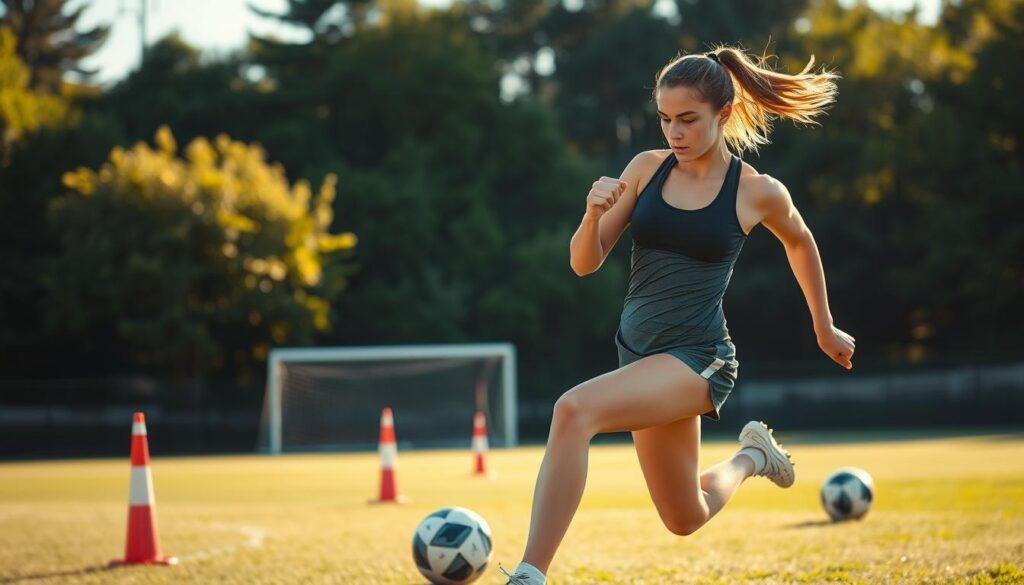
A powerful female soccer athlete in dynamic motion, showcasing her strength and determination, is positioned in the foreground. She is dressed in a professional athletic outfit, demonstrating her focus and intensity as she practices training drills on a lush green soccer field. In the middle ground, a diverse group of young female athletes watches in admiration, absorbing inspiration from her rigorous training session. The background features a stadium filled with cheering fans, under a clear blue sky. The scene is illuminated by the warm, golden light of a late afternoon sun, casting long, dramatic shadows. The mood is one of motivation and empowerment, capturing the essence of athleticism, commitment, and the legacy of champions that inspire future generations. The angle is slightly low, emphasizing the athlete's powerful stance and the energy of the environment.

Christine Sinclair: Record-Breaking Consistency and Training Discipline

Christine Sinclair is more than a player; she’s a symbol of soccer’s power. She holds the record for most international goals. Her discipline is unmatched.

In today’s world, where fame is often about show, Sinclair stands out. She leads by doing, not by talking. This soccer leadership is strong because it shows in results, not words.

Her training is strict. For 20 years, she has followed the same routine and diet. This shows her deep commitment. Here are some key parts of her training:

  • Movement Economy: Sinclair knows how to stay in place while setting up for goals. This skill is like a chess game, needing deep thinking.
  • Focused Preparation: She ignores distractions, staying focused. This is a lesson in leadership in a world full of noise.
  • Consistent Standards: Sinclair shows that the best leaders are quiet but consistent. They keep high standards, no matter who’s watching.

Her record is not just about goals. It shows the power of being your best every day. Who needs a TED Talk when you have 190 international goals?

To learn more about Sinclair, check her Wikipedia page. For tips on coaching young athletes, see inclusive coaching methods.

Ada Hegerberg: Comeback Story and Mental Resilience in Training

Ada Hegerberg’s journey back to soccer is a lesson in mental strength. She won the first women’s Ballon d’Or and then faced a strange moment when asked to twerk on stage. But this moment is just a small part of her amazing story.

Hegerberg was in the news for her talent and her choice to leave the national team for five years. She came back after a tough recovery from an ACL rupture that lasted nearly two years. In soccer, where careers are short, her time off felt like forever.

Her mental strength to rebuild her body is hard to understand. Here are the main points of her comeback:

  • Proprioception Training: Before she could run fast, Hegerberg worked hard on proprioception. This helped her get her balance and coordination back.
  • Psychological Warfare: She had to trust her knee again, which was hard. It took a lot of mental strength to face her fears.
  • Patience in Progress: She knew her new self might be different from the old one. This was important in her journey.

Hegerberg’s story is not just about winning. It’s a real story that shows the fear of starting over. For anyone who has faced a big setback, her careful comeback is a guide. It shows the hard truth of the journey.

In a world where female athletes are often seen as just talented, Hegerberg’s strength and hard work are unique. They show what it means to fight back.

Marta: Global Icon Status and Training Philosophy from Brazil’s Greatest

Marta’s journey from Brazil’s beaches to global stardom is inspiring. Known as “Pelé in a skirt,” she stands out as a female soccer icon. Her story is more than a nickname; it’s a journey of relentless pursuit of excellence in a sport that often overlooks women.

Born in a country where women’s soccer was ignored, Marta became a beacon of hope. She started training on the streets and beaches of Brazil, playing futsal. This small-sided game helped her develop incredible close control, leaving defenders stunned. Futsal is not just a game; it’s a place where skill and creativity are forged.

Her explosive power comes from beach training. Running on sand builds strength and agility, which she uses on the pitch. It’s not just about physicality; it’s about the improvisational creativity that no European academy could replicate. Marta’s artistry on the field is a direct result of her unique environment and training methods.

But let’s not confuse artistry with a lack of discipline. Marta’s long career in professional soccer is a result of hard work, resilience, and dedication. Her training regimen shows how she views soccer as an art form, not just a sport.

The broader lesson here is about how environment shapes excellence. Marta didn’t become a global icon despite Brazil’s challenges; she became one because she had to overcome them. This makes her a compelling figure among female soccer role models. Her story invites us to rethink talent development and the conditions that foster greatness.

Training Aspect Description Impact on Performance
Futsal Foundations Close control and quick decision-making Improved dribbling and agility
Beach Training Strength and explosive power Enhanced speed and endurance
Improvisational Creativity Free play and instinctual decision-making Unique playing style and adaptability

A powerful female soccer player, representing Marta's spirit, stands confidently on a lush green soccer pitch. She is wearing a stylish yet modest sports uniform, embodying strength and determination. In the foreground, she holds a soccer ball at her side, exuding an aura of leadership. In the middle ground, a diverse group of young girls are practicing drills, inspired by her presence. Their focused expressions reflect ambition and dedication. The background features a vibrant stadium filled with cheering fans, under a bright afternoon sun to create an uplifting atmosphere. The image is captured from a slightly low angle to emphasize her stature and importance, with soft natural lighting that highlights her features and the joy of the sport.

Sam Kerr: Explosive Power Training and Goal-Scoring Mentality Development

Sam Kerr doesn’t just score; she turns it into an art that leaves fans amazed. Her goal-scoring is a mix of explosive power and sharp thinking. It’s like watching a well-oiled machine, with every part working together perfectly.

At the core of Kerr’s success is her explosive power training. This isn’t just about lifting weights or running. It’s a detailed plan that boosts her athletic abilities. Here’s a look at some key parts of her training:

Training Component Description Benefits
Plyometrics High-intensity exercises that improve explosive strength. Increased vertical leap and sprint speed.
Strength Training Weightlifting focused on lower body and core. Enhanced overall power and stability.
Biomechanical Analysis Assessment of movement patterns to optimize performance. Improved efficiency and reduced injury risk.

But there’s also a mental side to her game. Kerr has a special mindset that helps her perform well under pressure. She has a mix of confidence and a quick forgetfulness—miss a chance? She moves on and demands the next one. This mental approach is key for top strikers.

Also, her growth from a talented player to a team leader shows her leadership. She’s a true example of athlete inspiration, showing how hard work and dedication can lead to success. Sometimes, the story isn’t about overcoming challenges. It’s about perfecting your craft.

Lucy Bronze: Defensive Excellence and Cross-Training for Complete Fitness

In soccer, Lucy Bronze is more than just a defender. She’s a strategic hunter on the field. Her playing style is like a lion stalking its prey. This English defender has won the Champions League with several clubs and was named FIFA’s Best Women’s Player. Her unique cross-training approach makes her stand out among women soccer leaders.

Lucy Bronze doesn’t just work out; she tries different sports to improve her game. Here are some key parts of her cross-training philosophy:

  • Martial Arts: This discipline has improved her balance and leverage, essential for winning defensive duels.
  • Track Cycling: By developing quadriceps power, she can execute overlapping runs with speed and precision.
  • Yoga: Maintaining flexibility is key for an athlete who faces physical contact for ninety minutes.

What’s interesting about Bronze’s training is the idea of transferable skills. Doing activities outside soccer helps her in ways traditional training doesn’t. Her defensive skills aren’t just about tackling. They’re about moving with agility and confidence on the field.

This cross-disciplinary approach is like the best ideas in business and academia. Lucy Bronze shows that thinking outside the box can lead to amazing results. Whether on the pitch or in life, being creative can bring extraordinary outcomes.

Training Like Your Heroes: Adapting Professional Routines for Recreational Players

You might not be as strong as Megan Rapinoe, and your body recovers differently. But you can learn from the best. Professional training methods can be made smaller and smarter for you. This way, you avoid injuries and keep improving.

Learn from Rapinoe’s flexibility without needing a yoga teacher. Add simple stretches and drills to your routine. It’s like having your own yoga class at home. Or, focus like Carli Lloyd does during games. Set goals for each practice, like improving your passing or stamina.

Sam Kerr’s power is impressive, but you don’t need expensive tools to get it. Bodyweight exercises like jump squats can help. The key is to find the right balance for your body.

To make a pro session work for you, focus on quality over time. Pick a few drills that target your goals. For example, spend 15 minutes on shooting drills instead of an hour of random practice.

Also, plan your training around your life. Know when to stop to avoid injuries. The goal is to learn from pros, not to be them. Find a balance that works for you.

In summary, learn from female athlete examples and their training. With smart adjustments, you can improve your game safely. For more on how former women soccer players are making a difference, read this article here.

Building Character: How Soccer Training Develops Leadership Skills and Personal Growth

Soccer is more than a game; it’s a school for leaders. Mia Hamm said, “The team is the ultimate champion.” This shows how soccer helps build leaders. Players learn that being part of a team makes their talent shine.

Training on the field is like facing real-life challenges. Athletes must handle pressure, make quick decisions, and control their emotions. They learn to accept feedback from teammates, a skill useful in any leadership role.

Michael Jordan said, “Teamwork makes the dream work.” This is true beyond sports. Phil Jackson also believed that team strength comes from individual strength. These ideas show that soccer skills like communication and strategic thinking are useful in life.

Female soccer stars are great examples of this growth. They face challenges with grace, inspiring others. The soccer field shapes them into leaders who can drive change. It’s not just a game; it’s about building lasting character and leadership.

Next Generation Women’s Soccer: Rising Stars You Need to Watch

rising stars womens soccer

Finding the next big stars in women’s soccer isn’t easy. It’s not just about numbers or stats in an office. True talent scouts have a special eye for youth national team prospects and love the game.

We take a unique approach to find talent. We look beyond the highlights, exploring leagues like the NWSL, Frauen-Bundesliga, and Liga F. Age is important, but it’s different when a young player shines in a senior team.

The game is changing fast. Roles are shifting. For example, Sophia Smith moves from the sidelines to the center with ease. What makes a player stand out? It’s the small details, like quick decisions and hard work that count.

Ten prospects snapshots strengths signature moves mindset quotes

Meet the ten prospects who will amaze you with their skills. They are changing the game in women’s soccer. Each player has a unique style that keeps everyone excited.

The goalscorers who redefine positioning

First, we look at the goalscorers. They can find space where it seems impossible. Their skills and training let them score when others can’t.

Finding space where none exists

Sophia Smith is a great example. She can beat defenders with her quick moves. Her ability to anticipate the game is unmatched. Her first World Cup goal showed how she finds and uses spaces.

The creators who see two moves ahead

Next, we focus on the creators. They have a vision that breaks through defenses. Their foresight lets them make plays that leave defenders confused.

Vision that breaks defensive lines

These players can plan attacks with great accuracy. They see the game in ways others can’t. This sets up amazing goals and assists.

The disruptors who change game tempo

Lastly, we have the disruptors. They are experts at changing the game’s pace. Their energy and tactics can change a match quickly.

When pressing becomes an art form

They excel at turning defense into offense. Their aggressive mindset lets them read the game perfectly. This skill makes them stand out as future stars.

How they train ball mastery speed core recovery day in life

Training for women’s soccer stars is more than drills. It’s a lifestyle. They practice endlessly, beyond what you see on social media. Their success comes from hard, repetitive work that’s not always glamorous.

Ball mastery rituals that build touch under pressure

Ball mastery is more than juggling tricks. It’s about a deep connection with the ball. Players do rituals to control the ball in tight spots. This makes their first touch feel like a part of their body.

The 15-minute warm-up that pros swear by

Every session starts with a 15-minute warm-up. It’s not just a routine. It’s a special preparation that gets their muscles ready and their focus sharp. They do dynamic stretches and ball touches to get ready for the game.

Speed work that translates to game situations

Speed is key, but not just straight-line sprinting. Rising stars work on agility and quick changes. This training prepares them for game scenarios, letting them slow down and speed up while thinking tactically.

Why straight-line sprinting is overrated

Many think speed means just sprinting straight. But games need quick speed in all directions. So, athletes focus on agility drills to improve their field performance.

Core stability as the foundation of durability

Core stability is vital but often overlooked. It supports every move on the field. Players who focus on core training can handle the game’s physical demands and lower injury risks.

The plank variations actually worth your time

Plank variations are not just trendy; they’re effective. Different planks in their routines build a strong core. This strength improves performance and career longevity.

Recovery protocols that extend careers

Recovery is key to extending careers. It’s not just ice baths or foam rolling. It’s a full approach that includes sleep and nutrition. Athletes see food as fuel, knowing it affects their performance.

Sleep, nutrition, and the unglamorous truth

Many underestimate the role of sleep and nutrition. It’s not just about working out. It’s about resting well and eating right. This discipline sets the best apart from the rest.

A skill to steal from each player with a drill progression

Why not learn from the best youth national team prospects? Each player has a skill you can steal. This could be a technical move or a way to make quick decisions on the field. Let’s explore drills that can help you master these skills.

Dribbling deception drills from the best one-on-one artists

First, let’s talk about dribbling tricks. Sophia Smith is great at making opponents lose balance. Start with the mirror drill. Find a partner and mirror each other’s moves while dribbling. This improves your agility and ability to read opponents.

Mirror drill variations for reactive agility

Add challenges to the mirror drill. For example, one player can pretend to move while the other reacts. This boosts your reactive agility and prepares you for intense game moments.

Anticipation and timing exercises for penalty box predators

Now, focus on anticipation. Sophia is good at finding open spots in the box. Play small-sided games with a shrinking goal area. This helps you make quick decisions and understand the game better.

Reading the cross before it’s delivered

Practice reading crosses with a partner. Try to guess where the ball will come from. This drill improves your game reading and reaction time.

Positional fluidity training for modern hybrids

Let’s talk about being flexible on the field. Modern players can play wide and then cut inside. Start by practicing on the touchline, beating a defender, and then crossing the ball. This prepares you for game scenarios and boosts your tactical thinking.

The inside-outside winger circuit

Make the drill harder by adding defenders or limiting touches. This not only sharpens your skills but also prepares you for game situations where you need to adapt quickly.

These drills start simple and get more challenging. They help you integrate these skills into your training. Remember, these are the same steps that top youth players take to improve.

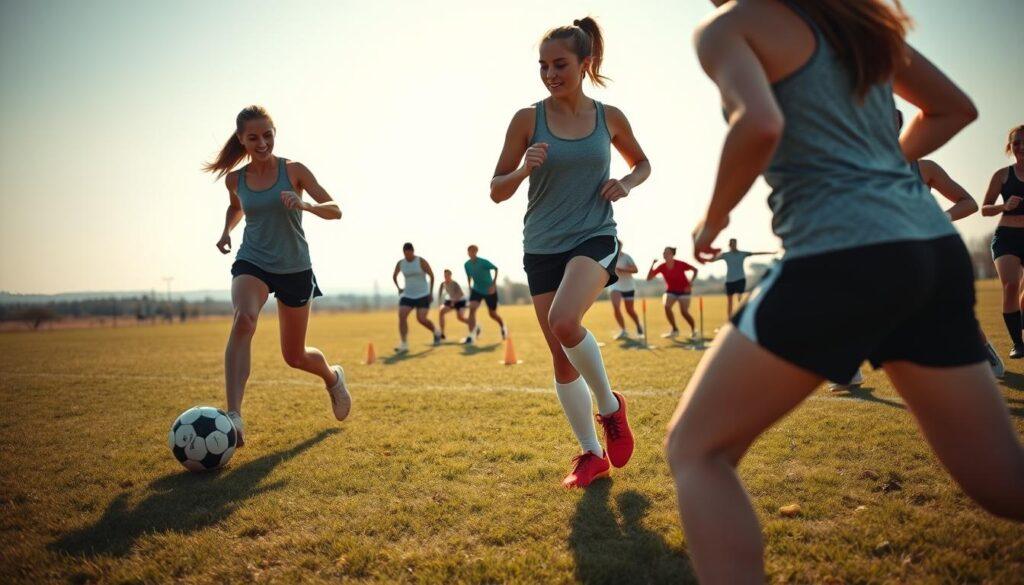
A dynamic training session featuring a youth national women's soccer team, focused on skill development. In the foreground, several young female athletes in modest athletic attire practice dribbling and passing drills with orange cones scattered around. In the middle ground, a coach observes and gives feedback, utilizing a clipboard and whistle, while another group of players practices shooting techniques at a goal. The background showcases a vibrant soccer field under bright, natural sunlight with a clear blue sky, creating an energetic atmosphere. Use a wide-angle lens to capture the action, emphasizing teamwork and determination amongst the players. The mood is inspiring and focused, reflecting the dedication of rising stars in women's soccer.

Youth fitness trends plyometrics sprint mechanics microdosing lessons

Training for young soccer players is changing a lot. We’re moving away from simple box jumps. Now, we focus on force absorption instead of just power. This is key, as ACL injuries in women’s soccer are a big concern.

It’s not just about jumping high. It’s about landing safely too.

Plyometrics That Prioritize Force Absorption Over Force Production

Plyometrics help players absorb force better. This is where landing mechanics play a big role. Learning to land right can lower injury risks a lot.

Players need to slow down and keep their knees safe. This helps them play longer and better.

Landing Mechanics as Injury Prevention

Knowing how to land is very important. A soft landing means fewer injuries. It’s like a dance, and the smoother you land, the better you’ll do.

Coaches should teach drills that focus on these skills. This prepares players for the game’s challenges.

Sprint Mechanics for Soccer-Specific Acceleration

Sprint mechanics have also evolved. The idea that arm drive is key to speed is not true. What really matters is the relationship between shin angle and ground contact.

Players need to keep a strong posture. This lets force move well from foot to hip.

The Arm Drive Misconception Everyone Has

Many young athletes are taught to pump their arms for speed. But, it’s the lower body that really matters. Fixing this mistake can make players faster and better on the field.

Microdosing: Training the Art of Accumulated Adaptation

Microdosing is a big change in youth training. It’s about short, focused sessions instead of long, distracted ones. Just ten minutes of daily intent can be more effective than two hours of aimless practice.

Why 10 Minutes of Daily Intent Beats 2 Hours of Going Through Motions

The future women stars are not just those who train the longest. They’re the ones who train smartest. Small, focused efforts can lead to big results over time. It’s all about quality, not quantity.

Balancing school and pressure mental health habits for teens and adults

The pressure on rising stars in women’s soccer isn’t just about the game. It’s about managing life’s demands. Young athletes today face an uphill battle, trying to excel academically while also training like future professionals. This challenge often goes unnoticed, yet it can make or break their mental health.

So, what does this academic-athletic tightrope look like? It’s not just about keeping up with homework while fitting in practice. It’s about mastering time management systems that actually work for travel schedules. Here are some effective strategies:

  • Prioritize Tasks: Identify what must be done daily and what can wait.
  • Set Realistic Goals: Break larger projects into manageable pieces.
  • Use Technology Wisely: Calendar apps can help keep track of both school and sports commitments.

Next up is the social media pressure that fuels performance anxiety. With every scroll, young athletes are bombarded with highlight reels of their peers, leading to the infamous comparison trap. But how do elite prospects escape this? Here are some insights:

  • Limit Social Media Time: Set boundaries to avoid constant comparisons.
  • Focus on Personal Growth: Celebrate your own achievements, no matter how small.
  • Engage in Positive Communities: Surround yourself with supportive peers who uplift, not judge.

Lastly, let’s talk about mental health habits borrowed from sport psychology. These tools are not just fluff; they are proven performance enhancers. Incorporating practices like breath work and visualization can significantly impact an athlete’s routine:

  • Breath Work: Helps in managing stress and anxiety before big games.
  • Visualization: Prepares the mind for success by mentally rehearsing performances.
  • Pre-Match Routine: Establish a consistent routine to foster a sense of control and calm.

A vibrant soccer training scene featuring a diverse group of young female athletes, aged 15-19, practicing on a sunlit field. In the foreground, two players engage in a focused drill, wearing modest, athletic gear. One is dribbling the ball, showcasing determination, while the other is poised to intercept. The middle ground highlights other team members stretching and exchanging tips, their expressions reflecting camaraderie and encouragement. The background reveals lush green trees and a clear blue sky, radiating positivity and energy. The lighting is bright, emphasizing the youthful spirit and resilience of these prospect players, evoking a mood of ambition and teamwork. Captured from a slightly elevated angle to include the expansive field and the dynamic interactions among the athletes.

Ultimately, the goal isn’t just to produce better soccer players. It’s about nurturing healthier humans who excel both on and off the field. By implementing these strategies, young athletes can better navigate the pressures they face, ensuring they thrive in their dual roles as students and rising stars in women’s soccer.

Where to stream schedules and social follows

Finding where to watch future women stars can be tricky. With women’s soccer on the rise, finding the right broadcast can be overwhelming. Let’s simplify it for you to catch every game.

Broadcast platforms carrying youth and senior competitions

To watch the games, you need to know where to look. Here’s a quick guide to platforms for youth and senior competitions:

  • ESPN+ – Great for NWSL and select college games.
  • Paramount+ – Home to the UEFA Women’s Champions League.
  • Peacock – Streaming some U.S. Women’s National Team matches.
  • FuboTV – Offers a range of channels broadcasting women’s soccer.

These platforms might require subscriptions. But they’re worth it to follow rising stars in women’s soccer.

The streaming services worth your subscription dollar

When choosing streaming services, look for value. Consider these factors:

  • Comprehensive coverage: Find services with a wide range of leagues and tournaments.
  • Quality streaming: Make sure the platform offers a smooth viewing experience.
  • Accessibility: Check if they have mobile apps or work with smart TVs.

Tournament calendars and key dates for prospect watching

Timing is key to catch the next big talent. Mark these dates on your calendar:

  • Youth World Cups: U-17 and U-20 tournaments are key for spotting future stars.
  • Qualifiers: Watch the qualifying matches for the senior teams.
  • Showcase events: Local tournaments can also reveal talent.

Youth World Cups, qualifiers, and showcase events

These events are where the magic happens. To see rising stars in action, don’t miss them. Follow the tournament schedules closely.

Social media accounts that provide actual analysis

Social media is more than just highlights. For real analysis, explore these accounts:

  • @TheEqualizer – Offers in-depth coverage and analysis of women’s soccer.
  • @WomenSoccerZone – Focuses on the latest news and player insights.
  • @Tactical_Analyst – Perfect for those who love tactical breakdowns.

Who to follow beyond the highlight accounts

These accounts offer more than just highlights. They analyze plays, discuss strategies, and keep you updated on women’s soccer.

In conclusion, the world of women’s soccer is more accessible than ever. With streaming services and social media, there’s a wealth of information out there. For more on catching NWSL games, check out this guide.

A dynamic scene capturing young women soccer athletes in action on a vibrant soccer field, showcasing their passion and determination. In the foreground, two players in sleek, modern soccer uniforms are intensely focused as they dribble and pass the ball, their expressions determined and energetic. The middle ground features a diverse group of young soccer players cheering enthusiastically, their camaraderie and sportsmanship evident. The background shows a sunny day with a clear blue sky, soccer goalposts, and cheering fans, creating an uplifting and inspiring atmosphere. Utilize soft, natural lighting to enhance the lively setting, with a wide-angle perspective that emphasizes the spirit of teamwork and aspiration in modern women’s soccer.

Tactical evolution these players signal position changes

Forget everything you thought you knew about player positions; women’s soccer is rewriting the rulebook. The game is changing fast, with players taking on new roles. It’s not just about being good at the game. It’s about being smart and flexible on the field.

The death of the traditional winger and rise of the hybrid attacker

Wingers used to stay wide and cross the ball. But now, we have hybrid attackers. Players like Sophia Smith can play wide and then move to the center. This makes them hard to defend against.

How Sophia Smith and others are redefining wide play

Sophia Smith is a great example of this change. She knows when to stay wide and when to move inside. This smart play is the result of hard work and understanding the game.

Center backs who build like midfielders

Center backs are no longer just defenders. They help start attacks with precise passes. This change is making teams play differently.

The ball-playing defender revolution reaches the women’s game

More teams are using this style. Center backs are now starting attacks and creating chances. This shows how important being versatile is in women’s soccer.

Fullbacks as primary creators

Fullbacks are now key in creating chances. They’re not just defenders anymore. They’re making assists from deep positions.

When the assist comes from deeper than you expect

Today’s fullbacks are heroes, making key passes from deep. Their offensive skills show how the women’s game is evolving.

Player Type Traditional Role Modern Role Key Skills
Winger Stay wide, cross Hybrid attacker Dribbling, positional awareness
Center Back Defend Ball-playing defender Passing, game reading
Fullback Defend Primary creator Crossing, assist-making

The players we highlight are not just stars. They’re leading a tactical change that will shape soccer’s future. Watch them closely to understand the game’s next steps.

30 minute combo workout inspired by the class of the year

Ready to elevate your game? Let’s dive into a 30-minute workout inspired by the best in women’s soccer. This isn’t just any fitness routine. It’s a bridge between watching and doing, designed to get you moving like the rising stars you admire.

Warm-up Activation Sequence Borrowed from Pre-match Routines

First things first: we need to get your body ready without exhausting it. This warm-up focuses on dynamic mobility that opens your hips and activates your glutes. Think of it as a gentle nudge to your nervous system, preparing you for the real action ahead.

Dynamic Mobility That Prepares Without Exhausting

  • Leg Swings: 10 each leg
  • Hip Circles: 10 each direction
  • High Knees: 30 seconds
  • Butt Kicks: 30 seconds

Technical Circuit Modeled on Prospect Training Sessions

Now, let’s get to the meat of the workout. This technical circuit combines ball mastery with conditioning. Because, let’s be honest, who has time for separate skill work and fitness? We’re merging them into drills that demand precision while your heart rate climbs.

Ball Work That Doubles as Conditioning

Drill Duration Focus
Dribble through cones 5 minutes Touch and control
Short passing with a partner 5 minutes Accuracy and speed
One-touch shooting 5 minutes Finishing under pressure

Finishing and Decision-making Under Fatigue

Now, we reach the segment that reveals your true character. This is where you’ll work on finishing exercises while feeling the burn. Decision-making scenarios become critical when your legs are heavy, and your brain wants to check out.

The Final 10 Minutes That Separate the Committed from the Curious

In this last segment, you’ll engage in:

  • Timed shooting drills
  • Quick decision-making exercises
  • Small-sided games to simulate pressure

All you need is a ball, some cones, and a willingness to embrace discomfort for half an hour. No gym membership, no excuses. Get ready to channel your inner rising star and transform your training routine today!

For more drills to enhance your skills, check out these must-try soccer drills.

How to support responsibly online and in stadiums

We’ve seen the talents of future women stars in soccer. But our role as fans is just as important. Responsible support goes beyond cheering; it shapes the culture around these athletes.

When we engage online, let’s uplift, not criticize. Remember, those comment sections are not empty spaces. Athletes read what we write. The pressure can be overwhelming, even for young players starting their careers.

Digital fandom that uplifts, not pressures

Positive interactions create a supportive environment. Criticism is okay, but let’s keep it constructive. Young players need encouragement to thrive.

They deserve a community that celebrates their efforts, not just their results.

The comment section and its real-world consequences

What we say online can affect a player’s mental health. Negative comments can overshadow their passion for the sport. Let’s choose our words wisely.

Match-day culture that respects the players as humans

At games, let’s create an atmosphere that acknowledges the players’ humanity. They are not just performers; they are young individuals facing immense pressure. A supportive crowd can inspire confidence, making every match an opportunity for growth.

What young athletes actually want from their supporters

They seek understanding, not just applause. Recognizing that every player has off days can foster a healthier sports culture.

Investing in the ecosystem beyond the stars

Support extends beyond the pitch. Following youth national team prospects or local clubs builds a rich soccer community. It creates depth in the sport, ensuring sustainability.

Following lower divisions, youth leagues, and local clubs

By engaging with every level of women’s soccer, we contribute to a vibrant ecosystem. Our attention helps nurture the next generation of stars, making the sport stronger for years to come.

The Wall A Trailblazing Goalkeeper’s Journey and Training Blueprint

goalkeeper pioneer profile

Every great story starts in an unexpected place. In football, it’s often near the biggest stadiums. David Fairclough, for example, grew up close to Anfield. He turned casual games in Stanley Park into a stage for legends.

Known as Liverpool’s “super sub,” Fairclough scored key goals under pressure. Now, imagine a similar story for a women goalkeeper legend. What drives someone to face a storm of shots? It’s a mix of destiny and determination.

This article looks at how a goalkeeper is made. We’ll see their early days, unique strengths, and tough training. We’ll also compare it to Fairclough’s journey. It shows that pressure can shape many heroes.

Signature strengths reflexes positioning distribution command of box

What makes a goalkeeper stand out? It’s mastering four key strengths. These are the foundation of a keeper’s success. Missing any can lead to trouble on the field.

Reflexes are essential. They’re like a goalkeeper’s sixth sense, reacting fast. A quick choice can turn a save into a showstopper.

Positioning is the unsung hero. It lets a keeper know where the ball will go. This way, they can make saves look easy, like chess moves ahead.

Distribution is about more than just passing. It’s about starting attacks from defense. A smart throw or kick can surprise opponents, changing the game.

Command of the box is about presence. It makes defenders confident and attackers uncertain. A keeper who owns their space can make forwards doubt themselves.

These strengths work together, improving a goalkeeper’s game. When all four are mastered, a player becomes a legend.

Sample week gym field recovery and film study for keepers

Imagine this: while field players are recovering, our goalkeeper is already working hard in the gym. It’s not just any gym; it’s where real work happens. A week in the life of an elite keeper is like a special ops training manual, not a fitness influencer’s highlight reel.

Monday starts strong. Gym sessions focus on explosive power with plyometrics. Your quads will question their existence. Medicine ball slams echo through the facility, and core workouts make Pilates instructors cry. It’s not just exercise; it’s building strength and agility.

Field sessions bring GK drills to life. Footwork ladders improve quickness, and reaction saves become instinct. Claiming crosses under pressure? Do it until your body does it without thinking. This practice is key for game-time skills.

A vibrant training scene showcasing goalkeepers engaged in various drills. In the foreground, two goalkeepers in modest athletic gear concentrate on catching high balls, with focused expressions. The middle ground features a coach demonstrating techniques, accompanied by training cones and rebounders scattered around, reflecting an active training environment. In the background, a gym with gymnastic mats and weights suggests recovery, alongside a large screen displaying recorded game footage for film study. The lighting is bright and dynamic, with sunlight streaming in through large windows, casting subtle shadows. The atmosphere is energetic and dedicated, capturing the essence of a week-long training regimen designed to elevate performance and recovery.

Recovery is a discipline, not an afterthought. Ice baths, compression therapy, and good sleep hygiene are essential. They help your body recover for the next challenge.

Film study is the unsung hero of goalkeeping evolution. Watching your own games frame by frame is vital. You’ll learn about opponents and penalty takers’ tells. It’s not glamorous, but it’s why top keepers always seem to be in the right spot.

For those aiming to improve, check out this skill-building guide for young female soccer players. Every training, recovery, and analysis session adds up. It makes a well-rounded keeper ready for any challenge.

Mental game visualization mistake reset and focus cues

What mental strength lets a goalkeeper stay strong for 90 minutes, even with little action? The secret is mental toughness. It’s not just about grit; it’s building a complex mental setup for top goalkeepers.

Visualization is key. Before games, our top goalkeeper practices different scenarios in their mind. They imagine a deflected shot or a penalty with the season at stake. The brain can’t tell the difference between real and imagined, making the actual moment feel familiar.

Resetting from mistakes is also vital. A goal can bring up feelings of frustration and doubt. But elite keepers have a quick reset: a physical action, a breath pattern, or a word. This helps them move on fast, because the next shot is coming.

Focus cues are also critical. They bring the mind back to the game when it drifts. It’s not just about staying focused; it’s a mental strategy for goalkeepers. For more on the mental challenges of goalkeepers, read this article on mental toughness.

Six keeper drills footwork handling crosses 1v1s distribution kick accuracy

Drill work is where the magic of goalkeeping unfolds, a symphony of sweat and skill. These drills are not just exercises; they are the backbone of a goalkeeper’s training regimen. Let’s dive into six essential GK drills that transformed our trailblazer from promising talent to an impenetrable force.

1. Footwork — Before you can make the save, you have to get there. Think of cone patterns, agility ladders, and shadow movements. They may look deceptively simple, but try doing them at full speed for the twelfth consecutive minute, and you’ll understand their true value.

2. Handling — This is the fine line between a clean catch and a rebound that turns into a tap-in for the opponent. Use tennis balls and reaction balls to sharpen your hand-eye coordination. Trust me, this is the kind of work that would make a juggler envious.

3. Crosses — The aerial duel that separates commanding keepers from those who flap. Timing your jump and reading the flight of the ball is key. And yes, opponents are allowed to challenge you, so prepare for that reality.

4. 1v1s — This is the ultimate psychological showdown. Just you, a striker, and eight yards of grass. Shot stopping in these moments is less about technique and more about presence. Make yourself big. Make yourself inevitable.

5. Distribution Drills — Turning saves into attacks is an art. Work on throws that launch counter-offensives and goal kicks that find teammates like heat-seeking missiles. This skill can change the game.

6. Kick Accuracy Under Fatigue — Anyone can ping a ball in warmups. But can you do it in the 89th minute when your legs are screaming and the score is level? This drill tests your focus and precision when it matters most.

These six drills aren’t a menu; they’re a mandatory curriculum for any serious goalkeeper. Below is a summary table of these drills for quick reference:

Drill Focus Area Key Equipment Outcome
Footwork Agility Cones, ladders Improved movement
Handling Coordination Tennis balls Secure catches
Crosses Aerial control Soccer ball Effective claims
1v1s Presence Soccer ball Shot stopping
Distribution Counter-attacks Soccer ball Quick transitions
Kick Accuracy Precision Soccer ball Reliable kicks

Fitness conditioner ladder plus plyo progression and safety notes

Goalkeepers face a unique challenge in fitness. They need both endurance and explosive power. The fitness conditioner ladder is a key tool for building this strength.

Training isn’t about long-distance running. It’s about quick, intense bursts of energy. Plyometric exercises, like box jumps and depth jumps, are essential. They help goalkeepers build power and stability.

A fitness training scene showcasing a goalkeeper working on exercise drills with a focus on a fitness conditioner ladder and plyometric progression. In the foreground, depict a male goalkeeper in modest athletic attire, executing high knees over the bright orange ladder on a well-maintained turf field. In the middle ground, include various agility cones and plyo boxes arranged for drills, with a water bottle and towel nearby for a professional touch. In the background, show a clear blue sky and distant trees, emphasizing a vibrant outdoor training environment. Lighting should be natural, with the sun casting soft shadows, suggesting a morning workout. The atmosphere should be energetic and motivating, capturing the essence of athletic training.

Safety is a top priority in training. Poor landing techniques can lead to injuries. Goalkeepers must focus on proper landing and controlling their movements.

Our legendary female goalkeeper knew the importance of staying healthy. She trained with great care, focusing on her body’s well-being. This dedication paid off, allowing her to have a long and successful career.

Leadership from the back organizing a defense communication terms

In soccer, the goalkeeper is more than a player; they’re the leader of the defense. They see every gap and every runner not being watched. This makes leadership from the back a non-negotiable job requirement.

Organizing a defense needs clear and simple communication. Every player must understand these commands. Here are some key terms every goalkeeper should know:

Term Meaning Usage
Step Push up the defensive line “Step! We need to close the gap!”
Drop Retreat to a safer position “Drop! We’re too high!”
Away Clear the ball “Away! Get it out!”
Keeper Claiming the ball “Keeper! I’ve got this!”

The best defensive organizers are like air traffic controllers. They are calm, clear, and strict. This requires mental toughness to manage the team’s emotions.

When the defense is shaky, you calm everyone down. If a center back makes a mistake, you help them recover. Your voice is a tactical tool. It must be firm but not harsh.

Our leader was great at this, and it made our defense stronger. So, when you play, remember: leading from the back is about confidence and clear communication.

A focused goalkeeper in professional gear stands confidently in the foreground, embodying mental toughness and leadership. His intense gaze is directed towards a group of defenders, signaling strategic organization on the field. The middle ground features the defenders, dressed in matching team jerseys, positioned to respond to an impending attack, showcasing teamwork and communication. The background reveals a dynamic stadium scene, with blurred fans and vibrant banners, creating an atmosphere of anticipation and excitement. The lighting is dramatic, with spotlights illuminating the goalkeeper, highlighting the intensity of the moment. A low-angle perspective captures the goalkeeper’s commanding presence, while a shallow depth of field emphasizes the action unfolding in the background, encapsulating the essence of leadership and resilience in goalkeeping.

Community impact clinics scholarships and outreach

A goalkeeper’s true legacy isn’t just about winning trophies. It’s about touching lives and making a difference. For a women goalkeeper legend, this means helping others. They create chances for young players who might not have access to resources.

Clinics are more than just teaching skills. They’re where young keepers learn the real game. They hear about failures, struggles, and victories. These clinics teach resilience and the value of hard work.

Scholarships are key to this impact. They open doors for talented players who might be overlooked. Legends fund scholarships to help young goalkeepers grow without financial worries.

Outreach programs are vital but often overlooked. They bring goalkeeping to communities that might not think about it. This work is about making the sport accessible and building a future talent pool.

David Fairclough is celebrated for his European Cup wins. But he’s also known for mentoring. His stories and willingness to help anyone interested in football make him a legend. He showed that being a legend means being open and accessible.

Every clinic, scholarship, and young keeper mentored by Fairclough are his unseen saves. These efforts create a lasting legacy that goes beyond individual achievements. It shapes the future of the sport.

Next chapter coaching pathway and how fans can support

Transitioning from player to coach is a big change. It’s not just a job switch; it’s a deep transformation. When a player retires, they often start a new journey. Coaching lets them share their knowledge with the next generation.

But becoming a great coach isn’t easy. The skills for playing and teaching are different. It takes patience and the ability to explain what was instinctive. Our women goalkeeper legend was very prepared for coaching, just like she was for playing.

Another path is punditry. Like David Fairclough, many former players love to analyze the game. They share insights that make the sport more interesting.

Fans can help a lot in this new chapter. Here are some ways to support:

  • Attend coaching clinics to learn from the best.
  • Engage with content that highlights women’s football.
  • Advocate for goalkeeper-specific training in youth programs.
  • Watch women’s football matches in full, not just the highlights.

Attention is the most valuable thing in sports. Where fans focus, resources will follow. The retired player’s legacy is being built on. To learn more about former women soccer players’ impact, check out this article here.

Takeaway checklist for keepers and field players

As we wrap up our journey, let’s focus on key takeaways. For goalkeepers, it’s all about where you stand. Get your angles right, and saving shots becomes second nature. Remember, it’s not just about how far you kick the ball; it’s how fast.

Quickly moving from defense to offense can turn the game around. Mental toughness is something you can work on. Develop a reset ritual for when things get tough. This habit will help you stay focused under pressure.

For field players, your role is just as important. Try to see things from your goalkeeper’s point of view. The gaps you leave and the players you forget to track are all seen by them. Good communication is key. Listen and respond to your teammates’ signals.

Protect your goalkeeper during set pieces. Teamwork is everything. This guide is just the start. Use it to improve, challenge yourself, and always be ready for the next game.

How Title IX Transformed Women’s Soccer and Athletic Fitness Opportunities

Title IX soccer impact

For those of us born after Title IX, it felt like a secret. It was the reason every girl played sports. My first game was bunch-ball, but it felt electrifying.

In suburban Seattle, it seemed like a dream. But every girl played sports. Soccer wasn’t just for boys; it was a fair competition. I couldn’t make the high school team, despite trying for years.

This change was huge for women’s soccer. It showed how one sentence in a bill could start a fitness revolution. We’ll see how it changed women’s sports forever.

This change made a big difference in women’s lives. It turned “tomboys” into top athletes. Women’s sports equality got a big boost, all thanks to a simple idea.

Historical Context: Pre-Title IX Soccer Landscape and Limited Opportunities for Female Athletes

Imagine a spring day in 1893, when women in sports were just starting to emerge. At Smith College, a soccer match was set up by Senda Berenson. This was a big moment in female soccer history. But Berenson had doubts, fearing it would harm women’s physical education.

By the late 1960s, female athletes faced a bleak future. Stanford University only allowed 500 female students, showing women’s sports were not a priority. In 1969, Syracuse University spent $90,000 on boys’ sports but just $200 on girls’. This huge funding gap showed society’s view of women’s abilities.

The belief that women were the “weaker sex” was widespread. Women were expected to stay on the sidelines, not play sports. Female athletes were often doubted and their dreams dismissed. It seemed like change was impossible.

Year Funding for Boys’ Sports Funding for Girls’ Sports
1969 $90,000 $200
1970 $100,000 $300
1971 $120,000 $400

Looking back, we see the beginnings of a fight for sports equality. Title IX would soon change everything, paving the way for women in sports.

The Transformation: How Title IX Created Pathways for Women’s Soccer Development

On June 23, 1972, President Richard Nixon signed Title IX into law. It didn’t mention sports, but it changed women’s sports forever. This law had a huge impact on women’s soccer.

Here’s the punchline of the century: a civil rights law aimed at academic sex discrimination ended up creating a soccer revolution. Before Title IX, women had few sports opportunities. By 1991, there was a 17,000% increase in U.S. girls playing high school soccer. That’s a huge jump!

Women like Bunny Sandler fought hard for this change. They were often told they were “too strong for a woman.” Their work paved the way for future generations. Title IX proved that with equal opportunities, more people will participate.

This law opened doors for female athletes and built soccer fields across the nation. Schools had to give girls equal sports chances. Soccer was a big winner, creating a community of female athletes eager to compete.

In essence, Title IX was more than a law; it was a movement. It changed how society sees women’s sports. It let girls dream big and play hard, filling today’s soccer fields with aspiring athletes.

College Soccer Explosion: Scholarship Opportunities and Elite Training Program Growth

The rise of women’s college soccer has opened new doors. Title IX brought more chances for female athletes. The NCAA’s first women’s soccer championship in 1982 was a big moment.

The University of North Carolina (UNC) led this change. They didn’t just win; they set a new standard. Winning the first three national titles and 16 of the first 19, UNC became a powerhouse. Their success helped feed talent into the U.S. Women’s National Team.

But it was more than just winning. Scholarships gave female athletes access to top coaching and facilities. No longer were these opportunities only for men. College campuses became places where world-class talent was nurtured.

Here are the main points of the college soccer explosion:

  • Increased Scholarships: Colleges started giving scholarships just for women’s soccer, helping athletes financially.
  • Elite Training Programs: Schools invested in better coaching and facilities, raising the bar for female athletes.
  • Competitive Environment: The growth of women’s soccer created a competitive atmosphere, pushing athletes to do their best.

This change has made the “student-athlete” a real option for women. It has changed lives and set the stage for future generations of female soccer players.

Fitness Evolution: How Increased Participation Improved Training Standards for All Female Athletes

More women playing sports changed the game and fitness standards. The idea of fragile bodies and health risks from running was debunked. This shift was a big step forward.

When I didn’t make the school soccer team, I joined cross-country. I used my endurance to race for miles. Women like Bobbi Gibb and Kathrine Switzer broke barriers in sports.

Soccer fields were soon filled with talented women. Training became serious, with a focus on breaking records. This was a revolution, showing women’s growing confidence.

The battle for women sports equality was about challenging old beliefs and budget issues. More athletes meant better coaching and facilities. This set the stage for future female athletes to succeed.

A vibrant scene depicting a diverse group of women athletes engaged in various sports, illustrating the theme of sports equality. In the foreground, three women of different ethnic backgrounds are in action: one is sprinting on a track, another is practicing soccer drills, and the third is lifting weights in a training gym. They are dressed in professional athletic wear, showcasing strength and determination. In the middle ground, a basketball court features women practicing and supporting each other, highlighting camaraderie. The background includes a stadium filled with cheering spectators, all under bright, dynamic lighting that creates an inspiring atmosphere. The scene captures the energy and empowerment of women in sports, emphasizing progress and training standards. The angle is slightly elevated to encompass the entire scene, promoting a sense of unity and excellence in female athletics.

This evolution shows how more women playing sports debunked myths and opened doors. For more on this journey, check out the Women’s Sports Foundation.

Professional Pathways: From Title IX to Professional Leagues and Olympic Success

The growth of women’s soccer from Title IX to the pros is amazing. Title IX opened doors and built a system for female athletes. It created a strong foundation from college to the pros.

The journey from the 1985 Mundialito to today’s sold-out games is revolutionary. It shows how far women’s soccer has come.

After Title IX, more women started playing sports. This led to Olympic champions and stars in professional leagues. The U.S. Women’s National Team (USWNT) is a big success story.

They recently won a lawsuit for equal pay, showing the fight for gender equity in sports. This victory is a win for all female athletes worldwide.

This fight is not just about money. It’s about fairness and resources. When women have equal resources, they can make a lot of money. This has been shown in the growth of women’s soccer leagues.

Year Event Impact
1985 Mundialito Tournament First international exposure for collegiate women
1991 First Women’s World Cup Showcased women’s soccer on a global stage
2019 USWNT wins World Cup Increased visibility and calls for equal pay
2021 Equal Pay Agreement Historic win for gender equity in sports

The journey from Title IX to today shows the ongoing fight for equal pay. The USWNT’s success inspires women everywhere. It shows what’s possible with the right support.

For more on Title IX’s impact on sports, read this article.

Grassroots Impact: Local Club Development and Community Soccer Program Expansion

While politicians argued in Washington, the real change of Title IX soccer happened at local parks on Saturday mornings. This law didn’t just open doors; it sparked a grassroots movement. Every town wanted a soccer club, and every girl wanted to play.

In my hometown of suburban Seattle, soccer became the favorite sport. The competition was intense, and the community was buzzing. Young girls, like myself, rushed to the fields, ready to play. Title IX showed us that being a girl in sports was more than just playing a game.

Local clubs became the heart of this change. They connected young athletes with coaches who loved the game as much as they did. Uniforms became symbols of a new era where athleticism was as important as schoolwork.

This change was more than just a game; it was cultural. The grassroots movement brought out a talent pool that few countries could match. Young girls learned teamwork, resilience, and leadership on those Saturday mornings. They set the stage for future success.

As these clubs grew, they paved the way for a generation of female athletes. The impact of Title IX soccer spread through communities. It created paths for young girls to dream big and aim high.

Training Innovations: How Competitive Growth Drove Better Coaching and Fitness Methods

The push for women’s sports equality has sparked a revolution in training. Female athletes are now in better gyms, wearing proper gear. This change has transformed women’s sports.

Take Mariah Burton Nelson, for example. Her sit-in at Stanford was more than just about gym access. It was about changing the game. She and her teammates wanted to be seen as equals, not sidelined.

As talent grew, coaching became a respected job. Coaches started using sports science and nutrition. This narrowed the fitness gap.

These changes weren’t out of kindness; they were needed. The fight for women sports equality made institutions rethink their ways. Female athletes were no longer treated as second-class citizens.

Today, we see the results. Coaching is better, and training is more effective. Women athletes are now contenders, with top-notch tools. This change has reshaped the game and what it means to be a female athlete.

International Success: US Women’s Soccer Dominance Rooted in Title IX Opportunities

The U.S. women’s soccer team’s success is not a coincidence. It’s thanks to Title IX. With four FIFA Women’s World Cup wins, the U.S. is a top team in female soccer history. Title IX helped by funding and supporting female athletes.

While others banned women’s soccer, the U.S. invested in it. This 50-year lead has made American women excel in soccer. It’s surprising that only two players, Lindsey Horan and Mallory Pugh, joined the World Cup without college experience. This shows how the NCAA system has been a top development academy.

So, why do other teams fear the U.S.? It’s not just pride. It’s because the U.S. has a strong system. Title IX turned a law into a way to win sports globally. It set a high standard for women’s soccer.

The U.S. women’s soccer team’s success is not luck. It shows the impact of opportunity and investment. For more on this, check out this comprehensive historical overview of women’s World Cup records and milestones.

A dynamic scene depicting a diverse group of female soccer players celebrating on the field, capturing the triumph of US women's soccer. In the foreground, three athletes of varying ethnicities—Caucasian, African American, and Hispanic—are high-fiving with joyful expressions, clad in modern soccer uniforms. In the middle ground, a crowd of supporters waves flags and banners in celebration, showcasing enthusiasm and unity. The background features a professional soccer stadium packed with spectators under bright daylight, with a vibrant blue sky. Use soft, natural lighting to highlight the players' expressions and the overall festive atmosphere, shot from a low angle to emphasize their achievements and power. The mood is triumphant, inspiring, and filled with a sense of victory and pride.

Modern Challenges: Continuing the Fight for Equal Resources and Training Facilities

The fight for gender equity in sports is tough, even today. Title IX made big changes, but many female athletes face big challenges. It’s like playing whack-a-mole; every problem solved leads to another.

Sedona Prince’s TikTok video showed a big issue. It compared the weight room for women’s college basketball to the men’s. This moment showed the big gaps in equality, nearly fifty years after the first sit-ins at Stanford.

The idea that women’s success means men lose is harmful. It affects how much money and resources go to sports. The fight for gender equity in sports includes:

  • Lingering pay gaps: Women often earn less than men, even in professional sports.
  • Abuse scandals: The NWSL has faced serious allegations that show deep problems.
  • Neglect of women of color: Their voices and needs are often ignored in the Title IX process.

While Title IX opened doors, we’re not done yet. It was just the start, not the end. To celebrate our progress, we must face the challenges ahead. A door that’s only half open is not useful.

Your Legacy: How Today’s Female Soccer Players Benefit from Title IX Pioneers

When a young girl steps onto the field, she carries a legacy built by brave women. These women fought against huge obstacles. They proved that women deserve the same chances in sports.

Today, women have many soccer opportunities. These chances were hard-earned. Women were once told they were not good enough for sports.

At a recent Title IX event, Nelson spoke about the law’s importance. She said, “Heck no. Women’s basketball itself is winning. That’s what I’m rooting for.” Her words show the impact of past struggles.

Bunny Sandler’s fight for equality is inspiring. Her efforts led to many complaints against discrimination. Now, young athletes have more chances in soccer, from youth leagues to professional teams.

We celebrate the growth in women’s soccer. But we must keep fighting for more. The journey is ongoing, and the future is bright. It’s up to us to protect and grow these opportunities.

Elevate Your Game: Advanced Skill Development for Recreational Female Players

Soccer Skill Development

Let’s cut through the noise. Most recreational soccer practice feels like a poorly scripted movie montage. It’s endless lines for drills that are as strategic as tic-tac-toe.

You’re not here for filler content. You want the chess match, not the checkers. This is about weaponizing your understanding of the game itself.

We translate the elite training ethos into a customizable program for the savvy player. It’s for anyone tired of just running laps. Ready to engineer their own breakthrough.

Think of it as moving from a background extra to the director. Are you ready to dissect your game with a critic’s eye? And rebuild it with a strategist’s cunning?

Technical Skill Assessment & Goals

Customizing your soccer training starts with a detailed check of your skills. It’s not just a pat on the back. Your journey begins with a thorough assessment, like the IMG Academy model for all skill levels.

How does your first touch act when a defender is coming? Does it handle the ball smoothly or cause a mess? This shows your ball control skills. Can you see the game’s strategy ahead or just react to the moment? That’s your tactical awareness being tested.

This step sets your baseline. It’s like having a guide in a museum, not just wandering. You find the big mistakes in your game. Is your weak foot a joke? Do you often miss the big picture of the game?

Forget vague goals like “get better.” We’re setting clear, specific goals. These are SMART goals: Specific, Measurable, Achievable, Relevant, and Time-bound.

Vague Goal SMART Goal
Improve my weak foot. Increase weak-foot passing accuracy to 85% on 10-yard targets within six weeks.
Stop ball-watching. Consciously scan the field over my shoulder every five seconds during possession drills for one month.
Have a better first touch. Successfully control 8 out of 10 driven passes from 20 yards under light pressure in the next three training sessions.

See the difference? SMART goals turn wishes into clear tasks. They give your ball control and tactical awareness drills a clear goal. This detailed work is your starting point. You can’t write the next chapter without knowing the current one.

Start your audit today. What’s one specific, measurable flaw you can fix this week?

Individual Training Programs

Creating a personal training plan without knowing your specific needs is like trying to win an Oscar by memorizing the phone book. It’s an impressive effort but misguided. The idea of a universal program is a comforting fairy tale. It promises results without the hard work of self-diagnosis.

Your reality is unique, filled with plot holes and untapped talent. An individual training program lets you be both author and editor. You’re not just doing random drills. You’re doing a deep dive to find your weaknesses.

What’s the main problem? Is it a weak first touch or poor recovery speed? This is where you move from browsing self-help books to writing your own story.

Elite camps like IMG Academy don’t succeed by giving out photocopies. They focus on personalized coaching. A striker’s session focuses on finishing under pressure. A goalkeeper’s regimen improves reaction time and penalty area command.

A focused female athlete engages in position-specific training on a grassy field, showcasing a dynamic shooting stance appropriate for soccer. In the foreground, she is positioned gripping a soccer ball, concentrated on her technique. The middle ground features an array of training cones and agility ladders arranged in a pattern, suggesting a structured training regimen. In the background, sports equipment like goalposts and a vibrant sky add depth, enhancing the scene's immersion. The lighting is golden-hour soft, casting long shadows to create an energetic yet calm atmosphere. The camera angle is slightly low, emphasizing her determination and skill. This image captures the essence of individualized training programs for female players.

So, what’s in your blueprint? A custom program isn’t just hard workouts. It’s a balanced syllabus. It includes technical drills, position-specific conditioning, and film analysis.

Every rep has a purpose. Every sprint has a context. Are you doing footwork cones because the internet said so, or because your game film shows you get beaten on the dribble?

Let’s be brutally analytical. The output of a generic plan versus a tailored one isn’t just a minor twist. It’s a complete genre shift.

Training Aspect The Generic “One-Size” Plan The Individual, Position-Specific Program
Primary Focus General athleticism; broad skill review Targeted improvement of role-critical weaknesses
Efficiency High volume, lower relevance High relevance, optimized volume
Mental Engagement Monotonous, can lead to burnout Purpose-driven, fosters deep tactical understanding
Outcome Incremental, scattered progress Accelerated, focused mastery of your role

The table doesn’t lie. The generic path is a slog. The personalized path is a strategic campaign. It transforms practice into a chapter in your own sports saga.

This is the core of elite position-specific training. It acknowledges that different roles face different challenges. Your job isn’t to complete someone else’s workout. It’s to plot your own sequel. The next chapter starts when you put down the generic playbook and pick up the pen.

Position-Specific Skill Development

Training like a generalist in a specialist’s world is a surefire way to get benched—true development requires drilling down into the specific, often unglamorous, skills of your position.

Think of it as moving from a broad liberal arts education to a focused master’s degree. This is the core philosophy behind elite programs like IMG Academy’s positional camps, adapted for soccer. It’s about creating a hyper-focused environment where every drill, every touch, and every decision is filtered through the lens of your role.

So, what’s in your positional toolkit? It’s not just a list of soccer techniques. It’s the contextual application of those skills under duress. For a holding midfielder, ball control isn’t about silky dribbling in open space. It’s crisis management: receiving a pass with a defender on your back, using one touch to pivot away from pressure, and delivering a line-breaking pass that changes the narrative of the attack.

Let’s break down the job descriptions. The table below isn’t just a list of attributes; it’s a blueprint for building a player who dominates their specific domain.

Position Core Mandate Non-Negotiable Skill Mental Framework
Holding Midfielder Dictate tempo, break lines, protect defense One-touch passing under pressure The Chess Player: Always thinking three moves ahead, valuing possession over spectacle.
Full-Back Provide width, support attack, secure flank Tactical decision-making for overlaps The Narrative Editor: Knowing when to be a daring subplot (overlap) and when to uphold the main plot (hold the line).
Winger Isolate defenders, create chances, score Explosive body feints and change of pace The Verbal Wit: Using subtle deceptions (feints) to out-argue and embarrass direct opponents.
Center-Forward Finish chances, hold up play, disrupt defense First-time finishing and aerial duels The Poker Player: Concealing intent, making ruthless reads in the box, and going all-in on half-chances.
Center-Back Organize defense, win duels, build from back Commanding aerial presence and clearance The Dramatic Monologue: Owning the space, projecting authority, and delivering decisive, clearing actions.

Notice a pattern? The non-negotiable skill is always tied to a mental calculus. This is the essence of advanced position-specific training. A full-back isn’t just told to “get forward.” They learn the precise triggers: when the winger cuts inside, when the opposing full-back is out of position, when the risk of a counter-attack is low. It’s a high-stakes algorithm.

This focused approach transforms raw ability into applied intelligence. By mastering the soccer techniques that matter most for your role, you stop just playing the game and start solving it. This deep, position-specific training is how you truly maximize your soccer with position-specific.

Ultimately, specialization isn’t about becoming a one-trick pony. It’s about achieving such mastery in your primary functions that you become an indispensable, intelligent cog in the machine. Your unique value isn’t in doing everything—it’s in doing your thing better than anyone else on the pitch.

Tactical Understanding & Game Intelligence

If soccer were chess, tactical awareness would mean seeing ahead while others react. Technical skill lets you make a pass. But game intelligence tells you the right pass at the right time to beat the defense.

Think of tactics as your operating system. Your first touch and shooting technique are just apps. But a good OS lets you process the game’s data well. Can you figure out why your team loses the ball in midfield? It might be a team setup or a player’s bad day.

A female soccer player in a dynamic, action-oriented pose, demonstrating tactical awareness on the field. She wears a vibrant team uniform with a focus on her intense facial expression, illustrating concentration and strategic thinking. In the foreground, she's dribbling the ball with precision, her body angled towards a teammate, signaling a pass. In the middle ground, a diverse group of other players, both opponents and teammates, are positioned to create a sense of movement and urgency. The background features a stadium packed with spectators under bright sunlight, casting dramatic shadows on the green pitch. The atmosphere is electric, capturing the spirit of teamwork and challenge. Use a wide-angle lens to emphasize depth and action, with natural lighting highlighting the scene's vibrancy.

Top academies, like IMG, focus on mental performance. It’s not just about being fit. It’s about being mentally sharp to make decisions during a game. This is where pattern recognition helps you see things before they happen.

Let’s look at what makes up game intelligence:

Component What It Is On-Field Action How to Train It
Spatial Awareness Knowing where you, your teammates, opponents, and empty space are at all times. Dropping into a pocket of space to receive a turn, pulling a defender out of position. Small-sided games with constrained zones, video analysis of positioning.
Pattern Recognition Identifying recurring sequences in the opponent’s build-up or defensive shape. Anticipating a pass into the channel and intercepting it. Studying match film, using dedicated cognitive training software.
Tempo Control Dictating the pace and rhythm of the game to suit your team’s strategy. Switching from a high press to a possession phase to rest and reorganize. Scenario-based drills where the coach changes the score or time remaining.

Creating numerical advantages, like a 3v2 overload, shows tactical awareness. It’s not random. It’s a smart move based on understanding the game. Controlling the tempo is like being the DJ, knowing when to speed up or slow down the game.

Developing tactical understanding is like going from being a pawn to thinking like the queen. You see the whole game. You command the angles. You don’t just play the game. You understand it.

Progressive Training Methodologies

Forget the training montage. Real soccer skill development is a carefully paced novel, not a three-minute clip set to an epic soundtrack. Sustainable improvement needs a plot that escalates.

Enter progressive overload. This principle isn’t confined to the weight room. Apply it to your ball control drills. Systematically increase complexity. Add defensive pressure. Turn a simple cone drill into a high-stakes narrative.

Real-world programs like IMG Academy’s tiered camps embody this. Moving from an IMG Academy Camp to a Game Changer Camp isn’t just about staying longer. It’s a structured escalation in training intensity and personalization. You build momentum week after week.

Pair this physical progression with ruthless self-analysis. Use video review like a film critic dissecting a bad scene. Why did that first touch betray you? What was your body shape the moment you lost possession?

This forensic approach transforms game experience into a textbook. It turns practice from doodling into deliberate practice. Combining escalating challenges with analytical cruelty is the one-two punch for genuine soccer skill development.

Are you accumulating hours on the pitch, or are you engineering a breakthrough in ball control? The methodology writes the final chapter.

Soccer Pioneers: How Trailblazing Women Redefined the Women’s Game

trailblazing women soccer profiles

Imagine telling a sports fan in 1985 about a women’s soccer match filling Wembley Stadium. They’d probably laugh. Yet, today we see a revolution. This journey isn’t just a trip down memory lane. It’s a deep look at how a few athletes broke down barriers.

I’ve watched the game grow from old VHS tapes of the 1991 World Cup to today’s HD. It’s clear: pioneers are key. They were the first to challenge the norms, before fame and TV time.

This article honors the amazing paths of these women. They didn’t just play; they changed the sport’s culture. From Marta’s incredible left foot to Mia Hamm’s bold moves, their stories are vital. If you love sports, progress, and excellence, get ready for a fascinating journey. For more on female athletes who changed the game, check out this insightful resource.

Why role models matter for recreational athletes and youth

Role models are the unsung heroes of recreational sports, lighting the path for aspiring athletes. Every time a child puts on their cleats, they carry the dreams and aspirations inspired by their role models. Icons like Mia Hamm, Marta, and Christine Sinclair do more than just score goals; they redefine what’s possible for young players.

When Mia Hamm dominated the 1999 World Cup, she wasn’t just scoring goals. She was handing out psychological hall passes to every kid who had been told soccer wasn’t “for them.” That’s the alchemy of role models. They create a space where ambition can flourish, even if it starts with a wobbly kick.

Here’s why role model athletes are so important for recreational players:

  • Inspiration: They show that success is achievable, no matter the background.
  • Visibility: Representation matters; seeing someone like you succeed opens doors.
  • Persistence: Role models embody the spirit of never giving up, a lesson every athlete can learn.

For many recreational athletes, it’s not about copying Christine Sinclair’s training regimen. It’s about absorbing her persistence and quiet refusal to let Canadian soccer remain an afterthought. That’s transferable. It’s the stuff that gets a 35-year-old accountant to join a Sunday league.

Representation isn’t just a buzzword; it’s the difference between a girl in Dois Riachos kicking a grocery-bag ball and the same girl becoming the greatest player in history. So, the next time you watch a game, remember: those athletes are more than just players; they are the catalysts for dreams yet to be realized.

Early barriers and breakthroughs timeline of women’s soccer milestones

Women’s soccer has faced many challenges. In 1921, England’s Football Association banned women’s soccer, saying it was unsuitable for them. This was just the start of a long fight against being ignored.

In 1991, the first Women’s World Cup happened. It was called the “1st FIFA World Championship for Women’s Football.” Michelle Akers scored 10 goals, despite fighting chronic fatigue syndrome. She was a true history maker!

The 1999 World Cup was a game-changer. It drew 90,185 fans to the Rose Bowl, a record. Sun Wen won the Golden Ball and Boot, showing Asian women’s soccer was ready for the world.

Every milestone in women’s soccer history was hard-won. These breakthroughs came from fighting against a system that saw women’s soccer as a joke. Seeing this timeline helps us understand the struggle behind every game we watch today.

A timeline illustrating key milestones in women's soccer, featuring diverse female soccer players of different ethnicities and ages, dressed in professional soccer attire with determination in their expressions. In the foreground, a middle-aged woman holding a vintage soccer ball symbolizes the early struggles of women's soccer, alongside younger players celebrating a victory. The middle layer showcases iconic moments in women's soccer history, such as women playing on makeshift fields and receiving awards. In the background, a colorful stadium filled with cheering fans highlights the growth and popularity of women's soccer over the years. Use soft, dramatic lighting to enhance the emotions and create a sense of progression. Capture the scene from a slightly elevated angle to showcase the action and excitement of the game while ensuring a cohesive storytelling atmosphere.

  • 1921: Women’s soccer banned by the FA in England.
  • 1991: Inaugural Women’s World Cup held, Akers scores 10 goals.
  • 1999: Rose Bowl final draws 90,185 fans; Sun Wen wins Golden Ball and Boot.

Five pioneer profiles origins key achievements and signature skills

In the world of women’s soccer, five names shine brightly. They changed the game and broke barriers. These trailblazers were not just great players; they showed the world what female athletes could do.

Pioneer Origin Key Achievements Signature Skills
Marta Brazil 6x FIFA World Player of the Year, 17 World Cup goals Exceptional dribbling, creativity
Mia Hamm USA 2x World Cup winner, 158 international goals Vision, playmaking ability
Birgit Prinz Germany 3x FIFA World Player of the Year, 282 goals in 282 club matches Precision timing, tactical awareness
Michelle Akers USA FIFA Female Player of the Century, 10 goals in ’91 World Cup Versatility, goal-scoring prowess
Sun Wen China FIFA Female Player of the Century co-winner, 1999 Golden Ball and Golden Boot Technical sophistication, strategic thinking

Marta is often called the greatest female player ever. She dazzles with her left foot, making defenders seem invisible. Growing up in Dois Riachos, she turned scarcity into art, making every touch a masterpiece.

Mia Hamm was a quiet assassin who showed corporate America that female athletes could sell products. Her 158 international goals prove her skill. But her true talent was in lifting those around her, like a rising tide.

Birgit Prinz’s stats are almost unbelievable: 282 goals in 282 club matches. Her timing was so precise, it seemed she had read the script.

Michelle Akers is special for her Hall of Fame careers in both scoring and defense. She was a goal-scoring machine in the ’91 World Cup and later became a defensive midfielder, all while battling chronic fatigue syndrome.

Lastly, Sun Wen played with a technical skill that seemed futuristic. She won both the Golden Ball and Golden Boot in 1999, showing her importance in women’s soccer.

These five pioneers didn’t just break records; they shattered the idea that women’s soccer was inferior to men’s.

Fitness habits these legends used that rec players can copy

The real fitness game is in the daily routine. For recreational players, legendary athletes’ fitness habits are more than stories. They are practical guides to success.

Christine Sinclair is a great example. With a 23-year career, she didn’t get there by chance. She focused on sleep hygiene, followed a good nutrition plan, and always warmed up. These habits are easy to add to your routine.

Michele Akers faced chronic fatigue syndrome. Instead of ignoring it, she learned to manage her energy. For weekend warriors, this means playing games at your own pace. Enjoy the game without overdoing it.

Birgit Prinz believed in steady, consistent progress. Her approach is simple: show up and listen to your body. You don’t need fancy equipment or a personal chef to follow her lead.

A dynamic scene showcasing the fitness habits of trailblazing women soccer athletes. In the foreground, three female athletes are engaged in various training activities: one is running on a track, another is practicing dribbling with a soccer ball, and the third is stretching on a mat. They are dressed in modest, colorful athletic wear, emphasizing movement and strength. The middle ground features agility training equipment like cones and hurdles, suggesting an intensive workout environment. In the background, a vibrant lush green soccer field under a bright blue sky provides an energetic atmosphere. Soft, natural lighting highlights the determination on their faces, while a low angle captures the power and athleticism of these inspirational figures. The mood is one of motivation and empowerment, illustrating the dedication and habits that can inspire recreational players.

  • Consistency: Show up regularly for training and practice.
  • Nutrition: Focus on functional foods that fuel your body.
  • Recovery: Prioritize sleep and manage your energy wisely.
  • Warm-ups: Never skip your warm-up routine; it’s essential for longevity.

These legends didn’t just get motivated; they built fitness on solid systems. By copying their systems, not their flash, you’ll find your own path to success is grounded in basics.

Tactical ideas each pioneer popularized and simple drills to try

The tactical innovations of these players are a masterclass in soccer artistry. Each trailblazing player brought something unique to the field, changing how the game is played. Let’s dive into their tactics and explore some drills that can elevate your game.

Marta is famous for her controlled chaos dribbling. This technique lets her move past defenders smoothly. To try it, set up a 6×6 yard cone grid. Dribble fast while changing direction with every touch. Don’t look down, even if you stumble. It’s all part of the learning process!

Mia Hamm was a master of finding space. Her moves created areas where none existed before. To practice, play a 3v3 game in a tight space. Score only after getting a pass in a “Hamm pocket,” between the opponent’s midfield and defense.

Birgit Prinz was all about perfect timing. Her runs into the box were so precise they seemed almost prophetic. To improve your timing, have a partner cross balls from different angles. Start your run from outside the 18-yard box, then accelerate at the right moment.

Michelle Akers showed us the importance of positioning. It’s not just about where the ball is; it’s about where it will be next. Practice this with a 5v2 rondo, focusing on anticipating the next pass. This drill improves your game awareness.

Lastly, Sun Wen’s technical skill is evident in her ability to receive, process, and distribute the ball quickly. Try a one-touch wall-pass drill, varying the angle and pace. Remember, these drills don’t need elite athleticism—just focus and attention.

Off field impact advocacy equal pay visibility and community work

While scoring goals grabs headlines, the real game-changers operate off the field. The legacy of women in soccer is rich with stories of history makers. They have championed causes that go beyond the sport itself.

Ada Hegerberg is a great example. In 2017, she stepped away from the Norwegian national team. This was a bold protest against the treatment of female players. She sacrificed World Cup glory to spark a conversation about equity in women’s sports.

Julie Foudy also made a big impact. She used her skills to influence policy. Her work may not always be in the spotlight, but it shapes the future.

Wendie Renard’s temporary retirement from the French national team is another example. She demanded better management from her federation. Her return under new leadership is a victory for all players fighting for change.

Mia Hamm showed that women athletes can be marketable superstars. Her endorsement deals opened doors for future female athletes. They proved that women’s sports are a viable business opportunity.

Community work often goes unnoticed, yet it’s vital. Marta’s foundation in Brazil and grassroots camps run by former players nurture the next generation. These efforts show that off-field impact is at the heart of their legacies.

A powerful scene illustrating trailblazing women in soccer, showcasing a diverse group of women of different ethnicities standing confidently together in an urban park. In the foreground, three women dressed in professional business attire - a Black woman with natural hair, a Hispanic woman with a ponytail, and a South Asian woman wearing a scarf, all exuding strength and unity. The middle ground features a soccer ball at their feet, symbolizing their connection to the sport, with banners advocating for equal pay and visibility in the background, softly blurred. The setting sun casts warm golden light, creating a hopeful and inspiring atmosphere. A wide-angle shot enhances the sense of community and impact, encouraging viewers to reflect on their importance off the field.

What they wish they knew advice quotes and mindsets

Imagine sipping coffee with soccer legends; what insights would they share? Women soccer pioneers have a wealth of wisdom to offer. Each story teaches us that the journey is as important as the destination.

Michele Akers is a great example. She talks about the importance of listening to your body. Her fight with chronic fatigue syndrome showed her the limits of willpower. “I wish I had understood earlier that rest is part of the game,” she might say, showing the need for balance between ambition and self-care.

Marta, known as “Pelé in skirts,” carries a heavy title with pride and pressure. Her story from poverty to greatness teaches us a key lesson: “You don’t need validation from anyone, not even from a man.” This shows the value of self-acceptance and confidence in one’s abilities.

Christine Sinclair is a model of quiet leadership. She might say, “Leadership doesn’t need to be loud. It’s about the collective, not the individual.” Her focus on teamwork over personal achievements is a lesson she wishes she’d shared more with her teammates.

Lastly, Homare Sawa, known for her calm under pressure, once said, “Embrace calm urgency.” This mindset helped her score a key goal in the 2011 World Cup final. It’s about knowing the stakes while staying calm—a lesson in emotional control.

The common thread in their advice? Focus on the process, not just the outcome. Control what you can, and don’t compare your early chapters to others’ later ones. These are not just words; they are lessons from women who have been there.

Pioneer Key Advice Mindset
Michelle Akers Listen to your body Balance ambition with self-care
Marta Seek self-acceptance Confidence without validation
Christine Sinclair Value teamwork Quiet leadership
Homare Sawa Embrace calm urgency Emotional control under pressure

How to watch read and learn documentaries books and matches

Exploring women’s soccer history can be as challenging as navigating a crowded field. But, with the right tools, you can uncover the stories of the history makers who changed the game. Let’s see how to start this exciting journey.

Documentaries are a great way to get into the stories of these pioneers. Start with “Dare to Dream,” which tells the story of the 1999 US Women’s National Team (USWNT) and their historic win. This film is more than just a look back; it shows the hard work and determination of these athletes.

Another must-see is “LFG,” which documents the fight for equal pay. This film shows the players’ passion and determination, making you want to cheer for them.

For reading, Caitlin Murray’s “The National Team” is a must-read. It tells the story of the USWNT’s growth from an afterthought to a cultural icon. Don’t forget to read international perspectives too—Marta’s biography and the 2011 Japanese team’s oral histories are insightful.

Now, let’s talk about matches. The 1999 World Cup final is a key moment. The footage may be old, but it’s important to understand its significance. Then, there’s the 2011 final, where Japan faced the USA in a tactical battle that will keep you on the edge of your seat.

Carli Lloyd’s hat-trick in the 2015 final is unforgettable. And don’t miss the 2023 World Cup final, where Spain’s tiki-taka style was showcased, showing the game’s evolution.

When watching these matches, watch them as a student. Pause, rewind, and think about why players made certain moves. It’s not just about nostalgia; it’s about learning. By diving into these resources, you can truly appreciate the impact of these history makers on soccer.

Resource Type Title Focus
Documentary Dare to Dream 1999 USWNT Triumph
Documentary LFG Equal Pay Fight
Book The National Team USWNT’s Journey
Book Marta’s Biography Global Impact
Match 1999 World Cup Final Historical Significance

Apply it to your routine 4 week inspiration based plan and further resources clubs camps and mentorship programs

Turning admiration into action is truly magical. Role model athletes have shown you the way. Now, it’s your turn to take the field, even with a busy schedule. This four-week plan helps you add their wisdom to your daily life.

Week One is all about building a strong foundation. Pick a fitness habit from your favorite athlete. Maybe it’s Sinclair’s dedication or Akers’ energy control. Make it a daily habit and track your progress. This is more than a suggestion; it’s a promise to yourself to grow.

In Week Two, focus on technical skills. Choose a drill from the tactical ideas we shared. Practice it three times a week for 20 minutes. Remember, getting better takes time, not perfection.

Week Three is about understanding the game’s tactics. Watch a historic match from our list. Take notes on strategy and decision-making. Seeing these aspects will make you appreciate the game more.

Week Four is all about connecting with others. Look for local clubs, leagues, or mentorship programs. Places like the NFCA offer clinics for all skill levels. Join online communities on Discord and Reddit. These spaces are filled with people who love the game as much as you do.

This four-week plan isn’t about becoming a soccer star overnight. It’s about building a lasting connection with the sport. The resources and community are ready for you. Now, it’s up to you to join in.

How to Train Like a Women’s Soccer Champion: Workouts and Fitness Tips

women's soccer training inspiration

Ever wonder how champions train? I’ve watched elite teams win trophies, thinking, “What do they do at 6 a.m.?” It’s not just talent or genes. It’s the strategic training that makes them winners.

We’ll look into the training philosophies of top teams like the U.S. Women’s National Team and Spain’s World Cup winners. It’s not just about quotes; we’ll dive into the science behind their hard work. Imagine having Alex Morgan’s speed or Aitana Bonmatí’s endurance. This is how they do it.

Championship fitness isn’t just about being tired. It’s about tactical conditioning and careful recovery. This might seem odd, but it’s what sets champions apart. Let’s see how these athletes get ready to win.

Position-Specific Training: Defender, Midfielder, and Forward Fitness Programs

Training isn’t a one-size-fits-all deal; it’s all about tailoring it to your role. A defender’s routine is far different from a forward’s. This is because each field position requires unique physical traits and skills. Let’s explore why.

Defenders need to be fast laterally and strong in the air. Think of Wendie Renard, who can head the ball with power. Their workouts focus on:

  • Agility drills to boost quick side-to-side movements.
  • Strength training for upper body power to win headers.
  • Endurance exercises to keep going throughout the game.

Midfielders, on the other hand, are all about endurance. They need stamina levels that would impress marathon runners. Their training includes:

  • Long-distance running to build stamina.
  • Interval training to increase aerobic capacity.
  • Ball control drills to improve passing under pressure.

Lastly, forwards rely on quick bursts of power. This is what lets players like Sophia Smith score goals before the goalie even knows what’s happening. Their fitness programs often include:

  • Short sprints to build explosive speed.
  • Strength training for lower body power.
  • Finishing drills to sharpen goal-scoring skills.

By understanding these specific training needs, you can tailor your workouts to fit your position. Training like a generic “soccer player” is not effective. To improve, dive into female athlete workouts designed for your role.

Pre-Season Preparation: 8-Week Conditioning Program Used by Professional Female Players

Pre-season is like a symphony, with each training session a note in the grand performance. This 8-week conditioning program is designed to get players from off-season relaxation to match-ready intensity. It’s like the overture to a spectacular show, where every movement builds anticipation for the main event.

The journey starts with building an aerobic base. In the first four weeks, players do steady-state cardio to improve endurance. This phase is key; without it, the later stages of training can feel like running uphill in quicksand.

As we move into weeks five through six, the intensity increases. We introduce lactate threshold work, essential for stamina. Players do high-intensity interval training (HIIT) that mimics match energy bursts. It’s like preparing for a rollercoaster ride—anticipation builds, and the heart races.

The last two weeks focus on sport-specific drills. Players do high-intensity movements that mirror game scenarios, refining skills and agility. This phase is not just about physical preparation; it’s about sharpening mental focus. After all, soccer is as much a mental game as it is physical.

To give you a clearer picture, here’s a detailed breakdown of the 8-week program:

Week Focus Area Training Type Key Goals
1-2 Aerobic Base Steady-State Cardio Build Endurance
3-4 Aerobic Base Steady-State Cardio Increase Duration
5-6 Lactate Threshold HIIT Improve Stamina
7-8 Sport-Specific Drills High-Intensity Training Enhance Skills

The takeaway? Pre-season isn’t just about arriving fit; it’s about arriving prepared to get fitter than your opponents. Embrace the grind, and remember: every drop of sweat is a step closer to excellence.

In-Season Maintenance: Weekly Training Schedule for Recreational Players

Keeping up with your game during the season can be tough, even with a busy schedule. As a recreational player, you might not have the time for full-time training. You need a plan that keeps you in shape without taking up too much of your time.

The secret is: maintenance isn’t about doing more; it’s about doing just enough. It’s like the Marie Kondo method for soccer fitness. If a workout doesn’t make you feel good or improve your game, it’s time to say goodbye.

Here’s a weekly plan that mixes high-intensity workouts, tactical runs, strength exercises, and rest:

  • Monday: High-Intensity Interval Training (HIIT) – 30 minutes
  • Tuesday: Tactical Run – 45 minutes, focusing on positioning and teamwork
  • Wednesday: Strength Maintenance – 30 minutes, targeting core and legs
  • Thursday: Active Recovery – light jogging or yoga for 30 minutes
  • Friday: Match Preparation – 20-minute warm-up followed by strategy discussions
  • Saturday: Game Day – bring your A-game!
  • Sunday: Rest Day – because you’ve earned it!

This schedule helps you stay sharp without overdoing it. It’s about finding the right balance between training and life’s demands. Remember, less is often more when keeping fit during the season.

A dynamic scene of elite soccer training on a vibrant green field during golden hour, capturing the spirit of teamwork and dedication. In the foreground, a diverse group of women in athletic gear engages in intense drills, showcasing their agility and focus. Some are executing precision passes, while others are practicing shooting techniques, all under the guidance of a professional coach, who provides encouragement. In the middle ground, fellow players are seen performing strength exercises and agility drills, demonstrating a comprehensive fitness routine. The background features a picturesque stadium, softly illuminated by the setting sun, casting long shadows. The atmosphere is energetic yet focused, embodying the essence of in-season maintenance for aspiring athletes.

Recovery Protocols: Rest and Regeneration Techniques from Elite Female Athletes

Recovery is often the unsung hero in the world of sports, specially for elite female athletes. While we often focus on the grind of training, the true magic happens during recovery. This phase is where the body repairs, rebuilds, and rejuvenates, allowing athletes to perform at their best.

One key aspect of recovery is sleep hygiene. Quality sleep isn’t just a luxury; it’s a necessity. Neuroscientists would nod in approval at the thought of prioritizing sleep as a non-negotiable part of an athlete’s routine. Elite players understand that deep, restorative sleep can enhance performance and reduce injury risk.

Next up is nutrition timing. The so-called “anabolic window” is a hot topic among athletes. Consuming the right nutrients at the right time can significantly impact recovery. While the science can be debated, many players swear by a post-workout meal rich in protein and carbs to kickstart recovery.

https://www.youtube.com/watch?v=tKMdyeCkfbk

Then there’s compression therapy. This technique, often seen on social media, helps reduce muscle soreness and improve circulation. It’s like giving your legs a warm hug after a tough game. Many elite athletes incorporate this into their routine to bounce back faster.

Lastly, let’s talk about the cold-water immersion debate. This method divides locker rooms more effectively than political discussions. Some swear by the icy plunge, claiming it reduces inflammation and speeds up recovery. Others argue it can hinder muscle growth. Whatever side you’re on, it’s clear that recovery protocols are vital for optimal performance.

In the grand symphony of sports, recovery is the silent interlude that prepares athletes for their next crescendo. Ignoring it would be like skipping the rehearsal before the big show. Embrace these recovery techniques, and you’ll be well on your way to achieving your fitness goals.

Nutrition Strategies: Fueling Your Body Like Professional Women’s Soccer Players

In elite women’s soccer, nutrition is key, not just a side note. The right diet can take a player’s game from good to great. Players like Sam Kerr have a detailed nutrition plan, not just a healthy diet.

Think of a routine where carbohydrate intake changes with training. This is called periodized nutrition. On tough training days, carbs boost energy. On easier days, carbs are cut back. It’s like knowing when to push hard and when to save energy.

Protein timing is also critical. Athletes carefully plan their protein intake for muscle recovery and growth. The amount of protein is as important as a precise pass. And don’t forget about micronutrients! Female athletes need more iron, so foods like spinach, lentils, and lean meats are key.

A dynamic scene depicting a group of women engaging in soccer training on a vibrant green field during a sunny day. In the foreground, two athletes demonstrate drills, one dribbling the ball while the other executes a precise pass. They are wearing bright, professional athletic gear that showcases team colors and logos. The middle ground features additional players participating in agility exercises, such as ladder drills and sprints, all focused and determined. In the background, a well-kept soccer field is lined with cones and goals under a clear blue sky, conveying a sense of energy and commitment. Soft, natural lighting enhances the scene, casting gentle shadows, while a wide-angle lens adds depth. The mood is inspiring and motivational, encapsulating the dedication and teamwork of elite women's soccer training.

Fueling for performance is different from diet culture’s focus on looks. It’s about getting your body ready for top performance, not just fitting a certain size. This mindset is essential for serious women soccer training.

So, what’s next? Create a grocery list based on these principles. Think of it as your nutrition playbook. Focus on whole foods, lean proteins, and complex carbs. It’s time to take your nutrition as seriously as your training.

In conclusion, nutrition is a hero in women soccer training. When athletes match their diet to their training, they’re set for success. Remember, you’re not just fueling your body; you’re getting it ready to win the game.

Cross-Training Benefits: Non-Soccer Activities That Improve Your Game Performance

Trying out non-soccer workouts can really boost your game. For a long time, I thought soccer was all I needed. But watching top athletes mix different sports showed me the power of cross-training. It’s a secret weapon that can make you better and keep you excited.

Swimming is a great example. It’s easy on your joints but works your heart hard. Imagine swimming and building endurance without putting stress on your legs. It’s a low-impact way to get fit and recover at the same time.

Martial arts are another game-changer. They improve your quickness and agility, more than just running drills. Picture a soccer player moving like a martial arts expert. The skills you learn can give you an edge on the field.

Pilates is also key for athletes. It’s known for helping players stay in the game longer. The reformer strengthens your core and boosts flexibility. A strong core means better balance and fewer injuries, so you can play longer and stronger.

Cross-training is like reading a different book. It expands your skills and keeps the excitement alive. So, why stick to just soccer? Add these female athlete workouts to your routine and see your game change.

Mental Training: Visualization and Confidence Techniques from Top Female Players

The brain is like a muscle that needs training to perform well. In soccer, mental training can be the difference between good and great. Elite players like Carli Lloyd use mental strategies to turn pressure into success.

Here are some powerful techniques that top female players use to enhance their mental game:

  • Structured Visualization: This technique activates the same neural pathways as physical practice. Players imagine themselves executing skills flawlessly, preparing for real-game scenarios.
  • Pre-Performance Routines: Think of this as your mental dimmer switch. By regulating arousal levels, players can find their optimal state of focus before stepping onto the pitch.
  • Cognitive Reframing: This strategy involves shifting your perspective on pressure and challenges. Instead of viewing them as threats, players learn to see them as opportunities for growth.

These methods aren’t about toxic positivity or wishful thinking. They are about deliberate mental rehearsal that prepares players for success before they even step onto the field. By controlling what they can and preparing for what they can’t, these athletes exemplify the intellectual parallel to Stoic philosophy.

Incorporating these mental training techniques into your routine can be just as important as physical conditioning. So, the next time you lace up your cleats, remember: mental strength is just as important as physical prowess in the game of soccer.

Injury Prevention: Strength Training and Flexibility Routines for Female Soccer Players

Building a strong base in strength and flexibility is key to a great season. Female soccer players often get hurt more, like ACL injuries. This is not just bad luck but a biomechanical issue that can be fixed with the right training.

The FIFA 11+ program is a great example of how to prevent injuries. Here’s a simple routine to boost your game and stay safe:

  • Strength Training: Work on lower body strength with squats, lunges, and deadlifts. These help with stability and power.
  • Nordic Hamstring Curls: This exercise is great for avoiding hamstring injuries. It strengthens the hamstrings and helps with fast movements.
  • Hip Strengthening: Do clamshells and lateral band walks to make your hips stronger. This is key for leg strength.
  • Core Control: Do planks and rotational exercises to build a strong core. A stable core keeps you aligned and reduces injury risk.

Don’t forget about flexibility routines. Stretching improves range of motion and reduces muscle tightness. Try these:

  • Dynamic Stretching: Do leg swings and arm circles before training to get ready.
  • Static Stretching: Stretch your hamstrings, quadriceps, and hip flexors after training to aid recovery.

Elite players like Becky Sauerbrunn say prehab routines are essential. These routines protect you from injuries and improve your game. Our sports system often waits to treat injuries, which is like waiting to fix a broken tooth.

For more tips on getting ready for the season, see this resource for effective conditioning strategies.

Age-Appropriate Modifications: Adapting Elite Training for Different Life Stages and Fitness Levels

Time waits for no one, not even in women sports fitness. As athletes age, their training needs change. What worked in your twenties might not fit in your forties. It’s not about giving up; it’s about adapting wisely.

In your twenties, the focus is on explosive power. Speed and agility drills are key. Moving into your thirties, the focus shifts to strength-endurance. It’s like building a strong foundation while keeping the excitement of competition alive.

For those in their forties and beyond, mobility and recovery are key. This is where training artistry truly shines. You learn to respect your body while staying competitive. Hormonal changes during perimenopause and menopause need special attention. Ignoring them can cause setbacks, but they also offer growth opportunities.

Adapting training programs for these stages is vital. Whether you’re a college athlete or returning to sports after years, there’s a tailored elite training for you. It’s like getting a custom-fit suit instead of settling for off-the-rack.

Women sports fitness is about being resilient and flexible. Embrace the changes. They are not obstacles but stepping stones to becoming a better version of yourself. Each chapter of your athletic journey deserves its own strategy. With the right modifications, you can keep thriving on the field.

Grassroots Growth: Building Women’s Soccer Communities from the Ground Up

grassroots women's soccer

In Boston’s South End, a revolution started in 2008. Caroline Foscato, a mom, launched South End Soccer with a city grant and summer clinics. She wasn’t an athlete or coach; just a parent wanting to give her kids a chance.

This wasn’t just about playing soccer. It was about breaking down barriers. Foscato and Carolyn McNeil made the program free for all. They reached out to communities, changing how they saw soccer.

Starting from scratch isn’t easy. It’s about hoping for enough kids to play. The biggest challenge is building trust. In areas where soccer is rare, it takes time for families to see its value.

It’s not just about forming a team. It’s about building a community where everyone wants the same thing: for kids to play. The early years are about more than just playing. They’re about making connections and understanding.

Volunteer Recruitment: Finding Passionate People to Support Women’s Soccer Development

Recruiting volunteers for women’s soccer is like finding the right cast for a play. Everyone brings their own special touch. The real challenge is finding those who truly believe in the mission of community soccer.

The South End Soccer initiative started with 20-25 passionate parents and community members. It attracted not just parents, but also people without kids. They all shared a belief in the power of sports.

The Soccer Unity Project welcomes non-parent volunteers. This has grown their support base. They now run a league on volunteer power, with paid coaches for quality training.

Volunteer groups do best when they mix parents and non-parents. Parents are driven by their kids, while non-parents see it as a community effort. But keeping volunteers is a big challenge.

Good programs see volunteer recruitment as an ongoing effort, not just a one-time thing. They offer flexible roles that fit volunteers’ schedules. Some can only give two hours a week, while others help seasonally.

Some of the most dedicated volunteers have complex sports histories. Like the woman who left soccer at 14 but now wants to be a mentor. Their passion is a powerful asset.

In short, a strong volunteer base is key for women’s soccer growth. For more on building role models, check out this article.

Funding Strategies: Securing Resources for Equipment, Fields, and Program Development

Getting funding for grassroots women’s soccer is tough. It’s like searching for a needle in a haystack. Many programs struggle to find money from different places. For South End Soccer, city grants like Boston Rocks helped them start with summer clinics.

After becoming a 501c3 nonprofit in 2011, they could accept donations. This was key because they offered their programs for free. They relied on optional donations from parents. But, getting money is often hard in grassroots soccer.

Most programs use 5 to 7 funding sources. These include:

  • Municipal grants
  • Private foundations
  • Individual donors
  • Corporate sponsorships
  • Registration fees
  • Fundraising events

Funding is vital for local soccer growth. Foscato says getting money unexpectedly is like a plot twist. But, it’s risky to count on these surprises.

Changing from all volunteers to paid staff is a big step. It’s scary, but it shows the work is valued. Paying coaches shows a commitment to lasting growth, not just temporary clinics.

Money shows what a community values. Diverse funding helps programs grow. It lets women play soccer at all ages. The right funding can make a small project a community cornerstone.

A vibrant community soccer field bustling with activity, showcasing young girls practicing soccer under a bright blue sky. In the foreground, a diverse group of girls, aged 8 to 12, wearing bright, colorful jerseys and modest athletic shorts, are engaged in a skill drill, passing the ball to each other with enthusiasm. In the middle ground, a coach, dressed in a professional soccer uniform, observes and provides encouragement. To the side, volunteers are setting up equipment and organizing cones, symbolizing community involvement in the program. In the background, a well-maintained soccer field with community members sitting on benches, watching the practice, fosters an atmosphere of support and encouragement. The lighting is warm and inviting, with the golden glow of late afternoon sun enhancing the sense of hope and growth in women's soccer development.

Partnership Building: Collaborating with Schools, Community Centers, and Local Businesses

In women’s soccer, strong partnerships are key. Building vibrant soccer communities requires teamwork. It’s not just about fields or money; it’s about support from schools, community centers, and local businesses.

The Soccer Unity Project shows the power of partnerships. They worked with safety task forces and officials to reach new communities. This is vital, like in Boston, where schools often miss their mark.

Think of partnerships like a dinner party. The right people sitting together makes all the difference. Schools have fields and kids, but in cities, it’s not always easy.

When schools can’t be community hubs, look elsewhere. Community centers, housing, and local businesses can help. A corner store owner, for example, knows the neighborhood well and can support soccer.

Foscato’s work in Boston was smart. He used existing connections to win over communities. The Boston Unity Cup, inspired by Philadelphia’s, shows how to adapt and succeed.

The best partnerships are about understanding each other. They speak the language of each partner’s goals. For schools, it’s about attendance. For community centers, it’s about youth programs. For businesses, it’s about good PR.

Age-Inclusive Programming: Soccer Opportunities for Women from Youth to Masters

Soccer is more than a game; it’s a mix of experiences from all ages. Age-inclusive programs change the game. They say soccer belongs to everyone, from six to sixty. This idea challenges the idea that you must stop playing soccer when you grow up.

The Boston Unity Cup shows this idea in action. It started in 2018 and now has eight women’s teams and thirty-two men’s teams. It’s a celebration of cultural diversity and community spirit. On the field, you can hear eight languages, showing the city’s rich mosaic.

In this setting, the youth-to-masters pipeline changes. It’s not just about keeping players; it’s about keeping women playing, no matter their age. Imagine a twelve-year-old girl watching her coach play in the Unity Cup. She learns that women don’t leave soccer at eighteen. They keep playing, growing, and inspiring others.

The South End Soccer initiative started with youth and grew to include all ages. When Foscato’s kids aged out, they started the Soccer Unity Project. This new project serves all ages, showing that age-inclusive programs are smart and lasting.

In conclusion, a soccer community that welcomes all ages is key. It encourages everyone to play, grows talent, and builds a lasting legacy. As we grow these programs, let’s remember that every player adds to our sport’s rich story. For more on how former women soccer players are making a difference, read this article.

Cultural Sensitivity: Adapting Soccer Programs for Diverse Communities

It’s key to understand cultural sensitivity when creating inclusive soccer programs. It’s not just about starting a program. It’s about making a place where everyone feels at home. As Foscato says, “Be ready to say, teach me.” This shows the importance of being open to learning.

In grassroots women soccer, building trust in diverse communities takes time. It’s not a quick race; it’s a long journey where every talk is important. Here are some important points to remember:

  • Listen First: Talk to community members to know what they need and want.
  • Be Humble: Start every interaction thinking you have a lot to learn.
  • Build Relationships: Find someone local who can help connect people.
  • Celebrate Diversity: Make everyone feel important by valuing their differences.

Foscato’s method shows cultural sensitivity is an ongoing effort. She talks about how programs grow naturally. For example, one family might join for a few seasons, encouraging others to follow.

Look at the South End, where different homes and families live together. Soccer helps kids from different backgrounds come together. They share a jersey and learn each other’s names, bridging economic gaps.

The main goal is to make a place where everyone feels welcome, not just pretending. Foscato points out the challenge is making everyone feel included. For more tips on building community, see this resource.

A vibrant grassroots women's soccer scene, showcasing diverse young women of various ethnic backgrounds playing soccer in a community park. In the foreground, a group of smiling female players, dressed in modest athletic wear, dribble and pass the ball while laughing, emphasizing camaraderie and teamwork. The middle ground features parents and community members of all ages, supporting the players, reflecting cultural diversity through clothing styles. The background displays a colorful mural celebrating women in sports, with trees and sunlight filtering through, creating a warm, inviting atmosphere. The image captures energy and joy, shot from a low angle, using soft, natural lighting to highlight the action and joyful expressions.

Coach Development: Training Volunteers to Become Effective Female Soccer Mentors

In women’s soccer, good coaching makes all the difference. The Soccer Unity Project knows this and has taken a big step. They pay travel team coaches but keep volunteer coaches for the grassroots league. This move helps keep top coaches and improves training for young players.

The project covers costs for certifications and training. This shows that they invest in coaches because they expect them to invest in players. This message is clear: coaches’ growth is as vital as the players’. With Eve Wilcox leading, the project aims for excellence.

But, the challenge is huge. Foscato says, “We have wait lists because we can’t staff our programs at the level we want.” Success means more demand, but it also shows where you need to improve.

Going from a whistle to a mentor is a big step. It’s not just about a weekend course or drills. Coach development is the heart of a program. Without skilled coaches, families may leave, and you might not know why.

In summary, investing in coach development is key for soccer’s future. Waitlists show success, but they also highlight the work needed. By focusing on coach development, we ensure the next generation of female soccer players gets the mentorship they deserve.

Facility Solutions: Creative Approaches to Finding Training and Game Spaces

In the world of community soccer, finding the right facilities is key. Securing places for training and games is a big challenge. For grassroots programs, having accessible facilities is essential. Without them, playing soccer is out of reach.

Foscato talks about the “half-mile measure” in urban planning. It shows that people are more likely to join activities close to home. If your soccer program is too far, it’s like asking people to run a marathon to play.

When Foscato started South End Soccer, she found a big gap. There was no soccer program within a half-mile. This led to creative solutions. Programs like the Boston Unity Cup use smaller fields to fit into tight spaces.

Fields are scarce in urban soccer. You can’t just make a full-size pitch appear. The half-mile rule is harsh. If your program is too far, many won’t be able to join due to travel issues.

So, what are some creative ways to find facilities? They might be right in front of you:

  • School gymnasiums during off-hours
  • Park spaces that can be reconfigured
  • Vacant lots awaiting development
  • Rooftop courts
  • Church basements with enough clearance for futsal

The distributed model serves many neighborhoods, not just one. It’s harder to manage but shows a strong message. It says, “We’ll come to you.” This makes soccer more inclusive and accessible to all.

Facility Type Accessibility Capacity
School Gymnasium High 50-100
Park Space Medium Up to 200
Vacant Lot Low Varies
Rooftop Court Medium 20-50
Church Basement High 30-70

For community soccer to thrive, finding creative facilities is essential. By using innovative spaces and adapting to city challenges, we can make sure everyone can play soccer.

Success Measurement: Tracking Growth and Impact in Community Soccer Programs

Measuring success in community soccer programs is complex, like the offside rule. It’s not just about game-day numbers. It’s about the deep impact on the community and players.

The Soccer Unity Project is a great example. In three years, they tripled their budget and grew from one neighborhood to a city-wide program. They now serve hundreds of young players. But, they have waitlists, showing they meet a real community need.

So, how do we measure success when programs are free and don’t cut players? Traditional metrics like revenue or win-loss records don’t always work. Instead, the Soccer Unity Project looks at the whole experience they offer.

This change shows the growth of grassroots organizations. They focus on more than just playing. They ask if the program is good, if coaches are ready, and if sessions are right for players. These questions are hard to answer but key to understanding the program’s impact.

Success also includes things you can’t measure. Does a player feel safe? Does she invite friends to play? Does she keep playing into her teens? These are the real wins of community soccer.

In short, measuring success in women’s soccer clubs is about more than numbers. It’s about creating an environment where players grow, feel valued, and stay involved. This is what success truly means in community soccer.

Sustainability Planning: Ensuring Long-Term Success of Grassroots Women’s Soccer Initiatives

Creating a lasting future for grassroots women’s soccer is essential. Organizations like Soccer Unity Project show how planning can turn a small idea into a big community asset. Getting 501c3 status in 2011 was a big step towards a future that goes beyond one person’s dream.

What happens when the person leading a program steps away? The need for sustainability becomes clear. If the program fails without its leader, it shows a lack of strong support. A good soccer program needs money, a team, and a mission that the community supports. It’s about building systems that last, not just honoring one person’s work.

From 2018 to 2020, Soccer Unity Project made big changes. They rebranded and hired full-time staff. This move helped them stay focused on their mission of fairness, access, and using soccer for change. Even when new leaders come, the mission stays strong.

Sustainability planning means being ready for change and growing. It’s about making a program that can stand on its own, not just because of one person. As we grow the women’s soccer community, let’s focus on building a lasting legacy, not just playing the game.

Inspiring Comeback Stories From Women’s Soccer Players Who Never Quit

women's soccer comeback stories

The term “career-ending injury” is often used too freely. We’ve all seen the press conferences filled with medical jargon. But what really matters happens behind the scenes, after the diagnosis.

Megan Rapinoe’s comeback after a third ACL tear is legendary. It seems like the universe had other plans for her. We’ll explore her journey, using the 2019 World Cup as an example. It shows the power of resilience and the human spirit.

Christie Pearce Rampone is another example. People thought she was done at 40, but she kept playing. Her knee became a warning for doctors. The real question is, what does our fascination with the “broken female body” say about women’s sports?

We’ll also look at how Hollywood and sports media portray women athletes. It’s not always kind. With modern rehab methods, we’re ready to debunk the myths surrounding these athletes.

Mental Health Battles: Overcoming Depression and Anxiety Through Soccer Training

Every successful female athlete has a story of overcoming mental health challenges. The way we view mental health in sports, like women’s soccer, has changed a lot. Now, we see that many athletes deal with real anxiety and depression.

Soccer training has become a key help for players facing these issues. It’s not just about saying “exercise fixes everything.” It’s about how training can be a mental support. For example, Christen Press talks about feeling lost when her identity is tied to her performance.

Interestingly, the same training that might cause anxiety can help in recovery. It’s like using a knife to fix yourself. This shows how closely physical and mental health are linked.

Here are some ways soccer training helps with mental health:

  • Routine and Structure: Training schedules offer a sense of normalcy and predictability.
  • Community Support: Being part of a team helps athletes feel less alone.
  • Physical Activity: Playing soccer releases endorphins, which fight anxiety and depression.
  • Mindfulness in Movement: The focus needed in training acts like meditation, helping athletes stay in the moment.

The National Women’s Soccer League (NWSL) is slowly adding mental health resources. Players are pushing for better support, changing the game. These efforts are like cognitive behavioral therapy, helping athletes deal with their past while playing.

The field is more than just a place for physical battles; it’s also where mental health is fought. Understanding this is key to supporting female athlete resilience. As we keep talking about this, let’s honor the athletes who share their stories, leading the way for others.

Age-Defying Returns: Players Who Came Back After Extended Breaks

Why do we celebrate a male player’s return at 34 but doubt a woman’s? In women’s soccer, age is seen differently. Carli Lloyd’s goal at 39 was like defying time itself. It showed how experience can boost tactical smarts and awareness.

The idea of a “peak performance” age in sports is challenged. Formiga played in her seventh World Cup at 41. This is not just a physical achievement but a mental victory. These athletes redefine what it means to age in sports.

What’s needed to return after years away? It’s not just physical strength; it’s mental toughness. Re-entering a competitive world is like a complete makeover. It’s about courage and a strong will to compete.

Player Age at Return Notable Achievement Years Away
Carli Lloyd 39 Scored in International Match 2
Formiga 41 Seventh World Cup Appearance 1
Brandi Chastain 38 Scored in a Friendly Match 2

In conclusion, it’s time to rethink how we view age in women’s soccer. Let’s celebrate these comebacks as more than just physical feats. They are stories of courage and determination. Each return adds a new chapter to the inspiring saga of sports comeback.

A dynamic scene depicting a female soccer player in her thirties, showcasing her fierce determination as she makes a powerful return to the field after a long break. In the foreground, the athlete is in an action pose, wearing a vibrant team jersey and shorts, sweat glistening on her forehead. Her strong expression conveys grit and resilience. The middle ground features teammates cheering, their faces filled with joy and encouragement, wearing similar jerseys. The background captures a sunlit soccer field, with a clear blue sky and cheering fans in the stands, creating an atmosphere of excitement and motivation. The lighting is warm and uplifting, emphasizing a hopeful and inspiring mood. The perspective is slightly low-angle, giving an empowering view of the athlete.

Pregnancy and Parenthood: Mothers Who Returned to Elite Competition

The world of sports and motherhood is complex for many women. In a world where women soccer perseverance is often overlooked, mothers returning to the pitch is a strong message. Alex Morgan, for example, came back to the USWNT after having her daughter Charlie. She scored for her team just months later. This shows the power of strong support and dedication.

Returning to elite sports is not easy. Women face huge physical challenges like hormonal changes and pelvic floor recovery. They also deal with sleep loss. It’s a tough task that many can’t even imagine.

Why did the NWSL wait until 2022 to offer good parental leave policies? It’s because of old beliefs and neglect. People thought sports and motherhood were separate. But they’re connected, and it’s time we see that.

Setback to Success: Learning from Failure and Using It as Motivation

The most inspiring athletic recovery stories often start with a big setback. In sports, failure teaches athletes a lot, leading them to win again. The 2011 World Cup quarterfinal loss between Brazil and the United States is a great example. Abby Wambach’s goal in the 122nd minute showed the importance of mental toughness in sports.

When athletes lose, their body’s stress hormone, cortisol, goes up. This hormone helps remember lessons from failure better than from winning. It’s like failure gives deeper lessons for growth.

Rose Lavelle faced many hamstring injuries early in her career. Instead of giving up, she worked hard to understand her body better. This effort made her one of the best midfielders in U.S. soccer.

Carol Dweck’s research on growth mindset shows that challenges are chances to grow. Megan Rapinoe’s story is a perfect example. Her missed penalty in 2016 didn’t stop her. Instead, it helped her score a key goal against France in 2019. This shows how setbacks can lead to success.

Player Setback Outcome
Abby Wambach 2011 World Cup Loss Increased Resilience
Rose Lavelle Hamstring Injuries Technical Mastery
Megan Rapinoe Missed Penalty Key Goal in 2019

Failure is not just a setback; it’s a key part of learning. By facing these moments, we can achieve more. So, when you hit a hurdle, see it as the start of your own athletic recovery story.

For more on how former women soccer players are making a difference, check out this insightful piece here.

A determined female soccer athlete, mid-action in a lush green soccer field, showcasing a moment of resilience after recovering from an injury. In the foreground, she is seen intensely focused, adjusting her shin guards, her athletic gear reflecting pride and strength. In the middle ground, teammates provide supportive gestures, embodying camaraderie and encouragement, while a subtle scoreboard in the distance highlights their recent game performance. The background features a stadium with cheering fans under a bright, sunny sky, creating an uplifting atmosphere. Soft, warm lighting enhances the mood, suggesting a moment of hope and motivation. The scene is captured from a low angle, emphasizing the athlete's determination and the expansive field around her.

International Comebacks: Players Who Earned Their Way Back to National Teams

Being left off a national team can feel like a huge setback. But some athletes manage to make a comeback. Ali Krieger, for example, returned to the U.S. Women’s National Team for the 2019 World Cup after two years away. Her journey is a lesson in patience and determination.

Krieger’s exclusion was a tough time, but she didn’t give up. She focused on her club games instead. This kept her skills sharp and her name in the conversation.

The world of national teams is always changing. New coaches and strategies can make it hard to get back in. Krieger handled this well, letting her game speak for itself.

Her comeback was a smart move. She stayed quiet during her time away, avoiding drama. Instead, she let her performance show everyone she was back.

Players like Krieger show us that never giving up can pay off. They turn setbacks into chances to get better. This is a key part of sports.

Let’s look at players from smaller countries too. They face big challenges like lack of resources and political issues. Yet, they make it back to the international stage. Their stories show us that overcoming obstacles is possible.

Here’s a table of some notable comebacks:

Player Country Years Excluded Return Year Notable Achievement
Ali Krieger USA 2 2019 World Cup Champion
Carli Lloyd USA 1 2015 World Cup Champion
Kim Little Scotland 2 2019 Euro 2017 Qualifier
Hope Solo USA 1 2016 Olympic Gold Medal

In conclusion, comebacks are incredibly valuable. They show athletes can grow stronger and more resilient. These soccer comeback stories remind us that perseverance and smart thinking can lead to great rewards.

Coaching Transitions: Former Players Who Found New Purpose in Developing Others

Switching from player to coach is often seen as a dream come true. But, it can also be a big identity crisis. Many athletes struggle with losing their physical skills’ importance. Now, they focus on communication and strategy.

This change is more than a job switch. It’s a complete shift in who they are.

Laura Harvey is a great example. She moved from Arsenal’s defense to leading OL Reign. Her story shows how athletes can use their past to coach. But, it’s a big mental shift. Going from quick field decisions to teaching others is tough.

Emma Hayes is another inspiring figure. She never played at the top level but became a top manager. Her success shows that you don’t need to be a star player to coach. It’s about understanding the game deeply.

In the NWSL, a new coaching model is growing. Coaches like Casey Stoney are changing the game and fighting sexism. This model helps create a new wave of coaches who can inspire and guide young athletes.

Coaching isn’t just for old athletes. It’s a tough job with its own challenges. Coaches lead, strategize, and develop players. They shape the sport’s future.

Coach Previous Role Current Team Key Achievements
Laura Harvey Defender OL Reign Multiple NWSL Championships
Emma Hayes None (amateur) Chelsea FC FA Women’s Super League Titles
Casey Stoney Defender Manchester United Promotion to WSL

Academic Balance: Student-Athletes Who Overcame Educational and Athletic Challenges

Being a student-athlete is all about managing time well under pressure. It’s like juggling fire while riding a unicycle. They have to balance school and sports, a tough task.

The NCAA’s travel schedules can make it hard to attend classes. Student-athletes might choose “easier” majors to keep their scholarships. But, their grades don’t always matter as much as their sports performance.

Naomi Girma is a great example. She balanced Stanford’s tough classes and became a top soccer player. Her story shows the hard work needed to succeed in both areas.

Many student-athletes face setbacks like failing classes. These challenges make them rethink their priorities. It’s a chance to change their approach.

Soccer skills like quick thinking and spatial awareness can help in school. So, why do colleges make students choose between sports and studies? It’s a big issue that needs fixing.

Student-athletes’ stories of overcoming obstacles are truly inspiring. For a great example, read about Julianna LaFond’s journey. It shows that success is more than winning games.

Financial Struggles: Players Who Overcame Economic Barriers to Achieve Success

Economic barriers in women’s soccer are like invisible defenders, stopping stars before they start. The pay-to-play system in the United States is like a tax on talent. If your family can’t pay for club fees and travel, your talent doesn’t matter.

Crystal Dunn is a great example. She came from a single-parent home in Rockville Centre and won the World Cup. Her story shows how hard work, community help, and scholarships can beat the system. It’s not just a story; it’s true for many.

Women soccer players face big economic challenges. The NWSL has low salaries, forcing players to work off-season jobs. They also deal with medical costs that weren’t covered until they fought for change.

The way players overcome these challenges is by facing their financial struggles head-on. Those who lost sponsorships, struggled with housing, or worked while recovering from injuries come back stronger. It’s not just a story; it’s a harsh reality.

Player Background Financial Challenge Overcoming Strategy
Crystal Dunn Single-parent household Pay-to-play fees Scholarships and community support
Jessica McDonald Low-income upbringing Travel expenses Grants and local sponsorships
Ali Krieger Struggled with injuries Medical bills Part-time jobs and crowdfunding

Your Comeback Story: Applying Lessons from Elite Athletes to Personal Fitness Journeys

Feeling daunted by your comeback? You’re not alone. The gap between elite athletes and your gym return seems huge. Yet, their principles can guide you in everyday life.

Learn from Alex Morgan. She didn’t focus on her past after pregnancy. She found a new athletic identity. This shift is key. Your journey is about growing, not just getting back to where you were.

Try the 85% rule. Elite athletes train at 85% to avoid burnout. It’s about steady effort, not just pushing hard. Change your thinking from “I used to be able to…” to “I’m working on my fitness.” This mindset shift boosts motivation.

Also, use micro-progressions. Break your goals into small steps. Whether it’s running a 5K or just getting off the couch, each step forward is a win.

Approach your comeback with patience, like elite athletes do. It’s not about winning a World Cup. It’s about creating your own recovery story, step by step.